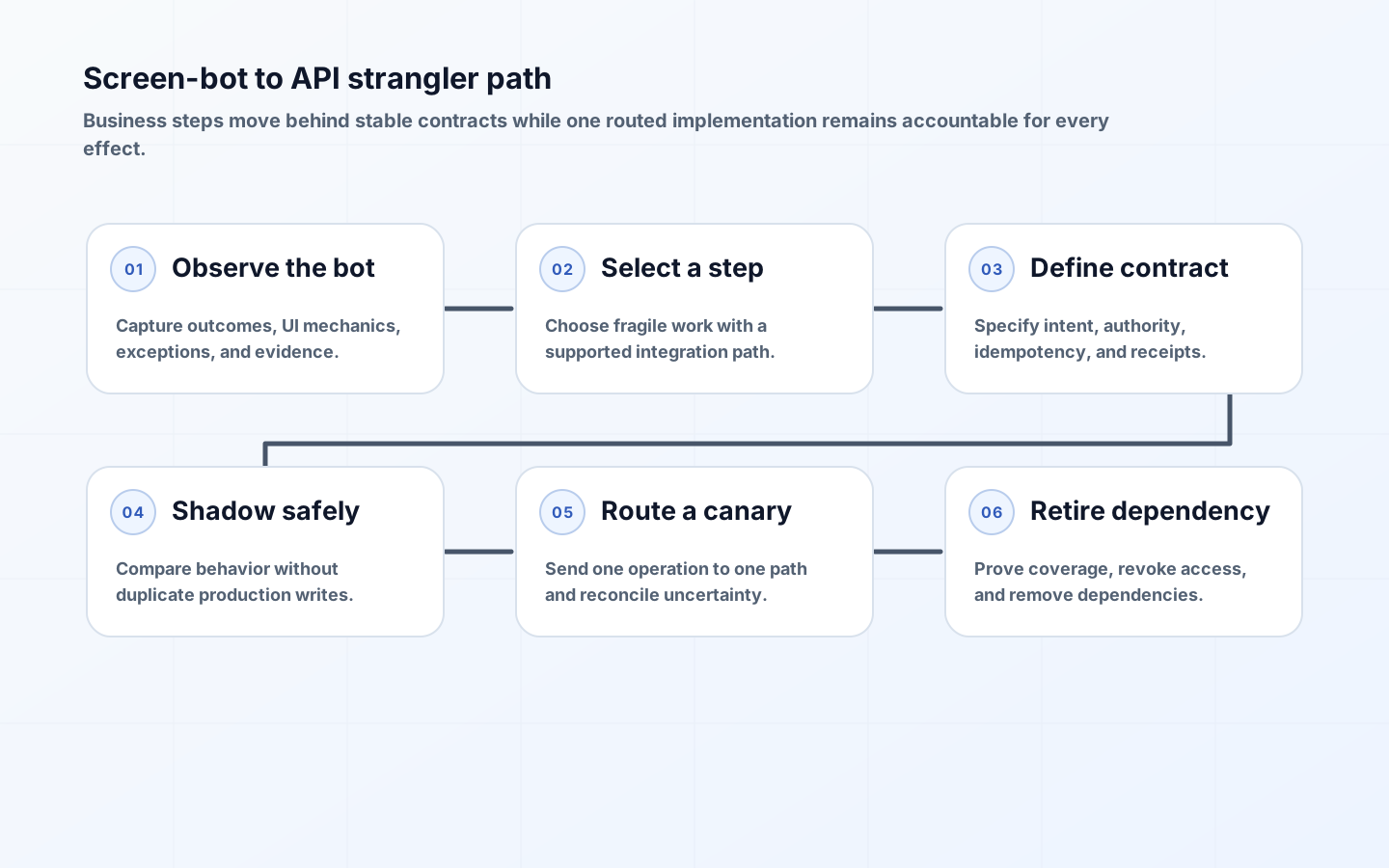
RPA modernization replaces fragile screen interactions with supported APIs, events, or direct service integrations while the business process keeps running. A production bot often contains more than clicks: it encodes validation, sequencing, credentials, exception work, evidence capture, schedules, and undocumented operator knowledge. Rewriting only the happy path can create a cleaner integration that fails the real operation.
Use an incremental strangler approach at the level of business steps. Introduce a stable orchestration boundary, route one capability to an API, compare outcomes, and retain a controlled fallback until evidence supports retirement. The goal is not to eliminate every user-interface action immediately. It is to move material business behavior onto explicit contracts and reduce dependence on presentation details without creating a risky big-bang cutover.
Inventory bot behavior and operational dependencies
Build an inventory from scheduler configuration, source definitions, run history, credential stores, virtual machines, queues, files, and operator interviews. For each bot, record process owner, applications and screens, triggers, frequency, volume, business calendar, input and output, credentials, data class, failure modes, manual fallback, service commitments, support owner, and upstream or downstream bots. Observe actual runs across peak, month-end, and exception periods.
Decompose the bot into business actions such as find account, validate status, create order, attach document, post payment, or read confirmation. Separate these from UI mechanics such as open window, select tab, wait for control, copy cell, or take screenshot. Microsoft documents that desktop automation can use UI elements, images, or coordinates; those mechanisms have different fragility, but none is the business contract. The decomposition identifies useful API boundaries.
| Bot evidence | Question answered | Modern target | Retirement check |
|---|---|---|---|
| UI selector and screen | Which presentation dependency exists? | API operation or supported event | No production route needs the selector |
| Credential and machine | Whose authority and runtime execute the step? | Workload identity with scoped permission | Bot account and VM access revoked |
| Screenshot or exported file | What proof does operations use? | Structured receipt and immutable audit event | Evidence accepted by process and control owners |
| Exception branch | How does work resume after failure? | Typed error and human work item | Historical exceptions pass recovery tests |
| Schedule and batch | When and how much work arrives? | Event or governed batch orchestration | Capacity and deadline objectives hold |
Prioritize steps by fragility, value, and API readiness
Score candidate steps on failure frequency, manual recovery effort, change volatility, transaction impact, security exposure, volume, observability gap, and supported integration availability. A frequently changing login or navigation sequence may be valuable to remove even if it performs no business update. A stable read-only extraction with no viable API may stay temporarily. Start where the organization can prove an outcome and learn the coexistence mechanics.
Validate the proposed interface with the application owner. A technically reachable internal endpoint is not automatically a supported API. Confirm authentication, authorization, quotas, version policy, transaction semantics, idempotency, error model, audit behavior, bulk capability, data ownership, and support commitments. Where no suitable interface exists, create an application-owned service façade or event rather than moving brittle scraping into another language and calling it modernization.
Specify the target API as a business contract
Define operations around intent and stable resources, not screen sequence. A create-order command should state required data, validation, identity, idempotency key, accepted outcome, errors, and authoritative record ID. Use a machine-readable interface description such as OpenAPI where appropriate, but accompany syntax with business semantics and examples. Decide whether the call is synchronous, asynchronous with operation status, or event-driven based on processing duration and coupling.
Translate every existing evidence requirement. Replace visual success indicators with response codes, resource versions, audit events, and reconciliation queries. Preserve source correlation and the bot's business operation ID so old and new routes produce comparable records. Add rate limits and backpressure rather than letting a formerly serial desktop bot overwhelm the application through parallel API calls. Test permissions with the least-privileged workload identity, not a developer's account.
Introduce a step-level coexistence router
Place routing before the business step. It decides API or bot based on capability, cohort, transaction risk, feature flag, and health, while assigning one stable operation ID. This resembles the Strangler Fig pattern, in which a façade routes requests between legacy and new implementations as capability moves incrementally. Keep orchestration and routing independent from either implementation so fallback does not require editing the business process during an incident.
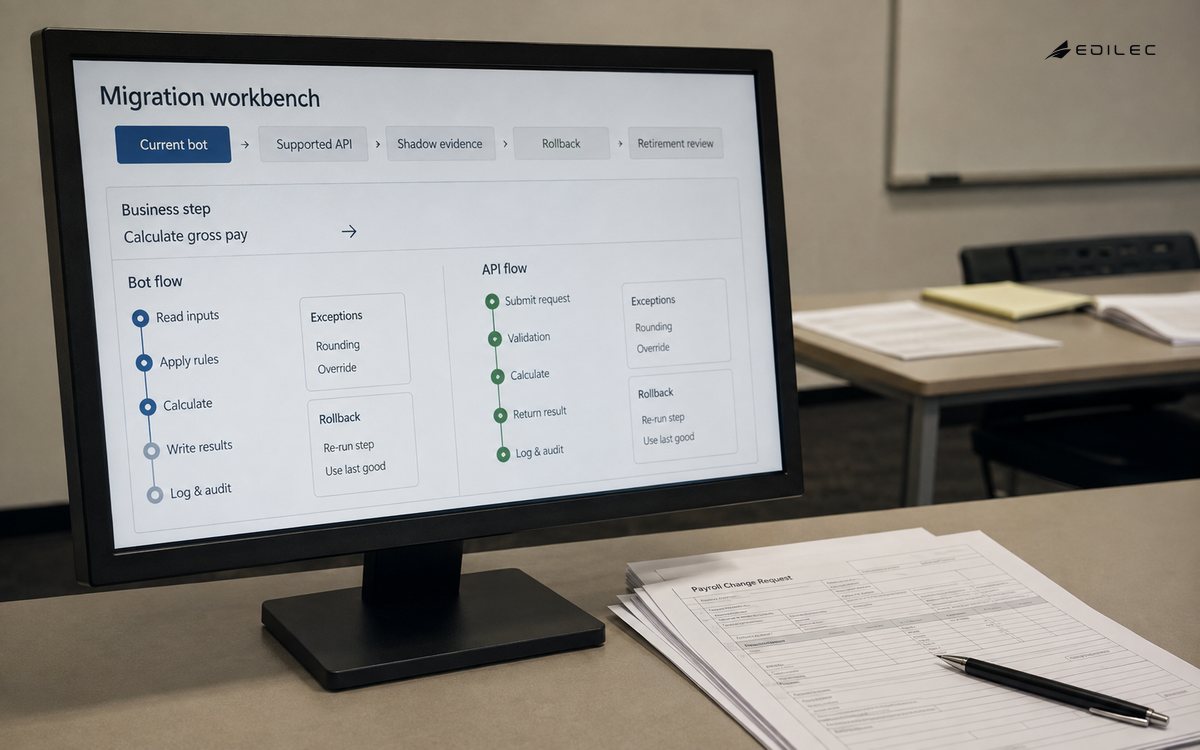
Prevent dual execution. The router must atomically select one primary path, and both paths must honor the same idempotency identity. A timeout from the API is an unknown result, not a signal to send the bot immediately. Query operation status or reconcile the target first. Permit fallback only for classified failures where repeating the effect is safe. Record route, version, attempt, outcome, and any switch so operators can explain mixed-mode periods.
| Migration mode | Writes allowed | Evidence | Exit condition |
|---|---|---|---|
| Observe | Bot only | Map bot inputs, outputs, timing, and exceptions | Contract and baseline approved |
| Shadow read | Bot writes; API reads or calculates | Compare normalized outputs without side effects | Differences explained within accepted tolerance |
| Canary API | One path writes per stable operation ID | Selected cohort outcomes and recovery drills | Service objectives and business controls pass |
| API primary | API writes; bot is controlled fallback | Route switches, reconciliations, fallback reason | Fallback unused through agreed operating windows |
| Retired | API only | Credential revocation and dependency scan | Bot assets archived or deleted under retention policy |
Compare outcomes without duplicating side effects
Shadow execution is safe for reads, calculations, validation, and transformations. Normalize timestamps, ordering, generated identifiers, and presentation formatting before comparison. For writes, do not run both paths against production. Use a sandbox, dry-run endpoint, transaction simulation, or golden test cases. Where the target supports it, validate the command and expected change without committing. A side-by-side screenshot is weaker evidence than comparing authoritative records and receipts.
Build a representative suite from production-shaped cases: ordinary work, boundaries, missing data, duplicate input, stale state, downstream unavailability, permission denial, and each known manual exception. Compare not only final values but created records, audit entries, notifications, ordering, latency, and recovery path. Business users approve semantic equivalence. Modernization may intentionally improve behavior, but each difference should be declared and accepted rather than hidden in an aggregate success rate.
Keep fallback narrow, state-aware, and temporary
A fallback runbook names eligible failures, authorization, maximum duration, capacity, credential activation, reconciliation, and return-to-primary checks. Keep the retained bot tested while it is a promised control. If application screens change during API migration, update or withdraw the fallback explicitly. Desktop-flow error handling can retry or continue after action failures, but those mechanics do not establish that switching paths is business-safe.
When either route fails after an uncertain write, stop automatic switching and create a recovery item with the operation ID and target evidence. Check whether the authoritative record exists before any new attempt. Provide a manual continuity procedure for critical work if neither implementation is available. Track every fallback invocation; a fallback used routinely is a second production system, not a temporary migration control, and must be funded and governed accordingly.
Modernize identity, evidence, and support with the step
Replace interactive bot credentials with a workload identity where the application and platform support it. Scope permissions to API operations and data, rotate or federate credentials, and separate development from production authority. Review whether the bot relied on shared accounts, desktop profiles, mapped drives, or local secrets. Removing clicks while preserving a broad shared credential leaves the largest security debt intact.
Move evidence from screenshots and local logs to structured, correlated telemetry and application audit records. Define support ownership, dashboards, alerts, and service objectives for the new route before increasing traffic. API errors should map to actionable business exceptions rather than expose raw server messages to operations. Update process procedures and user communications as behavior moves, especially when people previously watched a bot or collected output files manually.
Retire the bot only after dependency and recovery proof
Set objective retirement criteria: target route handles agreed volume and exception coverage, service objectives hold across peak periods, reconciliation is clean, rollback or continuity has been exercised, evidence is accepted, and no upstream schedule or downstream file still depends on the bot. Search orchestrators, credentials, machines, shared folders, monitoring, support documents, and tickets for hidden references. Obtain process and application owner sign-off.
Disable scheduling first and observe, then revoke credentials and machine access, remove licenses and infrastructure, archive source and run history under retention rules, and close monitoring deliberately. Preserve the final configuration and dependency record long enough for audit or incident review. Update the automation inventory and benefit baseline. Do not leave a disabled bot account with privileged access as an unofficial emergency option.
Key takeaways
- Decompose bots into business actions, UI mechanics, evidence, identity, and recovery before defining API scope.
- Migrate one step behind a stable router and operation ID, preventing API and bot paths from executing the same effect.
- Use shadowing for side-effect-free comparison and authoritative state for write validation.
- Treat fallback as a governed production capability with explicit eligibility, reconciliation, and expiry.
- Revoke credentials and remove hidden dependencies when retirement evidence is complete.
Frequently asked questions
Should every screen bot be replaced by an API? No. A stable, low-impact interaction may remain when no supported interface exists and the replacement cost exceeds risk. Document the decision, improve selectors and monitoring, isolate credentials, and review when the application roadmap changes.
Can the bot call the new API during transition? Yes. Replacing an internal group of UI steps with an API subflow is often the simplest first increment. Keep the shared operation identity, error contract, telemetry, and rollback behavior independent of the desktop tool.
How long should coexistence last? Long enough to cover representative volume, business calendar peaks, known exception types, and recovery exercises, but with a dated exit criterion. Indefinite coexistence doubles operational surface and weakens retirement pressure.
Conclusion
Successful RPA modernization preserves business continuity while moving behavior from presentation scripts to supported contracts. Step-level routing, comparable evidence, idempotent execution, and disciplined retirement let teams reduce bot fragility without betting the operation on one cutover. The result is not merely fewer clicks; it is a process that is easier to secure, observe, change, and recover.