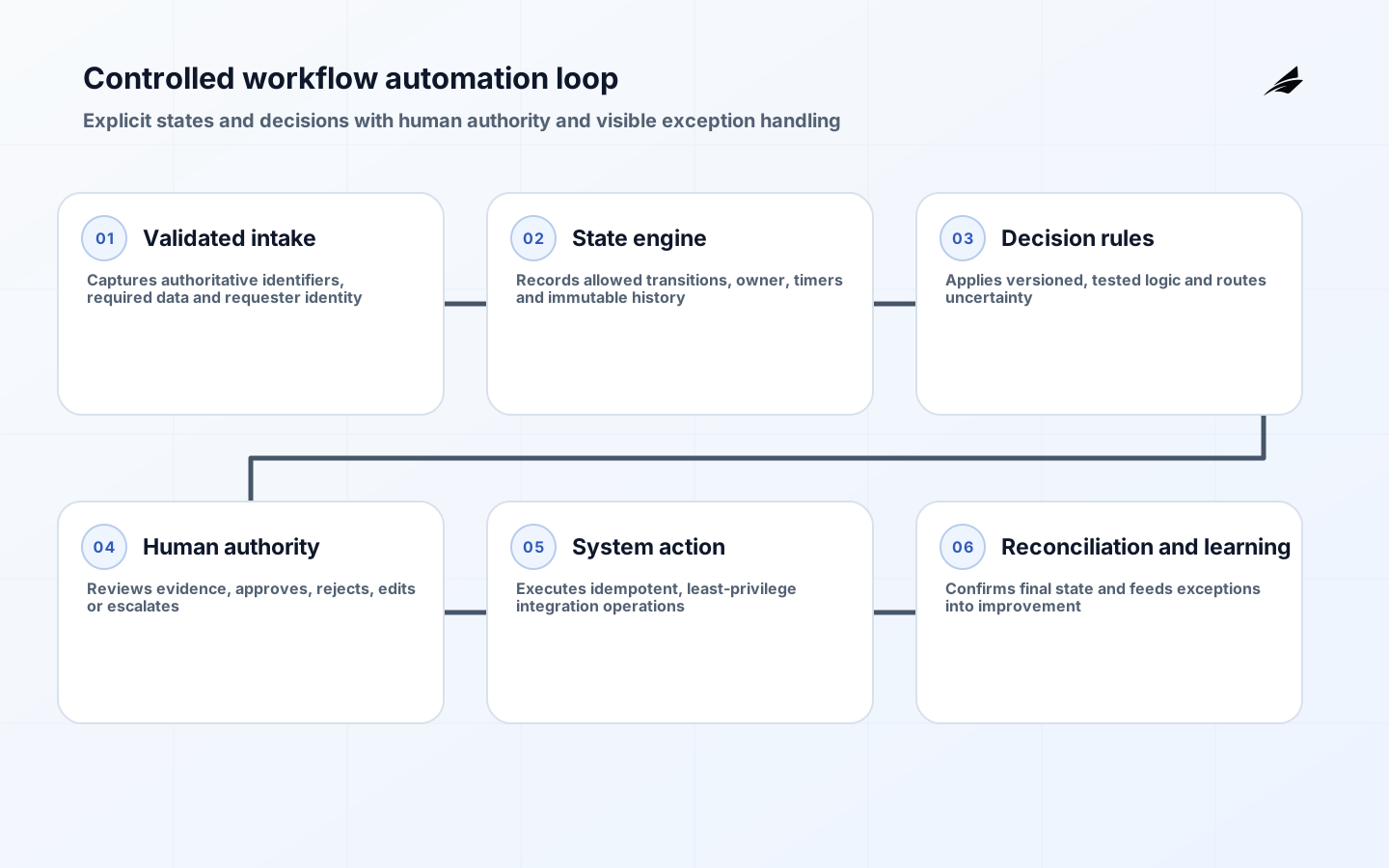
Business workflow automation coordinates records, decisions and actions across people and systems. It can reduce waiting and repetitive entry, but automation also moves mistakes faster when states, authority or exception paths are vague. The right starting point is a repeated operational outcome, not a tool demonstration. Teams should understand the existing work, simplify unnecessary steps, define the state machine and then automate only the parts whose rules and evidence are dependable. Human review remains essential where judgment, accountability or irreversible consequences require it.
Choose a workflow worth automating
Good candidates are frequent enough to justify investment, bounded enough to model and supported by records that can be accessed reliably. The work should have a named owner and a measurable pain such as queue age, duplicate entry, correction volume or poor status visibility. Avoid beginning with a rare process, a politically disputed policy or a workflow whose inputs are mostly undocumented judgment. Automation will expose those uncertainties as production incidents. Observe several real cases, including rejected, cancelled, escalated and reopened work, before estimating.
Map the current process with participants, triggers, tasks, decisions, messages, timers and end states. BPMN can help teams communicate this structure consistently. Mark every system boundary, manual handoff and spreadsheet. Distinguish required controls from historical habits; remove redundant approvals before encoding them. Baseline elapsed time, active work, rework and exception age. A faster automated route is not valuable if it creates more incorrect outcomes or transfers hidden work to another team. Agree the target behavior and first-release boundary with the people who perform and receive the work.
| Candidate factor | Promising evidence | Caution |
|---|---|---|
| Frequency | Repeated workload with measurable queue | Rare cases may not repay complexity |
| Rule clarity | Normal and exception decisions can be stated | Policy is disputed or relies on tacit judgment |
| Data readiness | Identifiers and authoritative inputs are available | Inputs are copied, incomplete or unowned |
| Consequence | Actions are reversible or gated | Errors create immediate legal, safety or financial harm |
| Ownership | One outcome owner can resolve conflicts | Handoffs have no end-to-end accountability |
| Measurement | Baseline and final state can be observed | Only task completion is visible |
Model states, decisions and human authority
Define a finite set of meaningful workflow states with allowed transitions. Each state should tell an operator what happened, who owns the next action and whether a deadline is running. Do not overload one status such as pending with intake, review, external wait and system failure. Keep immutable transition history with actor, timestamp, reason and correlation identifier. Decide how cancellation, correction, duplicate submission and reopening work. This state model becomes the shared contract for interfaces, reporting, integration and support.

Separate decision logic from orchestration when rules are substantial. DMN provides a standard way to represent decision requirements and tables, but plain version-controlled rules can also work when they are precise and testable. Record inputs, rule version, result and explanation appropriate to the context. Define when automation may recommend, approve, execute or only route. High-impact or ambiguous actions should pause for an authorized human, show relevant evidence and prevent rubber-stamp review. Human override needs a reason, audit trail and monitoring for patterns that reveal a bad rule.
Build reliable integration and access controls
Identify the authoritative record for every field and status. A workflow engine may coordinate work without becoming the master for customer, financial or employee data. Define API, event and file contracts with authentication, versioning, validation, timeouts, retry limits, idempotency and reconciliation. A retry must not create a second order, payment or approval. Queue failures visibly and provide operators with safe replay tools. Correlation identifiers should connect a case across services and logs without exposing sensitive content.
Map each action to a human or service role and enforce least privilege at the action boundary. Separate request, approval and administration where the risk requires it. Federated identity can reduce account sprawl, while service identities need their own credentials and lifecycle. Review access when people change roles, and protect emergency access with time limits and monitoring. Log material reads, decisions, changes, exports and administrative actions. NIST control guidance can inform tailoring, but controls must be tested in the real workflow rather than assumed from platform features.
| Failure mode | Preventive design | Operational evidence |
|---|---|---|
| Duplicate action | Idempotency key and unique business constraint | Duplicate attempts and suppressed repeats |
| Lost event | Durable queue, acknowledgment and replay | Queue depth, age and reconciliation |
| Bad rule release | Versioned rules and scenario tests | Decision version and rollback record |
| Privilege misuse | Least privilege and separation of duties | Actor, action, approval and review log |
| Stuck case | Explicit timers and escalation owner | State age by queue and alert response |
| Unsafe override | Authorized override with reason | Override frequency, reason and outcome |
Design the operator and requester experience
Requesters need clear intake, validation, current status and next steps. Operators need prioritized queues, ownership, context, safe actions and visible deadlines. Reviewers need concise evidence and a meaningful choice, not a generic approve button. Avoid forcing users to infer state from email or switch across systems for basic context. Make errors actionable and preserve entered data when correction is possible. Test keyboard use, focus, labels and status announcements. Accessibility and usability are operational controls because confusion creates bypasses, duplicate submissions and support demand.
Notifications should reflect state transitions, not substitute for the system of record. Send only to people who need to act or know, avoid sensitive details in insecure channels and link to the authoritative case. Deduplicate repeated alerts and allow escalation by age and consequence. Dashboards should separate normal workload, business exceptions and technical failures. A single backlog count conceals whether work is waiting appropriately, abandoned by an owner or blocked by an integration. Give supervisors tools to rebalance queues without silently changing business authority.
Deliver a production-like vertical slice
- Observe normal and exceptional cases and simplify the policy before implementation.
- Agree states, transitions, owners, decisions, timers and authoritative records.
- Threat-model actions and map human and service permissions.
- Build one complete path with intake, integration, review, audit and support views.
- Test duplicate, delayed, rejected, cancelled and dependency-failure scenarios.
- Pilot with a bounded team while comparing final outcomes to the former process.
- Expand only when queue health, correctness and support evidence are stable.
Test rules with historical examples plus adversarial edge cases. Contract-test integrations and simulate timeouts, duplicate delivery, out-of-order events and partial failure. Verify that unauthorized roles cannot view or act through any interface or API. Load-test realistic bursts and long-running timers. Run recovery from a known checkpoint and reconcile final business records. User acceptance should include the people handling exceptions and support, not only process sponsors. Record open risks and define stop thresholds for the pilot.
Measure complete outcomes: end-to-end time, active handling time, first-pass correctness, exception age, duplicate suppression, manual overrides, abandoned cases, final-state reconciliation and user effort. Automation rate alone can reward unsafe behavior by pushing more cases through without regard to correctness. Compare against the baseline by case type and complexity. Review whether work moved elsewhere, such as offline corrections or support tickets. Use measured benefits and operating cost to decide the next workflow segment rather than assuming every adjacent task should be automated.
Operate and improve the workflow
Assign owners for workflow policy, automation code, integrations and daily queues. Publish runbooks for stuck cases, failed dependencies, incorrect rules, rollback and customer communication. Monitor state age, transition failures, rule outcomes, queue capacity, integration health and privileged actions. Review overrides and repeated exceptions with process owners; they are product feedback. Version changes and communicate altered behavior before deployment. Retain records according to business, privacy and legal requirements, then delete them through tested lifecycle controls.
Schedule a periodic control review with operators who handle the work. Compare the encoded process with current policy, sample completed and overridden cases, test inactive-user access removal and confirm escalation contacts. Retire obsolete rules and notifications instead of layering exceptions indefinitely. This review keeps the automated workflow aligned with the organization that depends on it.
Key takeaways
- Automate a bounded, owned outcome after observing real exceptions.
- Use explicit states and transitions as the contract across users, systems and reports.
- Separate decision rules from flow and preserve human authority for consequential actions.
- Design retries, reconciliation, access and support before scaling volume.
- Judge success by correct final outcomes and queue health, not automation rate alone.
Frequently asked questions
Is workflow automation the same as robotic process automation?
No. RPA often automates interactions with existing interfaces, while workflow automation coordinates state, decisions and participants across a service. RPA can be one adapter, but fragile screen automation should not become the hidden authority for important records.
When should a human approval remain?
Keep human authority when rules cannot capture relevant context, consequences are high, policy requires accountable judgment or an action is hard to reverse. Design review around evidence and meaningful discretion, and monitor whether reviewers can actually detect errors.
What is a sensible first workflow?
Choose a frequent, bounded process with clear ownership, accessible inputs, measurable delay or rework and reversible actions. A narrow approval or triage flow often teaches more than attempting an entire cross-company process in the first release.
How should ROI be estimated?
Compare avoided handling and rework, faster outcomes and reduced error impact against implementation, licenses, integration, controls, support and change cost. Use observed case volumes and times, state assumptions and include the cost of exceptions. Do not value every automated minute as permanently removed labor.
Conclusion
Production workflow automation is an operating system for responsibility. Its quality depends on explicit states, authoritative data, reviewable decisions, reliable integration and visible exceptions. Begin by simplifying and bounding a real process, then prove one complete path under failure and recovery. Keep humans where accountability and judgment belong, measure final outcomes and treat overrides as learning. This produces automation that operations teams can trust and improve rather than a faster route into hidden queues.