Enterprise service intelligence is the practice of turning operational, delivery, support and business signals into decisions about services. It is broader than a monitoring dashboard and narrower than a promise that algorithms will run IT. A useful capability connects a service map to user outcomes, detects meaningful change, gives responders enough context to act and records whether the action worked. This FAQ focuses on the questions leaders, service owners and platform teams should settle before buying or building that capability.
Start with the scope and commercial decisions in Service Intelligence for Enterprise: Scope, Cost, Risks and Delivery Plan. The companion implementation checklist is useful once the operating model is agreed. Intelligence should make an existing service decision faster or better; collecting more telemetry without decision ownership merely increases storage, alert volume and ambiguity.
What does enterprise service intelligence include?
It combines a service catalog and ownership model with telemetry, incidents, changes, requests, customer experience, capacity, cost and delivery data. The analytical layer may provide correlation, forecasting, anomaly detection, summarization or recommended action. The operating layer routes evidence to a person or bounded automation. A service is the primary unit: infrastructure metrics matter because they explain or predict an effect on a customer journey, employee workflow or business commitment.
This differs from traditional business intelligence, which often reports periodic historical aggregates, and from observability, which supplies evidence about internal system state. OpenTelemetry describes traces, metrics and logs as complementary signals. Service intelligence adds organizational context: which service depends on the component, which objective is at risk, which change may explain the shift, who owns the response and what business trade-off is available.
| Capability | Question answered | Required context | Typical action |
|---|---|---|---|
| Service health | Are users receiving the promised experience? | Journey, SLI, SLO and error budget | Investigate, communicate or protect reliability |
| Event correlation | Which signals may describe one condition? | Topology, time, change and ownership | Group evidence for responder review |
| Demand intelligence | Where will volume or capacity become constrained? | Forecast, seasonality and unit economics | Scale, shape demand or revise commitment |
| Change intelligence | Did a release alter service behavior? | Deployment identifier and before-after signals | Continue, pause, roll back or repair |
| Support intelligence | What recurring user issue deserves product work? | Case taxonomy, journey and resolution | Fix root cause or improve self-service |
Which data should be connected first?
Begin with one service and one expensive decision, such as incident triage, change validation or capacity planning. Connect the smallest evidence set that can improve it: service ownership, a user-centered indicator, deployment events, incidents and an agreed business measure. Normalize identifiers and time semantics before adding sources. A host name, ticket assignment group and product name may refer to different layers; a maintained relationship model is more valuable than fuzzy correlation across ungoverned labels.
Data quality needs operational owners. Track ingestion delay, missing records, duplicate events, identifier coverage and schema changes. Retain enough raw evidence for investigation but apply privacy, access and retention controls to support text, user identifiers and payloads. Derived scores should preserve a route to source evidence. If a responder cannot inspect why a severity, anomaly or recommendation was produced, the system creates a new troubleshooting problem.
How do SLOs keep intelligence relevant?
Google SRE defines a service-level objective as a target value or range for a measured service level. Select indicators around user-visible success, not whatever metric is easiest to collect. Pair the SLO with an error budget and decision policy: what changes when reliability consumption is normal, fast or exhausted? This provides a stable reference for anomaly and forecast models and prevents a large infrastructure fluctuation from receiving more attention than a smaller but consequential customer failure.
Use multiple windows to distinguish a spike from a sustained threat to the objective. Add business and safety guardrails where appropriate. A checkout service could remain technically available while payment completion or fraud review degrades. Review objectives as services and user expectations change. Intelligence should expose uncertainty and contributing signals; it should not collapse a nuanced service into an unexplained red score.
What should be automated, and what should remain human?
Automate deterministic, frequent and reversible work first: enriching an alert with ownership, opening a collaboration channel, attaching recent changes, checking a runbook precondition or scaling within an approved limit. Require human authority for ambiguous diagnosis, destructive remediation, customer communication and changes with broad blast radius. Set transaction limits, approval thresholds and a kill switch. Every automated action needs an identity, reason, input evidence, result and rollback status in the audit trail.
Machine learning can rank likely causes or summarize evidence, but correlation is not proof. Show confidence and alternatives, and measure whether recommendations shorten resolution without increasing recurrence or harmful action. For generative summaries, ground the output in authorized records and preserve citations. Do not allow sensitive ticket content to flow into an unapproved model. The automation boundary belongs in the service runbook and risk register, not only in tool configuration.
| Automation level | Suitable work | Mandatory safeguard | Success measure |
|---|---|---|---|
| Inform | Dashboards, correlation and summaries | Source links and freshness indicator | Faster accurate understanding |
| Recommend | Likely cause or next diagnostic step | Confidence, alternatives and human choice | Accepted recommendations that resolve correctly |
| Act with approval | Restart, failover or configuration repair | Named approver, preview and rollback | Reduced recovery time without added incidents |
| Act within policy | Scaling or known-safe remediation | Bounded scope, rate limit and automatic stop | Reliable completion and low intervention rate |
| Autonomous exception | Only mature, reversible low-impact actions | Continuous evaluation and immediate disable path | Net toil reduction with stable service outcomes |
Should the organization buy a platform or build the capability?
Buy commodity ingestion, visualization and workflow integration where a product fits the architecture. Build the service semantics, decision policies and differentiating analytics that vendors cannot infer. Evaluate connectors for fidelity and maintenance, deployment model, data residency, access controls, model transparency, export, API limits and total data cost. Run a proof against representative incidents and changes, not a polished vendor dataset. Verify how the product behaves when topology is stale or an upstream source is unavailable.
Avoid a platform-first program. A short pilot should prove one operational decision and establish reusable identity, ownership and measurement conventions. Compare the result with the baseline: time to detect, time to engage the correct owner, failed-change recovery, alert load, repeat incidents and user impact. DORA currently groups delivery performance into throughput and instability metrics; use them at service or application level and pair them with reliability and business outcomes rather than creating a league table for individuals.
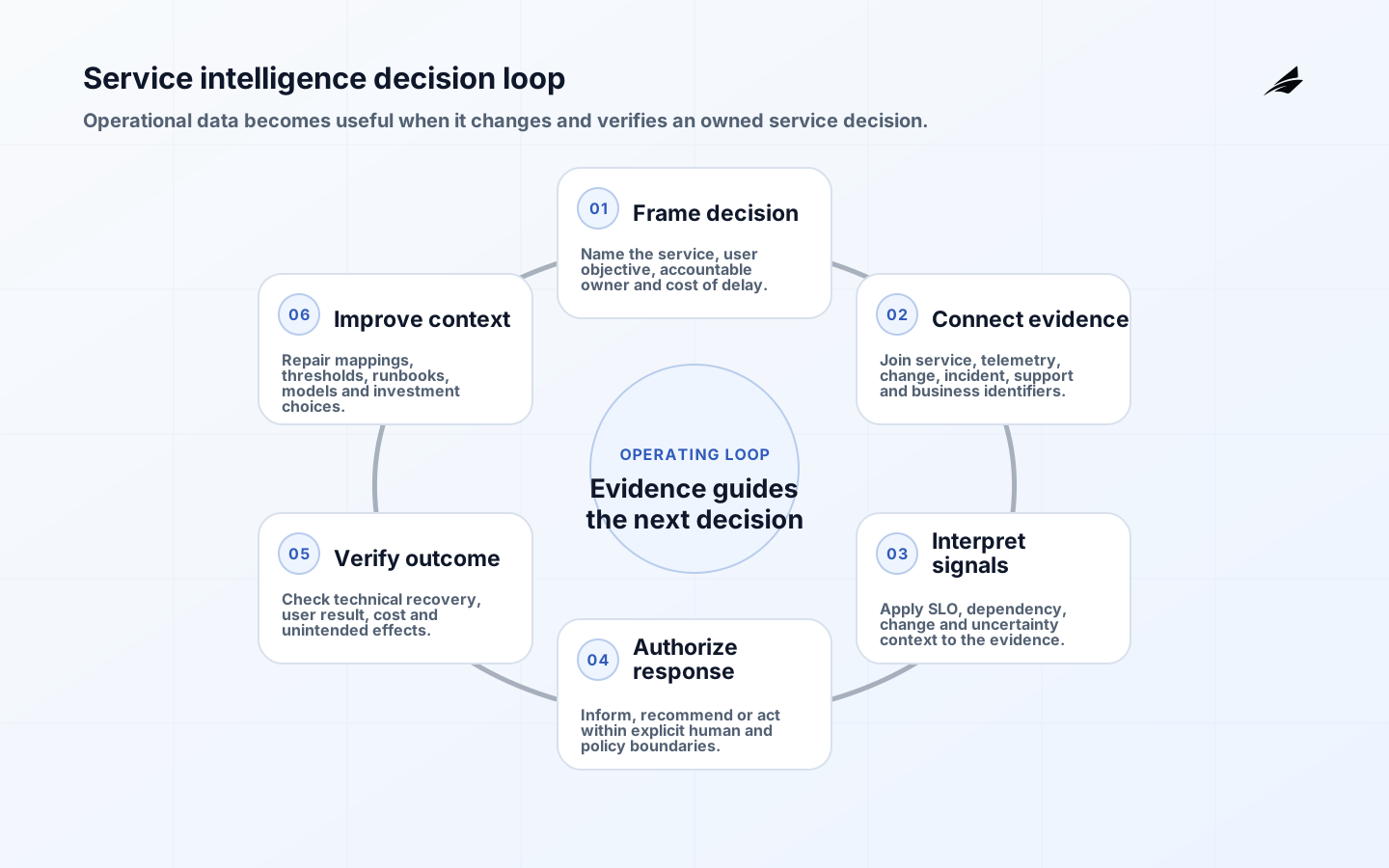
How does the six-stage operating loop work?
- Frame a service decision and record its owner, baseline, objective and cost of delay.
- Connect minimum viable evidence using stable service, change and customer identifiers.
- Interpret signals against SLOs, dependencies, recent changes and business context.
- Recommend or execute a bounded response with visible confidence and authority.
- Verify the response against technical health, user outcome and unintended effects.
- Update mappings, runbooks, thresholds and investment priorities from the result.
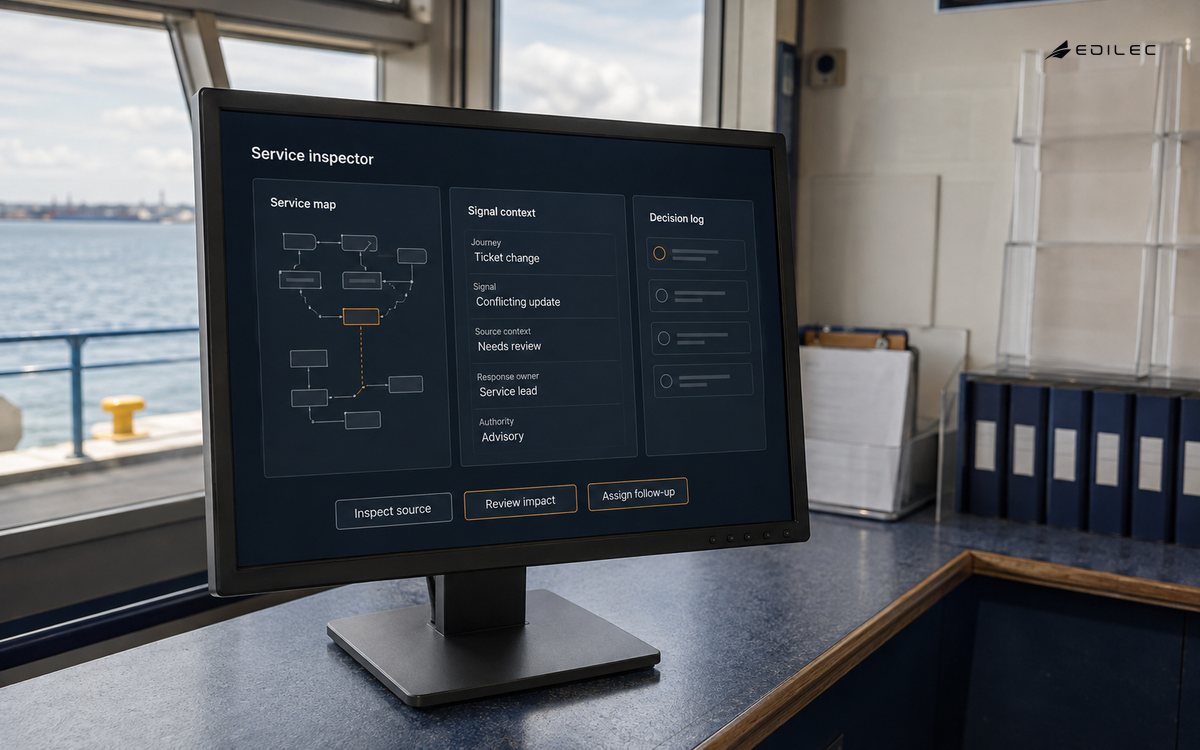
The loop is valuable only if verification feeds learning. Close each significant incident or automated action with disposition: useful, misleading, unsafe or inconclusive. Track false grouping, missed events, stale ownership and recommendation acceptance. The Service Intelligence for Enterprise FAQ offers additional buying and governance questions for stakeholders comparing approaches.
Govern models, thresholds and service semantics
Treat correlation rules, anomaly models, service mappings and response policies as versioned production assets. Assign an owner, peer review, test cases, release record and rollback. Changes to a threshold can alter incident load or hide a developing reliability problem even when no application code changes. Maintain representative event replays and verify that updates route evidence to the correct service owner under current topology.
Create a correction workflow for responders. They should be able to mark a grouped event as unrelated, identify a stale dependency, reject a recommendation or add missing context. Review corrections with platform and service teams and convert recurring themes into mapping, instrumentation or runbook work. Do not silently train on every responder action; some actions reflect time pressure or local workarounds rather than the desired operational policy.
Set data and model retention according to incident, audit, privacy and cost needs. Support records can contain personal or confidential information, while observability payloads may contain identifiers or secrets accidentally. Apply access controls and redaction, and keep administrative actions auditable. Intelligence should reduce the number of people who need raw sensitive evidence, not create a broadly accessible operational data lake.
Key takeaways
- Organize data around an owned service and a decision, not around a tool license.
- Use user-centered objectives to prioritize signals and automation.
- Preserve source evidence, freshness and uncertainty for responders.
- Automate reversible work inside explicit authority and transaction limits.
- Measure verified operational outcomes and continuously repair the service model.
Frequently asked questions
Is service intelligence the same as AIOps?
AIOps is one set of analytical and automation techniques within service intelligence. The broader capability includes service ownership, objectives, data contracts, operating procedures, human authority and improvement. An organization can create valuable service intelligence with rules and disciplined context before it introduces machine learning.
Does it require a perfect CMDB?
No. It requires trusted relationships for the scoped decisions. Begin with the critical services, owners and dependencies involved in the pilot, measure coverage and freshness, and improve from operational feedback. Waiting for a complete enterprise model delays value; ignoring model quality makes every correlation suspect.
Conclusion
Enterprise service intelligence works when evidence reaches a person or policy that can make a better decision. Start with an owned service, connect a small trustworthy signal set, interpret it against user objectives, bound automation and verify the result. That operating discipline produces faster learning and safer action; a larger dashboard alone does neither.