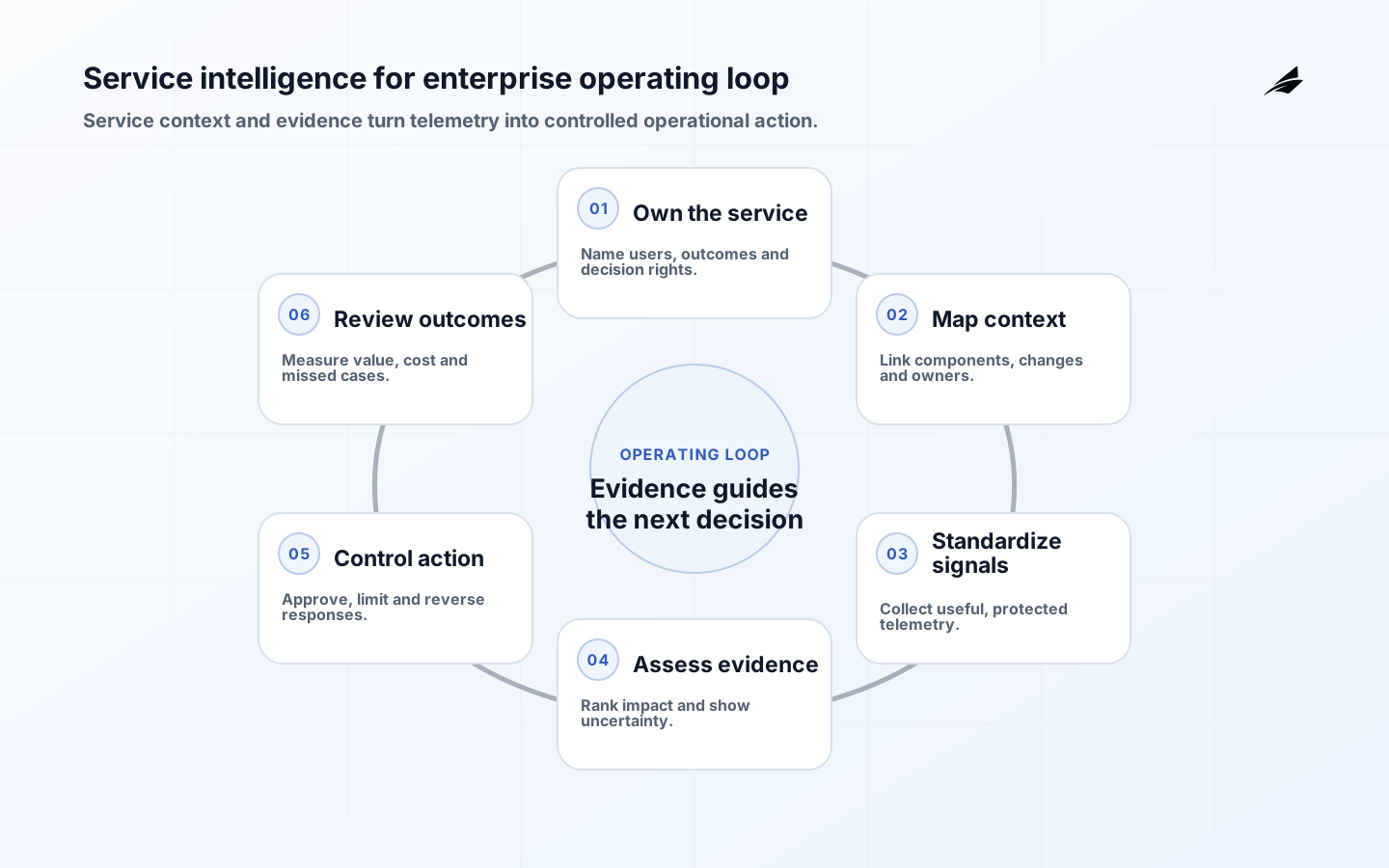
Service intelligence for enterprise connects service ownership, telemetry, changes, incidents and controlled automation so operators can protect outcomes that users notice. It is not a new dashboard layered over an unowned estate. A useful program begins with a small set of named services, the decisions teams struggle to make, and evidence showing whether those decisions improve. This delivery plan complements Edilec's implementation checklist, service intelligence FAQ and enterprise service intelligence checklist.
The operating model should fit the organization's service-management system. ISO/IEC 20000-1 frames service management around planning, design, transition, delivery and improvement. OpenTelemetry signals supply a vendor-neutral vocabulary for traces, metrics, logs and context, while Google SRE service-level objectives connect measurements to user expectations. These references are inputs to design, not proof that a purchased platform will understand the enterprise automatically.
Define the service intelligence outcome
Start with one service and one recurring decision. Examples include deciding whether to page an operator, determining which customer journeys are affected by a change, or choosing a safe recovery action. Name the service owner, users, critical transactions, dependencies, operating hours and unacceptable outcomes. Record the current baseline: alert volume, time to detect, time to restore, repeat incidents, change failure rate, operator effort and user-impact minutes. A model cannot improve an outcome that the program has not defined.
Separate intelligence from automation. Correlation, summarization, anomaly detection and probable-cause ranking may help a human decide. Automation changes a system and therefore needs explicit authority, preconditions, blast-radius limits, rollback and evidence. Early releases should recommend actions and capture operator disposition. Promote only stable, reversible actions to automatic execution after the team understands false positives, missed cases and failure behavior.
| Scope element | Decision to record | Evidence before build | Owner |
|---|---|---|---|
| Service boundary | Included journeys and dependencies | Service map and transaction traces | Service owner |
| Operational decision | Who acts, when and with what authority | Incident and change samples | Operations lead |
| Telemetry | Signals needed for that decision | Coverage and quality baseline | Platform owner |
| Automation | Permitted actions and stop conditions | Runbook and rollback test | System owner |
| Success | User and operator outcomes | Baseline and target definition | Product owner |
Build a service-centered data architecture
Create a current service catalog that links business service, technical components, owners, support groups, objectives and critical dependencies. Do not expect topology discovery to resolve ambiguous ownership. Instrument request boundaries, queues, scheduled work and important state transitions, then attach stable service, environment, version and region attributes. The OpenTelemetry semantic conventions help teams use common meanings across codebases and platforms, which makes cross-service correlation more dependable.
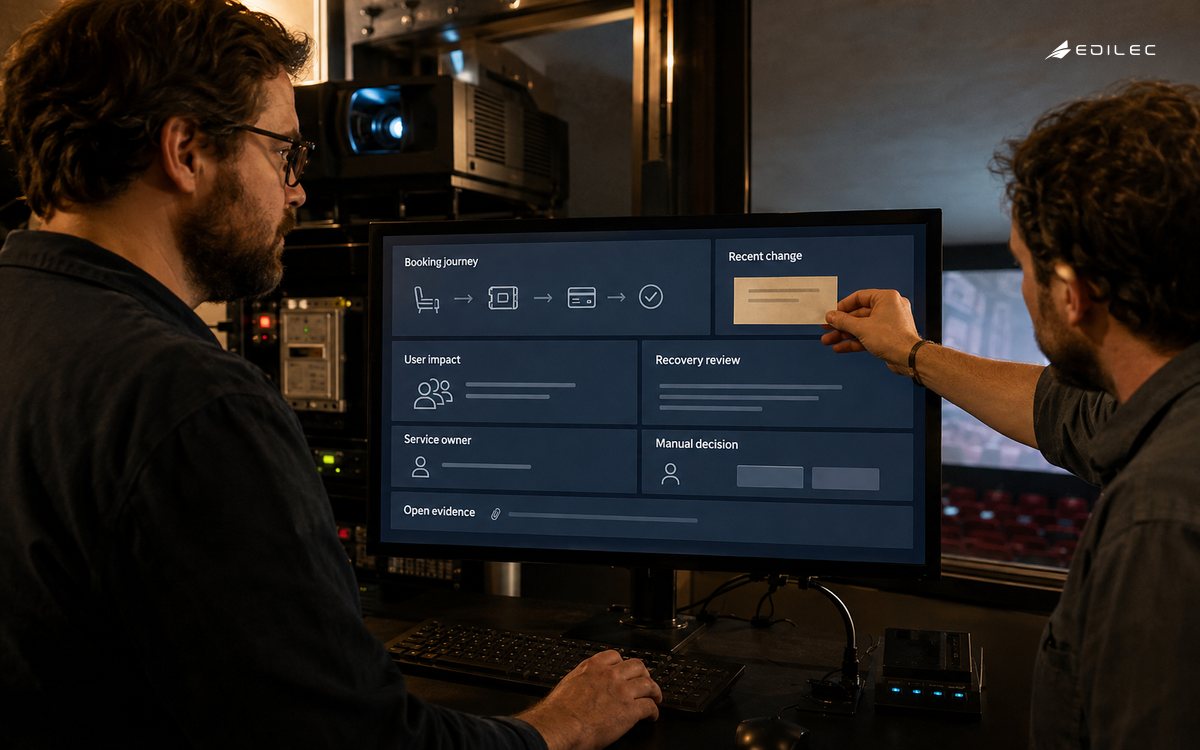
Route telemetry through controlled collection and processing. Define retention, sampling, redaction, access and regional handling by signal class. High-cardinality attributes can create severe cost and privacy exposure; credentials, personal data and customer payloads should not become diagnostic labels. Monitor dropped data, collector backlog, clock skew, schema drift and instrumentation version. The intelligence layer needs provenance so an operator can see which signals, model version and service map informed a recommendation.
Model cost before selecting tools
Service intelligence cost is a workload model, not merely a license quote. Estimate signal volume by environment and source, ingestion and indexing, hot and archive retention, network transfer, model inference, service-map maintenance, integration engineering, on-call migration, training and ongoing administration. Include overlap while old and new tools run together. Apply sensitivity ranges for traffic growth, cardinality, retention and query concurrency because these variables can dominate the bill.
| Cost driver | Sizing unit | Control lever | Watch for |
|---|---|---|---|
| Telemetry ingest | GB or events per day | Filtering and sampling | Discarding rare failure evidence |
| Retention | Signal volume by tier | Hot, warm and archive policy | Compliance or investigation gaps |
| Model use | Evaluations and inferences | Bounded use cases and caching | Unmeasured recommendation value |
| Integration | Systems and workflow paths | Standard interfaces and ownership | Brittle custom connectors |
| Operations | Platform and responder hours | Self-service patterns and training | Hidden manual reconciliation |
Control operational, security and AI risk
Treat the platform as a privileged operational system. It can reveal architecture, incidents, customer activity and administrator behavior, and its integrations may hold powerful credentials. Apply least privilege, separated administrative roles, protected audit trails, secret rotation and tested continuity. Use the NIST Cybersecurity Framework to connect governance, identification, protection, detection, response and recovery rather than focusing only on the detection function.
For model-assisted decisions, maintain use-case cards describing purpose, users, inputs, outputs, limitations, prohibited actions and review thresholds. The NIST AI Risk Management Framework organizes this work through Govern, Map, Measure and Manage. Evaluate recommendations on representative incidents, quiet periods, novel failures and adversarial or incomplete telemetry. Track harmful confidence, not just ranking accuracy. Operators must be able to reject a suggestion and continue safely when the model or vendor is unavailable.
Deliver through six evidence gates
- Select one owned service and document user outcomes, baseline incidents and decision rights.
- Repair the service catalog and instrument the minimum signals required for the chosen decisions.
- Integrate change, incident and ownership context while preserving source provenance.
- Run intelligence in shadow mode and compare recommendations with actual operator decisions.
- Release bounded human-approved actions with logging, rollback and service-level monitoring.
- Scale only after outcome gains, cost behavior, control effectiveness and support ownership are demonstrated.
Each gate needs an approver and exit evidence. A pilot should include normal traffic, a real or rehearsed incident, a failed dependency, noisy telemetry and model unavailability. Compare user-impact minutes and operator effort with the baseline while controlling for incident severity. Capture cases where the system added delay. A favorable demonstration should not erase unresolved service ownership, weak instrumentation or an unaffordable data curve.
Measure value in operating terms
Use a balanced scorecard. Outcome measures can include SLO attainment, user-impact duration and recurrence. Decision measures can include time to establish impact, routing accuracy, accepted recommendations and unsafe suggestions. Platform measures include signal delay, coverage, dropped data and cost per monitored service. Adoption measures include the proportion of incidents completed in the governed workflow and manual steps retired. Alert reduction alone is unsafe: deleting alerts may improve the count while reducing detection.
Run an enterprise assurance review
Before expanding beyond the pilot, convene service ownership, operations, platform engineering, security, data governance, finance and supplier management. Walk one representative incident from first user symptom through restoration and review. Ask which record owns service impact, which evidence supports each recommendation, who may authorize action and how the service continues if correlation or model output is wrong. Resolve conflicting ownership in the operating model, not in meeting notes.
Inspect telemetry coverage against the service boundary. Sample requests across regions, versions and customer classes and confirm that trace context, resource attributes and timestamps survive each handoff. Reconcile topology discovered by tools with the catalog and deployment records. Document intentional blind spots, their consequence and the alternative evidence responders use. A percentage coverage score is useful only when the denominator and importance of missing components are understood.
Review model and rule performance by consequence. Examine accepted, rejected, harmful and missed recommendations, including cases where operators followed a plausible but weak explanation. Require a trace from recommendation to input signals, service context, version and final outcome. Set thresholds for disabling a feature, reverting a model and notifying users. Do not let a vendor-defined confidence score become operational authority without local calibration.
Test economic controls under projected growth. Increase event volume, cardinality, retention and concurrent investigations; verify budgets, throttles and evidence preservation. Identify which data can be reduced safely and which is required for security or incident review. Confirm that procurement terms cover material product changes, export, deletion and transition assistance. A low introductory rate does not establish a sustainable service-intelligence cost.
Close the review with signed residual risks, dated remediation and a scale decision for each service class. Publish runbooks and responsibility maps to operators, then observe a handover shift without the implementation team. Revisit the review after a significant architecture, provider, model or service-objective change. The assurance record should make the next reviewer independent of project memory.
Include suppliers in the review without delegating acceptance to them. Ask each provider to demonstrate data boundaries, change notification, incident support, service objectives and export using the configured tenant, not a sales environment. Reconcile provider responsibility statements with the enterprise control map. Record dependencies between vendors and the lead party during a multi-provider incident. Commercial support tiers, technical escalation and the organization's own decision authority should be clear before a high-impact service relies on the capability.
- Trace one incident end to end.
- Sample signal coverage by service class.
- Review harmful and missed recommendations.
- Stress cost and retention controls.
- Prove handover without project specialists.
Key takeaways
- Anchor enterprise service intelligence in named services and recurring decisions.
- Standardize telemetry meaning and preserve provenance before adding models.
- Model ingest, retention, integration, transition and operating labor together.
- Separate recommendations from automated authority and test both failure paths.
- Scale from user and operator outcomes, not event-reduction claims.
Frequently asked questions
Is service intelligence the same as AIOps?
AIOps can be one component. Service intelligence is broader: it connects service ownership, objectives, telemetry, incidents, changes, knowledge and governed action. A platform that correlates events but cannot show the affected service, accountable owner or safe response is incomplete.
How long should a pilot run?
Long enough to observe representative operating conditions and at least one meaningful failure or rehearsal. Calendar duration alone is not an acceptance criterion. Define evidence gates, minimum incident samples and cost-volume tests before the pilot starts.
How should ROI be presented?
Show avoided user impact, reduced investigation and coordination effort, retired tool or integration cost, and any incremental platform expense. Use ranges and state assumptions. Do not convert every faster alert into revenue unless finance can defend that causal link.
Conclusion
Service intelligence for enterprise becomes useful when it shortens a specific decision without hiding uncertainty or weakening accountability. Bound the service, repair its operational context, standardize signals, evaluate intelligence in shadow mode and automate only reversible actions. A disciplined rollout produces a capability that operators can inspect, finance can size and service owners can trust through normal operation and failure.