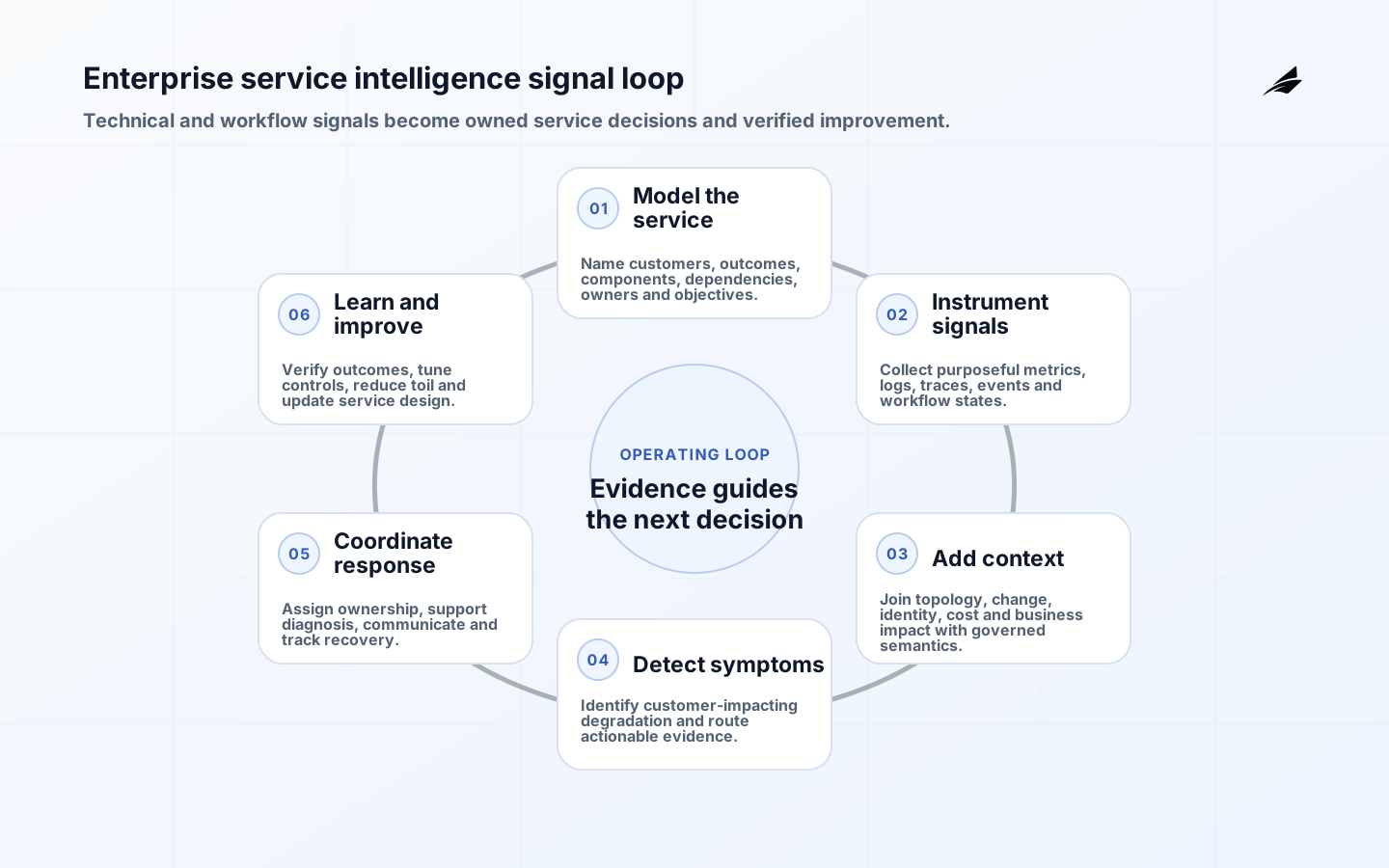
Enterprise service intelligence combines service-management records, topology, changes, telemetry, customer experience and business context so teams can understand service health and act. It is not a dashboard consolidation project or a promise that algorithms will replace operators. The implementation must create trustworthy service models, useful signals, governed semantics, actionable detection and a feedback loop from incidents and outcomes.
Use this checklist with the enterprise service intelligence delivery plan and the related service intelligence implementation checklist. The service intelligence FAQ addresses platform and operating questions.
1. Define service outcomes and decision use cases
Select two or three decisions: detect a customer-impacting degradation, identify likely affected services after a change, prioritize incidents by business impact, or reduce repeated support demand. Name users, current process, baseline and action. Define the service from the customer perspective, with owner, consumers, objectives, components, suppliers, data sensitivity and recovery needs.
ISO/IEC 20000-1:2018 specifies requirements to establish, implement, maintain and continually improve a service management system, including planning, transition, delivery and improvement. Use the current ISO service-management standard page to anchor governance, while tailoring intelligence to actual service requirements.
| Use case | Inputs | Decision evidence |
|---|---|---|
| Impact detection | Journey checks, indicators and dependency state | Affected users, severity and confidence |
| Change correlation | Deployments, configuration and topology | Timeline and plausible changed components |
| Incident prioritization | Impact, criticality, security and obligations | Priority rationale and owner |
| Problem reduction | Incidents, support contacts and known errors | Recurring pattern, root cause and avoided toil |
2. Build an owned service and dependency model
Create a minimal model for the chosen services: customer outcome, application and platform components, data stores, external suppliers, teams and objectives. Populate from authoritative configuration and deployment sources where possible. Assign owners and freshness. Do not attempt a perfect enterprise graph before proving a use case; unknown and stale relationships should be visible rather than silently inferred as fact.
Define stable identifiers for service, environment, component, team, change and incident. Map existing CMDB, catalog and observability names. Record confidence and source for discovered relationships. Protect sensitive topology and identity context with role-based access and retention. Service mapping is operational data and needs quality controls.
3. Instrument purposeful service signals
Collect signals that answer defined questions. OpenTelemetry signals include traces, metrics, logs and baggage. Use consistent service and environment attributes, propagate trace context across owned boundaries, and avoid personal or secret data. Control cardinality, sampling and retention because unbounded labels and verbose logs increase cost and can make analysis unreliable.

Combine technical signals with journey success, request volume, queue age, support contact, deployment, feature flag and business transaction outcomes. DORA’s monitoring and observability guidance distinguishes predefined monitoring from exploration for debugging and recommends customer-experienced and business measures. Instrumentation needs code and ownership, not only an agent installation.
| Signal | Good use | Quality check |
|---|---|---|
| Metric | Trend, objective and alert on aggregated behaviour | Definition, units, labels and missing intervals |
| Trace | Request path and dependency latency | Context propagation and representative sampling |
| Log or event | State change and investigation detail | Structured fields, time, access and retention |
| Journey probe | Customer-visible availability and correctness | Representative path and independent execution |
| Workflow record | Incident, change, request and ownership state | Lifecycle completeness and identifier linkage |
4. Design detection around symptoms and decisions
Define service indicators and objectives with error budgets or equivalent tolerances. Alert on user-impacting symptoms or conditions requiring timely action, then attach diagnosis context. Every page needs severity, affected service, evidence, owner and a useful first action. Route informational anomalies to analysis rather than on-call. Tune with false-positive, false-negative and actionable-rate reviews.
Use correlation and machine learning as decision support. Preserve contributing signals and confidence, allow operators to correct associations, and monitor drift. Do not automatically close, reprioritize or remediate consequential incidents solely from an opaque score. Automation is safest for bounded enrichment and reversible actions with receipts.
5. Integrate incident, change and problem workflows
Connect detection to the system of record without creating duplicate incidents. Carry correlation IDs, evidence and service ownership. Define acknowledgement, escalation, communication, containment, recovery and review states. The 2025 NIST SP 800-61r3 announcement emphasizes integrating incident response across cybersecurity risk-management operations and aligns it with all CSF 2.0 functions.
Rehearse dependency failure, bad deployment, capacity exhaustion, data delay and security incident. Verify that teams can navigate alert to service map, recent change, runbook, communications and recovery evidence. Post-incident work should create owned improvements in instrumentation, architecture, tests or process, not only a document.
6. Govern access, semantics, cost and automation
Create owners for service models, telemetry standards, detection, workflow integrations and automation. Version definitions and review material changes. Apply least privilege, protect customer and employee data, and set retention by purpose. Inventory vendor processing and export paths. Require approval, limits, audit and rollback for automated actions.
Budget ingestion, storage, query, licenses, instrumentation engineering, integration, on-call and improvement work. Attribute high-volume telemetry to services and value, then reduce useless data rather than indiscriminately shortening evidence retention. Establish exit tests for signal export, rule portability and service-model data.
7. Roll out by service and prove operational value
Pilot one critical service and one decision. Baseline detection, diagnosis, recovery, alert volume and customer impact. Run in parallel with current operations, compare misses and disagreements, and tune. Expand after service owners trust the model and responders can act. Standardize naming, instrumentation and workflow patterns that prove reusable.
Measure service outcomes and operating capability. Include customer-impact minutes, detection delay, diagnosis time, recovery time, actionable alerts, repeat incidents, support toil, model freshness, signal coverage and cost. The DORA delivery metrics can connect change throughput and instability to incident patterns without turning individuals into scorecards.
Define data contracts for every onboarded source: producer, schema, timestamps, identifiers, delivery expectation, sensitivity, retention and change notice. Validate at ingestion and expose gaps. When a source is late, the intelligence product should show degraded confidence rather than silently presenting stale context. Track source health as part of the service; an accurate algorithm cannot compensate for missing deployment or ownership events.
Design operator experience with real incident pressure in mind. Present the customer symptom, affected service, timeline, recent changes and recommended first checks before dense raw telemetry. Preserve links to source evidence and make confidence visible. Test with new and experienced responders, keyboard-only navigation and high-severity simulations. A visually impressive console that slows acknowledgement or hides uncertainty works against the operational goal.
Create a controlled knowledge loop from resolved work. Runbooks, known errors and dependency notes need owners, review dates and links to the services and scenarios they support. Suggest relevant knowledge during triage, but record whether it helped. Retire obsolete instructions promptly; an old recovery command can be more dangerous than no suggestion. Post-incident actions should be traceable to changed code, configuration, detection or procedure.
Plan platform resilience and fallback. The intelligence layer may be unavailable during the same widespread event it is meant to explain. Preserve provider-independent status channels, essential contact and ownership data, basic cloud-native views and manual incident creation. Rehearse operation without the correlation platform. Back up configuration, detection definitions and service models, and verify exports before relying on a vendor’s recovery claim.
Define acceptance thresholds before comparing vendors. Use representative historical incidents and synthetic service changes to test ingestion delay, topology accuracy, event linkage, alert usefulness, query performance, access controls and export. Score operator task success as well as algorithm output. A proof of concept run by vendor specialists in a curated dataset does not demonstrate that normal responders can use the product with production scale and imperfect metadata.
Manage onboarding as a repeatable service. Require a named service owner, context and identifier mapping, instrumentation review, objective and alert design, workflow routing, privacy classification, runbook, exercise and sign-off. Keep an onboarding backlog and publish readiness gaps. Refuse nominal coverage when a service has no owner or response path; collecting its logs may increase cost without creating a managed outcome.
Key takeaways
- Begin with a service decision and baseline, not enterprise-wide data collection.
- Own service models and make freshness and uncertainty visible.
- Instrument purposeful signals with consistent identifiers and privacy controls.
- Alert on customer symptoms and preserve human authority for consequential actions.
- Prove reduced impact and toil on one service before scaling patterns.
Frequently asked questions
Does this replace the CMDB?
Not necessarily. It may consume and improve configuration records while adding runtime relationships and customer context. Decide which source is authoritative for each fact and synchronize deliberately rather than creating another competing inventory.
Is AI required for service intelligence?
No. Stable identifiers, useful instrumentation, service ownership and disciplined workflows often deliver the first value. Add statistical or AI methods where they outperform transparent rules on a measured task and can be supervised.
Will it eliminate the operations center?
It should reduce manual correlation and noisy triage, but people still coordinate ambiguity, risk and recovery. Redesign roles around service ownership and improvement, and measure toil reduction without assuming headcount removal.
Conclusion
Enterprise service intelligence succeeds when signals become timely, accountable decisions that reduce customer impact and operational toil. An owned service model, purposeful telemetry, symptom-based detection, connected response and governed automation create that path. Pilot the complete loop on one service and scale only the standards that improve real operations.