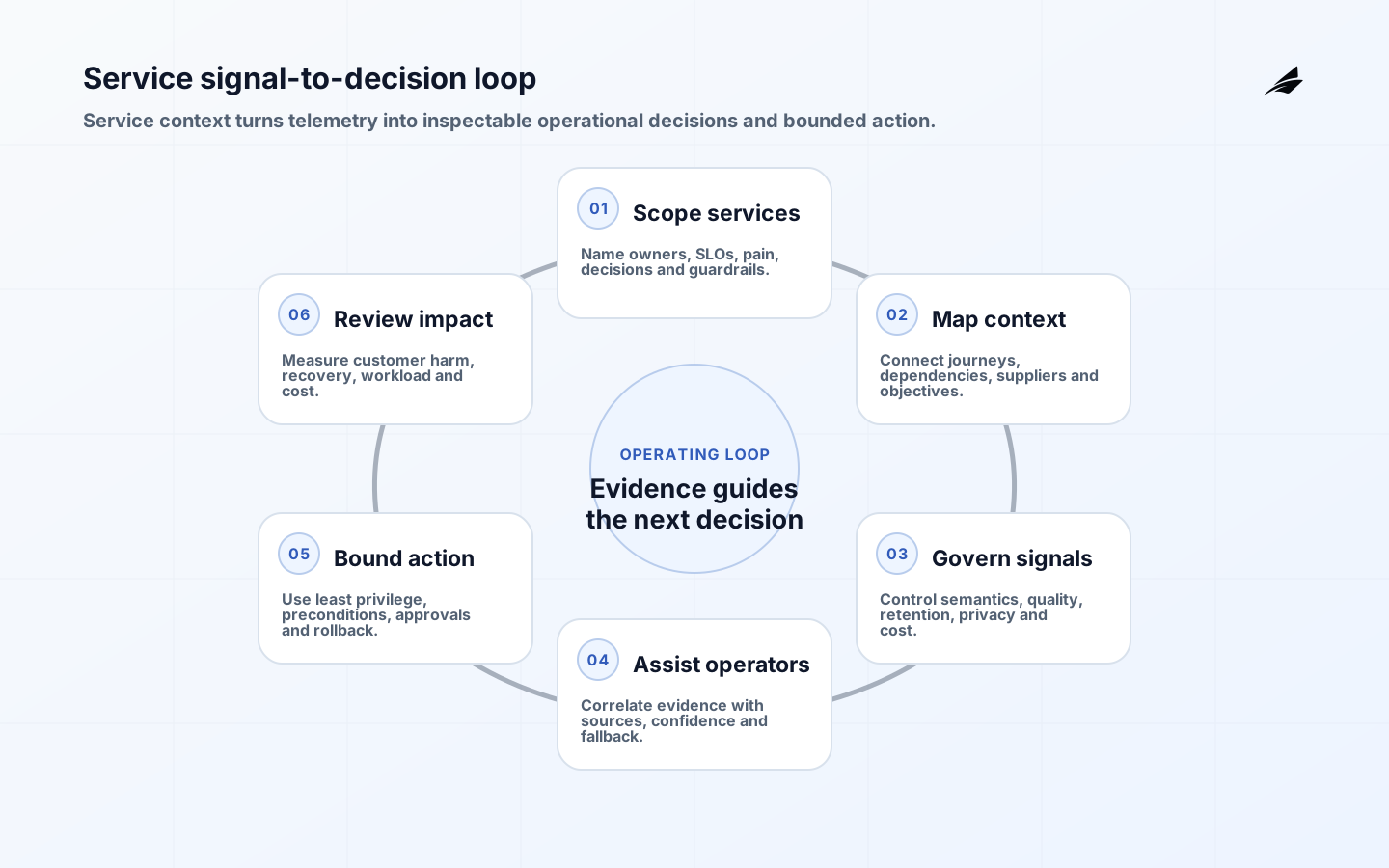
Enterprise service intelligence combines service context, telemetry, events, changes, incidents, requests and knowledge to improve operational decisions. It may correlate symptoms, identify affected services, route work, summarize evidence or automate bounded remediation. The objective is not an impressive event-reduction percentage. It is faster, safer restoration and better service decisions with evidence operators can inspect.
This delivery plan complements the service intelligence scope guide, the implementation checklist and the service intelligence FAQ. ISO/IEC 20000-1 frames service management as planning, design, transition, delivery and improvement; intelligence should strengthen that system rather than create a separate operations console.
Define enterprise service intelligence scope and outcomes
Choose services with meaningful customer impact, known operational pain and owners willing to change work. Define included applications, infrastructure, vendors, regions, support teams and hours. Baseline detection, acknowledgment, diagnosis, recovery, recurrence, alert burden, escalations and customer-visible failure. Write guardrails for missed critical events, unsafe automation, sensitive data exposure and operator workload.
Map decisions before tools: Is the service affected? Which dependency is likely? Who has authority? Which runbook applies? Can an action execute? What evidence closes the incident? Classify intelligence as presentation, recommendation, approval support or execution. Increase evidence, testing and human authority with consequence. Keep emergency manual paths usable.
| Scope element | Required definition | Cost driver | Acceptance evidence |
|---|---|---|---|
| Services | Owner, users, SLO and dependencies | Mapping and integration | Validated service graph |
| Signals | Sources, semantics, volume and retention | Ingest and storage | Coverage and quality profile |
| Decisions | Authority, confidence and fallback | Workflow change | Scenario evaluation |
| Automation | Eligible action and blast radius | Testing and controls | Rehearsed rollback |
Build service context and telemetry architecture
Create a service model linking customer journeys, applications, APIs, queues, infrastructure, owners, suppliers and objectives. Reconcile declared topology with discovered reality and assign confidence and freshness. Do not promise a perfect configuration database before delivering value; build deep context for pilot services and make missing ownership visible. Version important relationships so incident reconstruction uses the graph that existed at the time.
OpenTelemetry describes traces, metrics, logs and baggage as supported signals. Standardization can improve portability, but collection still needs semantic conventions, sampling, identity, clock quality and cost control. Instrument user-visible success and critical workflow states as well as infrastructure. Prevent secrets and unnecessary personal data from entering telemetry. Design retention around diagnostic and legal needs rather than collecting everything indefinitely.
Normalize events without erasing source evidence. Preserve source, timestamp, asset, severity, schema and transformation. Use idempotent ingestion, bounded retry, dead-letter handling and replay. Correlation windows and topology must accommodate delayed or missing data. When intelligence is unavailable, monitoring and incident work must degrade visibly rather than silently suppressing events.
Govern correlation, AI and automated actions
Evaluate rules and models against incident scenarios, including rare critical failures, maintenance, alert storms, topology change and adversarial inputs. Measure precision and recall where labels support them, but also time saved, missed critical events and operator correction. Keep citations to source signals. NIST AI RMF provides Govern, Map, Measure and Manage functions for AI risk; apply them when models affect prioritization, diagnosis or action.

Bound automation by preconditions, target scope, rate, approvals, observability and rollback. Start with enrichment and routing, then low-risk reversible actions. Separate recommendation from execution credentials. Use least-privilege service identities and log proposed, approved, executed and reverted steps. Test stale topology, duplicate commands, partial execution and operator interruption. A runbook that is safe manually may be unsafe at machine speed.
Apply NIST CSF 2.0 to the platform and operating model. Protect telemetry and configuration because attackers can use or manipulate them. Detect suppression, impossible state changes and administrative misuse. Integrate cyber incident response with service management, preserving forensic evidence while restoring safely. Ensure recovery of the intelligence platform does not flood teams with replayed pages or duplicate remediation.
Estimate cost and phase the delivery plan
Cost includes platform licenses or engineering, agents and collectors, ingest, network transfer, hot and archive storage, model use, integrations, service mapping, data remediation, security, training, support and process redesign. Model volume by signal and retention tier. Include parallel tooling during migration and supplier exit. Savings claims should distinguish avoided incidents, shorter impact, retired tools and changed labor from work merely shifted to another team.
Use phases: establish service ownership and baseline; instrument one journey; build context and correlation; run recommendations in shadow; introduce approved bounded action; then expand by service. Each phase should produce an operational result and evidence. Do not onboard hundreds of services to meet a coverage target before the data contract, ownership and triage workflow work for the first group.
| Phase | Deliverable | Gate | Expansion condition |
|---|---|---|---|
| Foundation | Owned services and baseline | SLO and dependency agreement | Pilot boundary stable |
| Observe | Quality signals and context | Journey can be diagnosed | Coverage and cost acceptable |
| Assist | Correlated evidence in workflow | Operators improve decisions | Critical misses within threshold |
| Act | Bounded reversible automation | Failure and rollback rehearsed | Outcome stable through peak |
Manage operational risks and prove value
Principal risks are incorrect service maps, noisy or missing signals, model drift, automation blast radius, privacy leakage, vendor lock-in, operator deskilling and metric gaming. Maintain a risk register with leading indicators and owners. Exercise platform outage, source compromise, stale credentials and regional failure. Keep operators practicing diagnosis and manual recovery for critical services.
Create a decision record for each recommendation or automated action: eligible services, required signals, topology confidence, authority, rate, preconditions, rollback, owner and monitoring. Version it with the runbook and model or rule. Operators should see why an action is proposed and what evidence is missing.
Govern telemetry cost by service value. Attribute ingest, retention and query use; remove duplicate, unused and excessive-cardinality signals; and preserve data needed for security, audit and diagnosis. Sampling must protect rare critical paths. Savings that remove evidence needed to investigate harm are false economy.
Measure operator interruptions, duplicate tools, rejected suggestions, evidence-validation time and after-hours load. Intelligence that shifts effort from diagnosis to proving the platform wrong has not reduced toil. Feed trust findings into workflow, semantics and models.
Maintain known unknowns for unmapped services, sampled signals, unsupported vendors, weak labels and automation exclusions. Expose limits to operators and owners. A platform that states uncertainty enables safer decisions than one rendering incomplete coverage as a confident map.
Test supplier exit by exporting maps, rules, cases, annotations and model evidence, revoking collectors and running parallel detection. Portability must be demonstrated before contract dependence becomes operational dependence.
Define service-level indicators from user-visible behavior. Google SRE guidance explains that indicators and objectives should represent service performance; percentiles can reveal tail behavior hidden by averages. Measure detection and recovery alongside customer impact, recurrence, change failure, operator load, automation reversal and cost per service. Compare pilot cohorts and review incidents qualitatively before attributing value.
Test intelligence against a realistic incident
- Inject checkout tail latency, partial inventory timeouts and delayed topology after a configuration change. The platform should connect user symptoms to signals, change and ownership while showing uncertainty and source evidence.
- Make rollback unavailable in one region and make replay capable of duplicate reservations. Automation must stop. Operators use the manual route, reconcile state and record why the suggestion was rejected, testing authority and data safety.
- Update relationships, semantics, runbook preconditions and training after the exercise. Measure time to impact recognition, viable hypothesis, correction and recovery, but review decision quality; a faster wrong diagnosis is not improvement.
- Run game days before increasing automation authority and after topology changes. Preserve configurations and outputs for reproducibility. Include business, operations and cybersecurity owners and observe ingest and license cost during event spikes.
- Test the intelligence platform's own outage. Monitoring, paging, communication and manual runbooks must remain available. Rate-control replay and mark stale recommendations when it returns so old advice cannot execute.
- Repeat with an unrelated failure and different team. This reveals whether models, runbooks and operators learned a general operating pattern or merely memorized the demonstration scenario.
Key takeaways
- Start with owned services and operational decisions, not enterprise-wide data ingestion.
- Connect standardized signals to a fresh, versioned service context.
- Require source citations, workflow evaluation and explicit authority for intelligence.
- Introduce only bounded, reversible automation with tested failure behavior.
- Measure customer impact, operator outcomes, reliability and full lifecycle cost together.
Frequently asked questions
Is enterprise service intelligence the same as AIOps?
AIOps is one enabling approach. Service intelligence is broader: it includes service context, observability, workflow, governance, human expertise and deterministic automation. AI is useful only where it improves a defined operational decision.
Must the CMDB be perfect first?
No, but critical service relationships need sufficient ownership, freshness and confidence. Build depth for pilot services, reconcile discovery and declared records, and expose uncertainty. Intelligence should not present inferred topology as unquestioned fact.
How quickly can value be demonstrated?
A bounded service can show better triage or diagnosis within a few operational cycles, but reliable value requires representative incidents and peaks. Define baseline and evidence first. Avoid annualized savings from a short quiet pilot.
Create an intelligence decision record for every recommended or automated action: eligible services, required signals, topology confidence, authority, rate, preconditions, rollback, owner and monitoring. Version it with the runbook and model or rule. Operators should see why an action is proposed and what evidence is missing before approval.
Govern telemetry cost by service value. Attribute ingest, retention and query use; remove duplicate, unused and excessively high-cardinality signals; and preserve data needed for security, audit and diagnosis. Sampling must protect rare critical paths. Cost reduction that removes evidence required to investigate customer harm is false economy.
Review operator experience. Measure interruptions, duplicate tools, rejected suggestions, time spent validating evidence and after-hours load. Interview responders after incidents. Intelligence that shifts effort from diagnosis to proving the platform wrong has not reduced toil. Feed trust and usability findings into workflow, semantics and models.
For supplier exit, test export of service maps, rules, cases, annotations and model evidence in usable formats. Revoke collectors and credentials, preserve required history and run parallel detection during transition. Portability should be demonstrated before contract dependence becomes operational dependence.
Conclusion
Enterprise service intelligence works when signals become accountable decisions. Map the service, govern the evidence, assist operators transparently and automate only within proven bounds. A phased plan tied to SLOs, recovery and customer impact turns observability data into durable operational improvement.