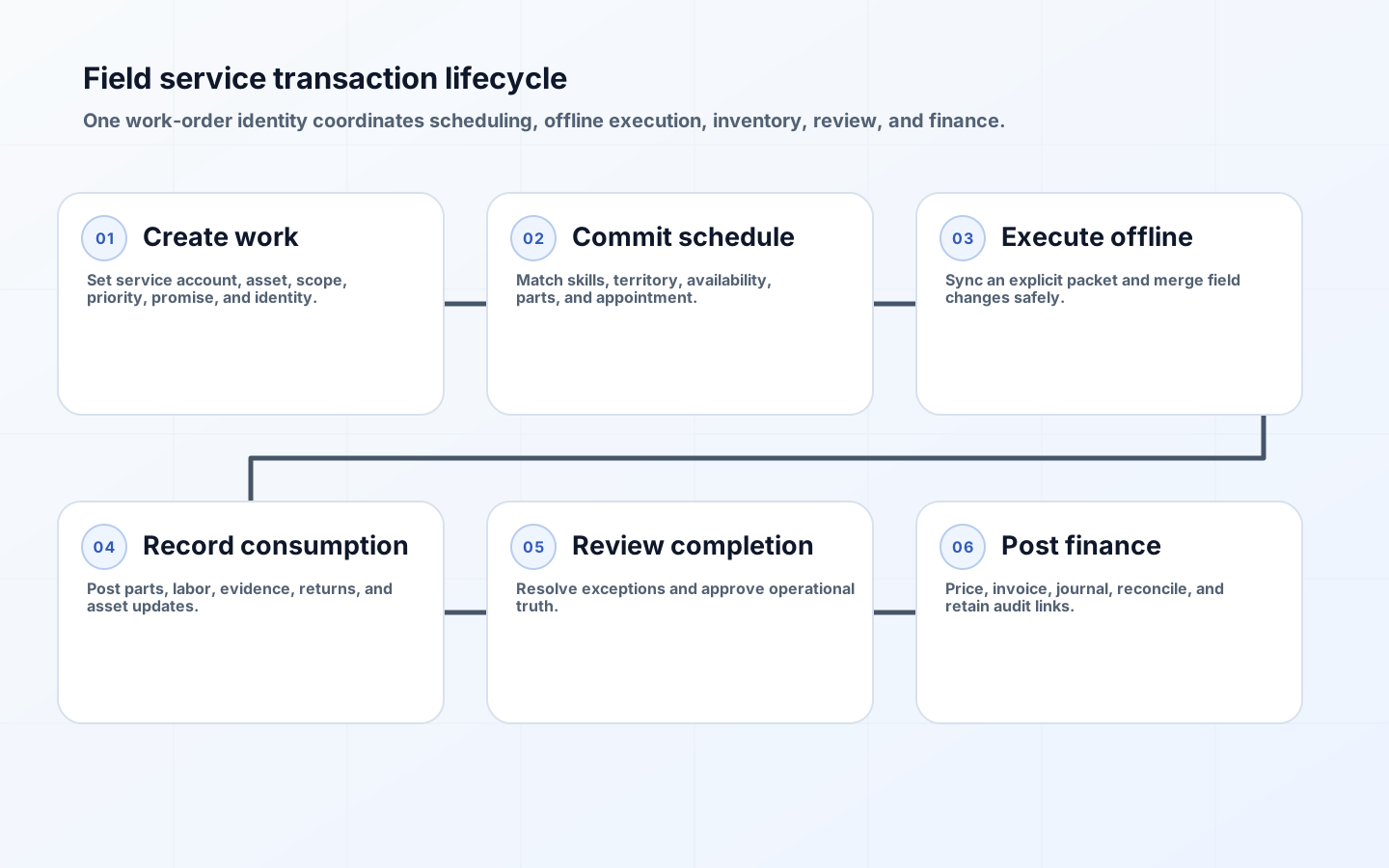
A field service integration architecture coordinates work that leaves the office and changes physical reality. A request becomes a work order; a dispatcher commits a person and time; a technician may work without connectivity; parts leave a truck; an asset gains service history; a customer approves evidence; and finance prices labor and material. Each step may sit in a different platform. Reliability depends on preserving one transaction identity and explicit authority across those boundaries.
The work order is the operational spine, but it is not the only lifecycle. Microsoft documents separate work-order and booking statuses, with booking changes influencing work-order state, and inventory or invoice effects occurring later. That distinction generalizes: appointment, visit, work scope, parts movement, asset update, approval, and financial posting must not be compressed into one overloaded status. Integration should expose their relationships while allowing each authoritative system to own its state.
Define the end-to-end service transaction
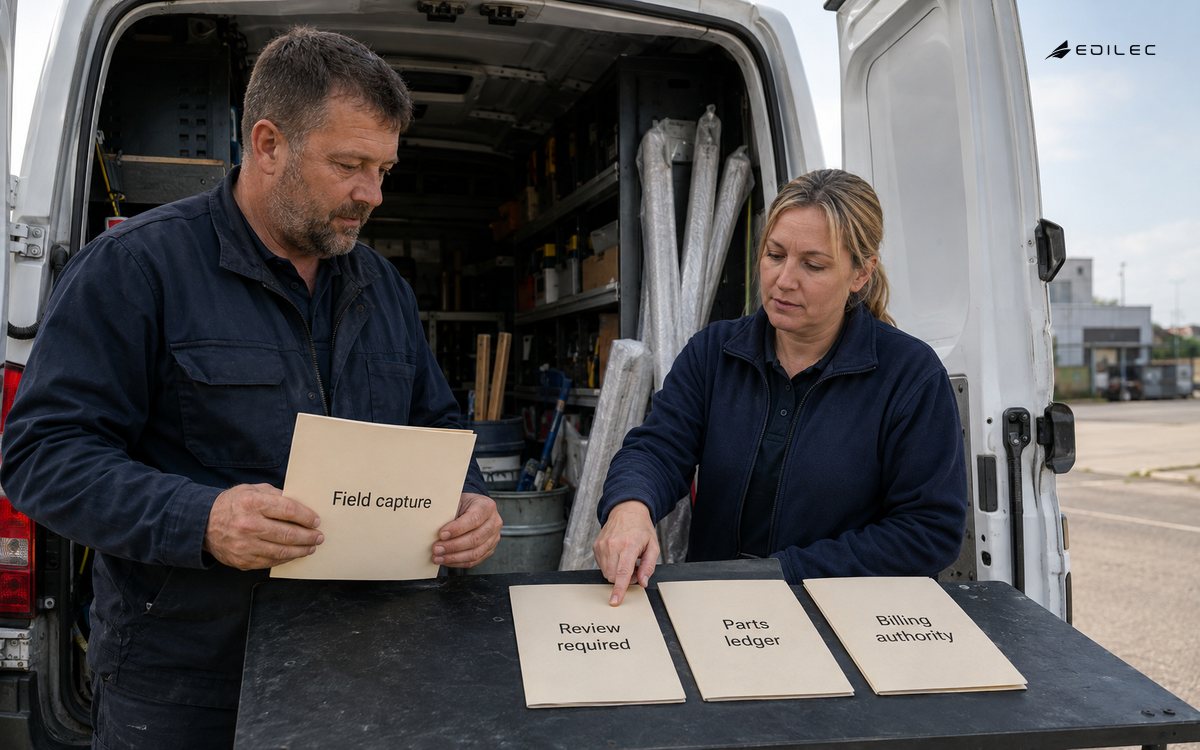
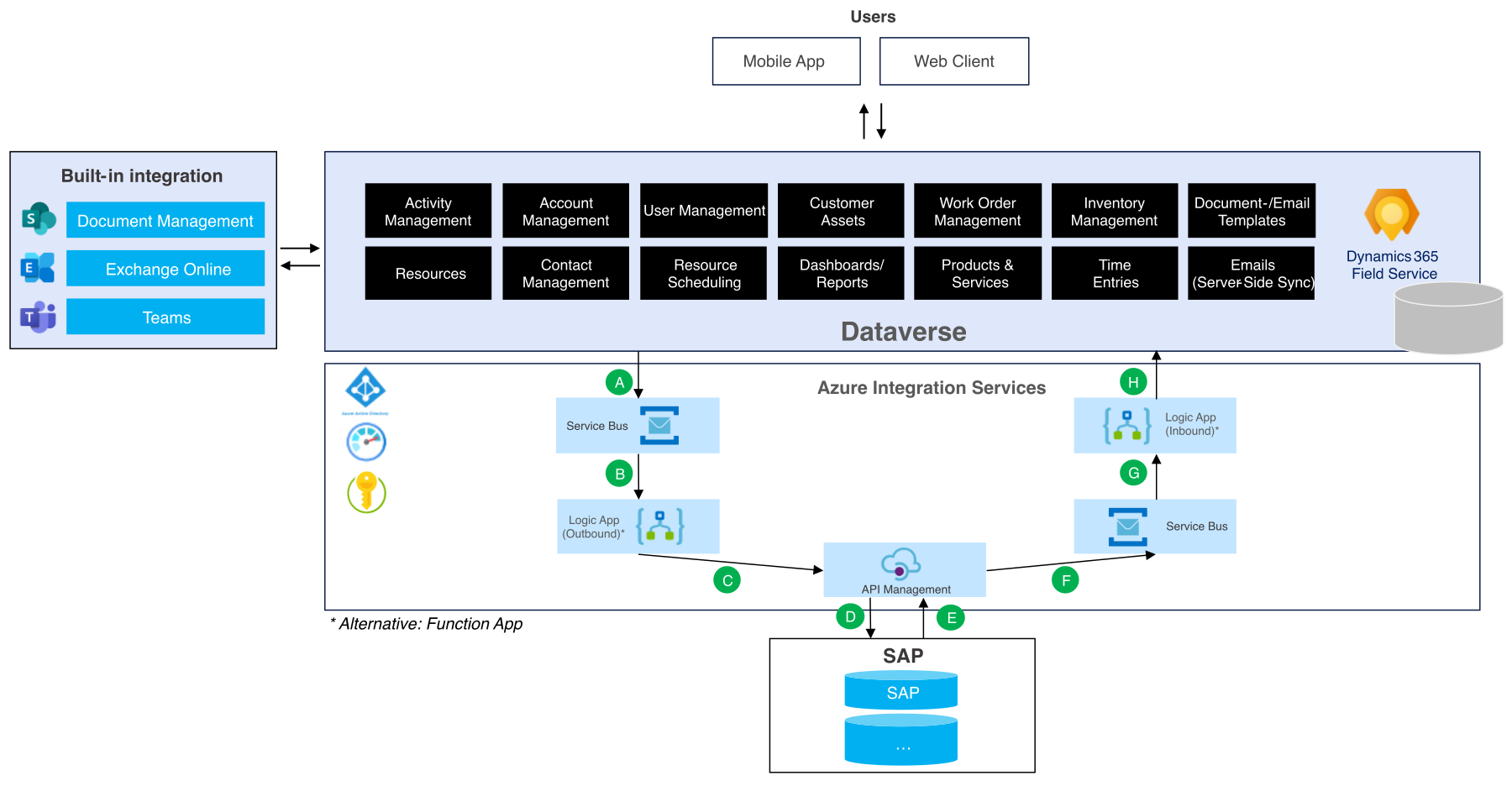
Write a lifecycle contract from intake to financial completion. Name the initiating case, agreement, sensor alert, portal request, or call; service account and location; covered asset; work scope; priority; promise window; skills; safety requirements; estimated parts and labor; price or warranty context; and accountable owner. Give the work order an immutable enterprise identifier carried through scheduling, mobile, inventory, documents, and finance. Preserve system-native IDs in a cross-reference table rather than reusing one mutable number everywhere.
Define state transitions with actor, preconditions, side effects, reversibility, and evidence. Created should not reserve stock automatically unless that is policy. Scheduled should represent a committed booking, not merely a suggested slot. Technician complete may mean field capture ended, while reviewed means a supervisor accepted completeness and posted means financial or inventory effects were authorized. Support cancel, reschedule, no access, follow-up, partial completion, return visit, and disputed completion as first-class outcomes.
| Domain | Likely authority | Published facts | Unsafe coupling |
|---|---|---|---|
| Customer and asset | CRM or asset system | Identity, location, coverage, service history | Mobile silently edits master identity |
| Work and booking | Field service platform | Scope, requirements, assignment, operational status | ERP status drives technician UI directly |
| Inventory | ERP or inventory ledger | Availability, reservation, issue, return, serial state | Schedule treats cached stock as committed |
| Mobile execution | Field service transaction store | Times, tasks, readings, evidence, consumption | Last write wins across offline edits |
| Finance | Billing or ERP | Price, tax, actuals, invoice and posting | Completion creates duplicate invoice effects |
Integrate scheduling around constraints and commitments
Scheduling inputs include service duration, promised window, territory, location, travel, resource availability, skills, certifications, crews, equipment, and parts. Publish normalized facts with freshness and source timestamps. Distinguish a candidate slot from a held slot and a confirmed appointment. Use a booking version or compare-and-set operation so simultaneous dispatch changes do not overwrite one another. Customer notifications should follow committed transitions and use an idempotency key to avoid duplicate messages during retries.
Keep optimization advisory until constraints are validated. A mathematically efficient route can violate labor rules, safety qualifications, customer access hours, or part availability. Dispatchers need reasoned overrides that record who changed the recommendation and why. When a booking changes, emit the previous and new assignment, effective time, work-order ID, and change reason. Downstream mobile and customer channels should apply only newer versions and surface conflicts instead of silently accepting an old schedule.
Design the technician mobile app for offline truth
Define an offline work packet: assigned bookings, work scope, customer and site details, asset and recent service history, tasks, safety instructions, entitled products, price visibility where appropriate, inventory snapshot, forms, and necessary documents. Minimize personal and sensitive data, encrypt storage, bind access to the technician and device, and expire cached work. Synchronize before departure when possible, but never imply that an old stock or schedule snapshot is current without its cutoff time.
Capture changes as domain operations rather than one mutable form: started travel, arrived, began work, recorded reading, completed task, consumed serialized part, captured signature, or requested follow-up. Give each operation a client-generated ID and timestamp so retries are idempotent. Use field-specific merge rules. A dispatcher cancellation may outrank an offline status update, while a technician's captured measurement remains valuable evidence. Queue conflicts for resolution with both versions, actor, time, and business impact; generic last-write-wins loses work and accountability.
Treat service inventory as a ledger
Model central warehouses, depots, lockers, technician vehicles, consignment locations, and customer sites explicitly. Separate availability, allocation, transfer, issue, consumption, return, scrap, and serial installation. Microsoft distinguishes estimated and allocated products from used products, and records inventory journals; that ledger approach supports reconciliation even when a separate ERP remains authoritative. An estimated part on a work order should not decrement on-hand stock, and an offline consumption event should not be applied twice after reconnect.
For serialized or regulated parts, record item identity, lot or serial, from and to location, technician, work order, asset, condition, event time, and evidence. Validate substitution and warranty rules. If the mobile snapshot says a part exists but the ledger rejects consumption, preserve the field event and route a controlled adjustment rather than deleting the evidence. Reconcile vehicle stock by transaction and periodic count. Returns require receipt and disposition, not merely a negative consumption line.
| Transition | Idempotency key | Required reconciliation | Failure response |
|---|---|---|---|
| Booking confirmed | Work order plus booking version | One active commitment and notification | Reject stale update or reschedule |
| Part consumed | Mobile operation ID | Ledger issue, work line, asset serial | Hold exception without duplicate deduction |
| Visit completed | Booking plus completion version | Tasks, time, evidence, follow-up | Keep review pending |
| Invoice requested | Approved work order version | Billable lines to invoice lines | Retry without creating second invoice |
| Financial posted | Posting document ID | Actuals, tax, ledger, work status | Compensate through finance controls |
Gate billing behind reviewed operational facts
Build billable lines from approved labor, travel, products, fees, discounts, warranty, entitlement, not-to-exceed terms, tax context, and customer contract. Preserve estimated, captured, approved, and invoiced values separately. Microsoft describes a pipeline in which work-order usage can become material usage logs, journal lines, actuals, and invoices; regardless of product, each conversion needs durable source references. Financial systems should own final accounting and tax logic, while field service owns what technicians recorded and supervisors approved.
Use an invoice request with an immutable work-order version and line identifiers. Retries must return the existing financial document or safely complete missing lines. Corrections after posting should create approved adjustments, credit, rebill, or journal compensation rather than editing historical facts. Reconcile quantities, units, rates, currency, tax, customer, project or contract, and totals. A posted flag without matching line-level financial evidence is not completion.
Operate with checkpoints, exceptions, and scenario tests
Monitor transaction age between created, scheduled, dispatched, arrived, technician complete, reviewed, inventory resolved, invoice created, and posted. Segment by territory, work type, integration path, and connectivity. Alert on aged business exceptions, not every transient retry. Provide a support view that joins IDs and states without exposing unnecessary customer data. Assign operational owners for scheduling conflict, mobile sync, inventory discrepancy, missing evidence, pricing rejection, and financial posting.
Version integration events and define required fields, ordering expectations, producer authority, consumer idempotency, and retention for replay. Include occurred and recorded time so offline capture and delayed processing remain distinguishable. Consumers should ignore compatible additions and reject unsupported breaking versions into a visible queue. Contract tests across field service, inventory, customer communication, and finance reduce the chance that one platform release quietly changes status or quantity semantics.
Test ordinary and difficult journeys: one visit, several bookings, crew work, emergency dispatch, offline completion, canceled appointment, failed access, partial job, part substitution, serial mismatch, return visit, warranty, customer dispute, and post-invoice correction. Inject delayed and duplicated messages, stale schedule versions, token expiry, and ERP outages. Reconcile after replay. Pilot with real technicians across weak-connectivity areas and measure task completion, conflict burden, stock variance, posting age, and support demand before expanding.
Key takeaways
- Use one immutable enterprise work-order identity while retaining native IDs for bookings, inventory events, assets, and financial documents.
- Keep work order, booking, visit, inventory, approval, and financial lifecycles distinct and define their transition dependencies.
- Represent offline technician work as idempotent domain operations with explicit merge and conflict rules.
- Treat parts movement as a reconciled ledger and gate billing behind reviewed operational facts.
- Test and monitor complete business journeys, including weak connectivity, retries, corrections, and cross-system exceptions.
Frequently asked questions
Should the field service platform own inventory?
It can own operational inventory for simpler environments, while complex supply chains often keep the ERP ledger authoritative. Choose one authority per fact and exchange reservation, issue, return, and adjustment events with explicit reconciliation.
What makes offline sync safe?
A bounded encrypted work packet, operation IDs, versioned records, deterministic merge rules, visible conflicts, and server-side idempotency. Simply caching forms and replaying updates can overwrite newer dispatch changes or duplicate inventory effects.
When is a work order financially complete?
Only when approved billable facts are represented in the authoritative financial documents and reconciled, with exceptions resolved. Technician completion is an operational milestone, not proof of invoice or ledger posting.
Conclusion
Field service integration works when the physical job and the digital transaction remain connected from request to ledger. Explicit state authority, offline-safe operations, inventory evidence, controlled financial conversion, and end-to-end reconciliation give dispatchers, technicians, customers, and finance a shared account of what was promised, performed, consumed, and charged.