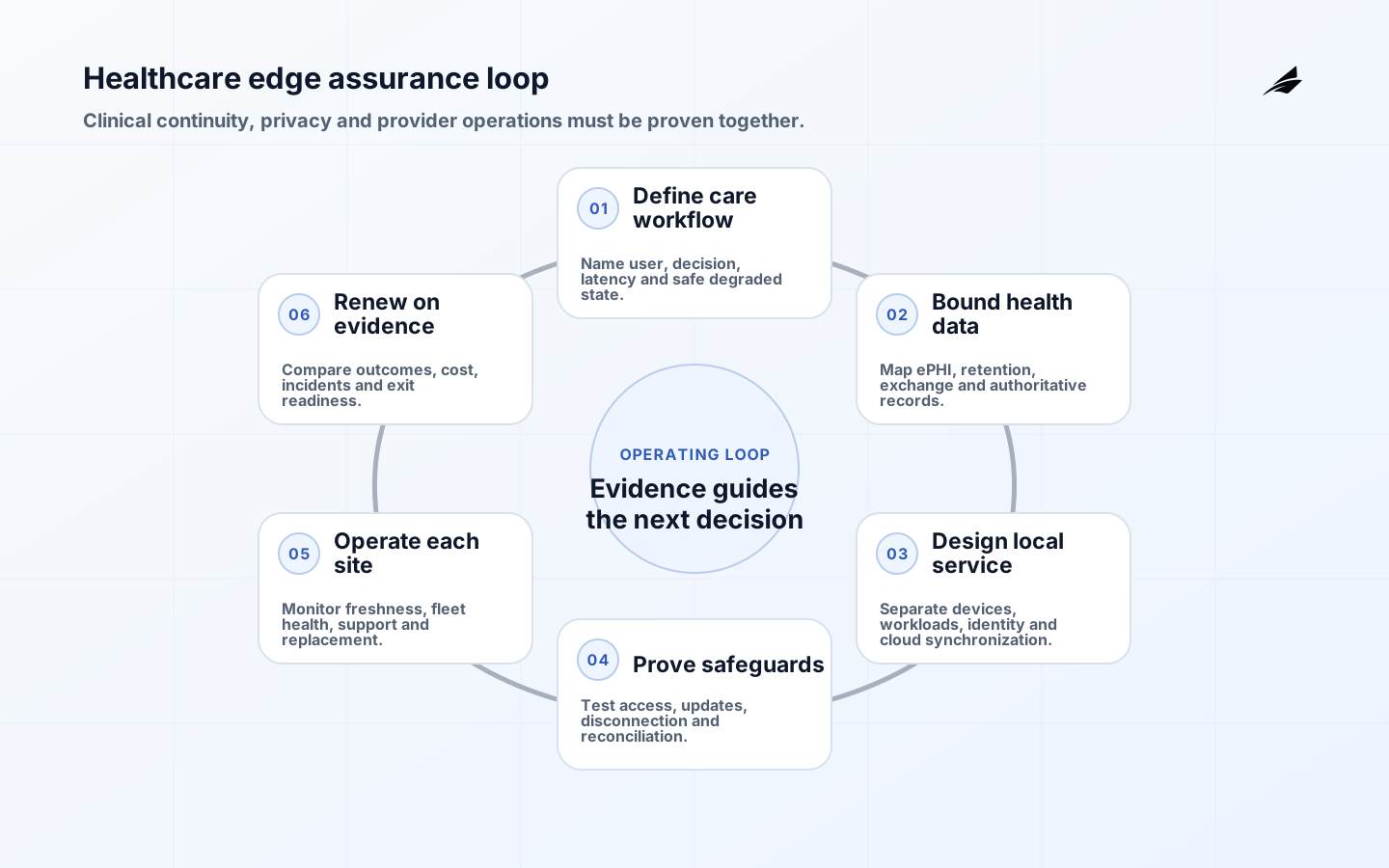
Edge providers for healthcare is not a product purchase with a predictable outcome. It is an operating change spanning clinical devices, local compute, hospital networks, cloud services and care operations. The useful question is whether the proposed service improves a named workflow while preserving security, recoverability and accountable ownership. This guide turns that question into a sequence of decisions, evidence and release gates that buyers, architects and delivery leaders can use together.
Begin with the companion Edilec resources on healthcare edge provider planning, the healthcare edge implementation checklist, edge computing in production. They provide neighboring architecture and implementation detail. This article concentrates on the exact boundaries, delivery evidence and recurring management decisions that determine whether healthcare edge service remains useful after the first release.
What should a healthcare edge provider actually deliver?
A healthcare edge provider supplies or operates compute, connectivity and management close to a care setting so workloads can respond locally, continue during a wide-area outage, or limit unnecessary data movement. Scope may include gateways, compact clusters, device adapters, inference runtimes, fleet management and cloud synchronization. It does not automatically include clinical validation, medical-device responsibility, network remediation or twenty-four-hour support. The statement of work must name sites, workloads, data classes, response objectives and every party’s duty.
Start from a clinical workflow, not a server location. Record who relies on the output, the maximum tolerable delay, what happens when inference or connectivity fails, which record becomes authoritative and whether the output informs care. Separate regulated medical-device functions from operational analytics. Edge placement can reduce latency, but it also creates distributed patching, physical access, certificate, inventory and support obligations across facilities where technical intervention may compete with patient care.
| Decision | What must be explicit | Acceptance evidence |
|---|---|---|
| Clinical purpose | Users, decision supported, latency and safe degraded behavior | Observed workflow test and clinical owner approval |
| Data boundary | ePHI fields, local retention, cloud synchronization and deletion | Data-flow map, reconciliation and deletion evidence |
| Provider duty | Hardware, platform, patching, monitoring, incident and field support | Signed responsibility matrix and escalation exercise |
| Continuity | Local operation during WAN, cloud or identity-provider outage | Timed disconnection and recovery test |
| Exit | Configuration, data, keys and replacement procedure | Export rehearsal and provider-assisted transition plan |
How should the healthcare edge architecture work?
Use a layered design: device and sensor interfaces feed a constrained local ingestion layer; applications or models run in isolated workloads; an identity and policy layer controls administration and service access; telemetry and signed updates flow through managed channels; and cloud systems receive only the data needed for longitudinal processing. Avoid making the edge a shadow data center. Standard images, declarative configuration and a small number of supported hardware profiles make recovery and fleet maintenance tractable.
Map data from creation to deletion. Identify ePHI at the field level, minimize local copies, encrypt storage and transport, rotate device and workload credentials, and define what is buffered during disconnection. Reconnection needs idempotent transfer, duplicate handling, clock-skew treatment and an authoritative-record rule. Clinical staff must see whether information is current, delayed or unavailable. Logs should support investigation without unnecessarily duplicating patient content or exposing it to provider personnel.
Which healthcare and security controls matter?
Where a provider creates, receives, maintains or transmits ePHI for a regulated entity, contracting and operations must reflect the applicable business-associate relationship. Hardware inventory, secure boot, unique identity, controlled configuration, update mechanisms, interface protection and cybersecurity-state reporting should be procurement requirements. For connected medical devices, involve biomedical engineering and the device manufacturer; an edge platform cannot unilaterally patch or alter a regulated device integration.
HHS explains cloud and service-provider obligations in its HIPAA cloud guidance and summarizes required safeguards in the HIPAA Security Rule. NIST’s IoT capability baseline provides concrete device capabilities, while the FDA’s medical-device cybersecurity program frames lifecycle expectations. Use FHIR when a supported health-data exchange standard fits the workflow.
| Control area | Implementation detail | Proof before scale |
|---|---|---|
| Identity | Unique device identity, federated workforce access, least privilege and break-glass review | Role test, credential rotation and emergency-access audit |
| Software | Signed artifacts, approved versions, staged updates and rollback | Provenance record and failed-update recovery |
| Network | Allow-listed flows, segmentation, mutual authentication and egress control | Packet-level flow validation and isolation test |
| Resilience | Local safe state, buffered transfer and deterministic resynchronization | WAN-loss drill with data reconciliation |
| Incident | Provider notification, evidence preservation and clinical escalation | Joint tabletop and contact-path test |
How should providers be evaluated and introduced?
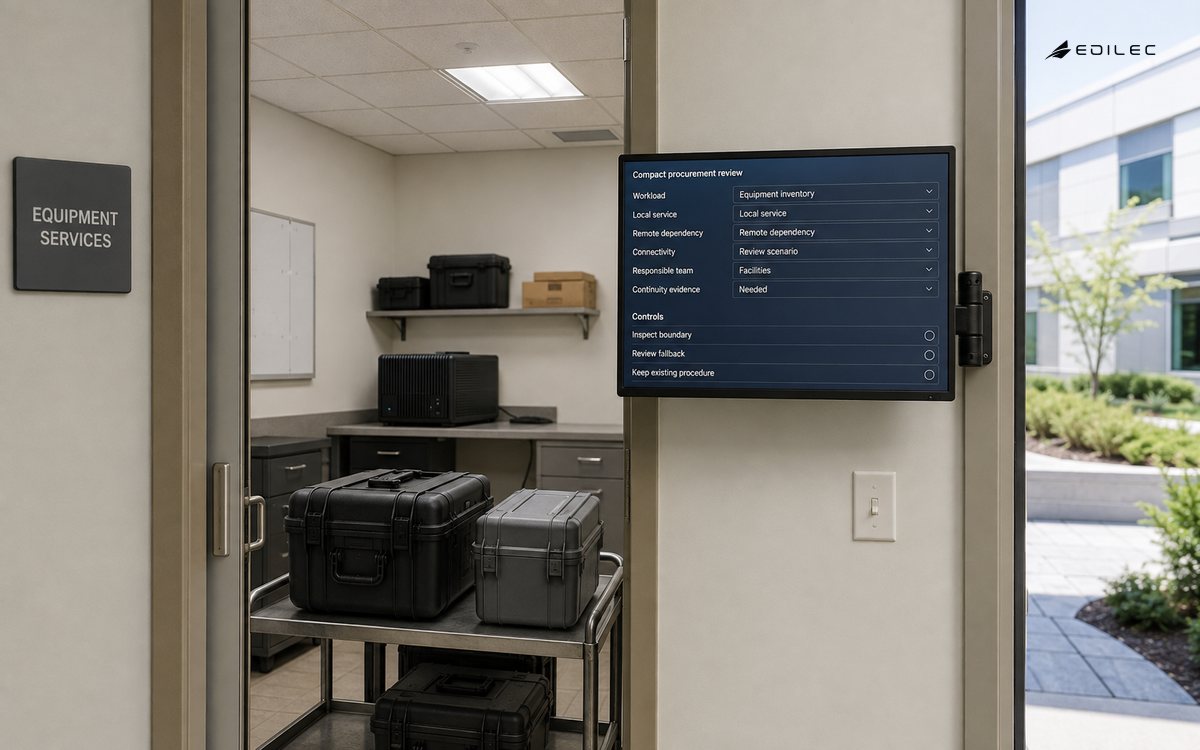
Evaluate providers with a workload packet containing interfaces, data classes, site constraints, service objectives and failure scenarios. Require a reference architecture, support boundaries, component inventory, vulnerability process, patch windows, remote-access method, subcontractor list, data-location statement and exit assistance. Pilot at a representative facility with real network constraints and an awkward device integration. Test cloud loss, certificate expiry, capacity pressure, corrupted update, hardware replacement and after-hours escalation before any multi-site wave.
Treat every stage as a gate, not a calendar milestone. The owner records the decision, evidence, unresolved exceptions and rollback trigger. A stage closes only when representative users complete the workflow, telemetry explains failure, support can diagnose it, and recovery has been exercised. This keeps healthcare edge service from expanding on enthusiasm while operational debt remains invisible.
What drives healthcare edge cost?
Cost includes appliances or consumption, resilient connectivity, platform subscription, implementation, interface work, facility visits, device certification constraints, security operations, observability, replacement stock, training and decommissioning. A cheap per-node price can be overwhelmed by site-specific integration and field support. Compare providers using a three-year workload model with site count, retained data, transfer, inference demand, availability tier and support hours. Price an exit rehearsal and hardware refresh rather than assuming they are exceptional events.
For healthcare edge providers, estimate lifecycle cost by workload and by responsibility. Include discovery, integration, migration, verification, security review, environments, observability, support, change management, vendor management, data movement, incident response and exit work. Keep contingency attached to known uncertainty rather than hiding it in a blended rate. Reforecast after the pilot with observed effort and consumption; that is more defensible than extrapolating a demonstration.
Common failure modes and practical responses
Common failures are choosing hardware before defining the clinical purpose, treating encryption as the whole HIPAA program, allowing shared administrator identities, storing more patient data locally than needed, depending on cloud identity during a WAN outage, and promising autonomous clinical decisions without validation. Another warning sign is a provider dashboard that reports node health while no one can tell whether bedside messages are delayed or records reconciled correctly.
For healthcare edge providers, the practical response is a small control loop: detect the condition, identify the accountable owner, limit exposure, preserve evidence, recover the workflow, and decide whether the underlying design must change. Record exceptions with an expiry date and compensating control. Repeated exceptions are architecture evidence, not administrative noise, and should change the roadmap or narrow the service boundary.
Example: bedside analytics without a cloud dependency
A hospital wants local deterioration-risk scoring from bedside observations because round-trip cloud latency and network interruptions are unacceptable. The first release is advisory: it displays a score and freshness timestamp to a trained team, never writes an order, and falls back to the existing observation workflow. The edge receives a minimum FHIR-aligned dataset, runs a versioned model, stores a short encrypted buffer and sends outcomes to the longitudinal system when connectivity returns.
Acceptance includes interface conformance, model-version traceability, role-based access, clock drift, duplicate messages, WAN loss, cloud loss, node replacement, update rollback and reconciliation. Biomedical engineering confirms device boundaries; privacy staff approve fields and retention; clinical safety owners define the degraded state. The provider demonstrates remote support through approved privileged access and then restores a replacement node from controlled configuration without exposing patient data in support logs.
For healthcare edge providers, the team releases only the proven slice, monitors user and system outcomes through a full operating cycle, and keeps the previous route available until reconciliation closes. At the review, leaders compare baseline and observed results, examine near misses and support effort, and either expand, redesign or stop. That decision discipline matters more than completing every item in an original feature list.
How to measure value and operating health
Measure clinical workflow availability, end-to-end event age, inference latency by percentile, synchronization backlog, reconciliation errors, unsupported software exposure, successful update rate, mean time to replace a node and incidents requiring facility intervention. Pair these with user acknowledgment and false-alert review where applicable. Infrastructure uptime alone is insufficient: the service is useful only when the correct information reaches the correct role in time and the fallback remains safe.
| Measure type | Example measure | Decision it informs |
|---|---|---|
| Workflow | Percent of eligible events delivered within the clinical freshness objective | Whether the edge improves the intended care workflow |
| Reliability | Disconnection continuity and reconciliation error rate | Whether local operation and recovery are credible |
| Security | Fleet coverage, credential age and critical-remediation time | Whether distributed assets remain governable |
| Support | Diagnosis time and on-site intervention per node | Whether the provider model scales operationally |
Key takeaways
- Define the clinical purpose and safe degraded state before selecting infrastructure.
- Contract explicitly for ePHI handling, updates, support, evidence and exit.
- Test disconnection, resynchronization and node replacement at a representative site.
- Measure workflow freshness and reconciliation, not only appliance uptime.
- Expand only after clinical, privacy, security and support owners accept evidence.
Frequently asked questions
Does edge computing remove HIPAA obligations?
No. Local processing may reduce transfer, but ePHI safeguards, risk analysis, access control, contingency planning and applicable business-associate duties remain. Responsibilities follow the data and service relationship, not the distance from a cloud region.
Should a hospital buy edge hardware or a managed service?
Choose from operating capacity and workload criticality. Hardware ownership gives control but transfers lifecycle work to the hospital. A managed service can add fleet expertise, yet contracts must expose remote access, subcontractors, patching, recovery and exit rather than hiding them.
When is a healthcare edge pilot ready to scale?
Scale after the workflow, data flow, degraded state, update path, provider escalation, reconciliation and replacement process succeed under representative conditions. One successful demonstration or low-latency benchmark is not enough.
Conclusion
A credible edge providers healthcare decision ties local computing to a precise care workflow and an explicit safety boundary. The provider must prove secure lifecycle management, useful telemetry, disconnection behavior, data reconciliation and field support. When those controls are tested together, edge infrastructure can improve responsiveness and continuity without becoming an unowned collection of clinical-site computers.