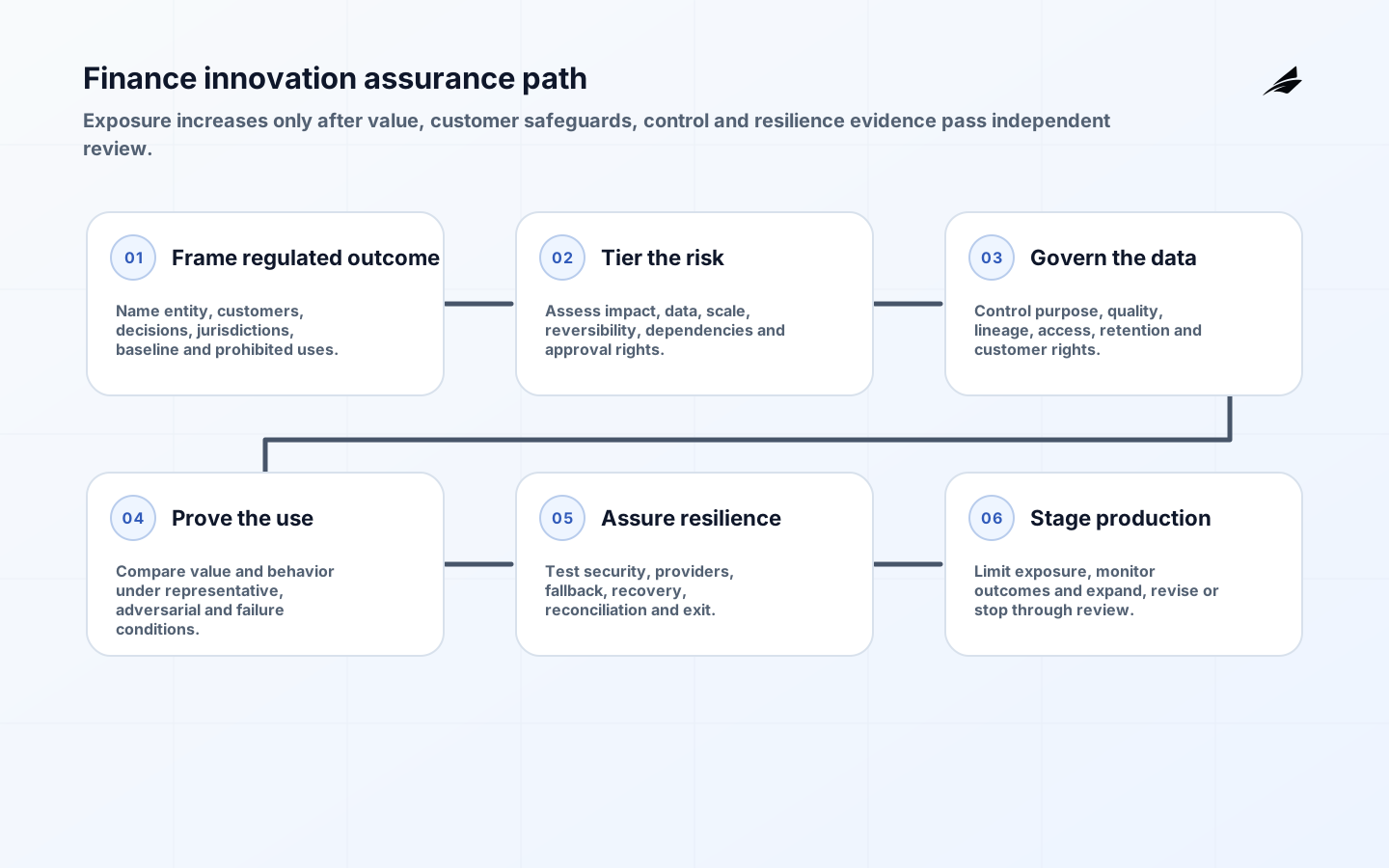
Emerging technology in finance includes artificial intelligence, distributed ledgers and tokenization, privacy-enhancing techniques, cloud services, new payment interfaces and cryptographic change. The right implementation question is not whether a technology is innovative; it is whether a bounded use improves a financial outcome while preserving customer protection, legal compliance, model and data governance, operational resilience and financial integrity. This checklist gives institutions a gated route from proposal to production.
Use the emerging technology finance practical guide and emerging technology finance FAQ for option framing. Delivery teams should layer in the financial services implementation checklist and data and AI services checklist. Regulatory scope depends on activity, entity, jurisdiction and effective date; legal and compliance owners must verify it.
Define the regulated outcome and prohibited uses
Name customer or operational outcome, process, baseline, population, legal entity, jurisdictions, accountable executive and material decisions. Describe why current technology cannot meet the need. Separate efficiency assistance from decisions affecting eligibility, price, access, settlement or reporting. List prohibited or deferred uses, especially where evidence, explainability or controls are immature. A chatbot that drafts internal text and a model that changes credit terms require different governance.
The Basel Committee’s digitalisation report reviews APIs, AI, distributed ledgers and cloud along with strategic, operational and system-wide implications. Build a use-case register with technology, vendors, data, customers, criticality, owner, approval, monitoring and exit. Apply the institution’s existing risk taxonomy before inventing a technology-specific one.
| Use-case factor | Lower-risk example | Higher-risk example | Control consequence |
|---|---|---|---|
| Decision role | Summarizes internal material | Determines customer eligibility | Independent validation and human authority |
| Data | Approved public reference | Sensitive customer and transaction history | Privacy, security and lineage |
| Reversibility | Discardable draft | Irreversible settlement instruction | Confirmation, limits and recovery |
| Dependency | Optional staff aid | Critical outsourced service | Resilience, substitution and exit |
| Scale | Bounded pilot cohort | Market-wide automated action | Stress, conduct and systemic review |
Tier risk and set independent decision rights
Create a cross-functional approval path involving business, risk, compliance, legal, security, privacy, data, model risk, operations and finance according to tier. Define maker, reviewer, approver and operator roles. Innovation teams should not approve their own production exceptions. Document assumptions, unresolved issues, residual risk and review dates. Stop criteria must be credible and funded.
NIST’s AI Risk Management Framework organizes AI work around govern, map, measure and manage. It can complement financial regulation without replacing it. Map institutional policies and evidence to each selected outcome. For DLT or other technologies, retain the same logic: contextualize risk, measure behavior and manage it through accountable controls.
Control data purpose, quality, lineage and rights
Inventory training, reference, transaction and evaluation data; source authority; purpose; consent or lawful basis; quality; retention; location and access. Test representativeness and missingness for the intended population. Prevent development data from leaking into prompts, logs or vendor training outside approved terms. Preserve effective definitions and transformations so decisions can be reconstructed.
The BIS Financial Stability Institute’s 2026 paper In data we trust? highlights privacy, quality, security, third-party dependency and concentration in financial AI data use. Define correction, deletion and challenge workflows where required. Monitor upstream changes; a model can drift because a source policy changed even when code did not.
Build a representative proof with explicit hypotheses
Test technical feasibility, business value, customer experience, control operation and economics separately. Use representative volume, latency, edge cases, adversarial inputs and failure. Compare with a simple baseline and current process. For AI, evaluate error types, segments, calibration, explainability and human review. For DLT, test legal finality, privacy, key loss, governance, interoperability and reconciliation with authoritative books and records.

Do not call a demonstration a pilot if it lacks production constraints. Use isolated environments, synthetic or minimized data and spending limits. Record versions, prompts, models, nodes, smart contracts, dependencies and configuration. The Basel Committee’s AI/ML newsletter identifies explainability, governance and resilience as continuing areas of attention. Evidence must support the exact proposed use, not AI in general.
| Gate | Evidence | Customer safeguard | Reject when |
|---|---|---|---|
| Value | Baseline comparison and measurable outcome | No hidden transfer of cost or friction | Benefit is speculative |
| Performance | Representative accuracy, latency and scale | Known limitations disclosed | Critical segment fails |
| Control | Access, review, records and limits tested | Human correction and appeal | Control exists only in policy |
| Resilience | Failure, fallback, recovery and exit exercise | Continuity of essential service | Single untested dependency |
| Economics | Whole-life and stress scenario cost | Fair pricing and service treatment | Cost depends on unsafe scale |
Design conduct, transparency and human safeguards
Explain material customer use in understandable language and provide required reasons, correction and complaint routes. Human review needs relevant evidence, time, competence and authority to disagree. Monitor overrides and automation bias. Test accessibility and assisted channels. Avoid dark patterns or forced consent. Marketing claims should match validated capability and limitations.
The Reserve Bank of India’s fintech and digital ecosystem discussion emphasizes customer-centricity, robust security, transparency, fair lending and resilient infrastructure. Apply equivalent principles across jurisdictions, then map local rules. Detect disparate errors, fraud displacement and exclusion after launch; aggregate accuracy can hide customer harm.
Engineer security, resilience and third-party control
Threat-model identities, APIs, data, models, ledgers, keys, administration and supply chains. Apply least privilege, strong authentication, protected logs, secure development and independent deployment authority. Define service objectives, capacity, fallback, incident command, recovery and reconciliation. Test cyberattack, provider outage, corrupted data, model unavailability, key compromise and market stress according to the use.
Assess subcontractors, concentrated cloud or model providers, regions, change notice, audit evidence, incident timing, data return and deletion. Maintain substitution or controlled manual fallback for critical services. Contract rights are useful only when technical exports and operational exercises prove that the institution can continue or exit. Reconcile financial records after every disruptive test.
Release in stages with continuous validation
Use internal, shadow, advisory, limited-customer and wider stages. Set exposure, transaction and loss limits; define approvers and automatic stops that cannot create greater harm. Keep the previous process available until reconciliation and recovery are proven. Compare decisions and outcomes with baseline, including segments and overrides. Material vendor or model updates require revalidation.
Monitor value, customer outcomes, data quality, technical performance, control exceptions, incidents, concentration, cost and drift. Review with independent risk owners and frontline operators. Preserve records needed to reproduce material decisions. Expand only when evidence meets thresholds; revise or retire when benefits do not justify continuing complexity.
Example: pilot AI assistance for payment investigations
A bank may use a language model to summarize evidence for analysts investigating delayed payments. The initial use does not decide whether money is released or a customer is reported. The register names investigation operations as owner, limits users and records the approved model endpoint, source systems, retention and prohibited data. Baseline measures include preparation time, missing evidence, analyst corrections and case quality. A simpler rules-based retrieval baseline remains in the evaluation.
The pilot uses historical cases that are lawfully available and carefully separated from final evaluation. Tests include incomplete records, conflicting timestamps, unsupported languages, prompt injection in uploaded documents and provider unavailability. Analysts must open cited source records and approve any summary used in a case. The interface exposes uncertainty and never invents a missing status. Security tests confirm that one analyst cannot retrieve another unit’s restricted cases.
Operational acceptance exercises fallback to manual retrieval, provider outage, deletion, model change and reconstruction of an approved case. Review compares time saved with correction effort, segment performance and control exceptions. If summaries are faster but omit evidence in a material payment type, that type remains excluded. Procurement also evaluates concentration, export and exit because the assistant may become operationally important even without formal decision authority.
Expansion is staged by case category and analyst group, with monitored overrides and periodic sampling by an independent team. The institution can pause the capability without stopping investigations. This bounded pattern captures emerging technology value while preserving records, human judgment, customer obligations and resilience. It also creates evidence for a later decision about broader use rather than treating a successful demonstration as enterprise approval.
Finance and procurement should model usage growth, evaluation labor, secure integration, logging, legal review, fallback capacity and exit. A low per-token or per-transaction price may become immaterial beside case review and provider concentration. Stress scenarios should include peak investigations, pricing change, regional restriction and forced migration. Benefits are recognized only from accepted analyst time or better case quality, not generated summaries. This keeps the business case aligned with controlled production rather than demonstration volume.
Change governance distinguishes routine configuration from material change. A prompt wording update may be material if it changes case evidence; a provider model update may alter behavior without application code changing. Version each production element, rerun affected evaluation and notify control owners. Emergency rollback uses an approved prior configuration or manual process. Records connect the version used to every case where the output informed work.
Key takeaways
- Begin with a regulated outcome, accountable entity and explicit prohibited uses.
- Tier governance by decision impact, data, scale, reversibility and dependency.
- Test value, performance, controls, customer treatment and economics independently.
- Engineer fallback, reconciliation and third-party exit before critical use.
- Expand exposure only through production evidence and continuous validation.
Frequently asked questions
Does a regulatory sandbox mean a product is approved?
No. A sandbox can support controlled learning under stated conditions. It does not remove licensing, conduct, privacy, security, prudential or production obligations, and results may not transfer to broader scale or a different jurisdiction.
Is human review enough to control AI risk?
Not by itself. Reviewers need understandable evidence, time, authority, training and monitored outcomes. Data, model, security, process and customer safeguards remain necessary, and some uses may remain unsuitable even with a person in the loop.
Conclusion
Emerging technology in finance should earn production trust through staged evidence. Define the regulated outcome, govern data and decisions, test realistic behavior, protect customers, engineer resilience and monitor consequences. Innovation becomes durable when the institution can explain, limit, recover and stop it.