Emerging technology in finance includes artificial intelligence, cloud services, advanced analytics, APIs, automation and distributed-ledger applications. The technology label does not determine value or risk; the use case does. A tool that summarizes internal policy has a different consequence from one that changes a credit decision, moves money or communicates regulated advice. Business teams need a repeatable way to classify, test and govern that difference.
Use this guide with the emerging technology finance implementation checklist and emerging technology finance FAQ. The airline technology scope guide offers a useful comparison for other safety- and continuity-sensitive operations. Apply local financial law, supervisory guidance and professional advice to the institution and jurisdiction.
Start with a material use case, not a technology
Describe the process, user, decision, data, affected customer, financial exposure and current baseline. Candidate uses include document extraction, reconciliations, fraud investigation support, customer service assistance, software development, risk analysis and personalized communications. State whether output informs, recommends, decides or acts. Automation authority is a major risk boundary: drafting a transaction for approval is different from submitting it.
Define success and guardrails before a pilot. Measure accuracy or task completion on representative cases, cycle time, manual review, exception rate, customer outcome and operating cost. Include unacceptable outcomes such as unauthorized action, missed suspicious activity, unfair treatment, fabricated evidence or inability to explain a decision. A compelling demonstration on selected examples is not proof of production fitness.
| Use-case factor | Lower materiality example | Higher materiality example |
|---|---|---|
| Action | Summarizes internal meeting notes | Initiates or blocks a customer transaction |
| Customer effect | Back-office drafting with mandatory review | Determines eligibility, price or advice |
| Data | Approved public and internal procedural content | Sensitive personal, transaction or market data |
| Reversibility | Output can be discarded without consequence | Action is time-critical or difficult to reverse |
| Dependency | Optional productivity aid | Required for a critical financial service |
Understand current adoption and sector risks
The Bank of England and FCA 2024 survey documents AI use and expectations in UK financial services. It should inform questions, not serve as a benchmark requiring adoption. Institutions differ in products, customers, architecture and obligations. Inventory use cases, including embedded vendor features and employee tools, so governance does not cover only centrally sponsored projects.
The FSB’s AI report identifies vulnerabilities including third-party dependencies and concentration, market correlations, cyber risk, model risk, data quality and governance. These can interact: many firms may depend on the same model or cloud service, while similar training data or strategies can increase correlated behavior. Assess portfolio and ecosystem dependencies, not just individual model accuracy.
Create proportional governance and accountability

Maintain an inventory with owner, purpose, technology, data, provider, automated authority, affected people, critical service mapping, jurisdiction and lifecycle state. Tier review by materiality. Low-risk internal assistance may use approved patterns; customer decisions, financial action or critical operations require deeper legal, compliance, model, security and resilience review. Name one business owner accountable for outcomes and one technical owner for implementation.
For AI, the NIST AI RMF 1.0 organizes risk work through Govern, Map, Measure and Manage. Use it to connect policies, context, evaluation and treatment over the lifecycle. It is voluntary and cross-sector, so map it to applicable financial rules and existing model, conduct, privacy, cyber and outsourcing governance rather than creating an isolated AI committee.
Govern data, models and decision evidence
Document data provenance, purpose, quality, representativeness, permissions, retention and known gaps. Separate training, evaluation and production data where appropriate and prevent leakage. For models, record version, provider, parameters, prompts or rules, evaluation set, thresholds, limitations and monitoring. Preserve the inputs, output and human decision evidence needed to reconstruct a material case, subject to privacy and retention obligations.
Evaluate performance by the real task and subpopulation. Average accuracy can hide severe failure in rare but high-impact cases. Include false-positive and false-negative consequences, calibration, stability under changing data, security attacks and human factors. Generative systems need tests for unsupported statements, retrieval boundaries, prompt injection, sensitive-data disclosure and abstention. A human reviewer is a control only if they have time, information, authority and a usable way to challenge output.
Control third-party and concentration risk
Map the full service chain: application vendor, model or data provider, cloud platform, integration partner and subcontractors. Review financial viability, security, data use, model change, service levels, incident notification, audit evidence, location, portability and termination. The FSB third-party toolkit supports financial institutions and authorities in managing and overseeing third-party relationships.
Do not assume a substitute exists because several vendors have similar interfaces. They may depend on the same cloud, model, data source or identity provider. Identify critical services and fourth parties, estimate switching time, preserve export and test degraded operation. Contracts cannot transfer accountability for customer outcomes or make an untested exit plan operational.
| Risk | Evidence before production | Ongoing signal |
|---|---|---|
| Model or rule error | Representative evaluation, thresholds and fallback | Outcome drift, overrides and error severity |
| Data misuse | Purpose, permissions, minimization and retention controls | Access, sharing, deletion and exception reviews |
| Third-party change | Version notice, regression test and acceptance rights | Provider releases and unexplained output shifts |
| Critical-service outage | Impact tolerance, fallback, recovery and exit exercise | Objective compliance and dependency health |
| Human overreliance | Role design, explanation, training and challenge path | Override quality, review time and automation bias indicators |
Design operational resilience around financial services
Map technology to the important business service it supports, including people, process, information, facilities and third parties. Define an impact tolerance or equivalent business limit, recovery objectives and minimum viable operation. The Basel Committee’s Principles for Operational Resilience emphasize mapping interconnections and dependencies, business continuity and third-party considerations.
Exercise plausible failures: unavailable provider, corrupted output, delayed market data, compromised credentials, incorrect automated action or a model update that changes behavior. Include detection, decision authority, customer communication, reconciliation and return to normal operation. Fallback may be manual, but test its capacity and error rate; a procedure that works for ten cases may collapse during a broad outage.
Integrate new technology without weakening controls
Place emerging components behind stable interfaces and policy enforcement. Authenticate workloads, authorize actions at the system of record and validate output before financial state changes. Use idempotency and immutable transaction references for retries. Keep an authoritative ledger or record separate from probabilistic interpretation. Log versions and decisions with sensitive-data controls.
The Basel Committee’s Digitalisation of Finance report considers implications of APIs, AI, cloud and distributed ledgers for banks and supervision. Architecture should preserve segregation of duties, reconciliation, auditability and change control as channels evolve. A new interface does not remove old obligations; it changes where they must be enforced and observed.
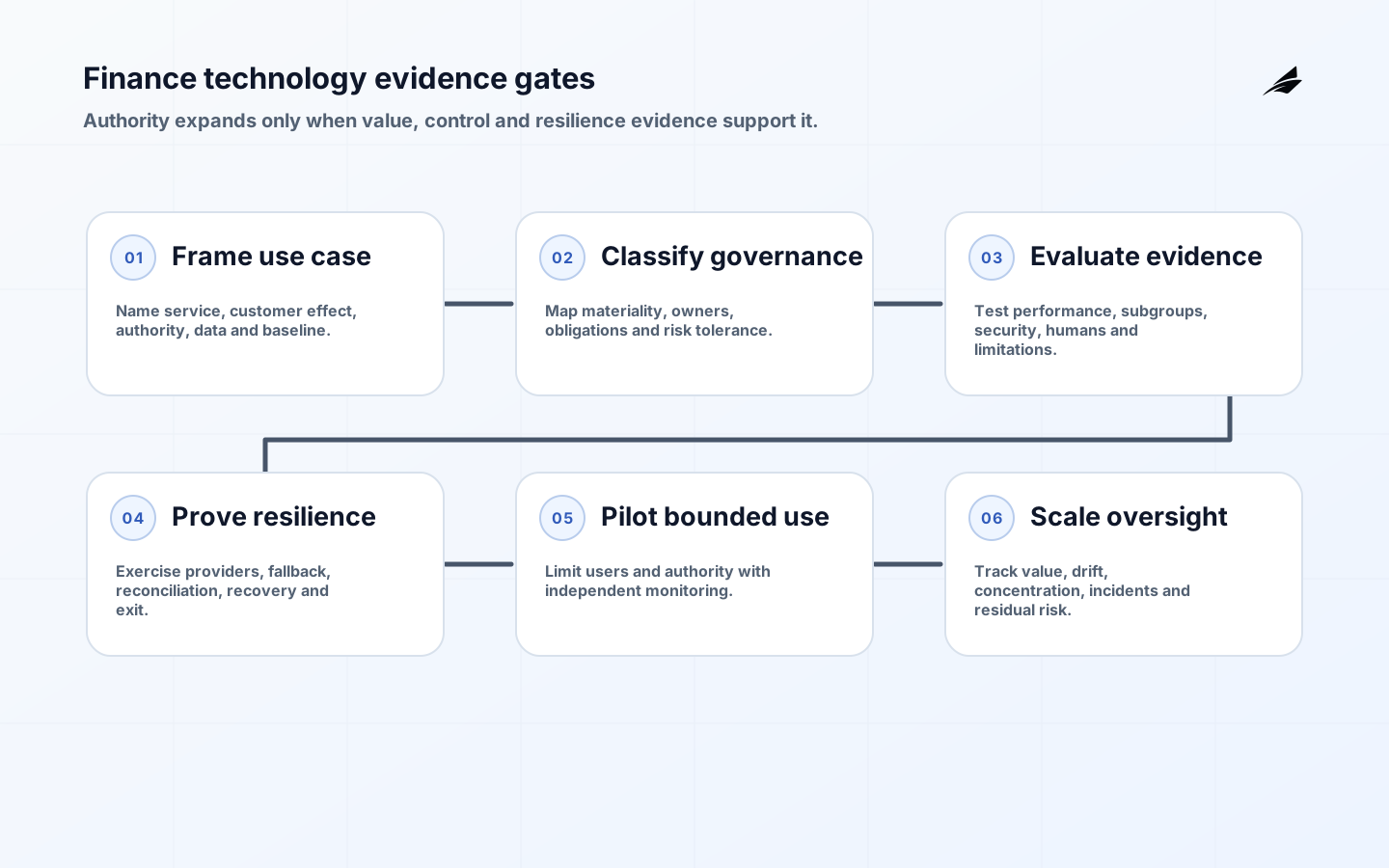
Move through evidence gates before scaling
- Frame the use case, affected service, authority, data, customer impact and baseline.
- Classify materiality and map legal, conduct, model, privacy, cyber and resilience obligations.
- Build a controlled evaluation with representative cases, guardrails and predefined stopping rules.
- Pilot with bounded users and authority, independent monitoring and a manual or system fallback.
- Exercise provider failure, incorrect output, incident response, reconciliation and exit.
- Scale only after the accountable owner accepts evidence and residual risk, then monitor change.
Keep pilot data separate from claims of value. Report sample selection, uncertainty, exclusions and operational overhead. A prototype may improve analyst speed while increasing reviewer effort or unresolved exceptions. Include control and resilience cost in the business case. Stop or narrow the use case when evidence cannot support the required authority; a useful assistant may still be valuable even when autonomous action is not justified.
Measure value, control and resilience together
Use a balanced set: task outcome, customer effect, error and override, fairness or subgroup performance where relevant, time, cost, control exceptions, service availability and recovery. Monitor provider and model versions. Set thresholds for investigation, rollback, narrowed authority or decommissioning. Avoid one composite score that allows productivity gains to conceal a severe conduct or resilience problem.
Review the portfolio for concentration, duplicated capabilities and correlated failure. Track how many critical processes depend on the same platform, dataset or model family. Include finance, risk, compliance, security, operations and customer representatives in material reviews. Document dissent and limitations so later decisions can understand why evidence was accepted.
Monitor regulatory and supervisory change as an operating dependency. Assign an owner to assess new obligations and guidance against the use-case inventory, contracts, evidence and customer communications. Preserve configuration and model version history so the institution can identify which decisions were made under which control state. Reassessment should also trigger when authority expands, data changes materially, a provider changes its service or an incident challenges an accepted assumption.
Key takeaways
- Evaluate emerging technology in finance by use case, authority and customer consequence.
- Integrate new governance with existing model, conduct, privacy, cyber and outsourcing controls.
- Test representative data, human oversight and reconstruction of material decisions.
- Map third- and fourth-party concentration to critical financial services and exercise exit.
- Scale through evidence gates while measuring value, control performance and resilience together.
Frequently asked questions
Does every AI use case require model-risk review?
Apply review proportionately under the institution’s policy and applicable rules. A material model influencing customer or financial decisions needs stronger validation than an internal drafting aid. Inventory both, because use and authority can expand after launch.
Is human approval enough to control AI risk?
Not by itself. Reviewers need context, competence, time, independence and authority to reject output. Measure overrides and review quality, and design a fallback. Repeated automatic acceptance is evidence that the nominal control may not be effective.
Should distributed ledger be used for every multi-party workflow?
No. It may help where multiple parties need a shared state and governance can define participation, privacy, finality and error correction. A conventional shared service may be simpler when one trusted operator can own the record. Compare governance and failure modes, not novelty.
Conclusion
Emerging technology can improve finance when its authority is bounded by evidence and accountable operation. Start with a material use case, preserve decision and data provenance, test providers and human controls, and exercise resilience around the financial service. Scale what proves value without weakening trust, and stop what cannot meet that standard.