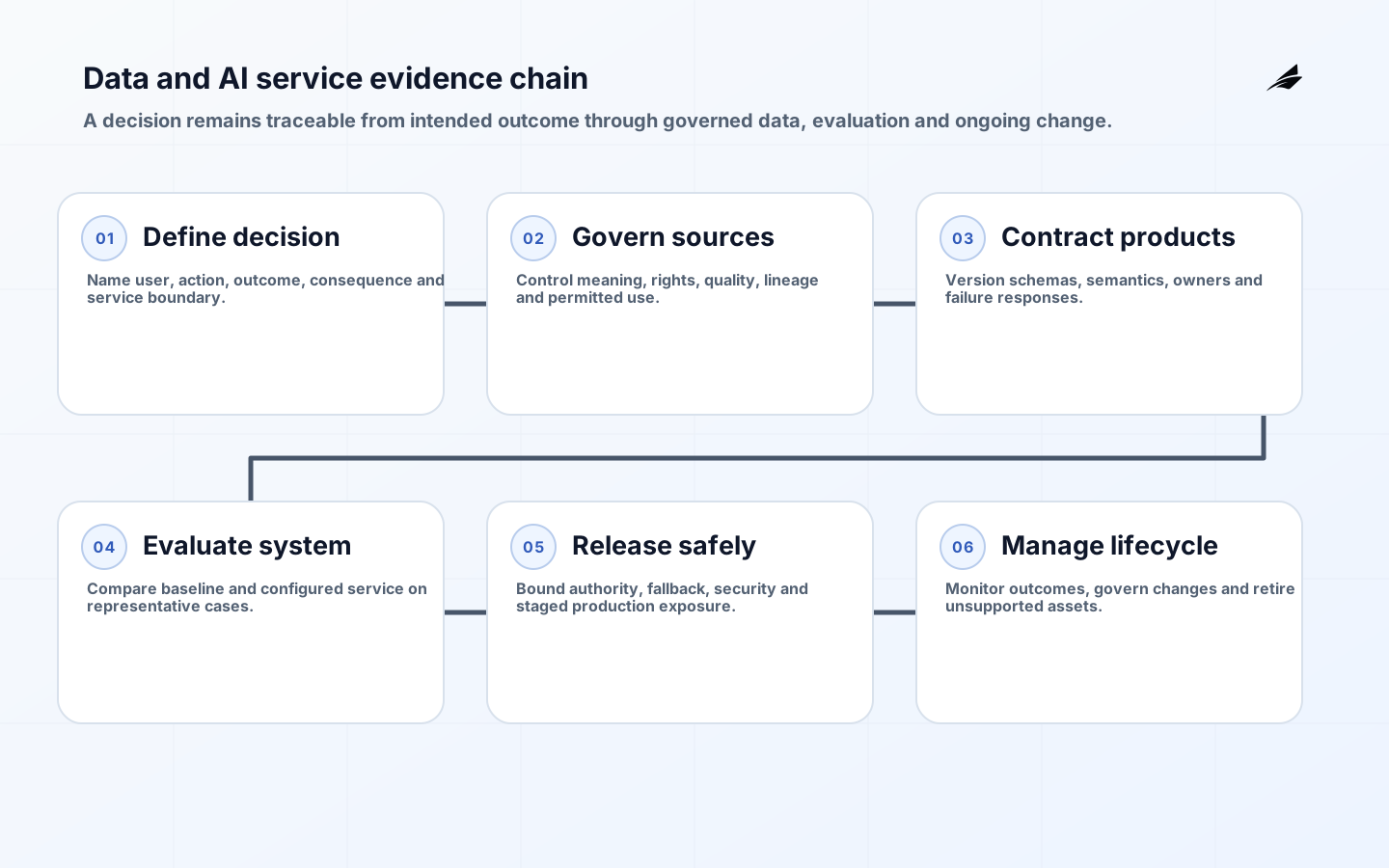
A data and AI services implementation checklist should connect a business decision to governed data, a validated analytical or model output, and an operating process that can detect and correct failure. The service is not complete when a pipeline runs or a model reaches a benchmark. It is complete when an accountable user can act on trustworthy information, the organization can reconstruct how it was produced, and the team can respond when data, assumptions, models or business conditions change.
Use this checklist after a sponsor and service owner have selected a bounded outcome. It complements the data and AI scope and delivery plan and data and AI services FAQ. Adapt controls to the data, consequence and jurisdiction. NIST’s AI RMF is a risk-management framework rather than an ordered checklist; the stages below are a delivery sequence that uses its Govern, Map, Measure and Manage concepts throughout the lifecycle.
1. Define the decision, outcome and service boundary
Write a decision statement: who decides what, using which information, within what time, and what happens next. Define the eligible population, frequency, baseline, target and unacceptable consequences. Separate descriptive reporting, prediction, recommendation, content generation and autonomous action because they require different evidence and controls. Record systems, teams and vendors inside the boundary and what remains outside. If the work cannot be expressed as an observable service, postpone tool selection and conduct workflow discovery.
Identify affected people and business processes, not only direct users. Map foreseeable misuse, denied service, harmful error, privacy loss, security compromise and overreliance. Classify legal and contractual obligations early. The EU AI Act, for example, applies risk-based requirements to defined systems and emphasizes data governance, documentation, logging, transparency and human oversight for high-risk uses. Applicability requires qualified assessment of the actual use. Maintain a dated intended-use and risk record, and re-evaluate it when scope changes.
| Decision class | Example | Primary measure | Release guardrail |
|---|---|---|---|
| Descriptive | Operational backlog dashboard | Freshness and reconciliation | Definition and denominator visible |
| Predictive | Demand forecast | Error by horizon and segment | Fallback planning remains available |
| Recommendation | Next-best action | Decision outcome and override | Material basis is reviewable |
| Generative | Draft service response | Correction and unsupported-claim rate | Human review for consequential use |
2. Govern source data and permitted use
Create a source register with system of record, owner, purpose, collection basis, sensitivity, contract restrictions, geography, refresh, quality rules, retention and approved consumers. Trace data from origin through transformations to the decision product. Record assumptions about what each field represents. Profile completeness, validity, uniqueness, timeliness and distribution using thresholds tied to consequence. A quality score without an owner and response path is only an observation. Define quarantine, correction, backfill and notification behavior.
Minimize data to what the service needs. Separate production, development and evaluation access; use de-identified or synthetic data only when it remains fit for the test. Review vendor rights to retain or train on inputs and outputs. Establish access by role and purpose, with individual and workload identities. Document dataset versions and lineage. For training, validation and test data, preserve provenance, preparation steps, inclusion criteria, known gaps and leakage controls. Evaluate whether historical data encodes a process the organization intends to change.
3. Build data products with explicit contracts
Define each dataset or feature product by schema, semantics, owner, update expectation, quality thresholds, access, retention and consumers. Version breaking changes and give consumers a migration period. Use stable identifiers and business time as well as processing time where sequence matters. Design idempotent ingestion, replay and reconciliation. Record lineage across jobs and environments; standards such as the OpenLineage object model can help represent jobs, runs and datasets, but ownership and business meaning still need local governance.

Treat reference data, taxonomies, labels and prompts as governed assets. Define who may change them, how a change is reviewed and which downstream evaluations must run. Establish development, test and production environments with controlled promotion. Infrastructure and transformation definitions should be version controlled and reproducible. Secrets belong in managed stores, not notebooks or connection strings. Build observability for volume, freshness, schema, quality and lineage before downstream teams depend on the service.
| Asset | Required contract | Failure response | Acceptance evidence |
|---|---|---|---|
| Source feed | Owner, schema, timing and rights | Quarantine and notify | Reconciled sample and delay test |
| Curated dataset | Meaning, quality, lineage and access | Stop publication or mark stale | Rule results and lineage |
| Model or rule | Intended use, version and evaluation | Fallback or disable | Signed release report |
| Decision interface | User, action, explanation and escalation | Route to safe manual process | Scenario and usability test |
4. Develop and evaluate models in context
Choose a baseline that reflects the current decision and a simpler alternative. Split development and evaluation data to prevent leakage, and maintain a protected holdout for release. Select measures according to consequence and class balance; one accuracy number is rarely sufficient. Report uncertainty and sample size. Evaluate important segments and boundary cases where lawful and meaningful. For generative systems, test unsupported claims, retrieval quality, refusal, data disclosure, prompt injection and human correction using representative tasks.
Evaluate the complete configured system: data retrieval, transformations, model, rules, interface, human review and action. Define release and stop thresholds before viewing final results. Record model, code, data, prompt, knowledge and configuration versions. Run security and privacy testing alongside performance. Independent review should challenge assumptions and difficult cases. When evidence fails, investigate and repeat a versioned evaluation; do not remove cases or change denominators without a documented rationale.
5. Design human authority, fallback and explanations
State whether the system informs, drafts, recommends, routes or executes. Assign the person or role accountable for consequential action and give that person time, information and authority to disagree. Show source, uncertainty and limitations at the point of decision where they are useful. Make edit, reject, defer and escalate paths efficient. Capture reasons proportionately. Avoid interfaces that default users into acceptance or hide alternative evidence. Test whether users understand the output under realistic workload and interruption.
Create a safe manual or deterministic fallback for unavailable dependencies, low confidence, missing data and out-of-scope cases. Decide which actions must stop and which may continue. Preserve queued work, idempotency and reconciliation. Test rollback and disable controls with the operating team. Human review is not a universal remedy: if the volume, interface or time pressure prevents meaningful assessment, the control is ineffective. Measure review burden, overrides, delayed decisions and disagreement rather than assuming oversight occurred.
6. Secure the service and its supply chain
Threat-model source poisoning, unauthorized export, prompt injection, insecure tools, model or package compromise, cross-tenant exposure and privileged misuse. Apply least privilege to users, pipelines, notebooks, agents and runtime tools. Restrict egress and dangerous actions. Scan dependencies and images, record artifact provenance, patch supported components and protect build and deployment credentials. Encrypt sensitive data, control bulk downloads and log material access. Test isolation between projects or tenants and verify that diagnostic data does not expose protected content.
Assess providers for data use, security practices, model and service changes, regions, subprocessors, incident notification, evaluation access and exit. Retain the ability to export data, configurations, logs and decision history. Define what happens when a hosted model is retired or silently updated. Use contract and technical controls together; a contractual promise does not prevent an API from sending prohibited data, while a technical gateway cannot resolve all legal rights. Periodically test provider disablement and transition for a bounded service.
7. Pilot and release through evidence gates
Begin with a representative but bounded group, decision and period. Run shadow or recommendation-only mode before enabling action where risk warrants it. Compare against the baseline with the same definitions. Monitor data quality, technical performance, user behavior, downstream outcomes and incidents. Train users on intended use, limitations, feedback, escalation and fallback. Keep support close enough to resolve surprises without normalizing workarounds. Expand only when acceptance thresholds hold and unresolved risks have owners.
The release package should include approved scope, architecture, source register, data contracts, lineage, evaluation, security and privacy evidence, user guidance, operations dashboard, runbooks, rollback, change policy and retirement plan. Each artifact must identify version and owner. Production acceptance should replay representative decisions, fail a dependency, restore data, rotate credentials, reject an output and reconstruct an event. If the team cannot explain and recover the service, it is not ready for broad dependency.
8. Monitor outcomes and manage change
Monitor source freshness and quality, pipeline reliability, output distribution, latency, use, overrides, exceptions, downstream corrections and business outcomes. Segment results where appropriate. Link events to deployed versions and retain evidence according to policy. Establish alerts, investigation thresholds and named response times. User feedback should enter a prioritized queue and connect to releases. Periodically sample successful outputs as well as failures because silent degradation may not create an alert.
Classify changes to data, transformation, model, prompt, knowledge, interface and decision authority. Map each class to regression tests, approvals and rollout. Re-evaluate intended use and legal obligations after material change. Review realized cost and value, including human review and support. Retire products with no owner, consumer or defensible outcome. Remove credentials and access, preserve required records, notify consumers and decommission pipelines. Lifecycle management prevents an experimental asset from becoming an unsupported production dependency.
Key takeaways
- Start with an observable decision and consequence, not a tool category.
- Govern source rights, meaning, quality and lineage before model development.
- Evaluate the complete human-and-software system against a baseline.
- Design fallback, security and supplier exit as production requirements.
- Monitor outcomes and version every material dependency through retirement.
Frequently asked questions
Does every data project need an AI model?
No. Reliable definitions, workflow redesign, rules or descriptive analytics may solve the decision with lower cost and risk. Compare against a simple baseline and select AI only when evidence supports additional value.
What is the minimum production documentation?
At minimum: intended use, owners, architecture, source and data contracts, evaluation, access and threat controls, user guidance, monitoring, incident and fallback runbooks, change policy and retirement path. Depth follows consequence.
How often should models be retrained?
Retrain when monitored evidence and approved change policy justify it, not on an arbitrary schedule. New training can introduce regression. Compare the candidate against the deployed version and repeat required assurance.
Conclusion
Data and AI services create durable value when decisions, data, models, people and operations form one accountable system. Governance is not a final review placed around technical work; it shapes scope, data contracts, evaluation, interface, monitoring and change from the beginning.
Before broad release, ask the team to demonstrate one normal decision, one difficult exception, one missing source, one unauthorized action and one rollback. Require reconstruction from records. When the service can produce, explain, protect and recover its outcome, it has meaningful production evidence. Until then, keep the dependency bounded.