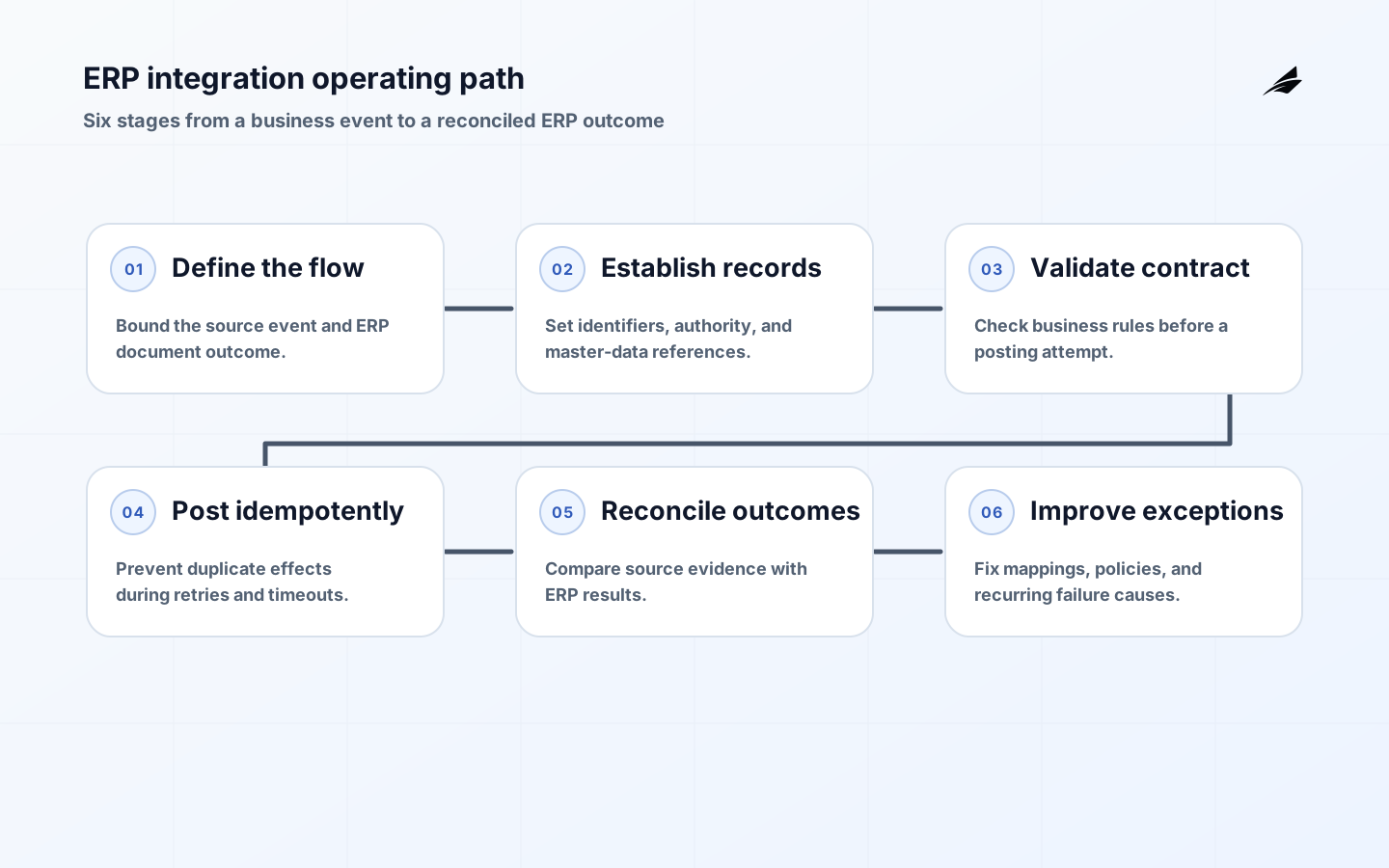
ERP integration is not a request to “connect the ERP.” It is a set of business commitments about orders, customers, inventory, invoices, journals, and status changes crossing a system boundary. Engineering succeeds when it makes those commitments explicit: which system originates an event, what identifiers link records, how the ERP acknowledges or rejects it, and how an operator corrects a failure without creating a duplicate transaction.
Build ERP integration around an accountable operating model
Choose one business flow, such as order-to-cash, procure-to-pay, or inventory adjustment, and model it end to end. Identify the ERP document types involved, the preconditions for posting, the master data required, and the downstream system that needs the outcome. Keep analytics extraction separate from transactional integration. A report can tolerate a scheduled load; a fulfillment release or journal posting needs an idempotent, observable path with defined recovery. Teams planning adjacent work should also consider this master data management guide, because shared records and handoffs often determine whether an apparently local improvement survives production use.

Define the records and states that make ERP integration explainable
Design around durable business events and stable correlation identifiers. An order-created event should carry the source order ID, version or sequence, relevant parties, amounts, currency, and references to the approved master data. The receiving adapter should validate its contract, map to ERP-specific structures, and return a business outcome, not just an HTTP status. Preserve the original payload and mapping version so a team can explain and replay a failed delivery safely.
| Decision | Practical definition | Why it matters |
|---|---|---|
| Business flow | Order-to-cash, procure-to-pay, or inventory adjustment | Creates a testable integration boundary |
| Record authority | Source and ERP ownership by entity and attribute | Prevents conflicting updates |
| Message contract | Business IDs, version, amount, currency, and references | Supports validation and traceability |
| Recovery | Retry, replay, correction, or compensating entry | Avoids duplicate financial effects |
Set ownership and controls before automating the happy path
The finance owner decides accounting policy and posting authority; the business owner decides process rules; engineering owns the integration service and operational reliability. Changes to chart-of-accounts mapping, tax handling, legal entities, and posting dates deserve review because they affect financial records. Use least privilege for technical accounts, separate test and production environments, and make manual reposting or override actions visible in an audit trail. The related billing operations guide is a useful comparison when the design includes cross-team rules, because both practices depend on knowing whose decision controls the next state.
- Select one flow and list its source event, ERP document, and final business outcome.
- Define stable IDs, sequence behavior, and idempotency for every transaction.
- Version mappings and retain the original event evidence for investigation.
- Restrict technical accounts and log manual reposts or overrides.
- Build an exception route for validation, timeout, and duplicate scenarios.
- Reconcile source and ERP business totals at an agreed cadence.
Deliver ERP integration in slices and make exceptions visible
Build a thin vertical slice using representative, non-sensitive test data and a controlled ERP environment. Exercise success, validation failure, timeout after acceptance, retry, duplicate message, out-of-order update, and a planned ERP outage. Introduce a dead-letter or exception workflow that records why a transaction stopped and who can resolve it. Reconciliation should compare source totals and ERP outcomes by business date, not merely count API calls.
Use operating signals that lead to an action
Track delivery latency, rejection reasons, duplicate prevention, unresolved exception age, and reconciliation variance. Split technical failures from business-rule failures; a malformed payload needs an engineering fix, while a closed accounting period needs an authorized business decision. Monitor integration changes around ERP releases and master-data updates, because a technically healthy connection can still post the wrong business result after a mapping assumption changes.
| Control area | Signal to review | Accountable role |
|---|---|---|
| Delivery | Latency, retry rate, and transport failure | Integration team |
| Business validation | Rejected posting reason and owner | Process owner |
| Reconciliation | Source-to-ERP amount and count variance | Finance operations |
| Privileged actions | Manual replay, override, and technical account use | System owner |
Common ERP integration failure modes and practical responses
ERP integration has its own failure patterns. A configured tool can still fail because a key record is ambiguous, authority is missing, or an integration hides a rejected change. Treat each repeated exception as a case with evidence, a named owner, and a specific decision about whether policy, data, process, or code must change. That approach preserves operational learning without normalizing a workaround as part of the system.
Use a decision workshop before expanding scope
A useful decision workshop for ERP integration starts with a concrete operating case rather than a platform diagram. Put the people who create the record, apply the policy, consume the result, and repair failures in the same discussion. Ask them to trace the first design choice: business flow. The team should agree on order-to-cash, procure-to-pay, or inventory adjustment and why it matters: creates a testable integration boundary. Then repeat the exercise for record authority. Disagreement is useful evidence; it often reveals that two teams have been using the same term for different business conditions.
Turn the workshop into a short operational rehearsal. First, select one flow and list its source event, erp document, and final business outcome. Next, define stable ids, sequence behavior, and idempotency for every transaction. Then test whether the team can version mappings and retain the original event evidence for investigation. Do this with a representative, non-sensitive record and an ordinary time constraint. A review that only describes the ideal path will miss the handoff, authorization, or missing-data condition that causes the real escalation. The purpose is to make ownership and evidence usable before more users depend on the workflow.
The exception path deserves equal design attention. Use the next steps as a practical test: restrict technical accounts and log manual reposts or overrides. Also, build an exception route for validation, timeout, and duplicate scenarios. Finally, reconcile source and erp business totals at an agreed cadence. Record the decision with the relevant source evidence and avoid repairing a symptom in a private message. When an exception returns, compare it with the earlier case; recurrence is a signal to change the input rule, policy, mapping, or service boundary rather than simply closing another ticket.
As scope grows, preserve the second set of design choices. For message contract, the operating definition is business ids, version, amount, currency, and references; this matters because it supports validation and traceability. For recovery, use retry, replay, correction, or compensating entry so the team can avoid duplicate financial effects. These details are where a pilot becomes a service other teams can rely on. They also give reviewers a stable way to distinguish a legitimate exception from an undocumented bypass.
Review evidence on a regular cadence with the people able to change the system. Look at delivery through latency, retry rate, and transport failure, owned by integration team. Pair that with business validation: rejected posting reason and owner. The goal is not a perfect dashboard. It is a short list of decisions: which failure needs an immediate repair, which trend needs a policy change, and which measurement no longer represents the operating outcome the team cares about.
Use a written acceptance test for the next release of ERP integration. The test should show that a normal record completes, an invalid record is stopped with a useful reason, and a corrected record can continue without creating a second outcome. It should also prove the policy behind business flow remains visible to the person reviewing the result. These tests create shared confidence between the business owner and the delivery team, especially when a change crosses an integration boundary.
Keep the review practical by sampling a recent case and asking the questions users actually ask: Should the ERP always be the system of record? Why is idempotency important? How should failures be repaired? Then compare the answers with the current evidence in the system. The control view should help the responsible team inspect reconciliation through source-to-erp amount and count variance, and decide whether the next improvement belongs in policy, data, product behavior, or operations. This small discipline prevents a growing system from accumulating unexplained exceptions.
Key ERP integration takeaways
- ERP integration is a business contract carried by technical messages.
- A successful transport response is not proof that the correct financial outcome occurred.
- Idempotency, mapping history, and reconciliation make recovery credible.
Frequently asked questions about ERP integration
Should the ERP always be the system of record?
It depends on the data and process. The ERP may be authoritative for financial postings, while a commerce or operational system owns the originating order or activity. Document authority by entity and attribute rather than assigning one global answer.
Why is idempotency important?
Networks and jobs retry. Without an idempotency strategy, a retry after an uncertain response can create a duplicate order, invoice, or journal. Use a stable business key and record whether that key has already produced an accepted outcome.
How should failures be repaired?
Keep the original event, validation result, mapping version, and target reference. Route the problem to the team with authority to correct it, then replay or create a controlled compensating action according to the business and accounting policy.
Conclusion
Reliable ERP integration treats finance-facing records with the same care as a public production interface. Define a bounded business flow, preserve identifiers and evidence, and design recovery before scale. A small integration that reconciles and recovers honestly is far more useful than a broad integration that succeeds only in the happy path.