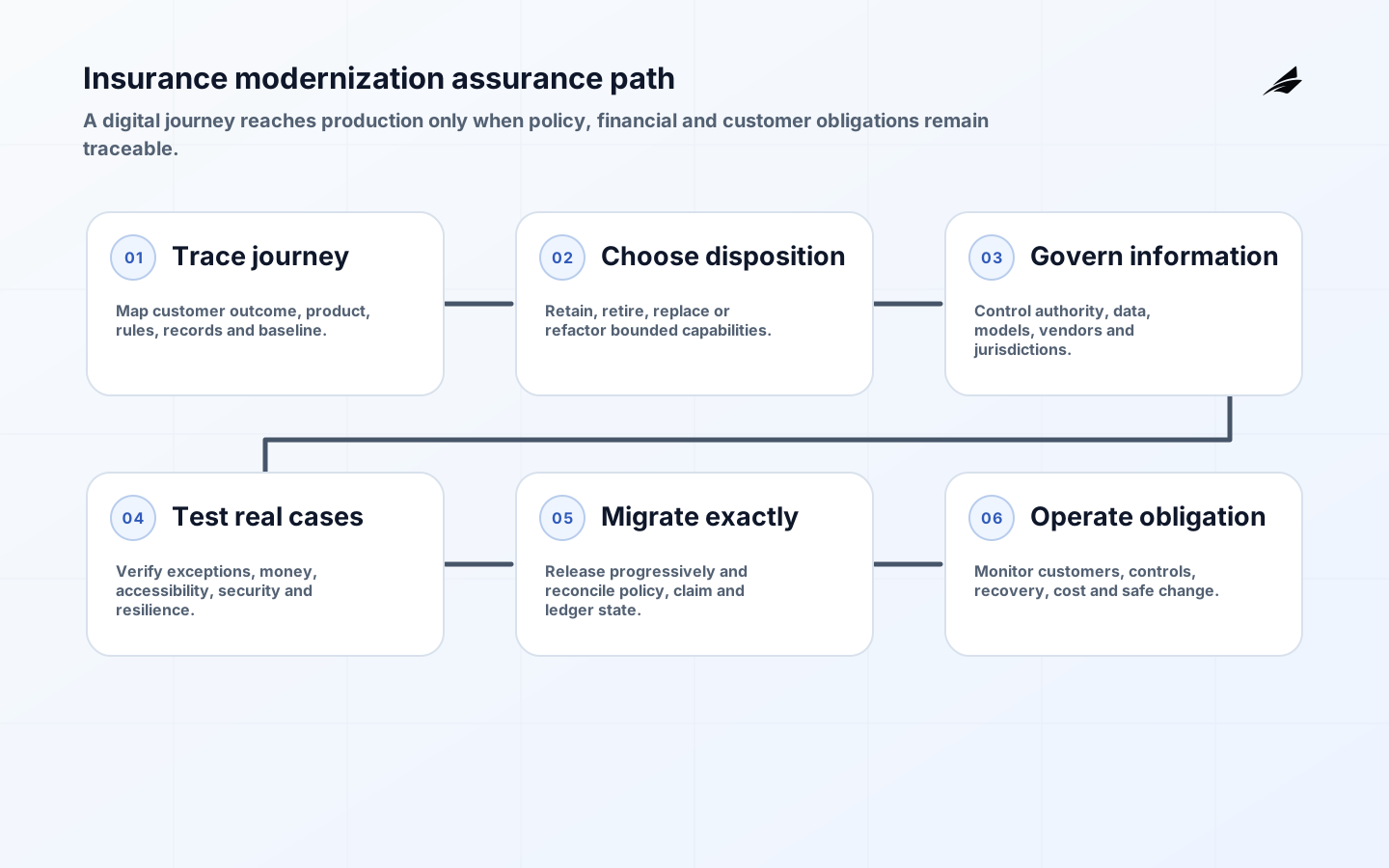
Digital engineering for insurance applies product, software, data, security and operations disciplines to policy, billing, claims, distribution, underwriting and regulatory capabilities. It is not a one-time core replacement or a mandate to automate every insurance decision. This FAQ focuses on how an insurer can modernize customer and employee journeys while preserving contractual records, fair treatment, financial control and continuity.
For portfolio planning, use the digital engineering for insurance practical guide and then the insurance implementation checklist. The broader digital transformation services FAQ helps compare sourcing models. The answers below assume that legal, actuarial and regulatory owners participate directly in engineering decisions.
What should digital engineering for insurance include?
Start with an insurance journey and measurable service outcome: quote-to-bind time, first-notice-of-loss completion, claim decision accuracy, payment delay, policy-change effort or complaint resolution. Trace the people, products, rules, channels, documents, data, integrations and ledgers that support it. Include brokers, repair networks, medical providers, reinsurers and regulators where relevant. A mobile front end cannot repair contradictory product rules or delayed policy records hidden behind it.
Create a capability map and choose disposition per component: retain, retire, replace, rehost, replatform or refactor. Separate systems of engagement, workflow, decisioning, product configuration, policy administration, claims, billing, document, analytics and finance, even when one suite currently supplies several. Modernization order should follow customer outcome, operational risk and dependency, not vendor module sequence. Define the authoritative record for policy terms, coverage, reserve, payment and communication.
| Insurance capability | Authoritative evidence | Critical acceptance |
|---|---|---|
| Product and rating | Approved product, rules and effective dates | Quote reproduces filed or approved behavior |
| Policy | Versioned contract, endorsements and parties | Coverage state reconciles at cutover |
| Claims | Event, evidence, decisions, reserves and payments | History and authority remain traceable |
| Billing | Invoices, allocations, refunds and ledger entries | Financial totals and timing reconcile |
| Distribution | Producer, appointment, consent and communication | Jurisdiction and authority are enforced |
| Analytics | Purpose, lineage, method and limitations | Decision use matches approved evidence |
Should an insurer replace the core platform?
Only when expected outcome and risk justify the transition. A replacement can simplify product configuration and lifecycle support, but it also concentrates migration, integration and operating change. Encapsulation with APIs may stabilize a viable core while new journeys move outward. A strangler pattern can replace bounded capabilities gradually, provided dual writes and authority are controlled. Evaluate product fit with real endorsements, cancellations, reinstatements, backdated changes and claim exceptions rather than a clean new-business demonstration.
Use domain contracts and event semantics to reduce point-to-point coupling. ACORD's data standards provide industry models and messages; adoption still requires product, jurisdiction and version decisions. Do not force every internal concept into an external exchange shape. Maintain canonical identifiers, effective dating, currency and time-zone rules. Version APIs and schemas, make retries idempotent and provide reconciliation for asynchronous processing.
How should insurance data and AI be governed?
Document purpose, source, consent or other authority, quality, lineage, retention and access for customer, risk, claims and third-party data. Test whether external variables create proxies for protected characteristics or conditions unrelated to legitimate insurance risk. Give consumers and staff correction paths. Separate exploratory data from production records and prevent model training from silently broadening approved use. Data governance must cover purchased data and vendor-derived features, not only information stored by the insurer.
The NAIC Model Bulletin on insurers' use of AI is a model bulletin, not itself a uniform law. It sets expectations for a written AI systems program, governance, risk management, validation and documentation in adopting jurisdictions. Track each jurisdiction's actual law and bulletin. Inventory models and rules, classify consumer consequence, validate fairness and accuracy, govern third parties, monitor changes and preserve human review and appeal where required or appropriate.
Can regulated insurance workloads use cloud and managed services?
Often yes, subject to applicable rules, risk and contract. Classify criticality, data, concentration, sub-outsourcing, access, audit, resilience and exit before selection. EIOPA's Solvency II outsourcing rule requires a written policy and specified oversight for relevant undertakings and makes clear that outsourcing does not remove the insurer's obligations. Other jurisdictions differ. Maintain an obligations register instead of importing one regulator's rules globally.
Architect identities, encryption, keys, networks, logs, backup, administrative access and software supply chain across insurer and provider boundaries. Contract locations, subprocessors, change notice, incident cooperation, evidence access, continuity, data return and deletion. Test restoration and provider exit with representative policy and claim records. Concentration includes common identity, cloud, data and software dependencies even when contracts name several vendors. The board needs a service consequence view, not a vendor-count proxy.
What must insurance engineering test?
Automate unit, contract, integration, journey, security, accessibility, performance and recovery tests. Build scenario libraries for product effective dates, quote variation, endorsements, cancellations, reinstatement, duplicate payments, partial loss, reserve change, litigation, catastrophe load and document failure. Compare outcomes to approved rules and independently calculated references. Mask or synthesize personal data while preserving useful distributions. Production-like testing must not create real communications, payments or external submissions.

Use progressive release by product, channel, jurisdiction or cohort. Reconcile records and money continuously and provide rollback or forward-correction for every wave. Monitor business outcomes, not only API health. Failed notices, unexplained premium differences and claim workarounds may be visible first in operations. Preserve exact software, product, rule and model versions used for a transaction so disputed decisions can be reconstructed. Require an authorized sign-off for residual discrepancies.
| Test layer | Representative evidence | Stop condition |
|---|---|---|
| Product rule | Golden policies across dates and jurisdictions | Unexplained premium or coverage variance |
| Migration | Counts, money, state and sampled history reconcile | Missing authoritative transaction |
| Journey | Customer and employee complete difficult cases | Unsafe workaround or inaccessible step |
| Security | Identity, abuse, data and supply-chain scenarios | Critical control bypass |
| Resilience | Service remains within impact tolerance | Recovery exceeds accepted disruption |
| Operations | Queues, documents and ledgers settle after release | Growing exception backlog |
How is insurance operational resilience designed?
Map important business services to applications, people, facilities, data and third parties. Define tolerable disruption from customer and market impact, then test severe but plausible scenarios. The FCA's operational resilience guidance applies to specified UK firms and should be read with the relevant rules; its service-mapping and impact-tolerance concepts are also useful design questions elsewhere. Do not confuse component availability with the ability to issue cover, support a claimant or make a valid payment.
Apply the NIST Cybersecurity Framework to govern, identify, protect, detect, respond and recover across the insurance service. Prepare for ransomware, compromised distribution credentials, catastrophe demand, payment interruption, corrupted product rules and provider outage. Recovery needs a clean source of policy and financial truth, current keys and accessible procedures. Exercise business, technology, communications, legal and supplier teams together and track remediation to closure.
How should cost and progress be measured?
Include licensing, implementation, integration, data remediation, testing, controls, cloud, environments, specialist people, business participation, dual running, training, support, decommissioning and contingency. Model product and transaction growth plus vendor indexation. Benefits should link to customer and operational outcomes: faster accurate decisions, fewer corrections, improved digital completion, reduced leakage, lower change lead time and retired risk. Avoid double-counting staff savings while assuming the same people perform migration and control work.
Track outcome, flow, quality, resilience, risk and unit cost per journey. Examples include quote completion, claim cycle with severity context, decision overturns, payment accuracy, complaints, change lead time, escaped defects, service disruption, policy exception age and cost per active policy. Segment outcomes by relevant customer and product groups. Governance should be able to stop a release when technical progress rises but consumer or financial evidence worsens.
Example: modernize first notice of loss
An insurer modernizing first notice of loss can begin with one motor product and channel. Map authentication, policy lookup, incident details, evidence upload, coverage indication, fraud referral, reserve creation, repair routing and customer communication. Baseline completion, correction, call transfer and claim setup time. Keep the policy and claims systems authoritative while a new journey orchestrates versioned APIs. Test backdated coverage changes, multiple claimants, inaccessible uploads, duplicate submission, severe injury and unavailable repair networks. An AI document classifier may suggest evidence type, but staff should see the source and correct it.
Release to a bounded customer cohort and reconcile every created claim, reserve and communication. Measure whether vulnerable customers and assistive-technology users can complete or obtain support. Simulate an outage after submission so customers do not create duplicates. Acceptance requires accurate records, explainable routing, protected personal data, trained handlers and tested rollback. This thin slice proves the full insurance obligation rather than only the visual quality of a new form.
After release, sample claim files and handler corrections, monitor complaint themes and compare digital abandonment with assisted-channel demand. Review product, fraud and repair-network changes before expanding. Retire the old intake only when open sessions, links, records and contingency routes are reconciled, and preserve required evidence for later disputes and regulatory examination.
Key takeaways
- Modernize a complete insurance journey and its authoritative records.
- Choose core replacement or incremental change from evidence, not fashion.
- Govern data, AI and suppliers against actual jurisdictional obligations.
- Test difficult policy, claim, financial, security and recovery scenarios.
- Measure consumer outcomes, control quality, service flow and full cost together.
Frequently asked questions
Can an insurer modernize without replacing the core?
Yes. APIs, workflow and bounded capability replacement can improve journeys while retaining a supportable core. The retained system still needs clear authority, security, performance and lifecycle plans.
Should claims decisions be fully automated?
Only where law, consequence, evidence quality and controls support it. Many uses are better as triage or advisory tools with trained review, explanation, correction and escalation.
Conclusion
Digital engineering for insurance succeeds when software change preserves the meaning of coverage, financial records and customer obligations. Modernize from journeys and authoritative evidence, control data and suppliers, test real exceptions, release progressively and operate within accepted disruption. That turns modernization into safer insurance capability rather than a technology replacement program.