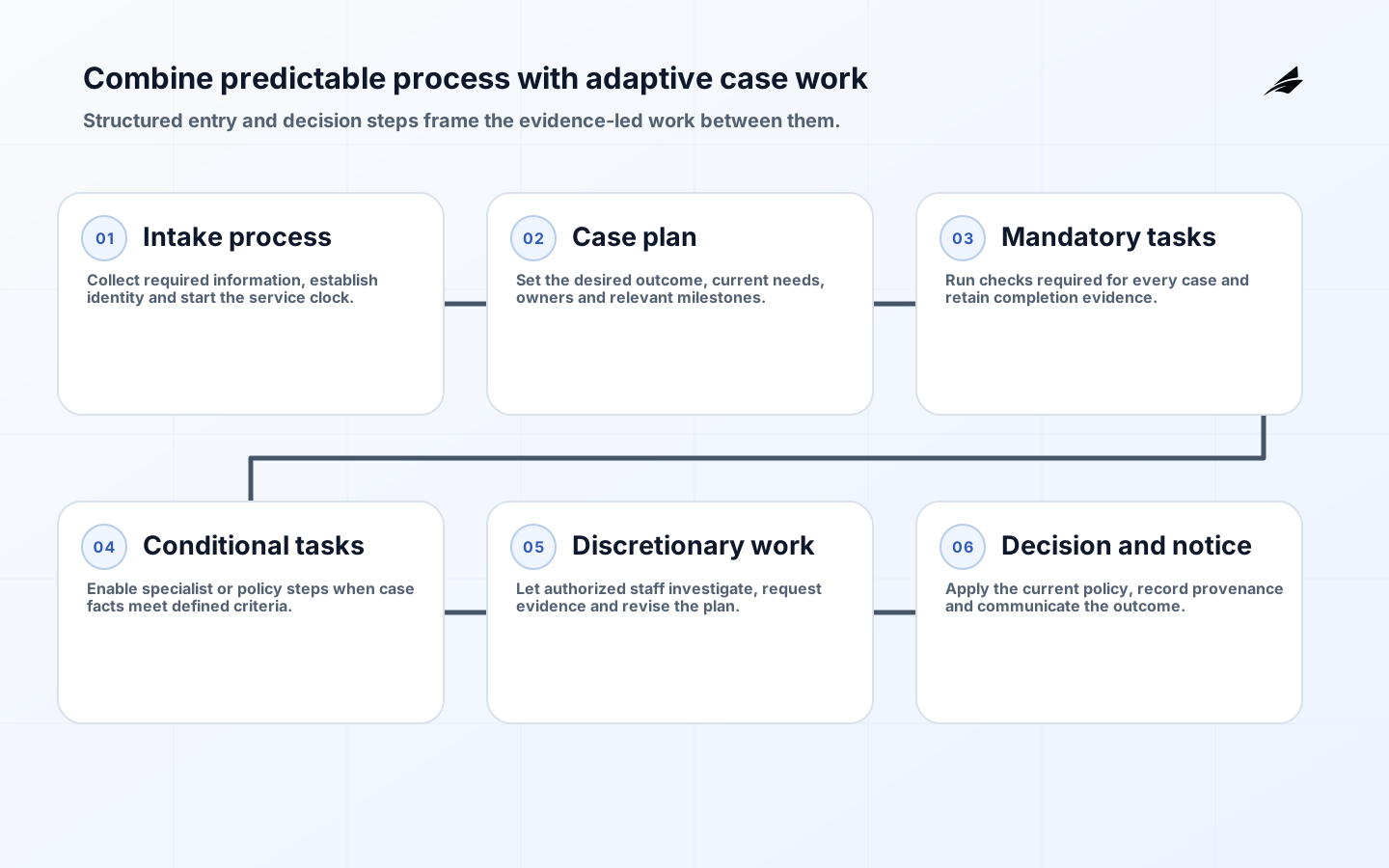
Case management systems coordinate service work that develops around a person, organization, request, incident or obligation. They bring together records, evidence, tasks, communications, decisions and deadlines while preserving a history of who did what and why. Unlike a simple ticket queue, a case may change direction as new information arrives. The system must guide consistent service without preventing authorized professionals from responding to circumstances that cannot be fully scripted.
Decide what is a case and what is a process
Some service work follows a predictable sequence: receive a complete application, validate payment, issue a standard confirmation. Other work is knowledge-intensive: an officer reviews evidence, requests clarification, chooses relevant assessments and records a reasoned decision. Most services combine both. Use structured processes for repeatable, deterministic stages and case behavior where information, events and practitioner judgment determine the next action.

OMG's BPMN standard models process flow, while CMMN models case plans, information and discretionary work. A team does not need to expose either notation to users, but the distinction prevents two common errors: forcing every case through an inflexible flowchart or providing an unstructured record with no service controls. Identify which activities are mandatory, conditionally available, repeatable, discretionary or triggered by an event.
| Work characteristic | Design response | Example |
|---|---|---|
| Fixed sequence | Orchestrated process with explicit gateways | Completeness check before registration |
| Information-dependent | Case task enabled by current facts | Request specialist assessment when evidence indicates it |
| Professional discretion | Authorized optional task with recorded reason | Arrange an additional interview |
| Time-dependent | Milestone, timer and escalation rule | Evidence response due date |
| External event | Event listener and correlation rule | Laboratory result received |
| Reusable service | Subprocess or integration with clear outcome | Identity verification |
Define the case record and service promise
Give each case a stable identifier, case type, subject, responsible team, current stage, priority, service dates and outcome. Define related parties and their roles rather than placing every person in generic contact fields. Separate submitted facts, verified facts, assessments and decisions. A case may contain allegations or disputed information; the data model should not convert every recorded statement into accepted truth.
Translate the service promise into milestones and clocks. State when a clock starts, pauses, resumes and ends; which calendar applies; and how changes are explained. Track both overall service time and the age of actionable work. A deadline hidden in a report cannot guide daily work. Queues should show priority, due state, next required action and blockers, with escalation that reaches an owner rather than merely changing a color.
| Case element | Questions | Control |
|---|---|---|
| Subject and parties | Who or what is the service about? | Typed relationships and identity checks |
| Evidence | What was received, from whom and in which version? | Metadata, integrity and access |
| Tasks | What is required, available or complete? | Owner, due rule and outcome |
| Decision | Who may decide and on what grounds? | Authority, rationale and review |
| Communication | What was sent, received or promised? | Template version and delivery status |
| History | How did the current state arise? | Append-oriented events and correction path |
Manage evidence, decisions and provenance
Documents need metadata beyond a file name: document type, source, received time, case relationship, version, sensitivity and review status. Scan uploads for malicious content, constrain formats and sizes, and store files behind authorization rather than public links. Avoid unnecessary duplication across CRM, document and case platforms. Retention and legal-hold decisions must follow the governing context and qualified advice.
A decision record should state outcome, decision maker, authority, relevant facts, reasons, time and applicable policy version. Keep the source evidence and transformation path inspectable. W3C PROV-O defines general concepts for entities, activities and agents that are useful when thinking about provenance across systems. Whatever representation is chosen, the system should distinguish the original submission, derived assessment and final decision.
Protect access and privacy by case context
Role-based permissions alone may be too broad. Combine role with assignment, team, region, case type, relationship and sensitivity. Separate powers such as intake, assessment, approval, payment and access administration where risk requires it. Enforce access in services and queries, not only navigation. Record access to sensitive cases where appropriate and provide a controlled emergency-access path with reason, alert and review.
NIST SP 800-53 provides control families covering access, audit, identification, integrity, incident response and privacy; teams should select and tailor controls according to system risk and obligations. The NIST Privacy Framework broadens attention from security to the effects of data processing on people. Minimize collection, limit secondary use, define retention and support correction or rights processes that apply in the relevant jurisdiction.
Design staff and customer experiences together
Staff need dense, role-focused workspaces with queues, saved views, history and quick access to relevant evidence. Customers need a clear portal for submission, status, requested actions and communication. Use plain language and explain what a status means without exposing internal or sensitive detail. Preserve drafts, confirm receipt and show deadlines. Do not force users to repeatedly provide information the service already holds unless verification is necessary.
Apply WCAG 2.2 to public and staff interfaces. Case services often include long forms, authentication, document uploads and time-sensitive tasks, making labels, keyboard operation, focus, error recovery, accessible authentication and session handling especially important. Offer supported alternatives when a digital path cannot meet a person's needs. Accessibility testing should include representative assistive technology and users, not automated checks alone.
Integrate systems without losing case truth
Map authority across CRM, identity, document, finance, scheduling, communications and reporting systems. The case system may coordinate a payment without becoming the financial ledger. Use documented contracts, stable identifiers, idempotent commands and explicit acknowledgement states. OpenAPI can describe HTTP interfaces, while events may distribute case facts. In both cases, reconcile important outcomes and expose integration exceptions to operations.
Avoid copying an entire master record merely for convenience. Store the fields required for case context and a reference to the authority, with a policy for snapshots when historical meaning matters. When a name or address changes, decide whether open cases use current or submitted information. These semantics belong in the service model and cannot be solved by synchronization frequency alone.
Example: coordinating a multi-stage support request
Consider a support service where a requester submits circumstances and evidence. Intake validates minimum information and creates a case. An assessor may request clarification, commission a specialist review or proceed to decision depending on evidence. Mandatory safeguarding checks remain visible regardless of chosen tasks. The decision uses a recorded policy version, rationale and evidence links; a separate role approves any resulting payment.
The first rollout covers one request type and one service team. New cases enter the system while existing complex cases remain in the prior register until individually assessed. Daily reconciliation compares submissions, open cases, communications and payments. Staff record exception reasons and receive direct support. Expansion follows evidence that deadlines, permissions, decisions and customer communications are reliable, not merely that forms submit successfully.
Manage case management risks
| Risk | Control | Early signal |
|---|---|---|
| Rigid workflow | Combine required stages with governed discretionary tasks | Staff create shadow cases or false statuses |
| Unclear case truth | Typed facts, evidence, assessments and decisions | Conflicting reports and manual interpretation |
| Missed deadline | Explicit clock rules, queues and owned escalation | Aging actionable work |
| Excess access | Context-aware authorization and review | Broad roles or unexplained sensitive access |
| Weak decision record | Authority, rationale, policy and evidence links | Outcomes cannot be reconstructed |
| Integration mismatch | Idempotency, acknowledgement and reconciliation | Cases and ledgers diverge |
| Unsafe migration | Profile, map, rehearse and retain source evidence | Missing history or open tasks |
A phased case management implementation
- Frame the service outcome, case types, accountable owners, obligations and current baseline.
- Discover real cases, exceptions, evidence, clocks, decisions, roles and system dependencies.
- Model predictable processes and discretionary case work with explicit authority and history.
- Prove one case type end to end, including portal, permissions, documents, decision and integration failure.
- Migrate a bounded team or intake channel with reconciliation and active user support.
- Expand by case type after service, access, quality and adoption gates are met.
- Retire legacy registers and access only after open cases, records and retention duties are resolved.
Measure service outcomes: time to first meaningful action, actionable backlog age, request-for-information cycles, decision corrections, missed deadlines, portal completion, accessibility issues and successful downstream outcomes. Segment by case type and meaningful service conditions. Operational measures should help teams improve service without becoming simplistic targets that encourage premature closure or avoidance of difficult cases.
Key takeaways
- Use structured processes for predictable work and governed discretion for information-led cases.
- Separate facts, evidence, assessments and decisions in a reconstructable case record.
- Make clocks, queues, ownership and exceptions visible in daily service work.
- Enforce context-aware access and design privacy, accessibility and auditability from the start.
- Roll out by case type or team with reconciliation before retiring legacy records.
Frequently asked questions
Is case management the same as CRM?
No. CRM commonly organizes relationships and interactions, while case management coordinates a bounded service matter with evidence, tasks, decisions and deadlines. A CRM may provide case features or integrate with a dedicated case platform; authority must remain clear.
How much workflow should a case system automate?
Automate stable rules, routing, reminders and repeatable checks. Preserve professional judgment where information and context matter, with bounded authority and reasons. Begin with observed cases rather than attempting to encode every possible path upfront.
What case data should be migrated?
Migrate what is needed to continue service, meet retention obligations and explain decisions. Open cases often need richer history than closed cases. Profile source quality, rehearse mappings and agree archival access and reconciliation before cutover.
Create structure without removing judgment
A strong case management system makes service commitments, evidence and decisions visible while leaving room for authorized people to respond to real circumstances. Clear records, contextual access and reliable integrations build trust. A staged implementation lets the organization learn from live cases without losing control of service or history.