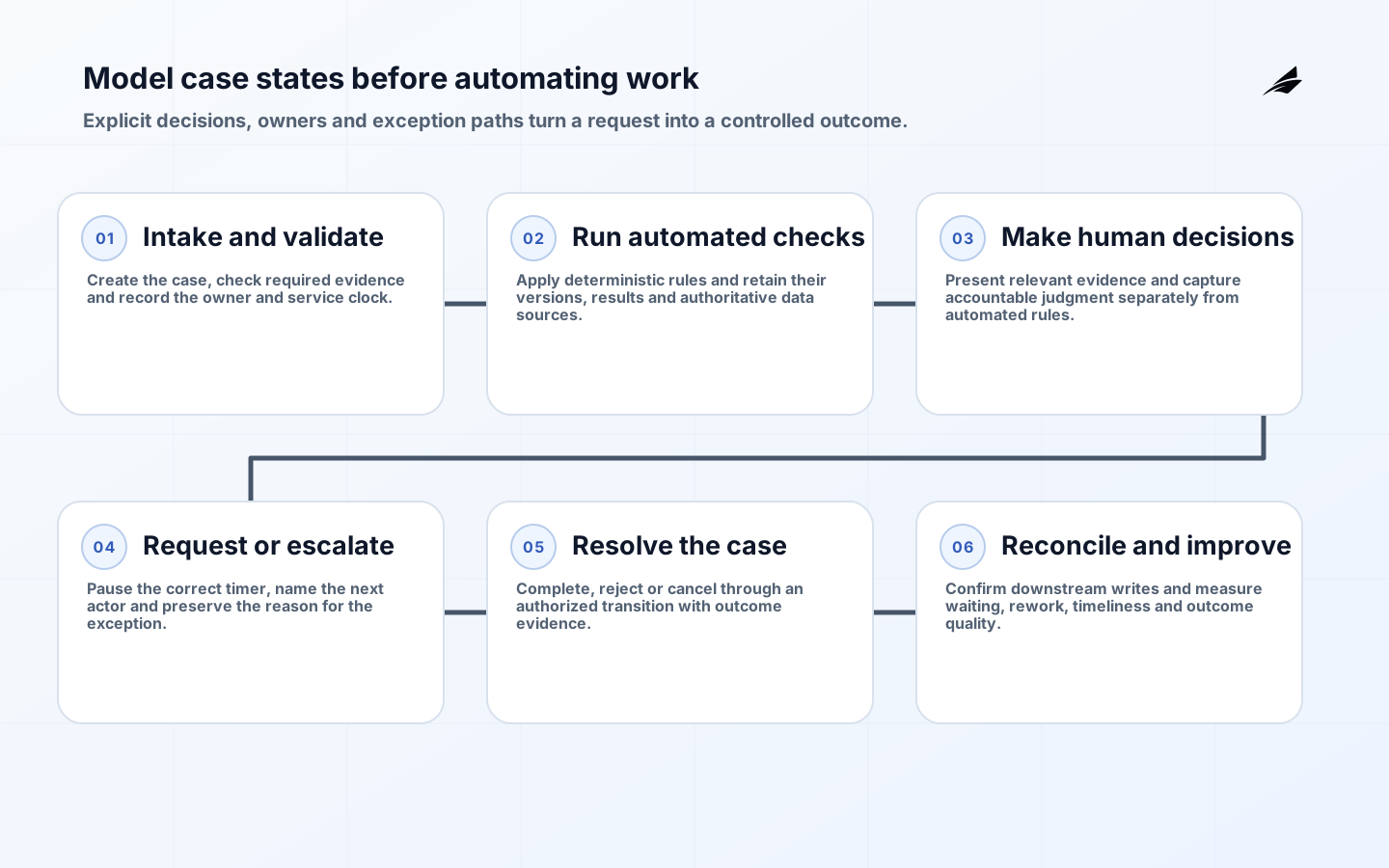
Business workflow software coordinates work that moves through people, rules and systems. The useful unit is not a form or notification; it is a case that reaches a valid outcome with clear ownership and evidence. Before comparing low-code, BPM, case-management or custom options, teams should understand states, decisions, exceptions, service expectations and systems of record. Automating an unclear process usually makes its ambiguity faster and harder to correct.
The first design artifact should state the operating outcome: Reduce avoidable delay and lost handoffs while preserving judgment, exceptions, auditability and change control. Translate that promise into named records, decisions, controls and measures. Tool selection becomes easier when vendors and implementation teams must demonstrate the difficult exception, the unavailable dependency and the recovery path rather than only the happy path.
Define scope in business and risk terms
Observe case workers, approvers, requesters, operations and audit staff handling representative work from intake to closure. Compare the documented process with rework, escalations and spreadsheet side channels. Choose a first workflow with a clear case owner and measurable waiting time. Record policy ambiguities, exception volumes, integration uncertainty and decisions that must remain human before configuring a platform.

- Observe representative cases, including rework, rejection, escalation and cancellation.
- Define the case record, states, allowed transitions, owners and completion evidence.
- Separate deterministic rules from human judgment and policy decisions.
- Name authoritative systems and integration behavior for every write.
- Set queues, priorities, delegation, absence and service-level rules.
- Measure elapsed time, waiting, rework and outcome quality from the first release.
Design the lifecycle, decisions and boundaries
Define business states, allowed transitions, owners, required evidence, timers and terminal outcomes. Authorization should govern who may perform each transition on a particular case. External effects need idempotency and durable status; a timeout should route to reconciliation rather than assume failure. Human queues require assignment and concurrency control so two workers do not act on the same case unknowingly.
| Area | Question | Practical design |
|---|---|---|
| Structured workflow | Stable sequence and rules | Repeatable approvals or fulfillment |
| Case management | Path depends on evidence and judgment | Investigations, complaints or complex service |
| Rules engine | Many explicit, changeable decisions | Eligibility or routing policy |
| Integration orchestration | Work spans reliable system calls | Cross-system fulfillment with retries |
| Custom application | Experience or domain behavior differentiates | Specialized workflow with product-level UX |
Resolve implementation details early
Assign ownership for the process model, decision rules, case data, integrations, queue operations and reporting definitions. Keep production records out of development while testing realistic volumes and exceptions with synthetic cases. Document rule versions, retention, delegation, holiday calendars, notification delivery, regional obligations, recovery objectives and how in-flight cases behave during a deployment or dependency outage.
For a supplier onboarding case, intake validates required identity and tax fields, screening runs asynchronously, reviewers see one queue, exceptions request specific evidence and approval records the authority used. A duplicate submission does not create a second supplier because the integration uses an idempotency key. Rejected, withdrawn and timed-out cases remain explainable rather than disappearing from a dashboard.
Build security, privacy and accessibility into acceptance
Threat-model unauthorized case access, approval bypass, rule manipulation, malicious attachments and support overrides. Apply least privilege by case relationship and transition, and separate request, approval and high-impact administration where warranted. Minimize collected data and enforce retention. User tasks need accessible labels, focus, error correction and keyboard operation; delegated actions and overrides must leave attributable history.
Roll out with observable gates
- Baseline the current outcome, delay, failure demand and risk before changing the process.
- Build a thin end-to-end path and test contracts, permissions, telemetry and recovery.
- Run in simulation, shadow or limited-production mode where the control permits it.
- Release to a named cohort with an owner, support coverage, stop conditions and rollback steps.
- Review technical signals and business outcomes together; investigate segment differences.
- Expand only when exceptions are handled reliably and operating documentation matches reality.
- Retire the previous path, credentials, jobs and access after evidence and retention needs are satisfied.
A workflow release gate should demonstrate normal completion plus rejection, rework, cancellation, timeout, escalation and reconciliation. Verify rule versions, permissions, queue ownership, notifications, audit history and recovery of in-flight cases. Pilot with a bounded team and stop intake if exception queues become unsafe. When external actions cannot be rolled back, define compensation and manual resolution before expansion.
Risks and measures
| Risk | Response | Evidence to watch |
|---|---|---|
| Automating waste | Process observation and outcome definition | Removed steps and exception rate |
| Hidden exceptions | Explicit states, queues and escalation | Cases outside normal flow |
| Duplicate effects | Idempotency and reconciliation | Duplicate writes |
| Rule confusion | Owned versions and decision tests | Overrides and disputed outcomes |
| Vendor dependence | Exportable models, data and interface contracts | Restore and portability exercises |
Track end-to-end elapsed time, active handling, waiting by state, queue age, rework, exception routing, rule overrides, duplicate effects and outcome quality. Faster completion can reflect premature rejection, while fewer exceptions may mean cases disappeared. Segment by case type and responsible queue, then review sample outcomes with workers. Combine process measures with customer and control consequences.
Operate the capability after launch
Name a workflow owner with authority over the process and clear technical owners for the platform and integrations. Review aging cases, delegation, rule changes, override patterns, reconciliation differences and inaccessible tasks. Exercise a stuck queue, unavailable target system, erroneous eligibility rule and urgent exception. Update the process model, staffing rules and runbook together rather than treating every problem as software.
Operational details that determine reliability
A workflow state should express a business condition, not the screen a user last visited. Define who may cause each transition, required data, resulting obligations and terminal outcomes. Keep a complete transition history. Avoid a single generic “in progress” state when operators need to distinguish waiting for customer, waiting for a system, queued for review and actively being handled.
Human queues need product design. Show priority and due basis, prevent two people from unknowingly acting on the same case, support assignment and delegation, and make absence visible. Escalation should route responsibility rather than merely send more notifications. Measure queue age and time waiting separately from active handling so managers can address capacity, policy or dependency constraints.
Rules should have readable inputs, outputs, versions, owners and effective dates. Test boundary values and representative past cases before activation. When a rule changes, decide whether open cases use the old or new version and retain the decision used for each outcome. DMN can provide a standard notation for decisions, but governance and understandable policy remain necessary regardless of engine.
Integration failures should become managed case states. A timeout does not prove an external write failed, so query status before retrying when the target supports it. Use idempotency keys and durable outboxes for important effects. Reconciliation should compare expected and actual records and route differences to an owned queue. This turns silent drift into visible work rather than another spreadsheet.
Procurement and architecture review should use scenario-based evidence for business workflow software, workflow automation, business process management. Ask each proposed solution to perform the representative case, reject an unauthorized action, survive an unavailable dependency, expose an understandable status, produce investigation evidence and export the owned data. Record configuration and integration work needed to achieve the demonstration. A feature visible in a product list is not proof that the complete control or journey will operate in the organization’s environment.
Acceptance should connect design claims to repeatable evidence. For structured workflow, retain tests or records that show repeatable approvals or fulfillment. For the risk of automating waste, assign the response before launch and review removed steps and exception rate. Add load, recovery, permission and accessibility evidence in proportion to impact. The release decision should identify residual risks, their owners and the conditions that would pause further rollout.
Key takeaways
- Start from a complete business outcome and the evidence needed to trust it.
- Make identity, authority, state, exception handling and ownership explicit.
- Design failure, recovery and reconciliation before expanding volume.
- Roll out to controlled cohorts with measurable gates and practiced rollback.
- Treat configuration, policy, access and retirement as continuing product work.
FAQ
Should we buy a product or build?
Compare low-code, BPM, case-management and custom options against process variability, human work, rule complexity, integration guarantees, accessibility, audit and model portability. A standard engine can accelerate timers and queues; custom software may fit a differentiated domain experience. Include licensing at expected users and volume, upgrade constraints, data and model export, operator skills and replacement of proprietary connectors.
What belongs in the first release?
Pilot one complete case type with meaningful exceptions and an accountable operating team. Configure intake, validation, assignment, decision, integration, notifications, history, escalation and reconciliation. Run old and new paths in a controlled comparison where possible, without duplicating external effects. A form that sends email is not proof that the workflow can manage state and recovery.
How should success be measured?
Measure cycle and wait time by state, queue age, completion quality, rework, exception rate, rule overrides, duplicate or missed effects, support demand and user accessibility. Define clock pauses and terminal outcomes so reports cannot be gamed. Automation percentage is not inherently valuable; an automated decision that produces more appeals or manual repair has moved work rather than removed it.
When can the old process be retired?
Retire the old workflow after all open cases are completed or migrated with preserved history, integrations and reports use the new state model, and users no longer rely on shadow queues. Stop scheduled imports, mailboxes, spreadsheet trackers and obsolete service accounts. Reconcile expected records, archive according to policy and monitor for new work arriving through the former intake path.
Conclusion
Business workflow software creates value when case state, responsibility, decisions and exceptions become visible and manageable. Careful modeling, accessible human tasks, reliable integrations, versioned rules and owned queues matter more than drawing an ideal flow. A representative pilot should prove difficult paths and reconciliation before scale, then close the informal channels that would otherwise fragment the process again.