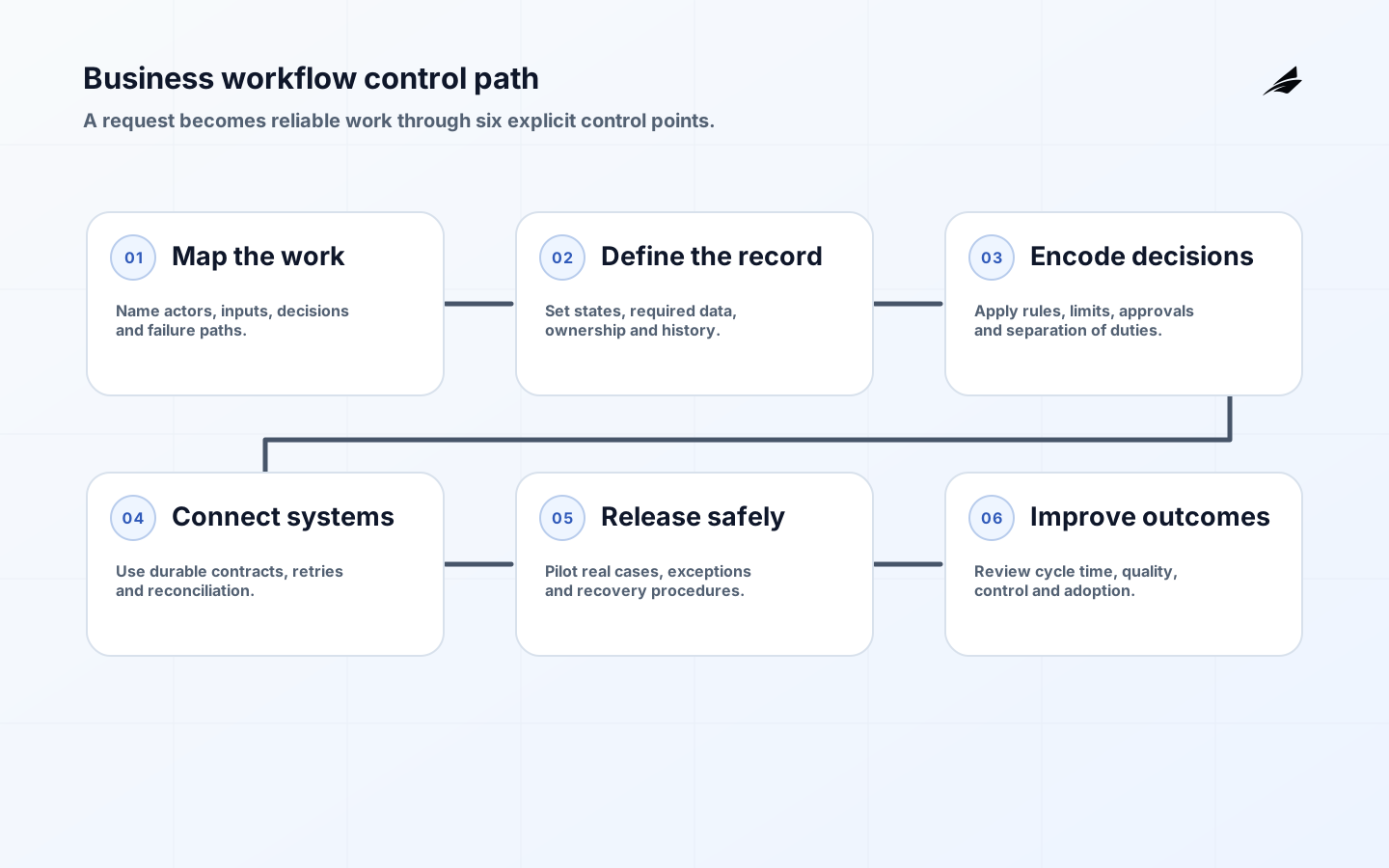
Business workflow software turns recurring work into explicit records, decisions and handoffs. A successful implementation does more than reproduce an email chain on a new screen: it defines what can enter the process, who may decide, how exceptions are resolved, what downstream systems receive, and which evidence proves the process operated as intended. This business workflow software implementation checklist gives product, operations, security and engineering teams a shared route from discovery to controlled rollout.
Start with the companion business workflow software guide for product selection and use the business workflow software FAQ to resolve ownership questions. Teams adding machine-assisted decisions should also review the AI workflow automation delivery plan and its implementation checklist. The same core rule applies throughout: automate a well-defined decision, not an unexplained habit.
1. Discover the real workflow before configuring software
Observe representative cases from request to closure, including returns, cancellations, delegation, missing data and system outages. Interview the people who perform and receive the work, then compare their account with timestamps from existing systems. Policy describes the intended path; records reveal the actual one. Capture triggers, actors, inputs, outputs, deadlines, decision criteria, sensitive fields and every place work leaves the official channel. Do not treat a diagram as complete until a frontline user can locate the awkward cases they handle each week.
Use the BPMN 2.0.2 specification when a portable process notation will help business and technical teams distinguish events, activities, gateways and participants. The implementation does not need every BPMN symbol, but it does need semantic precision. Separate a business state such as Awaiting risk review from a user-interface label such as In progress. Define the event that enters and exits each state, who can cause it, validation rules, timers and the next permitted states.
| Discovery artifact | Questions it must answer | Acceptance evidence |
|---|---|---|
| Case inventory | Which normal, exceptional and failed cases occur? | Sample records cover each material path |
| Actor map | Who requests, reviews, approves, fulfills and audits? | Named roles and accountable owners |
| Decision catalog | Which rule or judgment changes the route? | Inputs, authority and result recorded |
| System map | Where are source, master and reporting records? | Interfaces and data ownership agreed |
| Service baseline | How long, how often and how accurately does work run? | Measured volume, aging and rework |
2. Design the workflow record and decision model
Create one durable case identifier and a state history that records the prior state, new state, actor or service identity, timestamp, reason and relevant rule version. Store business facts separately from transient presentation data. An approval should reference the amount, currency, policy, cost center and evidence the approver saw; it should not be represented only by a mutable Boolean field. Preserve comments and attachments under retention and access rules appropriate to their content, and decide whether corrected requests create a new version or a new case.

Model rules in an ordered decision table before encoding them. Make precedence explicit when several rules match. Include a default route for no match and a controlled response for missing or contradictory inputs. Parallel approvals must define whether all responses, a quorum or any authorized response completes the step. Sequential approvals need a clear restart policy when data changes after an earlier approval. Microsoft documents sequential, parallel and request-level approval behavior; regardless of platform, verify the exact semantics with test cases rather than inferring them from a workflow designer.
3. Build identity, authority and audit controls into the path
Assign permissions to roles or attributes that reflect work, and provision those assignments from an authoritative identity source. Requesters should not approve their own controlled transactions. Administrators who configure routing should not silently complete business approvals. Emergency access should be time-bound, attributable and reviewed. NIST SP 800-171 Revision 3 calls for least privilege, restriction of privileged accounts, logging of privileged functions and defined audit records; those practices translate directly to workflow administration and exception handling.
Create an authority matrix using transaction type, value, legal entity, geography, risk and conflict conditions. Resolve the approver at the moment the task is created and record both the rule and resolved identity. Define substitution before absence occurs, with start and end dates and prohibited combinations. Treat rejection, return for information, cancellation, reassignment and override as distinct events. NIST SP 800-53 Revision 5 provides control families for access, audit, configuration, contingency and system integrity that can structure the control review without turning the workflow into a compliance-only exercise.
4. Integrate systems with replay and reconciliation
For each interface, name the system of record, data contract, authentication method, delivery guarantee, timeout, retry policy and reconciliation owner. Use idempotency keys so a retried approval does not create two purchase orders or payments. Include a correlation identifier across workflow, integration and destination logs. If an external write succeeds but its response is lost, query the destination before retrying. Move irrecoverable messages to an owned exception queue with enough context to repair and replay them; never make an operations team reconstruct intent from an opaque error code.
Version events and APIs compatibly. Consumers must tolerate additive fields, while breaking changes require a migration plan. Protect secrets in a managed store and rotate them without redesigning the flow. Instrument request count, latency, failures, retries and queue age using a consistent telemetry model; the OpenTelemetry specification provides vendor-neutral conventions for traces, metrics and logs. Reconcile business totals as well as technical delivery: ten successful API calls do not prove that ten approved invoices posted with the expected amounts.
| Test layer | Required scenario | Release signal |
|---|---|---|
| Rules | Every boundary value, precedence case and no-match route | Expected route and explanation match |
| Permissions | Self-approval, stale role, substitution and admin access | Unauthorized action denied and logged |
| Integration | Timeout, duplicate, partial failure and schema change | No loss or duplicate business effect |
| Workflow | Return, cancel, edit-after-approval and escalation | State and authority remain valid |
| Operations | Alert, replay, backup and restoration | On-call team completes the runbook |
| Accessibility | Keyboard, focus, names, errors and responsive layouts | Target conformance verified manually and automatically |
5. Test exceptions and roll out by measurable risk
Build tests from the case inventory, not from screen count. Unit-test deterministic rules; contract-test every integration; exercise the complete workflow with production-like identities, time zones and data volumes. Test timers without waiting days by controlling the clock. Verify that notifications contain enough context but do not expose sensitive records in email. Accessibility testing must include human keyboard and assistive-technology checks because WCAG 2.2 is designed for combined automated and human evaluation; use the WCAG 2.2 Recommendation as the acceptance reference.
Pilot one bounded process, team or transaction class with real work and a staffed fallback. Define rollback as an operational procedure: how new cases stop entering, how in-flight cases are completed or migrated, and how downstream systems are reconciled. Train approvers on decision criteria and exceptions, not merely button locations. Publish support routes and ownership. Expand only after the pilot demonstrates complete records, correct routing, acceptable queue aging, reliable integrations and manageable exception volume over a representative business cycle.
6. Operate the workflow as a business service
Measure outcomes with stable definitions and denominators. Cycle time should show medians and upper percentiles by case type, excluding only documented pauses. First-pass completion means a case reached its intended outcome without a return or manual repair. Track queue age, reassignment, override, integration replay, abandoned requests and control conflicts. Segment results by route and team to locate design problems, but restrict analytics where small groups or sensitive fields create privacy risk. A faster process is not better if it increases improper approval or downstream rework.
Give a named product owner authority over the process model and a technical owner responsibility for reliability. Review rules and authority matrices after policy, organization or system changes. Expire temporary exceptions automatically. Sample completed cases against source evidence and downstream results. Maintain a versioned change log and test pack so an apparently small routing edit receives proportionate review. Quarterly, remove unused fields and routes, challenge manual workarounds, and decide whether automation still serves the business objective that justified it.
Key takeaways
- Model real cases, exceptions and decisions before selecting configuration primitives.
- Store state changes, authority, evidence and rule versions as durable business history.
- Apply least privilege, separation of duties and controlled substitution to workflow roles.
- Design integrations for idempotency, replay, reconciliation and observable ownership.
- Pilot with real work and expand only when outcome, reliability and control measures agree.
Frequently asked questions
Should we build or buy business workflow software?
Buy or configure when the process fits supported states, rules, integrations and controls and the vendor meets portability and operating needs. Build when the workflow is a differentiating product capability or requires interaction, scale or decision semantics a platform cannot safely express. Compare total ownership, including governance, testing, observability, upgrades and exit, rather than license cost against initial development cost.
Should every step be automated?
No. Automate deterministic, repeatable work where inputs and recovery are understood. Keep human judgment where context, material impact or ambiguous evidence matters, but improve the decision screen and record the reason. A manual checkpoint should be a deliberate control with service expectations, not an unmeasured gap between systems.
How long should a pilot run?
Long enough to encounter representative volume, deadlines, absences, exceptions and period-end behavior. A low-volume workflow may need a full monthly or quarterly cycle. Set case-coverage and outcome criteria in advance instead of declaring success after a fixed number of days with no visible incident.
Conclusion
A dependable business workflow implementation makes work legible. It joins a precise case model, accountable decisions, secure authority, resilient integrations and outcome-based operations. Follow the checklist with real records and exception tests, and the software can reduce delay without concealing the judgment and control the business still needs.