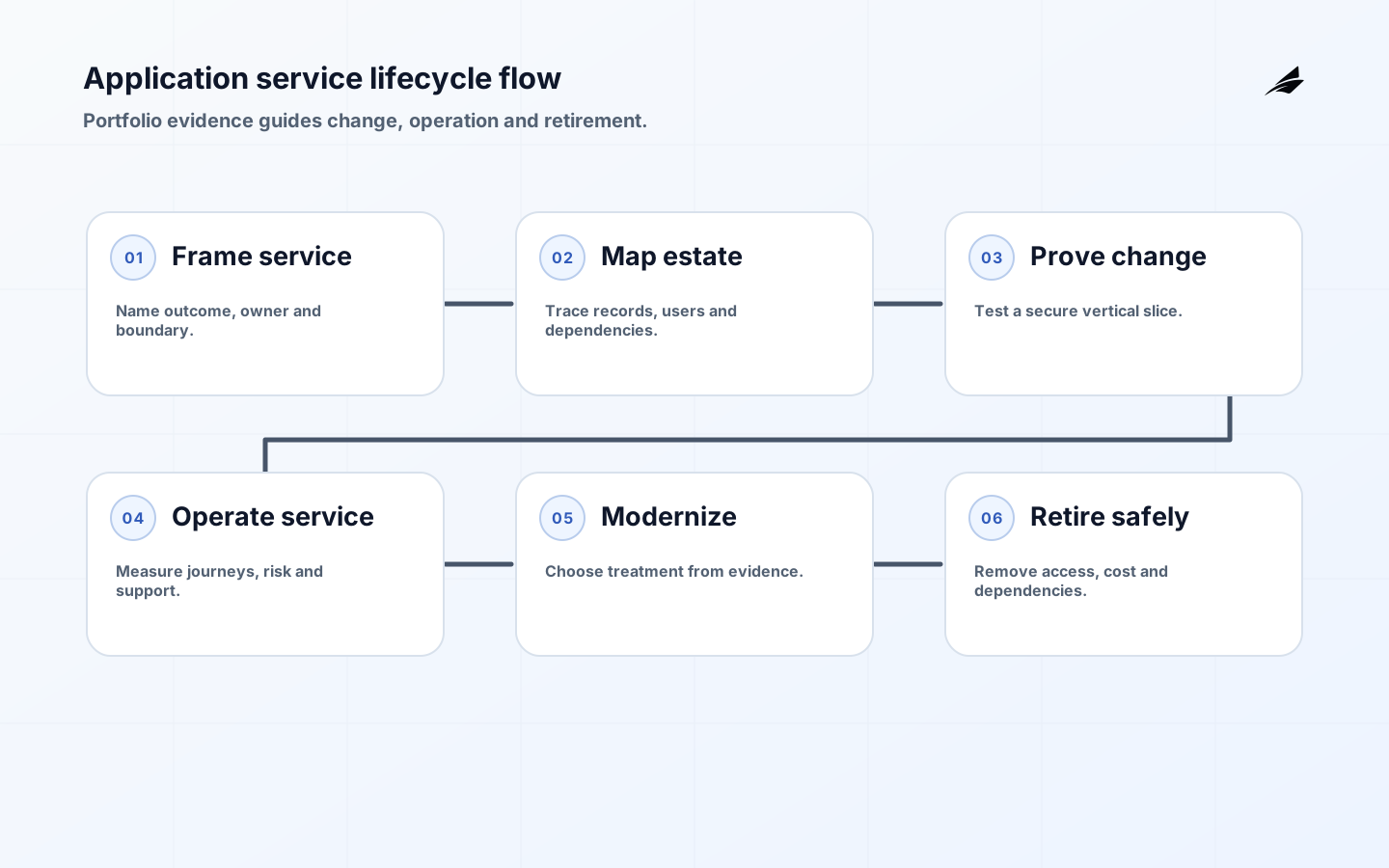
Application services and solutions should turn a mixed application estate into a set of owned business services, not a larger ticket queue. The operating model covers portfolio decisions, product change, integrations, security, reliability, support, cost and retirement. Its unit of management is a user or operational outcome: an order accepted, a claim resolved, a supplier onboarded or a payment reconciled. Each outcome needs an accountable owner, authoritative records, measurable service expectations and a route for exceptions. That service view prevents teams from optimizing code while a broken handoff, unsupported dependency or ambiguous data owner continues to determine the real experience.
A useful starting point is the enterprise application services scope guide, which goes deeper on sourcing boundaries. This guide focuses on the lifecycle operating model: how to choose work, make controlled changes, run the service and retire what no longer earns its risk and cost. It applies whether delivery is internal, outsourced or shared. The organization can delegate activity, but it cannot outsource accountability for business outcomes, access decisions, continuity obligations or the evidence used to accept risk.
1. Define the service and portfolio boundary
Inventory applications by business capability and journey rather than by server or vendor. For each service, record the owner, users, critical periods, systems of record, sensitive data, dependencies, support route, recovery expectations, contracts and end-of-support dates. Then trace a representative transaction from trigger to durable outcome, including manual queues and scheduled jobs. This reveals duplicate capability and hidden coupling. It also distinguishes an application that can be retired from one that merely looks inactive while still supplying a monthly extract or emergency lookup.

Prioritize with consequence and evidence. A fragile application supporting a regulated or revenue-critical journey deserves attention even if change volume is low. A fashionable rewrite with no measurable user or operating gain does not. The enterprise digital solutions modernization guide explains how to avoid a big-bang replacement. Use a short service charter to state the outcome, baseline, scope, exclusions, decision rights and first uncertainty to test.
| Portfolio question | Evidence to collect | Decision enabled |
|---|---|---|
| What does the service accomplish? | Journey, volume, failure consequence and owner | Invest, tolerate, replace or retire |
| Where is business truth held? | Record map, reconciliation and data steward | Integration and migration boundary |
| What can interrupt the outcome? | Dependency map, incidents and support history | Resilience priority |
| Who can act? | Role model, privileged paths and review evidence | Access redesign |
| What does it cost? | Labor, licenses, hosting, suppliers and change demand | Lifecycle funding |
| Can it exit? | Export, retention, contract and decommission constraints | Retirement sequence |
2. Design architecture and controls together
Map channels, workflow, domain services, integration, authoritative data and platform dependencies. Define trust boundaries and enforce authorization at the protected action, not only in the interface. Repeated requests need idempotency; asynchronous work needs durable state and correlation; partial transactions need compensation or reconciliation. Treat files, messages, browser input, partner responses and model output as untrusted. These patterns are less glamorous than a target-state diagram, but they determine whether operators can understand and recover the business process.
Use the NIST Secure Software Development Framework to organize preparation, software protection, secure production and vulnerability response. The OWASP ASVS provides testable web-application requirements and can inform contracts and acceptance. Neither selects controls automatically. Teams must tailor verification to data, exposed functions and failure consequence, then record exceptions with an owner, expiry and compensating evidence.
3. Build a repeatable delivery system
A service team needs client-visible demand, version-controlled source and configuration, reproducible builds, reviewed changes, automated checks, separated environments, protected artifacts and controlled release. NIST SP 800-204D describes supply-chain security strategies for CI/CD pipelines, including provenance and artifact concerns. Apply those controls to vendor packages and low-code configuration as well as custom code. The release record should identify what changed, evidence produced, approvals, deployment target and rollback or forward-recovery route.
Deliver a narrow vertical slice through real identity, data, integration, telemetry and support. Include an awkward case and a dependency failure. Expansion gates should use evidence: target users complete the journey, unauthorized paths fail, support can diagnose the transaction, recovery has been exercised, and cost is within the forecast range. The AI-led application services guide adds model-specific evaluation where AI assists development or operations.
4. Operate around service objectives and evidence
Define a small set of service-level indicators that describe the user outcome: successful completion, latency, correctness, freshness or durability. Google SRE guidance distinguishes an indicator from its objective and from an agreement with consequences; its SLO chapter also stresses choosing measures users care about. Infrastructure uptime alone can miss a journey stalled by a queue or an incorrect downstream record. State the population, measurement window, exclusions and source for every indicator.
Instrument requests and jobs so operators can move from symptom to affected transaction without exposing confidential payloads. OpenTelemetry signals cover traces, metrics, logs and baggage; consistent context makes them more useful together. Alerts should represent actionable service risk, while dashboards support diagnosis and trends. Run incident reviews without blame, track corrective work to completion and test restore, reconciliation and supplier escalation under realistic permissions.
| Operating evidence | Useful measure | Decision it should change |
|---|---|---|
| User outcome | Successful journeys by cohort and critical period | Release or reliability priority |
| Change system | Lead time, failed change recovery, change failures and rework | Delivery improvement |
| Service health | Latency, error, freshness and dependency budget | Capacity or resilience action |
| Security | Privileged use, unresolved vulnerabilities and control failures | Risk treatment |
| Support | Demand, repeat incidents, escalation age and workaround use | Problem elimination |
| Portfolio | Unit cost, unsupported exposure and retirement progress | Funding and decommission |
5. Fund lifecycle cost and govern suppliers
Separate discovery, transition, recurring operation and exit. Include product ownership, subject-matter review, security assurance, test data, parallel running, support, licenses, cloud use, migration and decommissioning. Reforecast after discovery and the first production slice. A cheaper build that creates opaque operations, proprietary configuration or permanent supplier dependence can have the higher lifecycle cost. Measure cost per useful business transaction or supported user where possible, while explaining shared-cost allocation.
Contracts should identify service outcomes, responsibility boundaries, access controls, incident cooperation, vulnerability handling, subcontractors, data use, intellectual property, audit evidence, transition support and deletion. Keep code, configuration, credentials, architecture decisions and operational evidence in organization-controlled systems. The Tanzu services enterprise guide offers related platform sourcing questions, but the same principle applies broadly: supplier performance must be observable and exit must be practicable.
6. Modernize and retire with proof
Choose modernization treatment per service: retain with controls, rehost, replatform, refactor, replace or retire. The label is less important than the assumptions. Wrapping a legacy system can create a useful boundary quickly but preserves its capacity and recovery constraints. Consolidation reduces duplicate capability but may enlarge a failure domain. Record why the treatment fits, what evidence would reopen the decision and which old cost or risk disappears after transition.
Coexistence requires an owner, reconciliation rule and end condition. Before migration, decide how records map, which system is authoritative at each stage, how rollback works and how users handle in-flight work. Retirement evidence includes zero authorized traffic, completed retention and legal checks, exported records, revoked access, removed integrations, terminated infrastructure and closed contracts. A new application is not value if the old one remains fully funded and reachable indefinitely.
Govern the model with a monthly service review and a less frequent portfolio decision. The service review should join product, operations, security and supplier evidence around incidents, change demand, unresolved risk and user outcomes. DORA's current delivery metrics history is useful context for throughput and instability trends, but those measures need service outcomes beside them. The portfolio review asks whether the application still deserves investment compared with consolidation, replacement or retirement. Record decisions and dates so temporary exceptions do not become permanent architecture.
Key takeaways
- Manage business services and outcomes, not isolated applications or supplier activity.
- Map records, identities, dependencies and exceptions before selecting a modernization treatment.
- Integrate secure development, release evidence and operational readiness in one lifecycle.
- Measure user journeys alongside delivery, security, support and lifecycle cost.
- Keep organization control of essential artifacts and make supplier exit testable.
- Treat verified retirement as part of value delivery, not an optional cleanup phase.
Application services and solutions FAQ
What belongs in application services and solutions? Portfolio management, product change, architecture, integration, testing, release, security, reliability, support, cost management and retirement can all belong. The exact boundary should be explicit, with named owners for work that remains outside it.
Should one provider manage the whole application estate? It can simplify coordination, but concentration also increases dependency and can weaken comparative evidence. Retain architecture authority, service measurement, critical access and exit capability. Use workload-specific partners when specialization or independence matters.
How should application service performance be measured? Start with successful user outcomes, correctness and recovery. Add delivery, control, support and cost measures that drive decisions. Avoid a single blended score that hides a failing critical journey.
When is an application ready to retire? After required records are retained or migrated, dependencies are removed, users have a working replacement or approved process, access is revoked, and monitoring confirms the old path is no longer used.
Conclusion
Application services and solutions create value when they make an enterprise estate easier to change, safer to operate and cheaper to understand. Build the model around owned business services, secure delivery, measurable reliability, transparent lifecycle cost and deliberate retirement. Start with one consequential journey, prove a vertical slice under realistic failure, and expand only when users and operators can explain the evidence. That discipline turns application management from reactive maintenance into a continuing portfolio decision system.