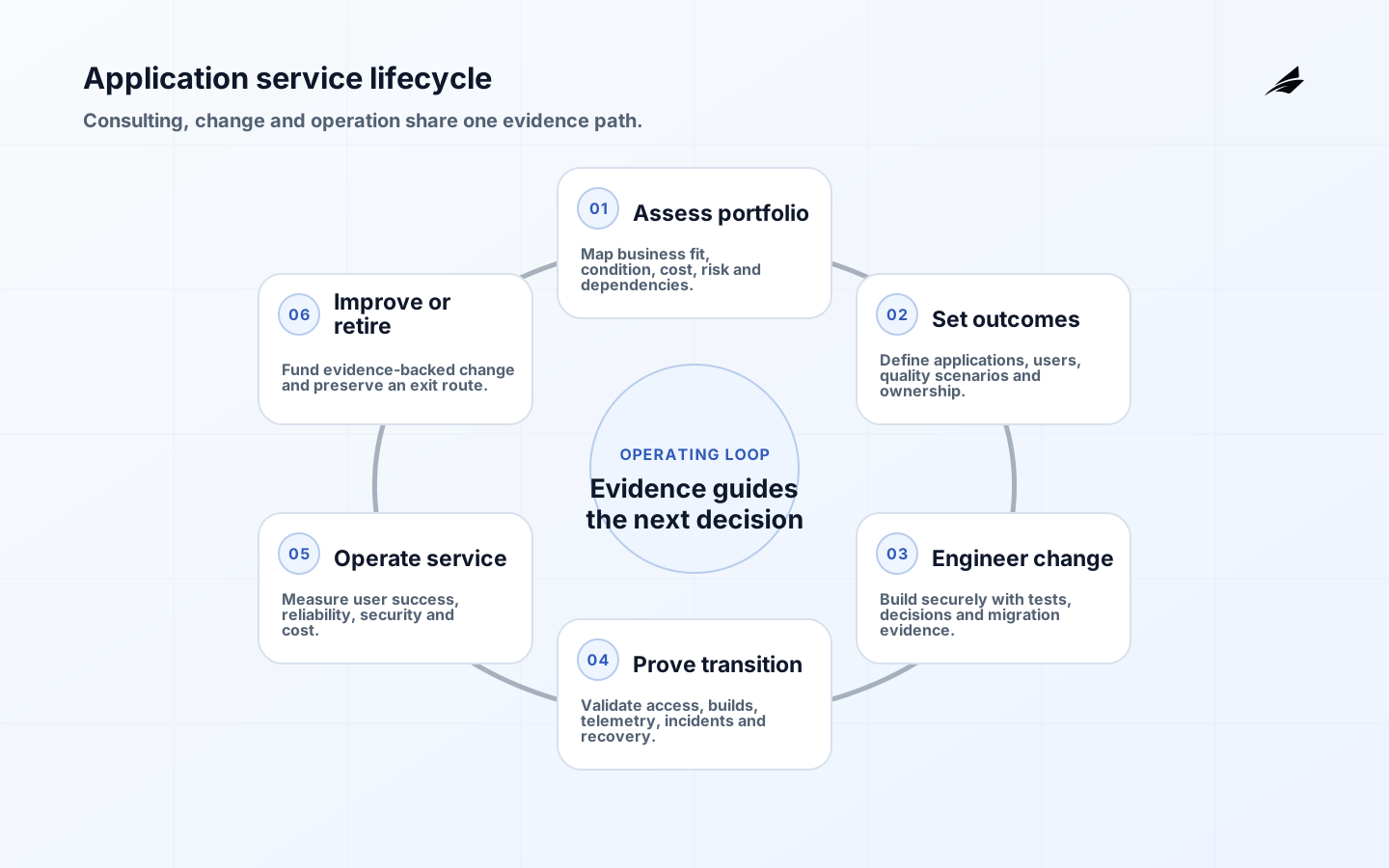
Consulting application services combine advice and delivery across an application portfolio: discovery, architecture, modernization, integration, testing, transition, support and improvement. Providers use the label differently, so buyers should evaluate the operating result rather than a service catalogue. The central question is which applications and outcomes the provider will own, with what authority, evidence and handoffs.
Use this FAQ alongside the consulting application services checklist, the application management transition checklist and the application management FAQ. Together they help turn a broad proposal into a governable delivery model.
What do consulting application services include?
Typical scope includes portfolio assessment, product and architecture advice, custom development, package configuration, cloud migration, API integration, data conversion, quality engineering, security, DevOps, observability and managed support. Separate advisory deliverables from build and run responsibilities. A provider may recommend modernization but lack authority to change the network, data source or business policy creating the constraint. Record dependencies and customer obligations in the plan.
Define scope by named applications, environments, interfaces, business hours, data classes and service outcomes. Include backlog ownership, minor enhancement boundaries and out-of-hours obligations. Inventory source code, licenses, pipelines, credentials, documentation, known defects and supplier dependencies during discovery. An application list without business criticality or ownership cannot support sensible service levels.
| Service layer | Provider output | Customer decision |
|---|---|---|
| Portfolio | Condition, cost, risk and dependency evidence | Invest, tolerate, modernize or retire |
| Engineering | Tested software, configuration and deployment evidence | Priority, acceptance and residual risk |
| Operations | Monitoring, incidents, changes and service reporting | Business priority and interruption authority |
| Security | Threat analysis, fixes and vulnerability evidence | Risk tolerance and exception approval |
| Improvement | Outcome trend and prioritized improvement backlog | Funding and product direction |
How should scope and outcomes be written?

Start with business service outcomes such as order completion, case turnaround or claims availability. Map applications and dependencies to those services. Define quality with scenarios: peak load, dependency failure, privileged task, data correction, deployment and recovery. Avoid measuring only tickets or sprint velocity. A provider can close more tickets by splitting work or reducing investigation while user impact remains unchanged.
Create acceptance criteria for deliverables and operation. Architecture advice should include options, assumptions, trade-offs and decision records. Software should include code, tests, dependency evidence, runbooks and ownership. Operations should demonstrate detection, escalation, recovery and reporting. State which customer decisions and access must arrive by when; mutual dependencies should be measurable without allowing either party to excuse chronic delay.
How does a provider choose what to modernize?
Assess business fit, technical condition, operating cost, security exposure, change demand and dependencies. Retain stable systems that meet needs; retire duplicate capability; rehost only when infrastructure change creates sufficient value; refactor or replace where constraints block outcomes. A fashionable architecture is not itself a business case. Test the highest-risk assumption with a thin slice before committing an entire portfolio.
Preserve semantic and operational evidence during migration. Profile source data, define record authority, reconcile transactions and rehearse cutover. Plan coexistence when old and new systems both serve work. Include rollback handling for data created after release. Modernization is incomplete if the new platform still depends on undocumented jobs, manual reconciliation or a legacy system no one is funded to support.
Who owns application security?
The customer owns risk and provider oversight; the provider owns contracted engineering and operational practices. Allocate threat modeling, identity design, code review, dependency management, testing, vulnerability response, secrets, logging and incident actions. The NIST SSDF offers high-level secure development practices that can be integrated into different lifecycles. Require evidence in normal delivery rather than a security report at project end.
CISA Secure by Design emphasizes customer security as a core product requirement. Apply that principle to consulting work: safe defaults, reduced privileged access and actionable logs should not be expensive extras. For test depth, the OWASP ASVS can support application-specific verification requirements. Select controls from threat and impact rather than demanding every test indiscriminately.
What should happen during transition?
Transition should prove the provider can operate, not just receive documents. Shadow current teams, reconcile the application estate, validate access, ingest telemetry, reproduce builds, deploy a low-risk change, handle a simulated incident and restore representative data. Create a dated gap register for missing code, unsupported components and absent runbooks. Do not accept responsibility transfer until critical gaps have owners and interim controls.
Protect knowledge continuity. Pair provider and customer staff around high-risk services, record decisions in customer-accessible systems and rotate responsibilities. Define key-person replacement and subcontractor approval. A large document repository does not replace practiced understanding. At transition end, test whether a qualified engineer who was not part of discovery can diagnose a failure using the service’s tools and records.
Which SLAs and metrics are useful?
Use service-level indicators tied to user and provider-controlled outcomes: successful transactions, latency, availability at the service boundary, alert-to-triage time, change failure, recovery and vulnerability remediation. Define clock start, pause, severity, exclusions and data source. Separate dependency outages from provider response. Service credits may create accountability, but they rarely compensate business harm and should not replace corrective action.
Review trends and distributions rather than averages alone. A monthly average response can hide a few severe delays. Pair speed with quality: faster release beside escaped defects, faster closure beside recurrence, automation beside user completion. NIST CSF 2.0 can help align security governance and operational evidence across Govern, Identify, Protect, Detect, Respond and Recover.
| Metric | Good definition | Governance use |
|---|---|---|
| Service success | Valid business transactions completed divided by attempted | Prioritize user-impacting reliability |
| Change failure | Releases requiring rollback, hotfix or causing impairment | Improve delivery controls |
| Triage time | Actionable alert available to documented severity | Assess response readiness |
| Recovery proof | Critical scenario restored and reconciled within objective | Challenge resilience assumptions |
| Improvement value | Verified outcome change attributable to released work | Fund the next backlog |
How are application services priced?
Common models include time and materials, fixed deliverables, capacity teams, per-application fees and outcome-linked components. Normalize proposals against portfolio size, complexity, support window, change demand, locations, security requirements, transition effort and third-party costs. Separate transformation from steady operation. A low run fee may exclude enhancement, major incidents, cloud consumption, tools or specialist support.
Use pricing that supports desired behavior. Per-ticket fees can discourage prevention; fixed capacity can hide unused skill; fixed price can encourage narrow interpretation when scope is uncertain. Define assumptions, units, bands, overages and review points. Require transparent subcontractor and tool charges. Compare total cost including customer governance, retained expertise, exit and technical debt, not only the provider invoice.
How should incidents and exit work?
NIST SP 800-61 Revision 3 places incident response within broader risk management. Define customer incident authority, provider actions, evidence preservation, communications, supplier escalation and recovery. Pre-authorize bounded containment and rehearse a serious scenario. Post-incident work should update code, tests, detections and runbooks, not end with a report.
Exit terms should cover repositories, pipelines, configuration, data, logs, tickets, documentation, licenses, credentials and assistance. Keep customer access throughout service and test exports annually. Revoke provider identities and remove agents at completion without destroying evidence. A credible provider should support portability because operational lock-in increases both commercial and resilience risk.
Key takeaways
A useful provider review also includes direct observation: sit with a user, an on-call engineer and a release owner for one representative workflow. Their friction often reveals gaps that aggregate reporting smooths away.
What governance cadence keeps the service useful?
Run weekly or biweekly operational review for major incidents, risky changes, aging vulnerabilities, blocked work and service exceptions. A monthly service review should connect user outcomes, reliability, delivery quality, cost and improvement backlog. Quarterly, reconsider portfolio priorities, architecture risk, supplier concentration, skills and modernization assumptions. Use a shared evidence pack with stable definitions; spending the meeting reconciling provider and customer ticket counts is a sign that the operating data contract is missing.
Decision rights should sit at the right level. Product owners approve workflow priority and acceptance; service owners manage reliability and interruption; security owners set requirements and advise risk; executives fund material portfolio moves. Escalation should resolve cross-team constraints, not pull routine technical decisions into a committee. Keep an action log with owner, due date and expected evidence, and close actions only when the outcome is verified.
What does a strong first ninety days look like?
In the first month, reconcile the estate, establish access, validate builds and observe current operations. In the second, the provider should handle supervised changes and incidents, close critical knowledge gaps and baseline service measures. In the third, it should lead normal operation, exercise recovery and propose an evidence-backed improvement backlog. For a billing application, that may mean tracing a failed invoice from alert through dependency diagnosis, correction, reconciliation and customer impact reporting.
Do not force the same transition schedule on every application. A static intranet and a high-volume payment service need different evidence. Move responsibility by application wave and retain a customer acceptance owner. If access, telemetry or recovery cannot be proved, keep the gap visible and delay transfer or adopt a time-bounded interim control. Declaring transition complete for commercial convenience shifts uncertainty into the first production failure.
- Define service scope through named applications, business outcomes and dependencies.
- Require operating demonstrations during transition, not document transfer alone.
- Integrate security evidence into normal engineering and vulnerability response.
- Pair service speed with user impact, quality and recovery measures.
- Price the full lifecycle and test portability before renewal or exit.
More application services questions
Can all application knowledge be outsourced?
No. The customer needs retained owners who understand business rules, data authority, risk and supplier performance. Providers can supply deep technical capability, but cannot make unaccountable business decisions or accept enterprise risk for the customer.
Conclusion
Consulting application services are valuable when advice, change and operation share one evidence chain. Define boundaries, prove transition, measure business service quality and preserve customer authority. That turns a broad vendor category into an accountable capability for evolving the application estate.