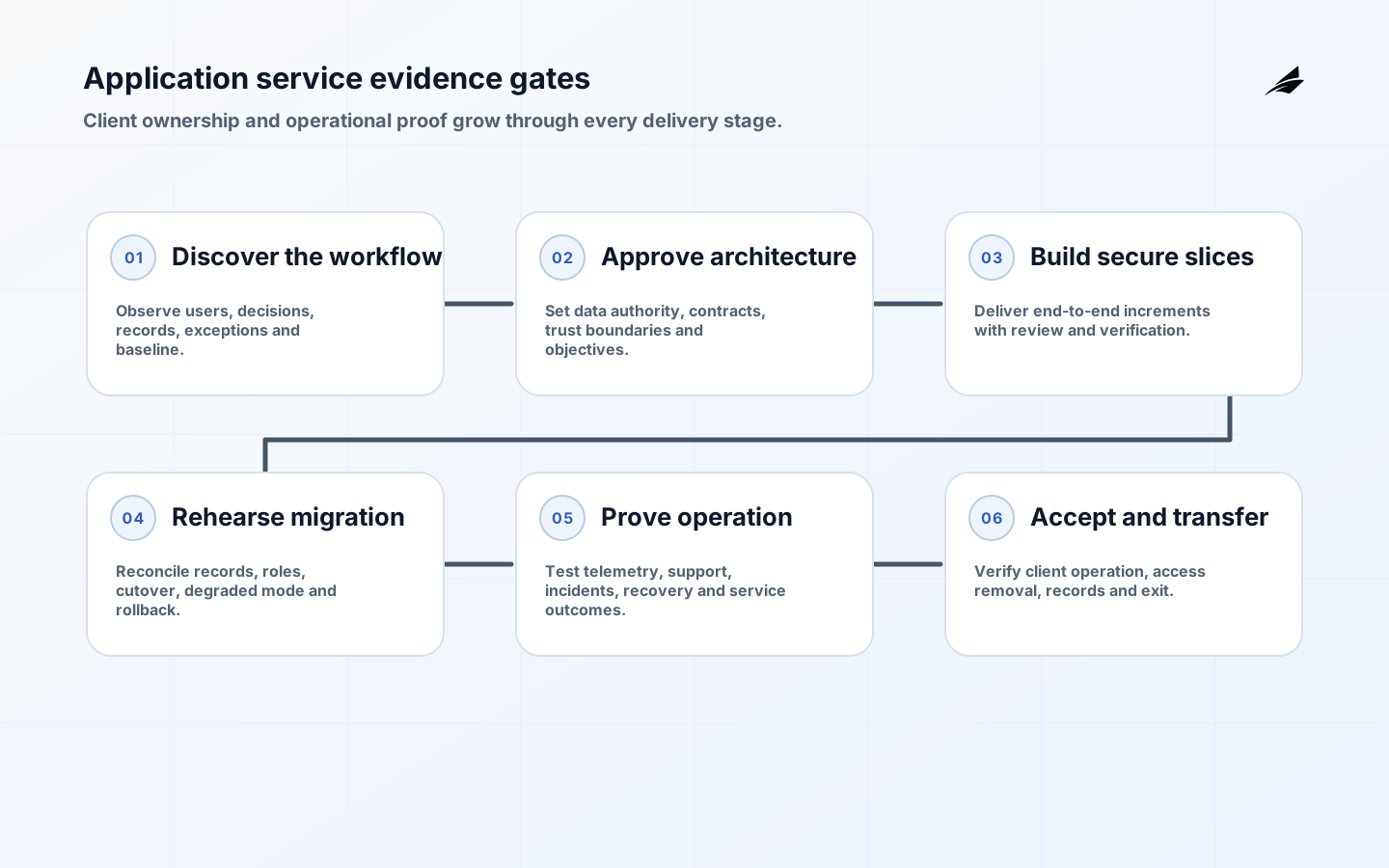
Consulting application services can assess, design, build, modernize, integrate or operate business applications. A successful engagement leaves more than deployed code: it creates an owned workflow, supportable architecture, tested controls, usable documentation and a clean path for future change. This consulting application services implementation checklist turns those outcomes into evidence gates from discovery through service acceptance, reducing dependence on reassuring status reports.
Use it with the consulting application services FAQ and, where distributed ledgers are genuinely relevant, the blockchain application services delivery plan and production blockchain checklist. Preserve the canonical business need when evaluating technology; a new architecture is not an outcome by itself.
1. Complete discovery and outcome definition
Observe the current workflow with the people who perform and support it. Map triggers, records, decisions, handoffs, exceptions, controls and delays. Baseline completed work, error, cycle time, cost and service impact. Define the target cohort and exclusions, then express acceptance as realistic scenarios rather than a feature inventory. Name the executive outcome owner, operational process owner, product owner and technical service owner. Clarify which decisions the consultant recommends and which the client must approve.
Reconcile assumptions about users, volumes, data, interfaces, environments, compliance and client availability. Rank uncertainty and resolve the highest-risk question with evidence: inspect an API, profile a migration sample, test identity integration or prototype a critical interaction. Discovery should end with a decision, prioritized backlog, architecture options, delivery forecast and explicit residual risk. It should not become an indefinite documentation phase or a fixed design that ignores later learning.
| Gate | Required evidence | Owner decision |
|---|---|---|
| Outcome | Baseline, target, users and completed workflow | Is this change worth operating? |
| Feasibility | Tested high-risk assumptions and options | Which architecture and scope proceed? |
| Delivery | Increment plan, dependencies and acceptance scenarios | Are resources and decisions available? |
| Risk | Security, privacy, continuity and change impacts | Which risks are treated, accepted or avoided? |
2. Align the contract with delivery reality
Define deliverables, environments, acceptance, client responsibilities, service levels, intellectual property, open-source handling, data use, subcontractors, expenses, change, pause and termination. Tie payment milestones to accepted evidence where practical. Include access to repositories, pipelines, design records, test results and operational telemetry from the beginning. A final source-code archive does not provide continuity if the client cannot reproduce builds, understand decisions or operate infrastructure.
Create a responsibility matrix for product decisions, data, identity, security controls, releases, incidents and support. Require timely disclosure of material delivery and security issues. CISA's Secure by Demand guide gives buyers useful questions about secure defaults, vulnerability history and manufacturer accountability. Adapt them to the service and require evidence relevant to the actual application rather than accepting a corporate policy as implementation proof.
3. Approve architecture and data boundaries
Document context, components, interfaces, data stores, trust boundaries, deployment topology and critical dependencies. Identify authoritative records and avoid silent multi-master synchronization. Define API schemas, errors, idempotency, timeouts, retry and version compatibility. Select technology based on operating constraints and team capability, not a consultant's preferred stack. Record significant decisions and consequences so later teams understand why a choice was made and which conditions would justify revisiting it.
Design identity, authorization, secrets, encryption, logging, backup, retention and deletion before build. Apply least privilege to users, service accounts and delivery personnel. Separate environments and production duties. Set performance, availability, recovery and accessibility requirements as testable scenarios. WCAG 2.2 requires conformance across complete pages and processes, so include keyboard, zoom, assistive technology and error-recovery journeys in acceptance rather than treating accessibility as a final scan.
4. Build in small, secure end-to-end increments
Deliver thin slices that cross interface, logic, data, integration, security and observability. Demonstrate them with representative roles and data. Keep code, infrastructure, schema and configuration under version control; require peer review and automated unit, integration, contract and security checks. The NIST SSDF defines practices for preparing the organization, protecting software, producing well-secured releases and responding to vulnerabilities. Map those practices to named delivery evidence.
Use a risk-based verification standard. The OWASP ASVS can structure application security requirements, while threat modeling identifies solution-specific abuse paths. Manage dependencies and produce an inventory appropriate to the client's supply-chain needs. Scan without flooding teams with unactionable findings; establish severity, exploitability, ownership, remediation time and exception expiry. Test abuse, authorization and business-logic failures manually where automation is weak.
| Evidence stream | Examples | Release blocker |
|---|---|---|
| Functional | Scenario tests, exception paths and user acceptance | Critical workflow cannot complete |
| Security | Threat model, ASVS checks, dependency and access review | Unaccepted high-impact exposure |
| Data | Reconciliation, lineage, quality and privacy tests | Material records cannot be accounted for |
| Operations | Telemetry, load, recovery and support rehearsal | Service cannot be diagnosed or restored |
| Usability | Accessibility and role-based journey tests | Target users cannot complete essential work |
5. Rehearse migration and organizational change
Profile source data and classify records for migrate, transform, archive or delete. Define mapping, cleansing, reconciliation, cutover delta and rollback rules. Run repeatable trial migrations and compare counts, control totals, relationships and sampled business records. Protect data in transit and restrict migration access. Record every manual correction. The business owner, not the vendor alone, should sign reconciliation because technical totals can match while meaning has changed.
Map role changes, procedures, training and support. Involve frontline users in scenario testing and revise the workflow when the software creates unnecessary work. Train using realistic tasks and exceptions, not feature tours. Prepare communications for cutover, degraded service and rollback. Identify policy or job-design decisions that technology cannot make. Adoption begins when users can complete work confidently and receive help, not when their accounts are provisioned.
6. Release with operational proof
Define go or no-go criteria, approvers, deployment window, rollback trigger and decision channel. Verify monitoring, alerts, runbooks, backup restoration, capacity and vendor contacts before launch. Use staged exposure or feature controls where they reduce risk. Rehearse incidents involving identity, integration, data corruption and dependency outage. Confirm logs contain enough context without exposing sensitive information. A release is not complete until support can detect, triage, communicate and recover.
Measure delivery and service outcomes together. Current DORA metrics assess throughput and instability through five measures, but apply them to one service in context and never rank individuals. Add business completion, error, accessibility, security, availability and support measures. Monitor after launch against a stable baseline and record whether changes actually improve work. A faster deployment pipeline cannot compensate for a product that solves the wrong problem.
7. Complete handover, acceptance and exit readiness
Transfer repository administration, environments, domains, certificates, secrets, vendor accounts, dashboards, data dictionaries, architecture decisions, runbooks, known issues and licenses. Rotate credentials and remove consultant access promptly. Pair client staff during delivery so handover confirms capability instead of attempting to create it in one workshop. Test a clean build, deployment, restore and common support task led by the receiving team. Record gaps with owners and deadlines.
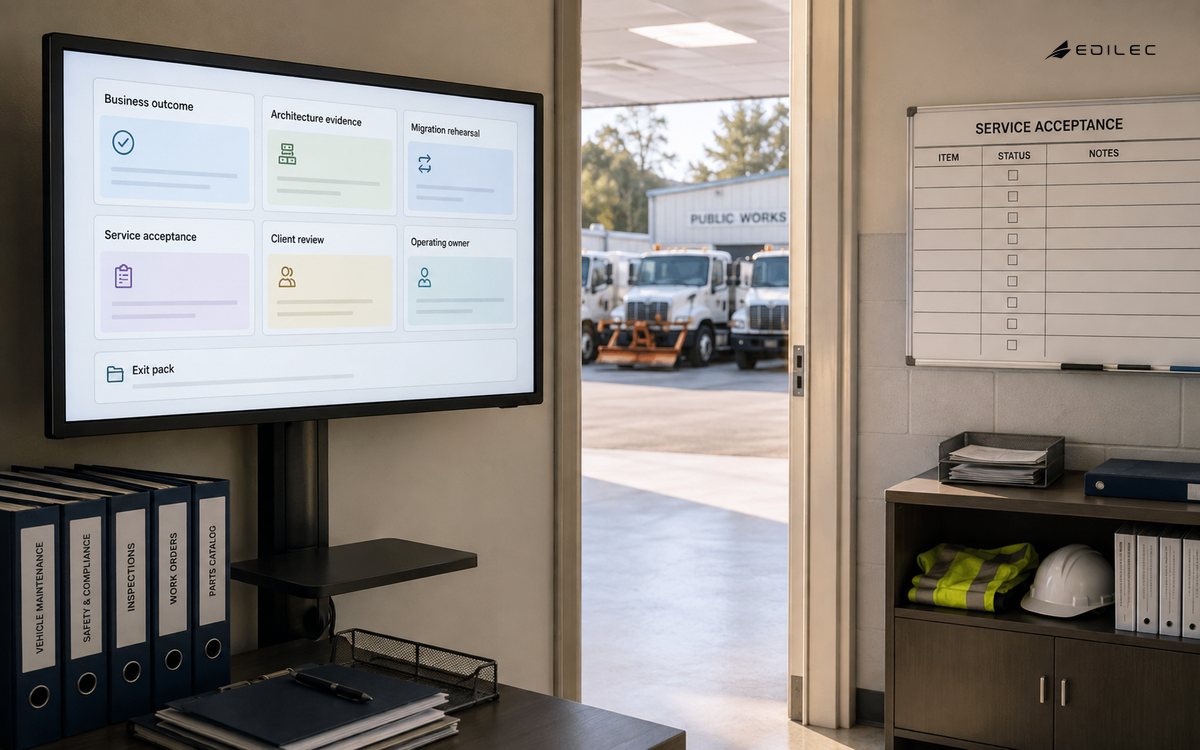
Service acceptance should confirm business scenarios, nonfunctional objectives, reconciliation, security findings, support readiness and contractual deliverables. Retain a warranty or stabilization path with severity and response rules. Review vendor concentration and export the assets needed to change supplier. Exit readiness is not distrust; it prevents continuity from depending on individual consultants and gives both parties a healthier basis for future work.
Govern the consulting engagement with evidence
Use one decision and evidence log shared by client and consultant. Record architecture choices, scope changes, risk acceptance, unresolved dependencies and acceptance outcomes. A weekly governance review should focus on decisions and movement in risk, not a percentage-complete estimate. Show working software and current operational evidence. Forecast ranges should narrow as uncertainty is retired; if they widen, explain the new fact and available tradeoffs.
Escalation should protect the outcome rather than status. Define thresholds for delayed client decisions, repeated quality failure, security exposure, budget variance and key-person dependency. Give both parties a route to pause work while preserving environments and records. Periodically sample whether contractual controls exist in practice: repository access, peer review, testing, backup, subcontractor approval and incident contacts. Correct drift before final acceptance makes it expensive and adversarial.
At each milestone, compare the remaining backlog with the target workflow and remove work that no longer contributes. Consulting teams often accumulate features promised during early uncertainty. Product ownership requires saying no, documenting the effect and preserving capacity for migration, support and recovery. A smaller service that users can operate safely is a stronger delivery than a broad release whose unresolved foundations become the client's maintenance burden.
Close governance meetings by naming the next client and consultant decisions, evidence owners and due dates. Preserve dissent when a specialist believes residual risk is unacceptable. A transparent record lets the accountable client owner decide with context and prevents urgency from being rewritten later as consensus.
Implementation takeaways
- Define the completed business workflow and test uncertain assumptions during discovery.
- Contract for repositories, evidence, responsibilities and exit from the beginning.
- Approve data authority, interfaces, security and operating constraints before scale.
- Build secure end-to-end increments and test realistic failure paths.
- Rehearse migration, organizational change, release and recovery.
- Accept the service only when the receiving team can operate and change it.
Frequently asked questions
Does the consultant become the application owner?
No. A consultant may perform product, engineering or service-management work, but the client retains accountable ownership of business outcomes, data, risk and supplier oversight. Assign client owners with authority and capacity throughout delivery.
When should acceptance criteria be written?
Define outcome and high-risk scenarios during discovery, then refine detailed criteria before each increment is built. Criteria must include exceptions and nonfunctional behavior. Writing them only at the end turns acceptance into negotiation rather than verification.
Conclusion
Consulting application services succeed when client ownership grows as delivery progresses. Anchor the work in an observed workflow, require engineering and operational evidence, migrate with reconciliation and prove the receiving team can run the service. That approach makes consulting expertise an accelerator while ensuring the application remains understandable, secure and changeable after the engagement ends.