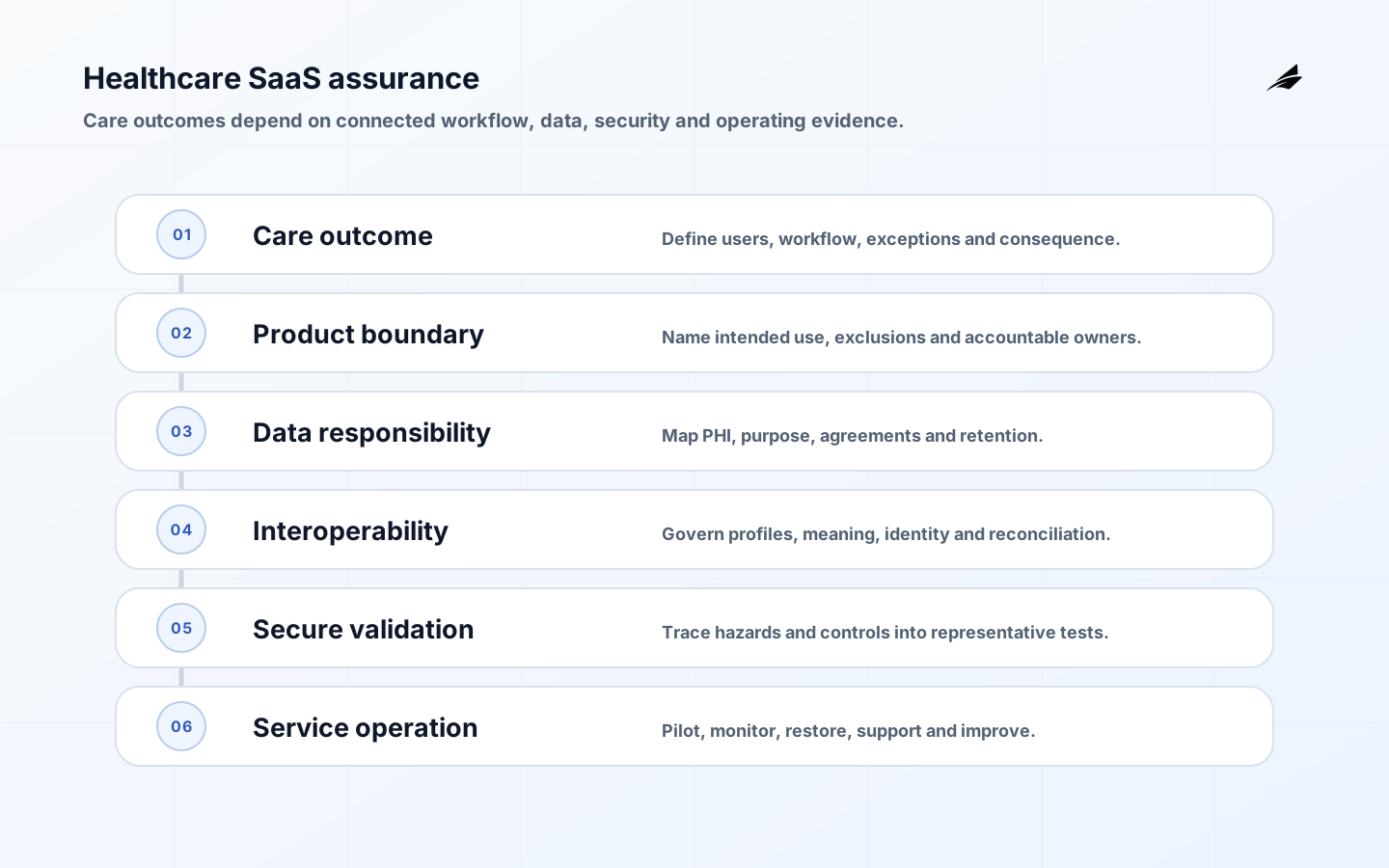
Selecting a healthcare SaaS product development company is a product, clinical, privacy and operating decision. The company must turn a care or administrative need into software that fits real workflow, protects health information, exchanges data accurately and remains supportable during change and incidents. A vendor claiming healthcare experience or hosting on an eligible cloud service has not proved that capability. Buyers need evidence about the named team, architecture, quality system, subcontractors, release controls and permanent ownership.
This implementation checklist complements Edilec's healthcare SaaS delivery plan, vendor selection FAQ and healthcare software implementation checklist. It is not legal or clinical advice. Determine applicable rules by product function, data, customer type and jurisdiction; HIPAA is important in the United States but it is not the only obligation a healthcare product may face.
1. Define the care workflow and product boundary
Name the users, setting, patient population, workflow, decision and intended outcome. Observe current work across routine, urgent and exception cases. Record where users switch systems, transcribe data, wait, interrupt or create informal workarounds. Distinguish administrative support from clinical decision support, diagnosis, treatment or device functionality because the assurance and regulatory profile can change. Define what the product will not do and how that limitation is communicated. Include downtime and degraded workflow before designing the happy path.
Create a data map from collection through use, disclosure, retention, export and deletion. Identify protected health information, sensitive non-PHI, provenance and the authoritative record. Minimize collection and secondary use. HHS explains in its cloud computing guidance that a cloud provider creating, receiving, maintaining or transmitting ePHI on behalf of a regulated entity is generally a business associate even when it lacks the decryption key. Map business-associate and subcontractor relationships before exchanging data.
| Workstream | Decision to make | Acceptance evidence |
|---|---|---|
| Clinical and operational fit | Which workflow and exceptions are supported? | Observed journey map and approved scenarios |
| Data responsibility | What data is used, why and by whom? | Data-flow and permitted-use matrix |
| Interoperability | Which systems and standards exchange state? | Versioned contracts and reconciliation tests |
| Safety and quality | What failure could harm care or access? | Hazard analysis and risk-based test plan |
| Operations | Who supports, restores and communicates? | Runbooks, exercises and named service owners |
2. Verify the company and delivery model
Assess the proposed people through a scenario relevant to the product. Verify product discovery, healthcare workflow, UX research, architecture, interoperability, security, privacy, quality engineering, DevOps and support skills. Ask for evidence from comparable systems without exposing another customer's confidential information. Review staff locations, subcontractors, background-check policy, turnover and replacement terms. Confirm who owns product decisions, clinical safety, privacy, security, architecture and production operation on both sides.

The contract should cover intellectual property, source access, business associate terms where applicable, permitted data use, incident notification, evidence access, vulnerability response, service levels, retention, deletion, portability and exit assistance. Do not allow production health data in general development, analytics or generative AI tools without an approved purpose and agreement. Require a current subprocessor inventory and change notice. Keep cloud tenants, domains, source repositories and critical encryption or signing authority under a deliberately governed ownership model.
3. Design privacy and security into the product
Perform a risk analysis for confidentiality, integrity and availability, then connect controls to identified threats and workflows. The HIPAA Security Rule summary describes administrative, physical and technical safeguards and requires a designated security official for regulated entities. Build unique identity, least privilege, emergency access, audit events, encryption, secrets management, backup and recovery into the architecture. Separate tenant data and administrative planes, and test authorization at every object boundary.
Adopt a secure development lifecycle aligned with the NIST Secure Software Development Framework. Protect repositories and build systems, review dependencies, scan code and artifacts, threat-model changes, manage vulnerabilities and retain release provenance. Define severity, remediation targets and customer notification. Test abuse cases such as record enumeration, insecure direct object reference, export overreach, malicious files and compromised support accounts. Production access should be time-bounded, approved and audited, with break-glass use reviewed.
4. Engineer interoperability and data meaning
Choose standards based on the exchange and market, not fashion. The U.S. health IT standards and technology resource describes FHIR as an API-focused standard for electronic clinical and administrative data exchange. The HL7 FHIR specification defines resources, APIs and implementation foundations, but a product still needs a version, profile, terminology bindings, identifiers and workflow semantics. Confirm customer requirements such as US Core, implementation guides, SMART authorization or older HL7 v2 interfaces where relevant.
For each interface, define source of truth, trigger, consent or authority, schema, code system, time semantics, identity matching, update behavior, idempotency, latency, error handling and reconciliation. Test realistic missing, duplicate, corrected and out-of-order data. Preserve provenance when normalizing. Avoid silent defaults for clinically material fields. Provide an interface monitoring view that distinguishes transport success from accepted and usable clinical state. Plan version coexistence and partner certification; healthcare ecosystems rarely upgrade every endpoint together.
| Quality area | Test focus | Release blocker example |
|---|---|---|
| Workflow | Routine, urgent, exception and downtime journeys | User cannot safely complete a critical exception |
| Data | Mapping, provenance, correction and reconciliation | Material field changes meaning or is lost |
| Access | Role, patient, organization and tenant boundaries | User can view or change unauthorized record |
| Interoperability | Profiles, terminology, duplicates and retries | Accepted message creates incoherent state |
| Resilience | Dependency loss, restore and backlog recovery | Recovery exceeds care or business tolerance |
| Accessibility | Keyboard, screen reader, contrast and errors | Core workflow excludes an intended user |
5. Validate with representative users and evidence
Build traceability from intended outcomes and hazards to acceptance scenarios. Combine automated unit, contract, integration, authorization, regression, performance and resilience tests with usability and workflow validation. Use synthetic or properly governed de-identified data where possible; verify that de-identification remains appropriate to intended use. Include clinicians, administrators, patients or caregivers who reflect the target setting. Record observed errors, workarounds and time pressure instead of asking only whether users like the interface.
Accessibility is part of usable healthcare, not a cosmetic review. Apply the current WCAG 2.2 recommendation to web experiences and test with keyboard and assistive technology. Use clear labels, focus order, error identification, target sizes and timeout handling. Include older devices, constrained networks, zoom and interrupted sessions. For clinical or time-sensitive workflows, test whether alerts are perceptible and actionable without creating excessive alarm burden. Document supported browsers, devices and known limitations.
6. Release safely and transfer operation
Pilot a bounded site, workflow or cohort with entry, pause and rollback criteria. Rehearse deployment, migration, interface switching, user support, monitoring and communication. Confirm data reconciliation before expansion. Progressive release should prevent broad impact and reveal differences between customer environments. Keep rollback coherent across schema, messages and customer actions; where true rollback is impossible, define a forward-recovery plan. Obtain explicit acceptance from product, operational, privacy, security and clinical or safety owners as applicable.
Operate the product as a healthcare service. Monitor successful journeys, interface acceptance, queue age, authorization failures, audit delivery, customer-specific health, vulnerability exposure, backups and restore tests. Establish 24-hour escalation where impact warrants it and communicate incidents in language customers can act on. Train permanent teams through shadowing and customer-led exercises. Provide export, retention and deletion functions that work at contract end. Feed support, safety, accessibility and security findings into a controlled product backlog.
If the product includes machine learning or generative AI, treat that as a separate governed capability. Define intended use, training and evaluation data, human oversight, refusal and recourse. Prevent prompts or retrieved content from bypassing access control or becoming an undocumented clinical record. Validate performance in the target population and setting, monitor change and provide a safe non-AI path. Do not infer that a model provider's compliance claims cover the complete healthcare workflow or the product company's obligations.
Maintain a product evidence pack throughout delivery: intended use, architecture, data flows, threat and hazard analyses, requirements, design decisions, test traceability, accessibility results, dependency inventory, release approvals and operational exercises. The exact contents depend on risk and regulation, but the discipline makes change review and customer assurance practical. Link evidence to a specific build and configuration. A collection of undated policies cannot establish what was actually released.
Assess the company's support and maintenance incentives before selection. Confirm whether the same engineering context remains available after launch, how customer-specific configuration is tracked, and how recurring defects enter the core roadmap. Establish a customer advisory and change-notification process for clinically or operationally material releases. The product should become easier to operate as it matures, not accumulate hidden customer-specific branches and manual support steps.
Key takeaways
- Define the care or administrative workflow, failure consequences and product boundary first.
- Verify the named team, subprocessors, data uses and operating responsibilities.
- Treat interoperability as governed meaning and reconciliation, not only API connectivity.
- Trace privacy, security, accessibility and safety risks into release tests.
- Pilot in bounded cohorts and prove permanent support, restore and incident capability.
Frequently asked questions
Does cloud hosting make a SaaS product HIPAA compliant? No; regulated responsibilities, agreements, configuration and operation still matter. Is FHIR always required? No, but use the applicable standards and profiles for the customer's ecosystem. Can developers use production PHI? Access should be minimized and governed; use representative synthetic or approved de-identified data where possible. Who owns clinical safety? The accountable product organization must assign qualified ownership; a vendor cannot absorb all responsibility. What should be handed over? Source, infrastructure definitions, data contracts, tests, evidence, runbooks, access records, known limitations and supplier details.
Conclusion
A healthcare SaaS development partner earns trust by making workflow, data responsibility, security and quality visible in the delivered product. Strong teams use standards where they preserve meaning, validate with representative users and prepare for degraded operation as carefully as launch. Select and govern the company around evidence that the service can be changed, supported and corrected without compromising care or confidentiality.