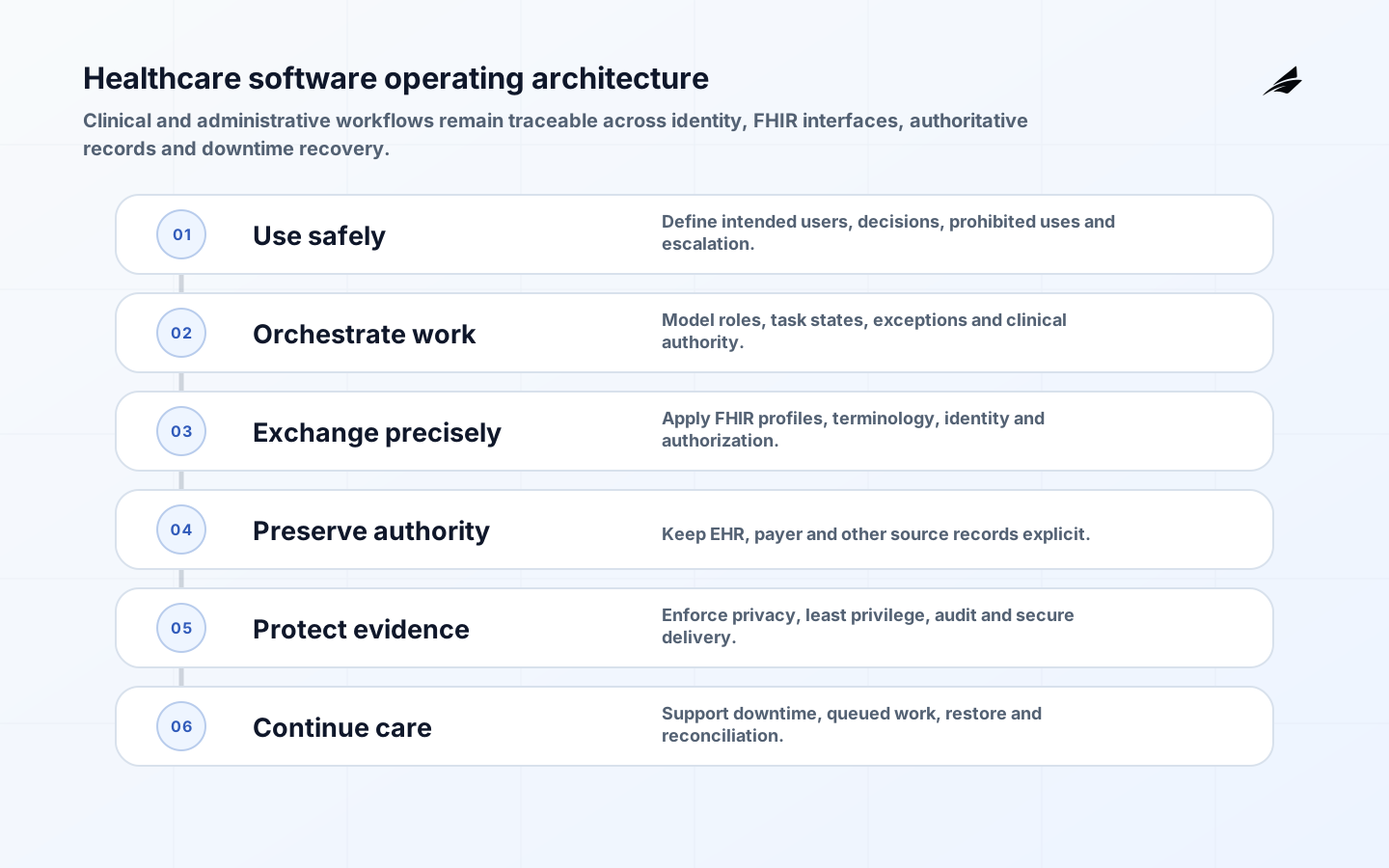
Healthcare operations software coordinates work such as referrals, scheduling, eligibility, document intake, care-team tasks, patient communication, inventory, billing support and quality reporting. These systems can improve visibility and reduce manual handoffs, but they operate inside a safety-sensitive environment containing protected health information, complex identities and interfaces that may affect care. A successful delivery plan must begin with the workflow and responsibility model, then address privacy, security, interoperability, resilience and product classification.
This guide focuses on operational and administrative software rather than assuming that every healthcare application is a medical device. Intended use and functionality matter. Software that merely routes an approved task differs from software that analyzes patient-specific data and produces a recommendation used for diagnosis or treatment. The FDA's January 2026 Clinical Decision Support Software guidance explains its current thinking about non-device CDS criteria and device software functions. Product teams should obtain qualified regulatory review when a function could fall within FDA oversight; this guide is not legal advice.
Define the product boundary and intended use
Write an intended-use statement in plain operational terms. Identify users, decisions, data inputs, outputs, affected workflows and prohibited uses. A referral work queue might collect records, display status and route cases according to organization-approved rules. If the same product interprets clinical signals and recommends a patient-specific intervention, its risk and regulatory analysis changes. Do not postpone this distinction until release; architecture, evidence, staffing and change control depend on it.
Map system boundaries as well as feature boundaries. Name the source of truth for patients, encounters, practitioners, coverage, orders, results, documents and tasks. Identify whether the application stores electronic protected health information or processes it transiently. Record user organizations, business associates, subcontractors, hosting regions, integration engines, messaging services and analytics destinations. The boundary should show where access, custody and operational responsibility change.
| Software function | Typical purpose | Required review path |
|---|---|---|
| Operational workflow | Route referrals, schedules, documents or administrative tasks | Clinical, privacy, security and operational review |
| Information display | Present source data without patient-specific interpretation | Source fidelity, usability and intended-use review |
| Clinical decision support | Provide patient-specific recommendations or options | Assess the FDA CDS guidance and applicable product requirements |
| Device software function | Perform a function meeting the device definition | Qualified regulatory and quality-system review |
Discover the real workflow before defining scope
Observe how work enters, changes ownership and exits. Interview registration staff, clinicians, coordinators, privacy and security teams, revenue-cycle staff, support personnel and patients where appropriate. Capture exceptional paths: duplicate records, missing consent, unavailable external systems, urgent cases, corrected results, late documents, downtime and reopened tasks. The happy path rarely explains the operational cost or safety consequence of a healthcare workflow.
Model each step with an accountable role, required information, decision rule, time expectation, escalation and evidence. Separate clinical judgment from automation. The application may prioritize a queue using an approved rule, but a clinician may retain the decision about patient care. Present that boundary in the interface and audit record. Avoid adding automation merely because a manual step exists; first determine whether the step protects safety, privacy or reconciliation.
- Select one measurable workflow and define its beginning and end.
- Record current handoffs, systems, delays, corrections and failure modes.
- Identify decisions that require clinical or privacy authority.
- Agree which system is authoritative for every critical data element.
- Prototype exceptional paths before committing to full architecture.
- Define outcome and balancing measures with workflow owners.
Translate privacy and security duties into system behavior
HHS explains that the HIPAA Security Rule protects electronic protected health information held by covered entities and business associates through administrative, physical and technical safeguards supporting confidentiality, integrity and availability. The Privacy Rule governs permitted uses and disclosures of protected health information more broadly. Determine which organizations and data flows are in scope with the organization's privacy, security and counsel teams. Do not treat a product badge or cloud setting as proof of compliance.
Begin with a documented risk analysis covering the complete environment. Threats include excessive privileges, credential theft, insecure APIs, misdirected messages, bulk export, insider misuse, vulnerable dependencies, ransomware, unavailable integrations and corrupted mappings. Connect each risk to an owner, safeguard, verification method and residual decision. Revisit the analysis after material changes. HHS distinguishes the current Security Rule from proposed modifications, so teams should track official rulemaking without representing proposals as current requirements.
Implement individual identities, least-privilege roles, strong authentication, access review, secure sessions, encryption, key management, tamper-evident audit events, data minimization, retention controls, backup and tested recovery. Administrative access should be attributable and time-bounded. Logs should record who accessed or changed sensitive information, the purpose-relevant action and the affected object without unnecessarily duplicating clinical content. Patients and workforce members need clear session, consent and communication behavior.
| Control area | Design question | Evidence |
|---|---|---|
| Identity and access | Can each user perform only authorized job functions? | Role mapping, access tests and review records |
| Data movement | Where does protected information enter, leave or persist? | Data-flow diagram and interface inventory |
| Auditability | Can the organization reconstruct material access and changes? | Protected, searchable audit events and test cases |
| Availability | How does essential work continue during failure? | Downtime procedure, restore result and reconciliation record |
| Supplier access | What can each vendor or subcontractor reach? | Contract boundary, account inventory and access evidence |
Design FHIR R4 interfaces as contracts
FHIR R4 is a healthcare data-exchange standard, not a guarantee that two systems mean the same thing. Define the implementation guide, profiles, extensions, terminology bindings, identifiers, search behavior and supported operations for every interface. Specify whether an integration uses REST, messaging, documents or bulk export. Preserve provenance and source context. A syntactically valid Observation can still be unsafe if its code, units, subject, effective time or correction status are misunderstood.

Where ONC certification applies directly to a Health IT Module, use the applicable certification criterion and adopted standards rather than a generic claim of FHIR support. The standardized API criterion at 45 CFR 170.315(g)(10) references FHIR R4 and related implementation specifications for patient and population services, with authentication, authorization, documentation and testing requirements. Not every custom operational system is seeking ONC certification, but certified modules and their contracts can impose precise interface expectations.
| Interface contract element | Example question | Acceptance evidence |
|---|---|---|
| Conformance | Which FHIR R4 profiles and operations are supported? | Capability statement and conformance tests |
| Identity | How are patient, practitioner and organization identifiers reconciled? | Match, duplicate and conflict scenarios |
| Terminology | Which code systems and value sets are authoritative? | Validated mappings and rejected-code tests |
| Authorization | Which user, patient or system scopes are permitted? | Positive, negative and revocation tests |
| Lifecycle | How are corrections, deletions and late data represented? | Versioning and reconciliation scenarios |
| Failure handling | What happens after timeout, partial success or duplicate delivery? | Retry, idempotency and alert evidence |
Build interface simulators and contract tests before depending on a production EHR or payer sandbox. Test realistic missing, duplicated and corrected data, not only ideal samples. Monitor schema validation, terminology failures, queue age, authorization errors and reconciliation outcomes. Assign ownership for each side of the interface so an incident does not stall between application, integration and vendor teams.
Choose architecture around clinical and operational consequences
Prefer clear service boundaries, explicit state transitions and idempotent integration. A task should have defined states, permitted transitions and an audit trail. Duplicate messages should not create duplicate appointments or requests. Separate presentation, workflow orchestration, interoperability adapters and reporting where that separation improves change safety. Keep critical business rules versioned and testable rather than scattering them across interface code and user-interface conditions.
Design for degraded operation. Decide what users see when an upstream EHR, identity provider, terminology service or messaging channel is unavailable. Queue work safely where appropriate, show data freshness, prevent unsafe action on stale information and reconcile after recovery. Establish recovery objectives from workflow consequence. A patient-facing convenience feature and an operational queue needed for time-sensitive care should not inherit identical availability assumptions.
Use production-like, synthetic test data whenever possible. If protected health information is necessary for a controlled test, apply the organization's approved access, minimum-necessary, environment and disposal procedures. Do not copy production databases into development as a shortcut. Ensure backups, logs, support tooling and analytics follow the same boundary decisions as the main application.
Estimate cost from workflow, integration and assurance effort
Feature count is a weak predictor of healthcare software cost. A short intake form may require identity proofing, consent handling, accessibility, multilingual content, EHR write-back, audit evidence and support across multiple organizations. Integration uncertainty, data quality, clinical review, privacy and security assurance, operational downtime and vendor coordination often dominate the effort. Estimate those workstreams explicitly.
| Cost driver | Questions to answer | Ways to reduce uncertainty |
|---|---|---|
| Workflow variation | How many roles, locations and exceptions differ? | Observe representative sites and prototype edge cases |
| Integration | Which interfaces, profiles, sandboxes and vendors are involved? | Run an early vertical integration slice |
| Data quality | Are identifiers, codes and histories consistent? | Profile source data and test reconciliation |
| Assurance | What privacy, security, clinical and regulatory evidence is required? | Define reviewers and acceptance artifacts early |
| Operations | What support, recovery and monitoring coverage is needed? | Exercise incidents and downtime before rollout |
| Adoption | How will roles, training and procedures change? | Pilot with actual users and workflow owners |
Fund discovery before committing to a full build. A useful discovery produces an intended-use statement, workflow map, data-flow diagram, interface inventory, risk register, delivery slices and evidence plan. Estimate each slice with assumptions and dependencies. Keep software construction, third-party licenses, integration fees, security testing, regulatory work, training, support and ongoing maintenance visible. A single blended estimate makes later tradeoffs unnecessarily difficult.
Use a secure and evidence-producing delivery lifecycle
NIST's Secure Software Development Framework organizes practices around preparing the organization, protecting software, producing well-secured releases and responding to vulnerabilities. Apply those practices within the team's delivery method: define security requirements, protect repositories and build systems, review changes, scan dependencies, test misuse cases, preserve release provenance and maintain a vulnerability-response process. Security activity should produce evidence tied to a release rather than a separate checklist completed near launch.
Maintain traceability from a workflow requirement to design, test and release. High-consequence scenarios deserve explicit tests: wrong-patient selection, unauthorized bulk access, stale clinical data, duplicate order or task creation, failed consent enforcement, corrupted terminology mapping and unavailable upstream systems. Use automated tests where repeatability helps, then add human factors, workflow and recovery exercises that automation cannot replace.
Treat clinical decision support as a distinct product decision
The FDA's January 2026 guidance discusses the statutory criteria under which certain CDS software functions are excluded from the device definition and provides examples of non-device CDS and device software functions. The boundary depends on the function and intended user, including whether the healthcare professional can independently review the basis for a recommendation. A product team should not infer classification from labels such as workflow assistant, AI copilot or analytics.
When a proposed feature interprets patient-specific information, pause ordinary backlog refinement and start a documented classification review. Record intended use, users, inputs, output, time sensitivity, transparency, clinical reliance and failure consequence. Involve qualified regulatory, clinical, quality, privacy and security specialists. If the function is regulated device software, its development and evidence path differs materially from ordinary healthcare operations software.
Pilot with operational gates and human oversight
Start with a bounded site, workflow and user group. Establish baseline measures from the current process, then monitor completion, correction, queue age, user-reported burden, interface failures, privacy events and safety concerns. Avoid claiming success from activity alone. More messages or closed tasks do not prove that referrals reached the right destination or that staff spent less time reconciling errors.
Before expansion, exercise downtime, recovery, incident response, access revocation, data correction and vendor escalation. Confirm who can stop the rollout and how users revert to an approved procedure. Review help-desk themes and direct observations with workflow owners. Expand only when the application, interfaces, training, support and governance meet the same acceptance gate.
Key takeaways
- Define intended use and distinguish operational software from possible device functions.
- Map healthcare workflows, exceptions, data custody and accountable owners before building.
- Turn HIPAA privacy and security considerations into verifiable system behavior.
- Treat FHIR R4 profiles, terminology, authorization and failure handling as interface contracts.
- Estimate integration, assurance, adoption and operations alongside feature development.
- Pilot with downtime, reconciliation, safety and privacy evidence.
Frequently asked questions
Does using FHIR R4 make two healthcare systems interoperable?
Not by itself. Teams must agree on profiles, implementation guides, identifiers, terminology, operations, authorization, provenance and lifecycle behavior. Conformance and workflow tests should cover missing, corrected, duplicated and unauthorized data as well as valid exchanges.
Is every clinical workflow application regulated as a medical device?
No. Classification depends on intended use and functionality. Operational routing or information display can differ from software that analyzes patient-specific information and provides recommendations. Review the current FDA CDS guidance and obtain qualified advice for the particular function.
What should a healthcare software discovery phase deliver?
It should produce an intended-use statement, observed workflow and exception map, system and data boundaries, interface inventory, authoritative-source decisions, initial risk analysis, product-classification questions, measurable delivery slices and an evidence-based estimate. These outputs should be reviewed by operational, clinical, privacy, security and technical owners.
Conclusion
Healthcare operations software earns trust when it represents real work accurately, protects information throughout its lifecycle and fails in understandable, recoverable ways. The strongest delivery plans make ownership, intended use, data meaning, interface behavior and operational evidence explicit before scaling.
Begin with one bounded workflow and a complete vertical slice through identity, user experience, FHIR or other interfaces, audit, monitoring and recovery. Validate it with the people who perform and govern the work. That approach exposes the difficult dependencies early while creating a sound foundation for broader healthcare software delivery.