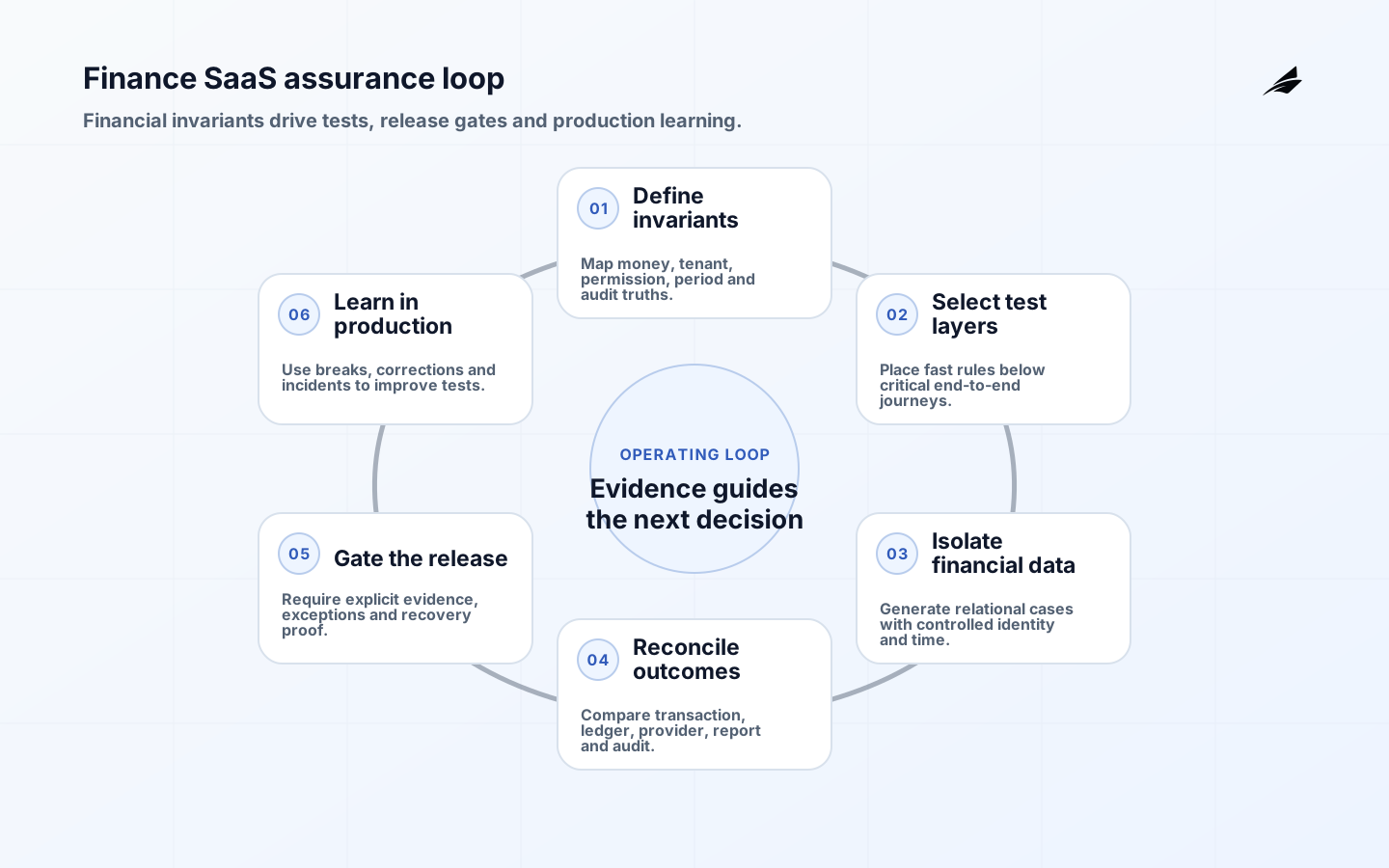
QA automation for SaaS finance must protect more than screens. Financial software carries monetary state, approvals, tenant boundaries, effective dates, reports, exports and audit evidence through retries, integrations and close periods. A passing user-interface suite cannot prove debits and credits reconcile, permissions hold across APIs, or a failed payment callback is handled once. This practical guide organizes automation around financial invariants and release risk.
Use the finance SaaS QA checklist, finance SaaS QA FAQ and automation testing checklist. Business, accounting, engineering, security and quality roles should agree what must always remain true. Those invariants become the backbone of data, assertions, telemetry and reconciliation.
1. Model financial risk and transaction invariants
Map critical journeys such as account setup, role change, invoice, payment, allocation, adjustment, approval, close, report, export and reversal. For each, identify authoritative records, value and currency, time basis, actor, approval, downstream posting and acceptable recovery. Include unauthorized, duplicate, late, out-of-order and partial events. Rank by financial loss, customer impact, regulatory or contractual consequence and detectability.
Write invariants independently of the interface. Examples include balanced postings where the accounting model requires them, immutable posted history with explicit correcting entries, unique external references, amount and currency preservation, tenant isolation, approval separation and report totals reconciling to source entries. Invariants let teams generate many scenarios and catch defects across UI, API, job and integration paths.
| Risk area | Invariant or oracle | Automation focus |
|---|---|---|
| Ledger posting | Each accepted event produces defined balanced, traceable entries | Property, API and reconciliation tests |
| Money movement | One authorized instruction has at most one intended financial effect | Idempotency and callback replay |
| Authorization | Actor performs only allowed action on allowed tenant and state | Negative role and object tests |
| Period control | Effective and posting dates obey open, close and timezone rules | Boundary and clock-controlled scenarios |
| Reporting | Report filters and totals reconcile to authoritative entries | Dataset-level expected results |
| Audit | Material changes preserve actor, reason, correction and time | Event and reconstruction tests |
2. Choose test layers for fast and credible evidence
Place most deterministic rules below the browser. Unit or property tests cover calculations and invariants; component tests cover persistence and state machines; API and contract tests cover boundaries; a smaller browser set verifies critical journeys and client behavior. Add data-pipeline, migration, performance, accessibility, security and resilience suites where risk requires them. Each layer should have a decision purpose and time budget.
Use the NIST Secure Software Development Framework to integrate secure practices into development and vulnerability response. Finance test code and fixtures are software: review them, protect dependencies, use attributable pipeline identities and avoid production secrets. A compromised runner with broad database or cloud rights can become a production attack path. Segment environments and minimize standing credentials.
3. Build isolated, representative financial test data

Create synthetic datasets preserving financial relationships without copying customer records. Generate accounts, currencies, tax treatments, periods, permissions, transaction histories and expected balances from versioned seeds. Include zero, negative, maximum, rounding, precision, leap day, daylight-saving, month-end and year-end cases applicable to the product. Maintain reviewed golden scenarios plus generated properties that explore combinations.
Isolate tests so state cannot leak between executions. Playwright’s browser-context guidance explains clean-slate isolation for cookies and storage; apply the principle to tenants, ledger records, queues and payment simulators. Use unique identifiers, controlled clocks and per-test setup. Avoid suites depending on a shared test customer or execution order. Separate contract evidence from external sandbox availability.
- Version datasets, expected outcomes, currency tables and business calendars with the behavior they test.
- Use deterministic decimal handling and assert rounding at each required boundary, not only the displayed total.
- Simulate provider success, decline, timeout, duplicate, delayed and contradictory callbacks.
- Generate cross-tenant and cross-role negative cases for every material object and action.
- Mask approved production-derived data and verify logs, screenshots and reports do not expose it.
- Reconcile created test transactions and remove or expire them without hiding failures.
4. Automate tenant, permission and payment controls
Treat authorization as a matrix of tenant, actor, action, object and state. Test every interface server-side: API, bulk import, export, report, background job and support tool. Attempt identifier substitution, stale tokens, revoked roles, approval self-service and cross-tenant search. The OWASP ASVS provides application requirements, while the OWASP Web Security Testing Guide adds manual and active techniques. Automation does not replace threat analysis or penetration testing.
If the service stores, processes or transmits cardholder data, determine PCI scope and responsibility. The PCI SSC library contains PCI DSS v4.0.1 and current supporting documents. Prefer architectures minimizing card data and test that sensitive authentication data never enters logs or fixtures. Verify hosted payment integration, applicable script controls, webhook authentication, token lifecycle, refunds and chargebacks with providers and assessors.
5. Test reports, integrations and failure recovery
Assert financial truth at several levels. For each transaction, compare request, state transition, posting, payment response and audit event. At batch level, reconcile counts and amounts across application, ledger, processor and report. Preserve unexplained differences as failures rather than rounding them away. Test corrections and reversals as new controlled events. A report matching itself is not reconciliation; compare independent records or derivations.
Inject failures between steps: after authorization before order commit, after posting before notification, during batch close, while an exchange-rate source is unavailable, or during export. Verify retry is safe, pending state is visible and recovery does not duplicate value. Restore a production-like backup, replay or resume queued work, and reconcile before declaring recovery. Load tests should use realistic transaction mix, tenant distribution and period-end bursts.
| Release evidence | Pass condition | Concern exposed |
|---|---|---|
| Invariant suite | All financial properties pass on the release artifact | Calculation or state regression |
| Permission matrix | Positive and negative cases pass across interfaces | Tenant or approval bypass |
| Provider simulation | Every response sequence reaches one valid outcome | Duplicate or stranded transaction |
| Reconciliation | Transaction and aggregate totals match with explained differences | Silent posting or reporting loss |
| Period-end load | Objectives hold at representative close workload | Queue, lock or latency failure |
| Restore exercise | Service resumes with valid balances and no duplicate replay | Backup or recovery gap |
6. Operate risk-based release gates and production learning
Build a feedback ladder: fast invariant and component suites on every change, API and permission checks before merge, selected end-to-end journeys on deployment, and broader reconciliation, performance, security and resilience suites at scheduled or release gates. Define which failures block and who can accept an exception. Never allow a flaky finance test to disappear silently; quarantine it with owner, reason, expiry and compensating control.
Production monitoring completes the quality system. Track reconciliation breaks, duplicate suppression, authorization denials, manual adjustments, report corrections, queue age, close duration, support incidents and escaped defects. Use privacy-safe synthetic probes for critical journeys. When a defect escapes, add the most economical test at the correct layer and examine why requirements, review or telemetry missed it. Review whether automation still predicts risk rather than merely accumulating scripts.
7. Include accessible financial workflows
Financial users need to review dense tables, errors, approvals and time-sensitive sessions with assistive technology. Test keyboard navigation, focus, headings, names, status messages, error identification, reauthentication and timeout extension against WCAG 2.2. Automated scanners catch only part of the problem; manually complete critical journeys with screen readers and zoom. Preserve context when errors occur so users do not re-enter transactions and risk duplication.
Use automated assertions for semantic table headers, visible focus, programmatic labels and status announcements, but evaluate task understanding with people. Security controls such as authentication and fraud challenges need accessible alternatives. Accessibility defects in invoice, payroll or expense workflows can prevent users from meeting financial deadlines, so prioritize them by business consequence rather than cosmetic severity.
Key takeaways
Practical example: a finance SaaS release changes partial refunds across currencies. Property tests verify amount conservation and rounding rules, API tests cover open and closed periods, and permission tests prove a requester cannot approve the same refund. The payment simulator sends success, timeout, delayed and duplicate callbacks. Each scenario must produce one intended financial effect and an auditable correction path. A batch reconciliation compares application transactions, ledger entries, provider totals and the customer report. The team restores a backup, resumes the callback queue and reruns reconciliation before release. A flaky cross-tenant test blocks unless the risk owner records a temporary manual control and repair deadline.
- Base finance QA on monetary, authorization, period, tenant and audit invariants.
- Put deterministic rules at fast layers and reserve end-to-end tests for critical integration evidence.
- Generate isolated relational financial data with reviewed expected outcomes and controlled time.
- Test permissions across every interface and payment paths through uncertain and duplicate events.
- Reconcile independent records at transaction and aggregate levels, including after recovery.
- Operate explicit release gates and use production breaks to improve the smallest effective test layer.
Frequently asked questions
Should automated tests run against production?
Use narrowly scoped, non-destructive synthetic probes when benefit and controls justify them. Do not create uncontrolled financial records or use customer data. Production verification needs dedicated identities, identifiable transactions, cleanup or reversal, monitoring and an emergency stop. Most exhaustive suites belong in isolated environments.
Can a release proceed with a flaky finance test?
Only through an explicit risk decision. Determine which invariant or journey lost evidence, whether flakiness may indicate a product race, and which compensating check exists. Record owner and expiry. Retry-passing should remain visible. Repeatedly ignoring the result teaches teams that financial gates are optional.
How should rounding be tested?
Define decimal representation, precision, rounding mode and the stage where rounding occurs for each currency and rule. Test item, tax, discount, allocation, conversion and aggregate boundaries with expected values from an independent oracle. Include reversals and partial refunds; small per-item errors can become material at scale.
Conclusion
QA automation for SaaS finance provides confidence when it protects financial invariants through every interface, failure and recovery path. Combine fast rule tests, isolated transaction data, hostile permission checks, provider simulation, independent reconciliation, accessibility and production learning. The goal is not a green dashboard; it is a financial service whose state can be trusted and explained.