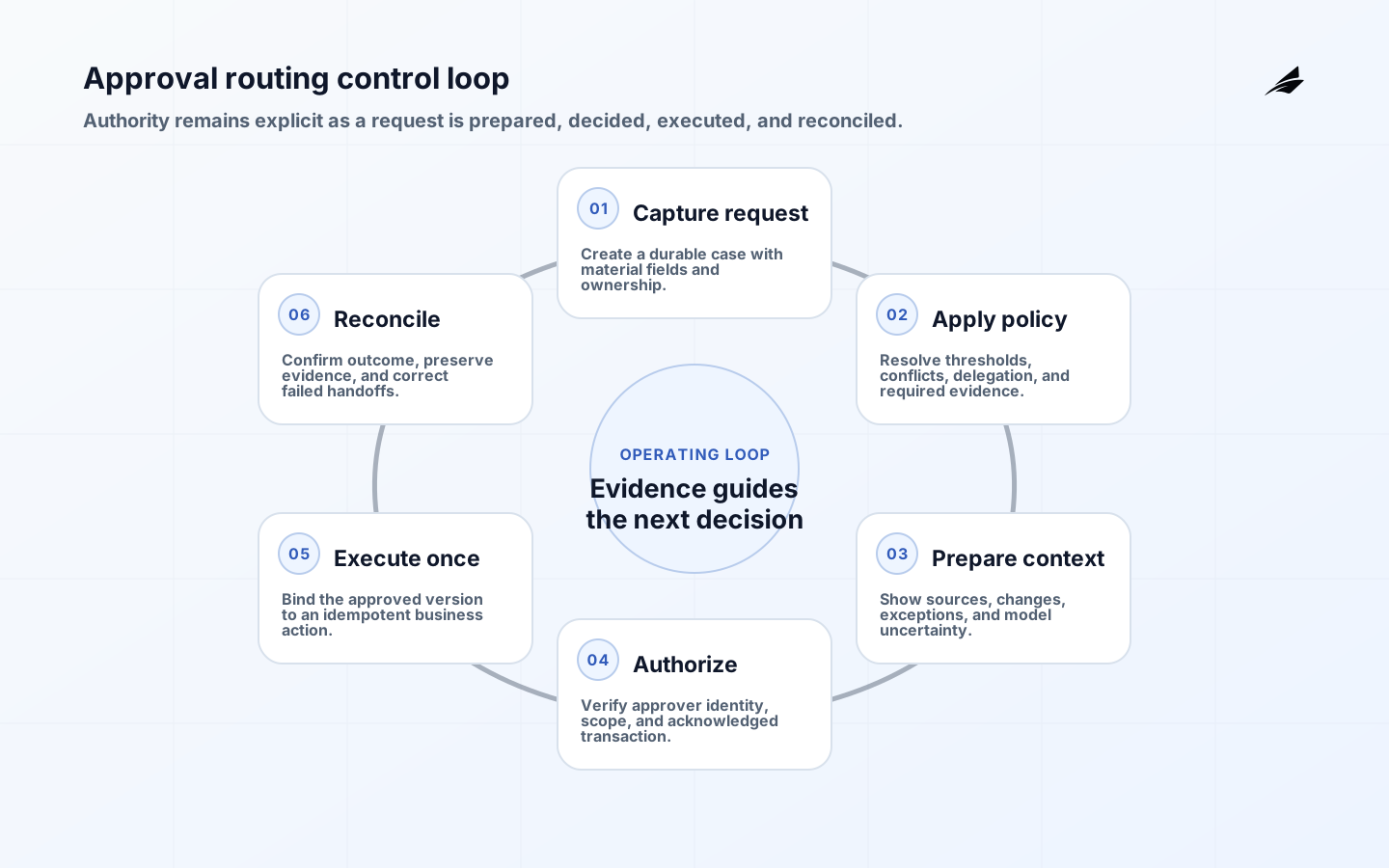
AI approval routing automation should help the right person reach a timely, well-supported decision; it should not turn a prediction into authority. A dependable implementation captures the request, applies an explicit policy, prepares relevant evidence, routes the case to an authorized approver, records the version that was approved, and verifies the downstream action. This FAQ is for teams working across finance, procurement, legal, people operations, or service delivery, where a fast answer is useful only if exceptions, conflicts of interest, and corrections remain visible.
Define the outcome before selecting tooling
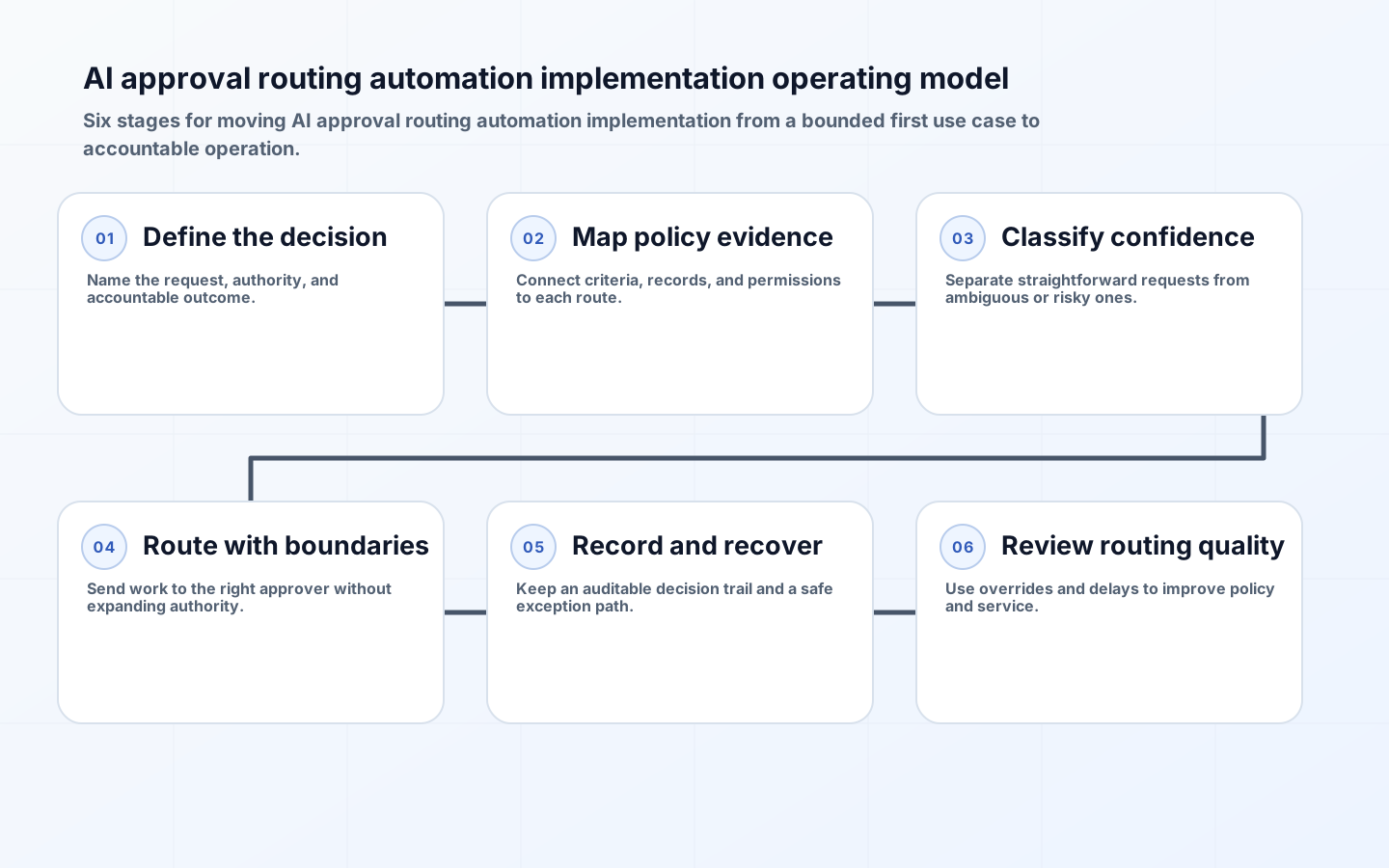
Begin with one decision or task that a real person already performs. Describe the starting signal, the information that is allowed to influence the result, the accountable role, the action or response, and the evidence that proves completion. For AI approval routing automation implementation, this gives every technical choice a business test: does it make a timely, explainable approval or a clear escalation more reliable, faster, or easier to review? The NIST AI Risk Management Framework is a useful discipline here because it frames risk management as an ongoing activity, not a one-time compliance review. Write down unacceptable outcomes as clearly as desired outcomes, including an incorrect result, an unavailable service, an unauthorized disclosure, and an unresolvable dispute.

| Question | Working answer | Evidence to request |
|---|---|---|
| What is in scope? | One approval request path with a named user, decision, and owner. | A current journey map and a plain-language success condition. |
| What may change? | Only the records, routes, or release decision explicitly approved for the first use case. | A boundary statement and a list of excluded actions. |
| Who can intervene? | A business owner, a technical owner, and a support route with escalation authority. | Named roles, response expectations, and access review. |
| How is value judged? | By the quality and timeliness of the resulting work, not by activity volume. | A baseline and a scheduled review of outcome measures. |
Map the operating model and its boundaries
A sound design starts with the information lifecycle. Identify the source of each important field, the person or system allowed to change it, the rule for freshness, and the conditions under which it should not be used. Keep the presentation layer separate from the authoritative record; otherwise a convenient display can quietly become a decision source. For decision authority, evidence, and exceptions, this distinction is practical. It lets a reviewer trace a result back to a record, an event, or a test run instead of relying on a summary that may already be stale. It also surfaces the unglamorous requirements that determine whether a pilot can become a service: identity, permissions, environment ownership, retention, and incident handling.
For approval routing, the design review should walk through a real policy collision rather than an abstract outage. For example, a request may be complete but exceed a delegated limit, cite a cost centre that has closed, or arrive after the authorisation window has expired. Decide whether the route stops, requests additional evidence, or moves to a named escalation queue. Record the policy version and the inputs that produced the route so a reviewer can distinguish a bad rule from a bad record. The NIST Secure Software Development Framework supports this discipline of defined practices and verification. It is particularly important not to grant a wider approval merely because the preferred approver is unavailable; absence is an exception that needs its own authority and audit trail.
Design controls that help people make decisions
Controls should make the intended workflow easier, not merely add a separate audit ritual. Apply least privilege to the people and services involved; use a stable identifier for each request, run, answer, or decision; and record material inputs, policy version, result, and intervention. Match the review threshold to consequence. A low-impact approval request may proceed after routine checks, while an ambiguous or high-impact case should pause for a qualified human. Do not disguise uncertainty as confidence. A useful interface says what it knows, what source or test supports it, and what the user should do next when it cannot proceed safely.
| Risk or failure | Control to include | Signal to review |
|---|---|---|
| Input is incomplete, stale, or contradictory | Validate essential fields, preserve source time, and send unresolved cases to an exception queue. | Exception reason, age, and resolution outcome. |
| A permission or policy changes | Evaluate access at the action boundary and version the governing rule. | Denied action, policy version, and override history. |
| A dependency becomes unreliable | Use timeouts, bounded retries, and a manual continuation path. | Failure rate, retry age, and user impact. |
| A result is challenged | Keep a traceable record of inputs, result, reviewer action, and correction. | Challenge volume, reversal cause, and recurrence. |
How should authority and transaction integrity be enforced?
Treat routing, approval, and execution as separate decisions. A model may classify a request or recommend an approver, but the application must enforce authority on the server for the specific record and action. The OWASP Authorization Cheat Sheet recommends deny-by-default rules and permission validation on every request. For consequential actions, the OWASP transaction authorization guidance adds a crucial principle: the approver should see and acknowledge the significant transaction data, and the system should verify that the executed transaction is the one that was authorized.
Store an immutable approval snapshot containing request version, material fields, policy version, recommendation and confidence where relevant, evidence references, approver identity, delegated authority, timestamp, decision, reason, and resulting action identifier. If the amount, beneficiary, legal entity, scope, or attachment changes after approval, invalidate or re-evaluate the decision instead of silently carrying it forward. NIST SP 800-53 distinguishes access enforcement, separation of duties, least privilege, and audit controls; use those outcomes to design maker-checker rules and privileged overrides.
| Approval state | Allowed system action | Evidence that must persist |
|---|---|---|
| Prepared | Validate and route; no business side effect | Request version, policy result, candidate approvers |
| Awaiting decision | Notify and remind within policy | Assignment, due time, disclosed material fields |
| Approved | Execute only the bound transaction once | Approver, authority, approved snapshot, idempotency key |
| Rejected or expired | Prevent execution and return a reason | Decision or timeout reason and next permitted route |
| Changed after approval | Invalidate or re-evaluate | Changed fields, prior decision, new policy evaluation |
| Emergency override | Require named break-glass authority and review | Justification, scope, time limit, after-action review |
Pilot a real path and rehearse the difficult cases
Choose a pilot that is narrow enough to understand end to end but meaningful enough that a user will notice the difference. The first release should exercise the same identities, data handling, integrations, and approval or release practices expected in production. Avoid treating a sandbox success as proof of service readiness. Before widening access, run deliberate scenarios: a bad input, a changed rule, a revoked account, a delayed dependency, and a disagreement about the result. Capture the evidence a support colleague would actually need. In AI approval routing automation implementation, the rehearsal is where the team discovers whether the operating model can survive an ordinary inconvenient Tuesday.
- State the pilot population, approval request boundary, and exit criteria in language a business owner can challenge.
- Run an expected path, a rejected path, a delayed dependency path, and a recovery path with the production-like controls enabled.
- Give every finding an owner, a due date, and a decision: correct now, accept temporarily, or exclude from the first release.
- Use the related planning guide and the companion checklist to keep planning, readiness, and delivery decisions aligned.
Measure the result, not just the system
Measure approval routing with operational questions in mind: how long do straightforward requests wait, where do cases age, how often does an approver override the route, and which policy conditions create repeat escalations? Separate a request held for missing evidence from one held for a manager decision. Those are different service problems. Sample completed cases with policy owners to check that the evidence shown to the approver was sufficient and current. The NIST AI RMF Playbook offers a useful cycle of govern, map, measure, and manage; here, the practical output is a revised delegation rule, clearer request form, or better exception queue, not a vanity automation percentage.
Key takeaways
- AI approval routing automation implementation earns trust through a bounded decision and named ownership, not through a broad technology promise.
- Make decision authority, evidence, and exceptions visible in the working flow so people can intervene before a small defect becomes a business problem.
- Use rehearsal evidence to decide whether to expand; counts of completed tasks or test runs are not enough by themselves.
- Connect this work with a connected implementation article so the broader operating model remains consistent.
Frequently asked questions
- What should a first approval request release include? Include one valuable path, explicit boundaries, a named owner, reliable evidence, and a recovery route. Broader scope can wait until this path has survived change and exception handling.
- How should a team estimate effort? Estimate discovery, access and data preparation, design, build, verification, rehearsal, documentation, and handover separately. The unknowns are usually in dependencies and operating ownership, not in the first screen or rule.
- When is human review required? Use it where consequence, uncertainty, policy sensitivity, or incomplete evidence makes an unattended result unsafe. Define who reviews, what they see, and what they may override.
- Can automation or retrieval replace accountability? No. It can organize evidence and accelerate a bounded task, but an accountable business role still owns policy, exceptions, and the decision to expand or stop the service.
Conclusion
The practical question behind ai approval routing automation implementation faq is whether the team can operate the capability with clarity when the usual path fails. Start with a decision that matters, protect its boundaries, make evidence inspectable, and rehearse recovery with the people who will support it. That creates a credible base for improvement instead of an expensive promise. For implementation detail, Playwright assertions documentation is a helpful reference when automated user-interface evidence is part of the delivery, while the related planning guide provides a useful next step for the surrounding operating plan.