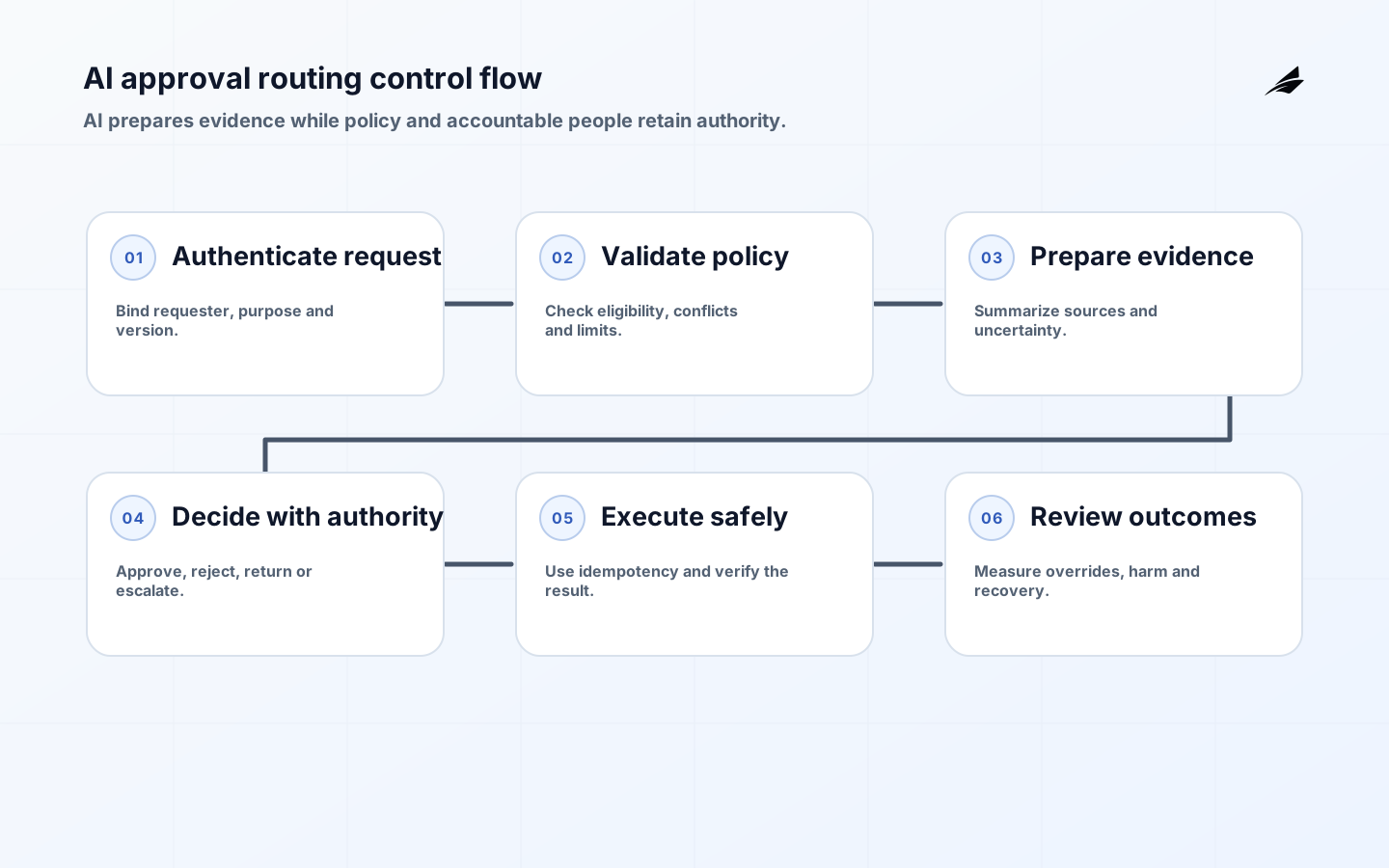
AI approval routing automation uses models to classify requests, gather evidence, recommend a route, summarize policy context, or prioritize review. It should not make decision authority disappear inside a score. A reliable design keeps authenticated identity, deterministic eligibility, approver authority, segregation of duties, execution, and audit evidence in trusted workflow services. The model helps people handle complexity; the application remains responsible for control.
This FAQ addresses implementation questions that appear after a prototype works. For deeper patterns, see Edilec's guides to AI workflow escalation rules, approval-agent mistakes, and human-in-the-loop automation failures. Use local legal, HR, finance, safety, and compliance expertise for decisions governed by specific obligations.
Key takeaways
- Automate preparation and routing before automating consequential approval decisions.
- Enforce eligibility, authority, amount limits, conflicts, and required approvals outside the model.
- Bind an approval to a fixed request version, evidence set, and exact proposed action.
- Treat low confidence, missing evidence, policy conflict, and out-of-scope cases as designed workflow states.
- Measure decision quality, review effort, overrides, missed risk, fairness, and recovery, not throughput alone.
What approval work is suitable for AI?
Good starting tasks are repetitive and evidence-heavy but reversible: classifying a request type, extracting fields from an approved document, identifying a missing attachment, finding the applicable policy section, summarizing prior decisions, or recommending the next reviewer. Start where a human already follows a stable process and the system can show its evidence. Avoid vague mandates such as deciding whether a request is good. Define the user, decision, permitted inputs, output, prohibited action, and safe fallback.
| Candidate task | AI role | Deterministic control | Human authority |
|---|---|---|---|
| Expense request | Extract category and summarize receipt | Policy limit, duplicate check, cost center, and approver map | Approve exception or material spend |
| Supplier onboarding | Flag missing or inconsistent documents | Sanctions, bank-change, tax, and segregation rules | Accept supplier risk and activate |
| Access request | Summarize role need and similar entitlements | Identity, resource policy, privilege limit, and expiry | Authorize privileged access |
| Contract deviation | Compare clauses and route issue type | Required legal review and prohibited terms | Accept legal or commercial risk |
| Customer credit | Assemble account and exposure evidence | Mandatory data, limit, and conflict rules | Make regulated or material credit decision |
The consequence determines the review model. Low-impact routing can be sampled; actions affecting money, access, employment, essential services, legal position, or safety usually need explicit authority and recourse. The NIST AI RMF helps teams map context, measure risk, assign governance, and manage outcomes. Use it to ask who is affected, what failure means, how performance varies, and which owner can stop or narrow the system.
What does a controlled architecture look like?
A request enters through an authenticated workflow. The application validates required fields and checks deterministic policy. Approved data is retrieved under the user's and service's permissions. The model returns a typed recommendation, reason, evidence references, and uncertainty. A policy service calculates the eligible route and required approval chain. The interface shows the reviewer the request, evidence, conflicts, model contribution, and exact effect. A transactional executor performs the approved action, then verifies the system of record.
| Layer | Trust boundary | Failure response |
|---|---|---|
| Intake | Authenticated requester and immutable request ID | Reject malformed input or save incomplete draft |
| Evidence | Approved sources filtered by identity, purpose, and freshness | Show missing or conflicting evidence |
| AI recommendation | Typed output treated as untrusted advice | Validate schema; abstain or route on uncertainty |
| Policy and routing | Deterministic rules for eligibility, authority, conflict, and sequence | Block invalid route and alert rule owner |
| Human decision | Eligible reviewer sees material context and action | Allow reject, return, escalate, or request evidence |
| Execution and audit | Idempotent command, system receipt, and protected log | Reconcile timeout, stop duplicate effect, and recover |
Do not place policy solely in the prompt. Prompts help the model interpret, but they are not a dependable authorization boundary. NIST SP 800-53 Rev. 5 provides a broad control catalog covering access control, audit, identification, system integrity, contingency planning, and other families that teams can tailor. The useful implementation is a server-side policy decision with evidence, version, and test cases, not a claim that the model was told to follow the policy.
How should confidence and exceptions work?
A model confidence score is not approval authority. It may support routing only after calibration on representative local data and with other signals such as evidence completeness, policy ambiguity, novelty, amount, and action consequence. Define bands with explicit behavior: auto-route a low-risk, well-supported request; send ambiguous classification to triage; require specialist review for a policy trigger; stop when required evidence is absent. Monitor performance within each band and across meaningful user groups.
Exceptions need a receiver, deadline, and complete context. A generic manual review queue often becomes the place where automation hides its hardest work. Use categories such as missing evidence, conflicting source, uncertain classification, no eligible approver, segregation conflict, stale request, policy exception, integration failure, and suspected manipulation. Capture which stage raised the exception and preserve the request version. Feed recurring cases into source quality, policy, form design, or evaluation rather than simply adding reviewers.
What makes human review meaningful?
The reviewer should see the decision, consequence, key evidence, source links or references, missing information, policy rule, prior steps, model recommendation, and alternatives. Avoid anchoring by revealing the recommendation only after the reviewer has seen critical facts for high-consequence cases, or run experiments to detect automation bias. Require a reason for overrides and exceptions, but keep it proportionate. The reviewer needs enough time and authority to disagree; a one-click screen under an unrealistic service target is ceremonial oversight.
- Verify the reviewer is currently eligible for the entity, amount, request type, and resource.
- Prevent requesters from approving their own material requests and detect indirect conflicts.
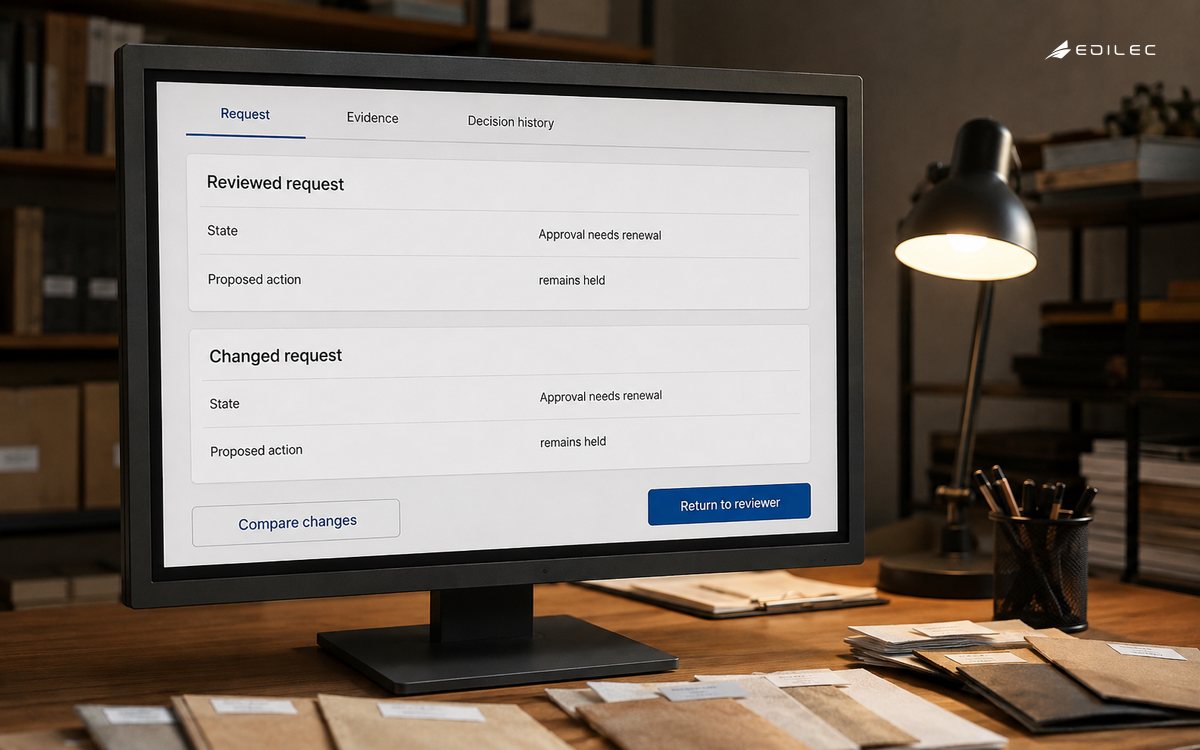
- Bind the decision to request version and evidence hash; any material change invalidates approval.
- Offer approve, reject, return for evidence, reassign, escalate, and report-a-problem states where applicable.
- Show what the action will do before confirmation and provide a receipt after execution.
- Create a recourse route for the affected person when the decision can materially affect them.
How should the workflow resist attack and leakage?
Treat request text, uploaded documents, retrieved content, and tool results as untrusted. An attachment may contain instructions intended to redirect the model or exfiltrate data. Isolate content from policy, restrict retrieval and tools by trusted identity, validate typed outputs, allowlist destinations, minimize secrets, and scan or sandbox file processing as appropriate. The OWASP agentic application guide offers current practical controls for systems with agency, while the NCSC secure AI guidelines frame security across design, development, deployment, and operation.
Audit evidence should support investigation without becoming a new sensitive-data lake. Record request ID and version, trusted identity, policy result and version, model and prompt version, evidence references, recommendation, human decision and reason, execution command ID, system receipt, and correction. Redact or tokenize protected fields in general logs. Limit audit access, define retention, and test retrieval for an investigation. Never log credentials, full payment details, or unrestricted document bodies simply because debugging is easier.
How should teams test and roll out approval routing?
| Evaluation area | Example test | Release gate |
|---|---|---|
| Routing quality | Routine, ambiguous, novel, and mislabeled requests | No critical route regression by class |
| Policy integrity | Amount boundary, expired authority, self-approval, and changed request | Deterministic controls always block invalid action |
| Evidence use | Missing, stale, conflicting, restricted, and injected documents | System exposes uncertainty and does not leak data |
| Human factors | Reviewer correction, anchoring, queue load, and decision time | Review remains meaningful and serviceable |
| Execution | Timeout after write, duplicate submit, downstream rejection, and reversal | No duplicate effect; reconciliation succeeds |
| Fairness and recourse | Relevant population slices and challenged decisions | Material disparities investigated and response route works |
Run in shadow mode first: generate routes and recommendations without changing the live workflow, then compare with actual decisions and final outcomes. Next allow AI-assisted preparation for a small team, keeping existing authority. Expand by request type and risk band, not by a percentage of random traffic alone. The NIST Generative AI Profile can inform generative-AI-specific risk review. Monitor overrides, exception age, rework, missed policy triggers, reviewer effort, outcome corrections, complaints, incidents, latency, and cost.
Keep a decision register for every scope expansion. State the eligible request population, model and policy versions, approval roles, evaluation results, known limitations, monitoring thresholds, fallback capacity, and owner who accepted the release. Set an expiry or review trigger. This makes gradual autonomy visible and prevents a temporary pilot exemption from becoming an undocumented permanent control.
Frequently asked questions
Can low-risk requests be auto-approved?
Possibly, if deterministic policy already permits the action, the consequence is low and reversible, evidence is complete, performance is proven for the population, monitoring is effective, and an accountable owner accepts residual risk. Let AI classify or extract within that controlled path; do not use a score to invent a new approval exemption.
Is a model-generated explanation enough for audit?
No. Audit needs trusted identity, source evidence, policy and versions, human authority where required, execution result, and correction history. A generated explanation may help a reviewer, but it can be incomplete or inconsistent with the actual action.
What changes require reevaluation?
Reevaluate material changes to model, prompt, policy, evidence source, form, taxonomy, reviewer population, authority map, tool, interface, risk level, or downstream system. Also update tests when incidents, overrides, challenges, and novel exceptions reveal missing cases.
Conclusion
AI approval routing automation is strongest when it makes evidence and exceptions easier to handle without blurring who may decide. A bounded AI role, deterministic policy, meaningful review, idempotent execution, protected audit evidence, and staged evaluation create that balance. The real outcome is not fewer approval clicks. It is faster, more consistent work with authority, recourse, and recovery still intact.