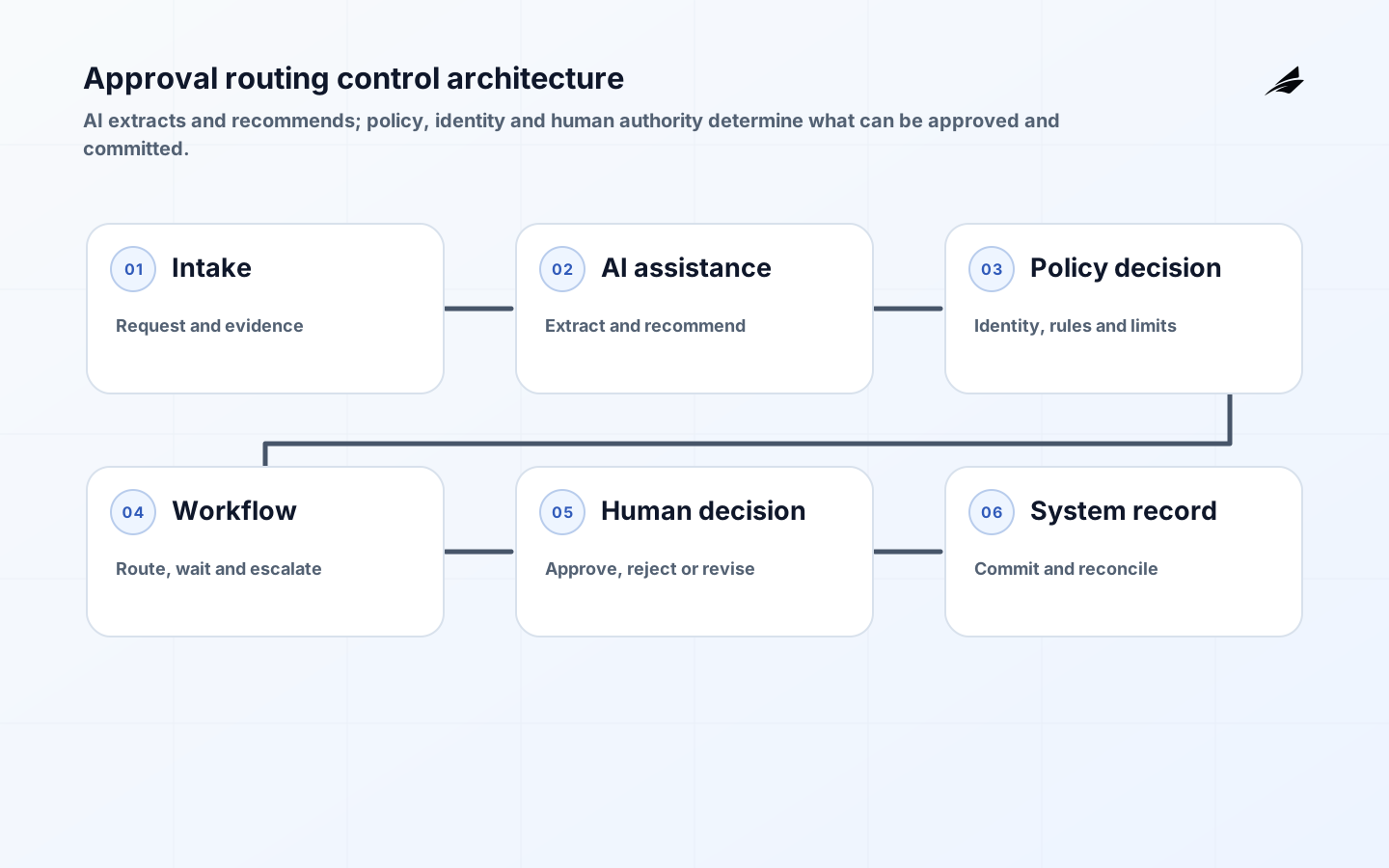
AI approval routing automation should make a decision process faster and easier to inspect, not hide policy inside a model. The safest design keeps authority in explicit business rules and named human roles. AI can classify the request, extract relevant facts, detect missing evidence, summarize supporting material and recommend a route. A workflow engine should still enforce who may approve, in what order, under which thresholds and with which exception path. That distinction is the foundation for a system that operations, finance, security and audit teams can trust.
What AI approval routing actually means
An approval workflow has two related decisions. The first is routing: which policy applies, what evidence is required and who must review the request. The second is disposition: approve, reject, return for changes or escalate. AI is usually most useful in the first decision, where unstructured text and attachments make manual triage slow. It may infer that a purchase request concerns software, identify a contract value and data-processing clause, then recommend finance, legal and security review. It should not silently invent a threshold or substitute a different approver because a prompt made that route seem plausible.
The Object Management Group's DMN specification is useful here because it treats decision logic as a first-class artifact. Even if a team does not adopt DMN tooling, the principle matters: keep the decision table versioned and testable, and keep orchestration in the workflow layer. NIST SP 800-53 reinforces two operational controls that map directly to approvals: separate duties where conflicts matter, and create audit records that identify the event, time, source, outcome and associated identity.
| Layer | Primary responsibility | What must remain explicit |
|---|---|---|
| Intake | Validate the request, attachments, requester identity and required fields | Allowed channels, schema, file limits and duplicate handling |
| AI assistance | Classify, extract, summarize and flag anomalies | Approved model, prompt/version, confidence and prohibited uses |
| Policy decision | Choose route, thresholds, quorum and separation-of-duty constraints | Versioned rules with an owner and effective date |
| Orchestration | Create tasks, wait, remind, time out and escalate | State transitions, idempotency and recovery behavior |
| Human decision | Approve, reject, request changes or delegate within policy | Identity, authority, rationale and conflict checks |
| System of record | Apply the authorized outcome and retain evidence | Final status, immutable decision history and reconciliation |
Choose where AI belongs and where it does not
Start by labeling each step as deterministic, assistive or judgment-based. Deterministic steps include amount thresholds, cost-center ownership, country restrictions, mandatory reviewers and deadline calculations. Assistive steps include document classification, entity extraction, duplicate detection and concise evidence summaries. Judgment-based steps include accepting commercial risk, granting an exception or deciding that an unusual request serves the business. This classification prevents a common failure: using a probabilistic model for a rule that was already clear enough to encode.
- Use AI to reduce reading and triage effort when inputs are unstructured or inconsistent.
- Use policy rules for monetary limits, regulated categories, approval authority and quorum.
- Require human review when consequences are material, confidence is low or evidence conflicts.
- Prohibit automatic approval for exceptions, self-approval, privileged access and high-impact commitments unless a documented policy specifically permits it.
- Send unknown categories and model failures to a named operations queue rather than guessing a route.
Design the routing policy before the model prompt
A routing matrix should be readable by the policy owner without opening application code. Give every rule an identifier, owner, effective date, test cases and precedence. Define whether conditions are cumulative, whether any one reviewer or every reviewer must respond, whether delegation is allowed and what happens when directory data is stale. Sequential, parallel and first-response approvals have different meanings; Microsoft documents these as distinct approval patterns, while AWS demonstrates a workflow that pauses until a callback resumes execution. Your design must also cover cancellation, duplicate callbacks and a response arriving after timeout.
| Policy question | Example answer | Required test |
|---|---|---|
| Who owns the request? | Cost-center owner from the authoritative finance directory | Missing, inactive and changed owner |
| Which reviews are mandatory? | Security for systems handling restricted data; legal for non-standard terms | Both conditions true, neither true and conflicting classifications |
| What is the approval order? | Manager, budget owner, then specialist reviewers in parallel | Early rejection, parallel partial response and reassignment |
| What blocks self-approval? | Requester cannot satisfy manager or budget-owner role | Requester holds multiple directory roles |
| What causes escalation? | No action within the role-specific service level or missing valid approver | Reminder, timeout, escalation and late response |
| What may be automated? | Low-risk standard requests that satisfy a documented auto-approval policy | Boundary values and policy-version regression suite |
Practical example: routing a software purchase
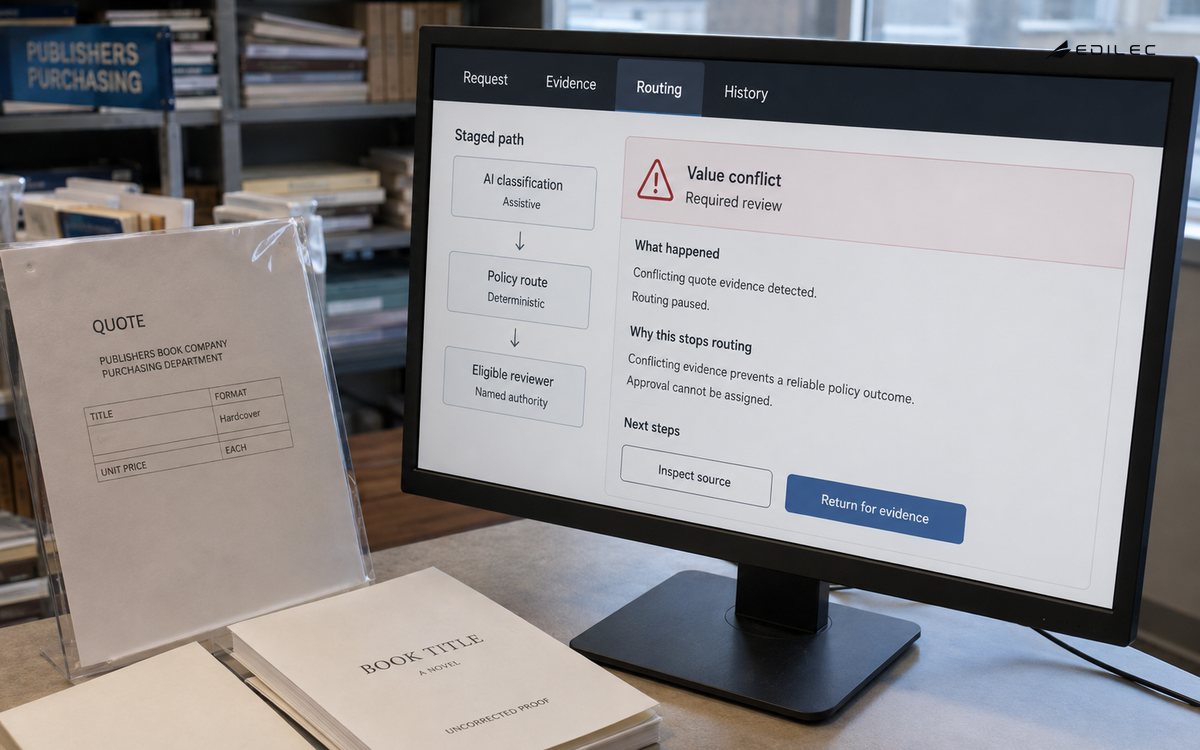
A requester submits a supplier quote, security questionnaire and business justification. The intake service validates the files and creates one canonical request ID. AI extracts supplier, total commitment, renewal term, data categories and hosting locations, attaching page references and confidence to each field. Rules then compare those facts with policy. The manager and budget owner review first. Security and privacy review in parallel if customer or employee data is involved; legal reviews non-standard terms. A discrepancy between the quote total and extracted contract value stops the route and sends the request to triage. No approval is inferred from silence. After all required decisions, the procurement system receives an idempotent update and the workflow reconciles the recorded purchase order with its own final state.
Build audit, security and governance into the state machine
Record the original request, normalized facts, supporting evidence references, model and prompt versions, rule version, route selected, each task assignment, reminders, delegations, decisions, comments and final system-of-record write. Protect the log from routine editing and avoid copying unnecessary personal or confidential content into it. An audit event should be useful without becoming a second uncontrolled document repository. Access must be role-based, and changes to routing policy should require review by someone other than the person deploying it when the process carries material risk.
For AI governance, use the NIST AI RMF functions as a recurring operating loop: govern ownership and acceptable use; map affected people, systems and consequences; measure route quality and harmful failure modes; manage issues and residual risk. ISO/IEC 42001 adds a management-system perspective for policies, risk treatment and continual improvement. Neither framework supplies a universal approval threshold. The organization must choose controls proportionate to the request and applicable obligations.
| Risk | Control | Operational signal |
|---|---|---|
| Wrong route from bad extraction | Field-level evidence, confidence gates and reviewer correction | Routing precision by request class |
| Self-approval or conflicting duties | Identity-aware separation rules evaluated at assignment and response | Blocked conflict attempts |
| Policy drift | Versioned rules, effective dates and regression tests | Requests processed under obsolete policy |
| Stalled requests | Durable timers, reminders, escalation owner and dead-letter queue | Age by workflow state and overdue rate |
| Duplicate side effects | Idempotency keys and reconciliation with the system of record | Duplicate callback and write attempts |
| Sensitive data exposure | Least privilege, minimized notifications and controlled evidence links | Unauthorized access and overshared notification incidents |
A six-stage rollout plan
- Baseline the current process. Sample real requests, map policy variants, quantify handoffs, rework, queue age and exception volume, and document who can authorize each outcome.
- Create a decision inventory. Separate deterministic rules, AI-assisted tasks and human judgment; resolve contradictory policies before automation.
- Run in shadow mode. Produce suggested classifications and routes without changing assignments, then compare them with actual expert decisions by category and consequence.
- Launch assisted routing. Let coordinators accept or correct the proposed route, capture reason codes and keep a fast manual fallback.
- Automate low-risk paths. Only after measured evidence, enable straight-through handling for explicitly permitted cases with monitoring, rollback and a narrow scope.
- Operate and review. Re-test rules when policy, models, organization structure or source systems change; review incidents and override patterns on a fixed cadence.
Measure quality, not just speed
Cycle time is useful but can improve while decision quality deteriorates. Track route precision and recall for each request class, correction rate, low-confidence rate, exception rate, overdue tasks, rework after approval, policy violations prevented, successful reconciliation and model or workflow failures. Segment results by business unit and consequence level. A small number of severe misroutes can matter more than a large number of harmless corrections, so pair aggregate metrics with incident review.
Key takeaways
- Keep approval authority in policy and named roles; use AI to interpret evidence and recommend routes.
- Represent routing rules as versioned, testable decision artifacts with clear precedence.
- Design durable wait states, timeouts, delegation, cancellation and idempotent callbacks before launch.
- Apply separation of duties and retain a complete but minimized audit history.
- Prove route quality in shadow and assisted modes before automating any disposition.
Frequently asked questions
Can AI approve a request automatically?
Only when a documented policy allows straight-through processing, the required facts are validated, consequences are low enough and monitoring plus rollback are in place. Many teams should begin with AI recommendations and human decisions. High-impact exceptions, conflicting evidence and separation-of-duty cases should remain human-controlled.
Should routing use rules or a machine-learning model?
Use both for different jobs. Models help interpret unstructured requests; rules enforce thresholds, authority and mandatory reviews. If a requirement can be stated unambiguously as policy, encoding it as a rule is easier to test and explain.
What belongs in the audit trail?
Record who or what acted, when, on which request, under which model and rule versions, what changed, the outcome and the evidence reference. Retain reviewer rationale for exceptions. Minimize sensitive content and protect the integrity and retention of the record.
Which approval process should be automated first?
Choose a frequent, bounded process with a stable policy, accessible source systems, measurable outcomes and moderate consequences. Avoid starting with the organization's most exceptional or politically contested approval path.
Conclusion
A dependable AI approval system is a governed decision service, not a chatbot attached to email. It combines validated intake, evidence-linked AI assistance, explicit policy, durable orchestration, accountable human action and reconciled records. Build those layers separately, test their boundaries and earn the right to automate higher-volume paths with evidence from production.