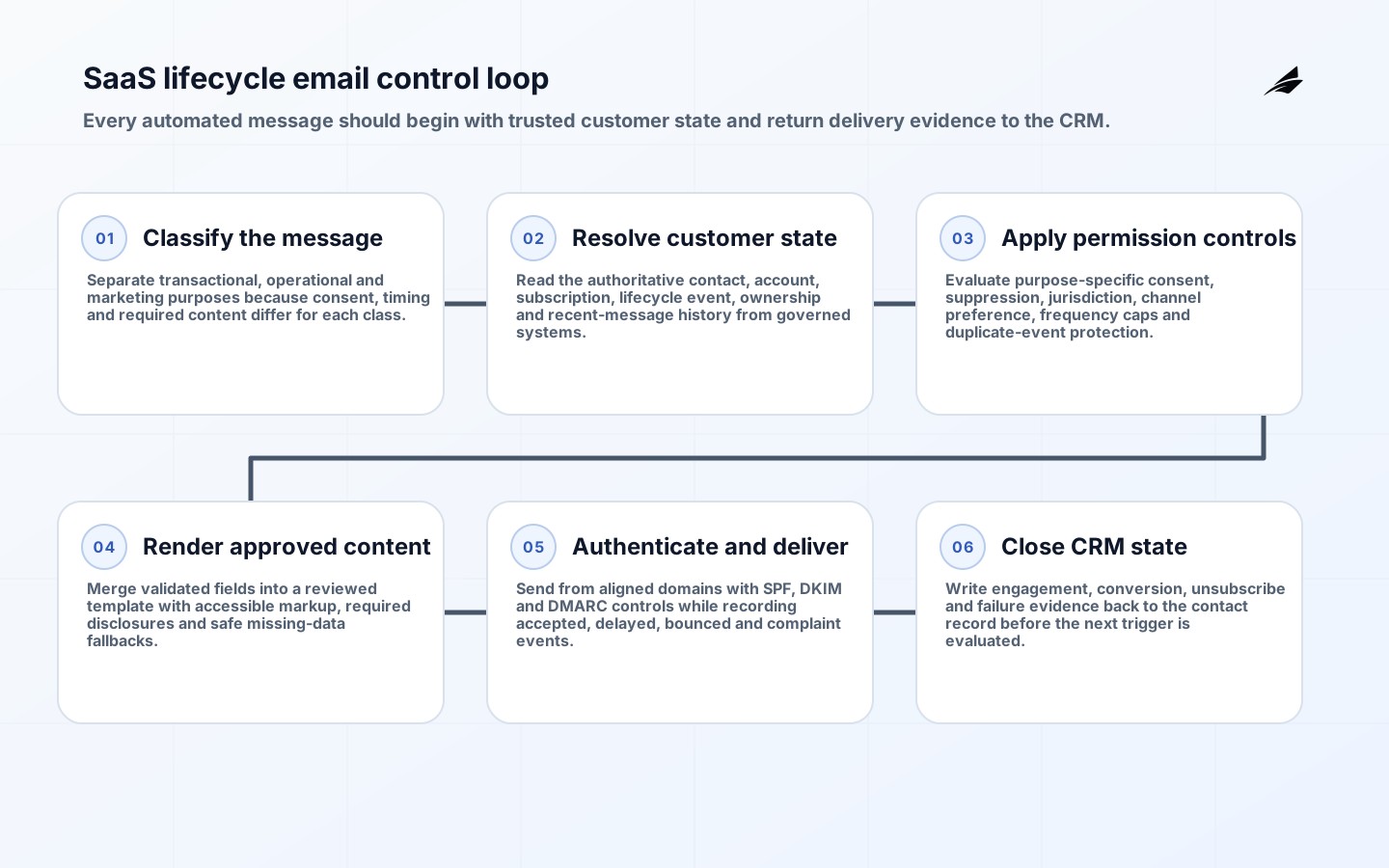
CRM email automation for SaaS companies is not a sequence of timed campaigns. It is a decision system that turns account events, customer permissions and product state into messages. A trial reminder, security alert, invoice receipt and renewal offer may share an email service, but they have different purposes, legal treatment, urgency and failure consequences. Reliable automation keeps those differences visible from the trigger through delivery, reply handling, suppression and measurement.
The questions below focus on architecture and operating decisions rather than vendor buttons. Teams preparing an implementation can use the companion SaaS CRM email automation checklist and business guide. Support leaders should also compare the support-team email automation plan because support messages carry different reply and case-ownership requirements.
What should be automated first?
Begin with a narrow message whose trigger and completion can be observed. Examples include confirming an account action, notifying an administrator that a requested export is ready, or asking a trial user to complete one missing setup step. Avoid starting with a large cross-sell journey that combines uncertain audience rules, many content variants and several downstream systems. A first workflow should prove identity resolution, consent, suppression, rendering, delivery telemetry and ownership of replies.
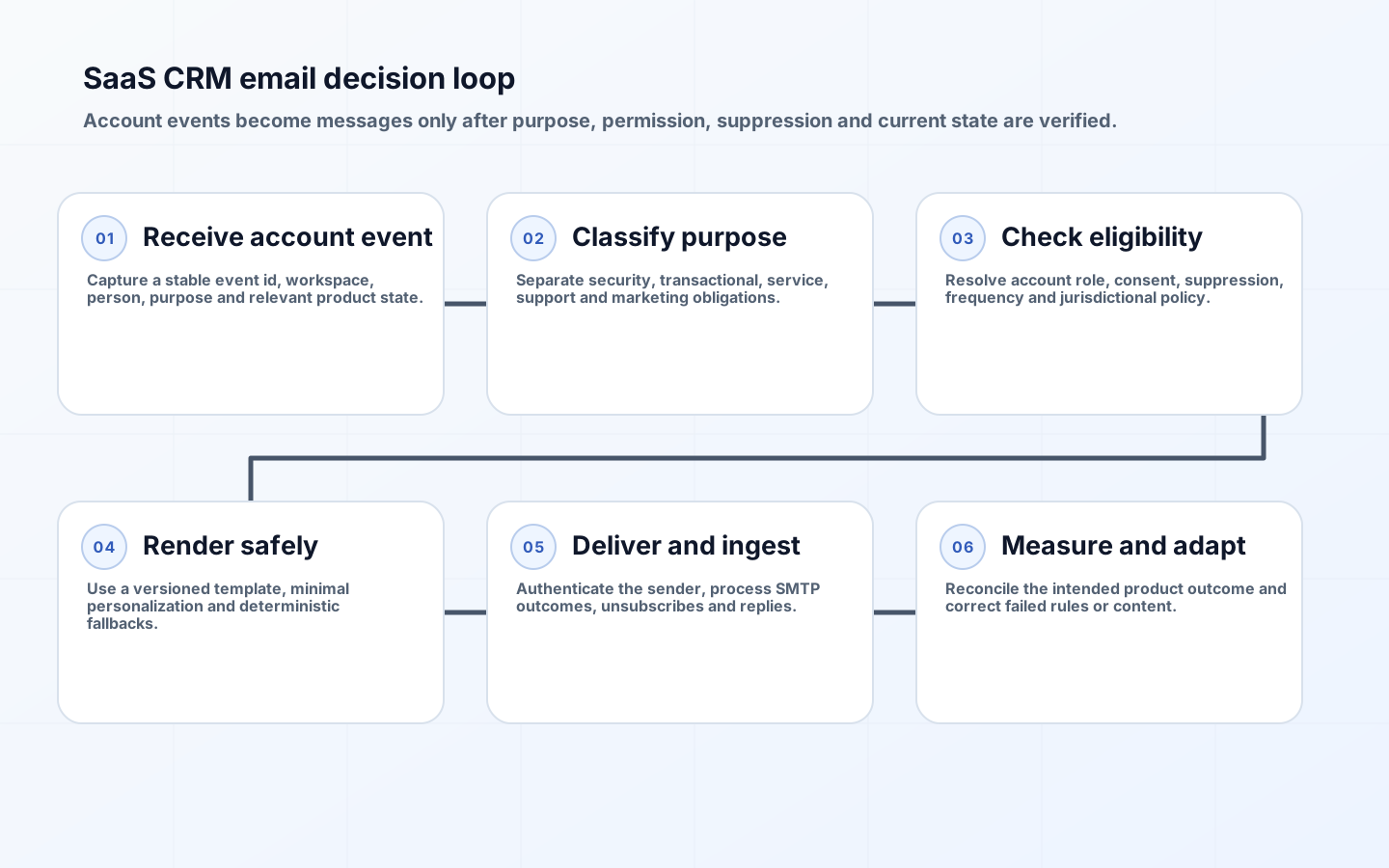
Classify every message as transactional, security, service, support or marketing according to its actual primary purpose. The FTC CAN-SPAM guide explains that transactional and commercial messages are treated differently, and mixing promotional material into an operational notice can change how a recipient reasonably interprets it. Local counsel should determine applicable law; the automation should preserve the classification and legal basis used at send time.
| Message class | Typical trigger | Essential control |
|---|---|---|
| Security | Password, sign-in or privilege event | Immediate delivery path, no marketing content, monitored failure. |
| Transactional | Invoice, receipt, export or agreed service action | Immutable event reference and accurate account recipient. |
| Service | Planned change, limit or product-status update | Audience snapshot and versioned notice content. |
| Support | Case update, request for evidence or resolution | Thread ownership, reply ingestion and case-state check. |
| Marketing | Lifecycle segment or campaign eligibility | Consent, frequency policy, suppression and one-click unsubscribe. |
Which system should decide whether to send?
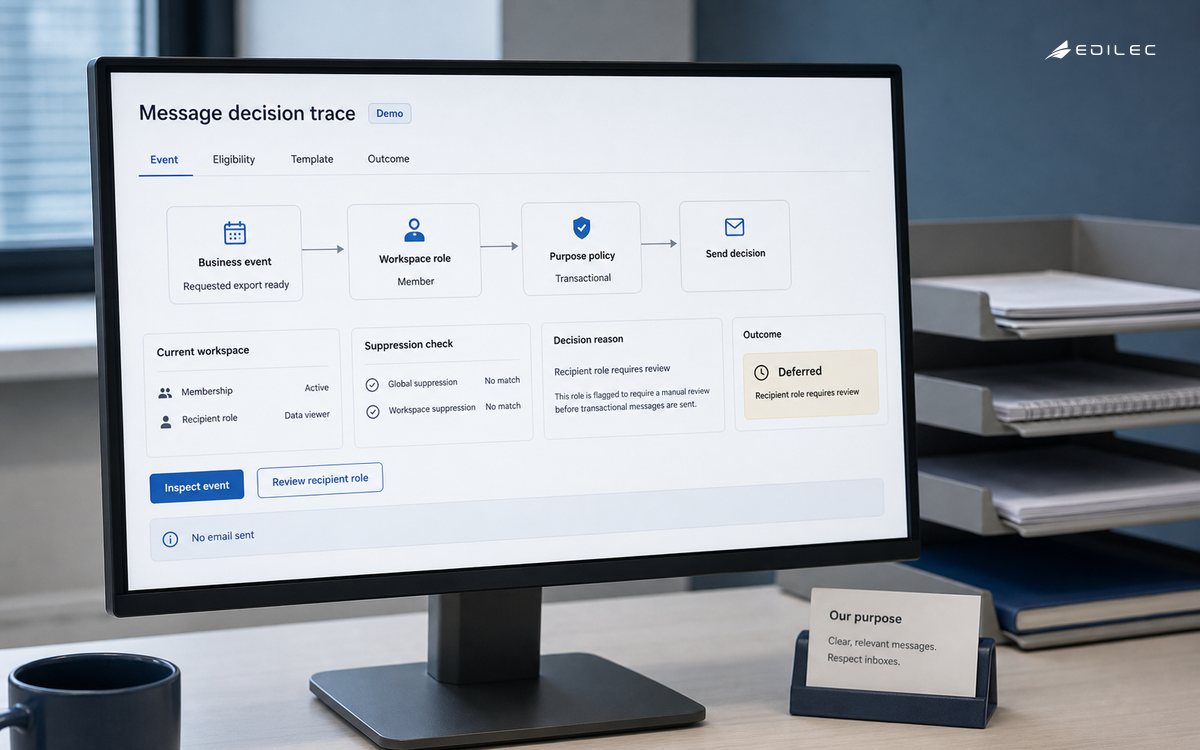
The product or billing system should emit a durable business event; the CRM or messaging orchestration layer should evaluate eligibility and communication policy. Do not make an email-open event the source of truth for account state. Give each message a stable event identifier, account and person identifiers, purpose, locale, template version and relevant product state. The orchestration service should record why it sent, deferred or suppressed the message.
Identity resolution is critical in B2B SaaS. One person may belong to several workspaces and hold different roles in each. An invoice notice may go to billing contacts, a security event to administrators, and a support reply to the requester. Model the relationship explicitly rather than attaching one email address to an account. When an address changes or a person leaves, historical records should remain interpretable without continuing to target the old identity.
How should consent and suppression work?
Store communication preferences as governed data, not as a boolean copied between tools. Record the person, purpose or channel, status, source, time, policy version and evidence. A preference center may offer granular choices, but a global marketing opt-out must override campaign eligibility. The EU GDPR includes a right to object to direct marketing, while United States commercial email rules include clear opt-out obligations. The NIST Privacy Framework helps connect these processing choices to enterprise privacy risk.
Build a central suppression check immediately before send. Include unsubscribe, hard bounce, complaint, invalid recipient, account closure, legal restriction and internal safety holds. Propagate changes to every sender and test eventual-consistency delays. A recipient should not receive another marketing message because one journey cached eligibility before the opt-out. Keep transactional and security exceptions narrowly defined and explain them in the preference experience.
What infrastructure is required for deliverability?
Authenticate each sending domain with SPF and DKIM, publish DMARC, use TLS and maintain aligned identifiers. Separate streams when reputation or purpose differs, but do not create a confusing forest of domains. Google's current email sender guidelines require authentication for all senders to personal Gmail accounts and additional controls for bulk senders, including DMARC alignment and one-click unsubscribe for marketing or subscribed messages. Requirements change, so assign an owner to review provider guidance rather than treating setup as permanent.
Warm new domains or IPs gradually, monitor bounces, deferrals and complaint rates, and stop increasing volume when receivers signal trouble. Implement one-click unsubscribe according to RFC 8058 where required, alongside a visible link in the message. Validate RFC-compliant headers, reverse DNS and From-domain alignment. Deliverability is an operational feedback loop, not a score that belongs only to marketing.
| Signal | What it can mean | Operational response |
|---|---|---|
| Hard bounce | Address or domain is invalid | Suppress promptly and inspect identity-source quality. |
| Temporary deferral | Rate, reputation or receiver capacity issue | Back off, preserve queue age and review SMTP codes. |
| Complaint | Recipient considers mail unwanted | Suppress, inspect acquisition source and segment logic. |
| Unsubscribe | Recipient withdrew marketing permission | Apply centrally before any subsequent campaign send. |
| Open or click | Client-reported engagement with measurement limits | Use cautiously; do not treat it as proof of customer success. |
| Reply | Customer expects a human or automated response | Ingest into the correct case or monitored mailbox with ownership. |
How should templates and personalization be controlled?
Version templates as production assets. Separate approved content from user data, escape untrusted fields, validate links and keep a plain-text alternative. Define behavior for missing names, long organization names, right-to-left languages and absent product data. Never expose one tenant's information through a reused render context or preview. Test common clients, dark mode, images disabled, narrow screens and assistive technology.
Personalization should make a message more relevant, not prove how much data the company holds. Use only fields required for the stated purpose. For generated summaries or recommendations, constrain source data, label uncertainty and route consequential content for review. Security, billing and contractual notices should use approved deterministic wording unless a controlled process explicitly permits variation.
How do you prevent duplicate or mistimed email?
Make event handling idempotent. The same product event may be delivered twice, a worker may restart, or a CRM sync may arrive out of order. Use an idempotency key that combines the business event and message purpose, then record the final send decision. Before sending a delayed message, re-read material account state. A reminder created yesterday may be wrong if the customer completed the task, upgraded, cancelled or opened a support case today.
Set frequency policies by purpose and audience. A cap for promotional lifecycle messages should not delay a security alert, while multiple product nudges should not compete in the same hour. Resolve priority centrally and make suppressed-by-frequency outcomes visible. When several workflows want to contact the same person, choose the message that best supports the current account objective rather than sending all eligible templates.
What should teams measure and how should they recover?
Measure the business result beside delivery. For onboarding, track the intended product action; for renewal notices, track successful acknowledgement or a resolved question; for support, track case progress and customer effort. Segment by message version, audience rule and deliverability state. Opens are increasingly incomplete because clients may preload or block tracking, so do not use them as the sole success criterion.
Create runbooks for a bad audience query, wrong template, broken link, domain block, delayed queue and compromised credential. The system should support pausing a workflow, identifying affected recipients, preserving the exact decision packet and sending a correction through an approved path. Practice the stop-send control before a high-volume launch. An incident review should improve event contracts, approvals and safeguards rather than merely blame the person who pressed publish.
Key takeaways
- Classify each message by purpose before designing a journey.
- Keep account state, identity, permission and suppression as governed inputs to the send decision.
- Authenticate domains and operate deliverability as an ongoing service.
- Recheck state before delayed sends and make event handling idempotent.
- Measure the customer outcome and maintain a tested stop-send and correction path.
Frequently asked questions
Should a SaaS company use one platform for transactional and marketing email?
It can, provided purpose, permissions, reputation, access and failure handling remain separated. Some teams use distinct providers or subdomains to reduce blast radius. The important design is not the number of tools but whether a marketing workflow can delay, suppress or alter a critical account message and whether operators can trace each stream independently.
Can AI write lifecycle and support emails automatically?
AI can help draft or summarize low-risk content, but the workflow still needs approved sources, protected customer context, output checks and a human review rule for consequential messages. Do not allow a model to invent account facts, policy terms or security instructions. Retain the prompt, source versions and approval decision needed to investigate a disputed message.
Do transactional emails need an unsubscribe link?
Requirements depend on jurisdiction and the message's primary purpose. A genuine transaction or security notice may need to reach the account contact even when marketing is disabled, but promotional content can change the analysis. Keep operational messages narrowly focused and obtain legal advice for the markets served. The automation should never use a transactional label as a way around a recipient's marketing choice.
Conclusion
Good SaaS CRM email automation is quiet infrastructure: it sends the right message for a recorded reason, to the right account role, with the right permission and a visible recovery path. Build from durable events, central policy, authenticated delivery and outcome measurement. That foundation supports useful lifecycle communication without sacrificing customer trust.