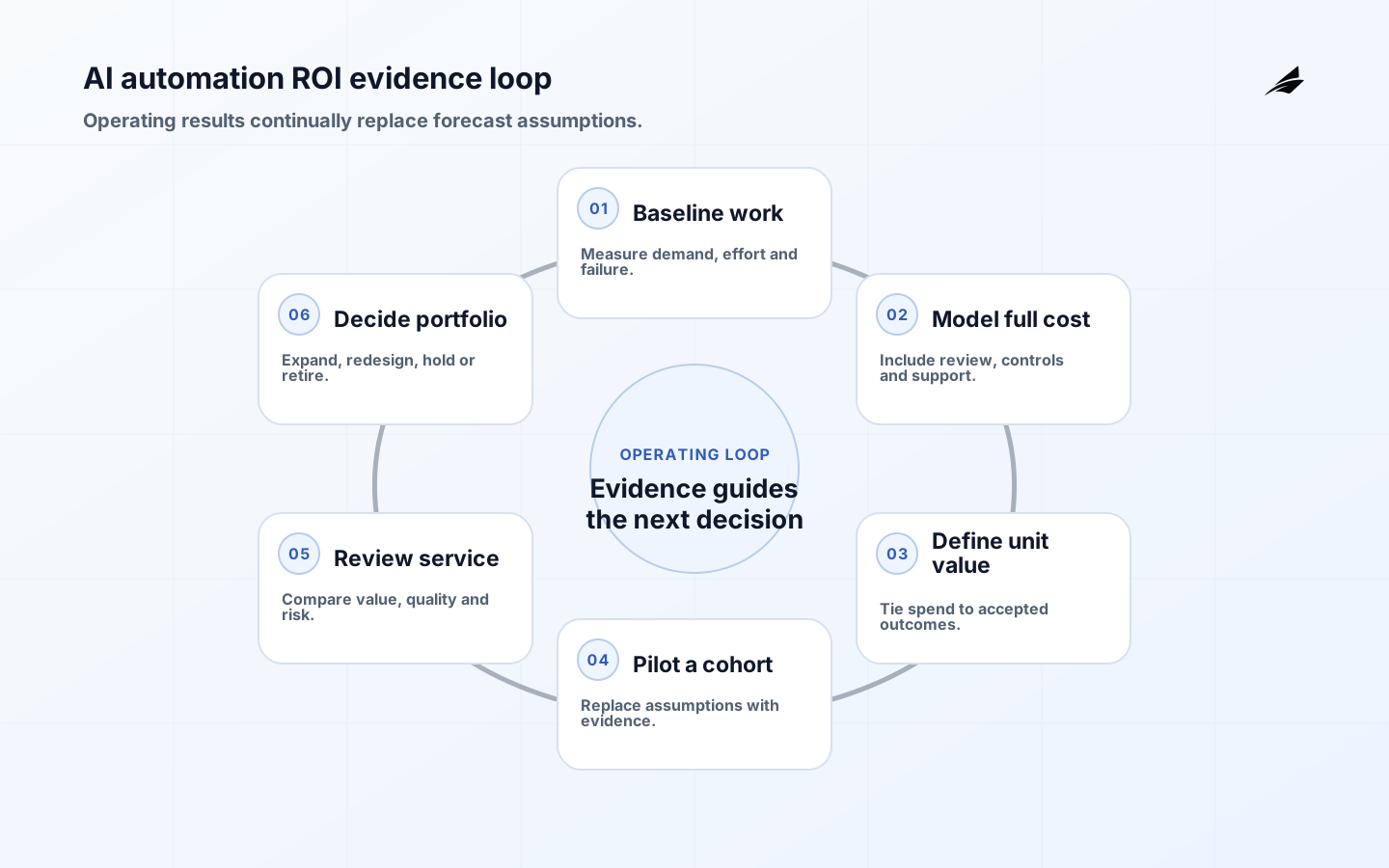
AI automation ROI planning should answer a management question: under what measured conditions should this workflow be funded, expanded, changed or stopped? Starting with token price or a vendor productivity claim gives a precise-looking but incomplete result. Begin with the work, its demand, the decision being improved and the consequence of error. Then include build, integration, evaluation, human review, security, observability, support and change costs. The FinOps Foundation defines unit economics as connecting technology use and management to the value of products, services or activities. For automation, that means cost per completed and accepted business outcome, not cost per model call.
Establish a decision-ready baseline
Observe a representative period before changing the workflow. Capture arrival volume, active handling time, elapsed time, backlog age, rework, corrections, escalation, abandonment and service failures. Separate waiting from labor: shortening an approval queue improves service but does not automatically remove cost. Segment by work type, customer, language, business unit and complexity so a median does not hide expensive exceptions. Name the system of record and calculation owner for each baseline. The business approval agent guide helps identify authority and exception measures when the use case includes consequential decisions.

| Benefit claim | Baseline evidence | Realization test |
|---|---|---|
| Faster service | Elapsed time by comparable work class | Accepted cases finish sooner without a larger downstream queue |
| Recovered capacity | Active handling and review minutes | Named work absorbs the released capacity or spend changes |
| Fewer errors | Correction and reconciliation rate | Comparable outcomes need fewer amendments |
| Better availability | Backlog age during peaks | Service level holds under forecast demand |
| Lower risk | Unsafe action and policy exception rate | Control tests and incidents stay within threshold |
Model the fully loaded service cost
Separate one-time discovery and integration from recurring operation. Recurring cost includes model and API use, retrieval, storage, evaluations, review, monitoring, incident response, vendor management, prompt or policy changes and support. Estimate a base, conservative and stress case. Demand, input size and exception rate can rise together, so do not vary them independently without justification. Treat avoided hiring as a benefit only if the staffing plan changes; otherwise describe recovered capacity or service improvement. The human review workflow guide is useful for estimating reviewer load rather than pretending it disappears.
Choose a business unit of value
A useful denominator is completed work that meets acceptance criteria: an invoice posted correctly, case resolved, report approved or lead qualified. Track model calls and tokens as engineering drivers underneath that business unit. Fully load shared platform cost using a documented allocation rule, and keep quality beside cost. A falling cost per document can be misleading if manual correction or customer complaints rise. Review the unit trend over time within the same workflow; comparisons across unrelated products are rarely fair. FinOps guidance also recommends documenting data sources and refreshing metrics when they no longer improve decisions.
| Scenario | Adoption and review assumption | Decision use |
|---|---|---|
| Conservative | Low adoption, broad review and high exceptions | Confirms downside is affordable and reversible |
| Planned | Pilot adoption and measured reviewer effort | Supports the operating budget and break-even range |
| Stress | Demand spike, provider issue or forced manual fallback | Tests resilience and maximum support burden |
| Expansion | New cohort with different data or consequence | Shows whether evidence transfers or a new pilot is required |
Design a pilot that can replace assumptions
Choose one bounded workflow with measurable volume, available historical examples and a business owner who can validate outcomes. Define eligibility, authority, manual fallback, spend limit, evaluation threshold and stop rule before launch. Instrument rejected suggestions, edits, retries, tool errors and cases completed outside the new path. Compare against a similar historical or concurrent cohort while documenting seasonality and policy changes. A pilot is complete when it supports a decision, not when the demonstration looks good. Use the internal-tool quality framework to test difficult cases and reviewer agreement.
Govern ROI at portfolio level
Automations share providers, platforms, reviewers and risk appetite. Keep a portfolio record of owner, workflow, authority, data class, dependency, expected unit value, actual unit cost, evaluation status and next decision date. This reveals duplicate assistants and concentrated vendor or review capacity. NIST’s AI RMF Core calls for ongoing monitoring, clear responsibilities and safe decommissioning. A monthly forum should expand strong services, correct weak controls and retire experiments whose measured benefit does not justify their support or risk.
- Record whether each benefit is cash, avoided cost, capacity, service level or learning.
- Do not count handling-time reduction again as both capacity and savings.
- Attach every forecast assumption to a data owner and refresh date.
- Include reviewer interception and near misses in the risk evidence.
- Fund an exit path so ending a weak automation is an available decision.
Turn the business case into an operating review
After release, compare forecast and actual demand, acceptance, correction, review minutes, reliability, unit cost and business outcome on a fixed cadence. Annotate baseline changes rather than manufacturing a gain. Provider price reductions do not prove ROI if usage expands faster; rising cost can be rational when accepted outcomes rise more. Record each decision and its date: hold the boundary, improve data, change the workflow, expand a cohort or retire the service. OECD’s accountability principle emphasizes lifecycle traceability, which is exactly what makes an ROI narrative auditable.
Avoid false attribution
A before-and-after improvement may come from staffing, policy, seasonality, training or a simultaneous product change. Document these factors and use comparison cohorts where practical. For lower-volume workflows, combine quantitative results with sampled task observation and reviewer interviews rather than claiming statistical certainty. Distinguish adoption from effect: frequent use does not prove value, and low use may indicate poor fit rather than resistance. Keep the causal claim modest and decision-oriented. Leadership usually needs to know whether evidence is strong enough for the next investment, not whether the pilot has produced an academically perfect estimate.
Keep risk-adjusted value visible
Some benefits are asymmetric. A faster process may save minutes on thousands of cases but create one rare, costly unauthorized action. Model expected operational cost where evidence supports it, and use hard risk limits where money would trivialize unacceptable outcomes. Include the value of reviewer interception and fallback: those controls may reduce apparent labor saving while making the service viable. Likewise, an automation that improves traceability or consistency can create value before headcount changes. Present the financial model beside risk, service and learning outcomes so a sponsor cannot use one favorable number to hide a failing control.
Test the commercial model under scale
Provider pricing often combines input and output usage, provisioned capacity, storage, search, network transfer and support. Translate the contract into the business unit model and test it against long inputs, retries, peak demand and minimum commitments. Include taxes and currency exposure where material. Record whether discounts require a volume commitment that reduces exit flexibility. Procurement should negotiate data export, usage reporting and change notice because cost control depends on observability. Reforecast before committing to capacity: pilot traffic can be too small and too clean to reveal prompt growth, exception review or tenancy patterns that dominate production spend.
Worked example: document intake automation
Suppose a team receives 8,000 documents each month. The baseline shows twelve active minutes per document, three days elapsed time, a nine percent correction rate and a growing peak backlog. The proposed workflow extracts fields, checks completeness and routes uncertain cases to a reviewer. The business unit is an accepted document posted to the target system, not a page or model request. The conservative case assumes only half the volume is eligible, reviewers inspect every extracted field and exceptions remain high. The planned case uses pilot acceptance and reviewer minutes. The stress case doubles average input size and includes a provider outage that activates manual fallback.
The decision table should show monthly platform and model cost, review labor, support, expected accepted units, correction, elapsed time and backlog outcome for each case. Recovered capacity is assigned to peak demand and faster customer response, not labeled as cash saving unless the staffing or contract budget changes. Expansion requires the acceptance threshold, stable correction rate and tested fallback; a rise in unresolved exceptions pauses the cohort. This model gives finance, operations and engineering the same assumptions and reveals whether better extraction, simpler forms or process redesign would create more value than adding more model capability.
Key takeaways
- Measure present work before estimating value.
- Use fully loaded service cost and a business outcome denominator.
- Model conservative, planned and stress scenarios.
- Pilot with explicit expansion and stop rules.
- Refresh the case from production evidence and retire weak services deliberately.
Frequently asked questions
What is a good ROI target for AI automation?
There is no universal percentage. The threshold depends on investment alternatives, consequence, uncertainty and whether value appears as cash, capacity or service quality. Use the organization’s normal hurdle logic and keep nonfinancial risk thresholds separate.
How long should the pilot run?
Long enough to cover normal variation, difficult cases and at least one operating review. Sample size and workload rhythm matter more than a fixed number of weeks. Stop when the agreed evidence can support a scale, redesign or end decision.
How should quality enter the calculation?
Include correction effort, delayed work, required review and remediation. Keep unacceptable harms as hard thresholds rather than forcing them into money. A cheaper path that crosses an authority or safety boundary is not a positive return.
Conclusion
AI automation ROI planning is most useful as a living decision record. A measured baseline, complete cost model, representative pilot and recurring portfolio review turn hopeful claims into investments IT managers can operate responsibly.