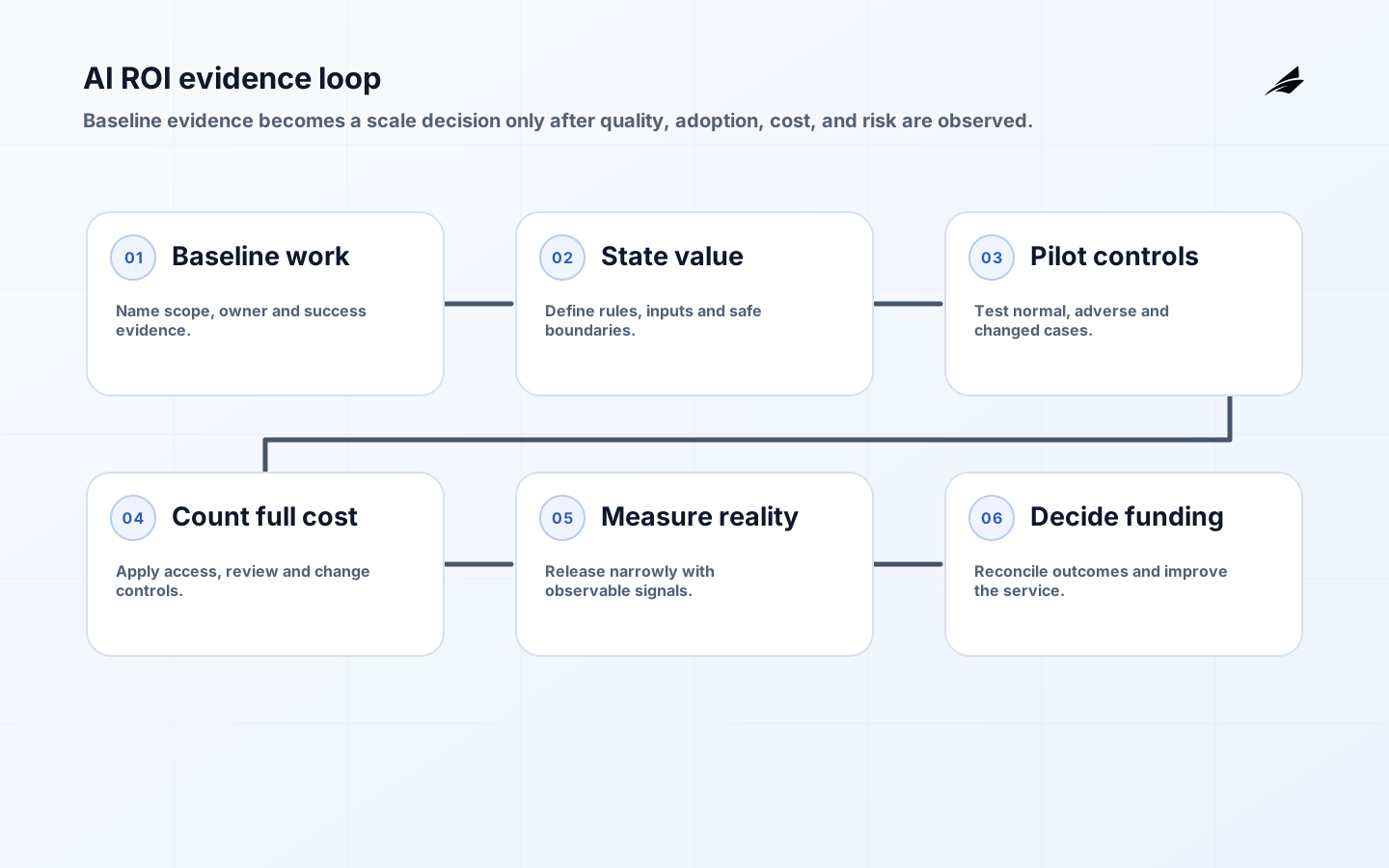
AI automation ROI planning should begin with the present cost of a specific workflow. Measure incoming volume, handling and waiting time, rework, escalation, error correction, and the demand placed on customers or employees. Then separate steps that a model might assist from policy judgments, approvals, and system changes that still need accountable control. The investment case must include integration, evaluation, human review, exception handling, monitoring, vendor usage, security, and ongoing change—not just inference charges or minutes apparently saved in a demonstration. State the expected adoption and quality assumptions so a pilot can disprove them. Involve the operators who know where work actually accumulates and the finance owner who will recognize realized value. Use the ROI mistakes guide to challenge optimistic estimates and the AI escalation design guide to price the cases automation should hand back.
Establish the operating baseline
Build the ROI baseline from eligible work, not the entire queue. Count monthly cases that fit the proposed boundary, then measure active handling time, waiting, handoffs, corrections, abandonment, and exception effort for that cohort. Interview the people who finish difficult cases and note the records or permissions they need. Separate observed values from planning assumptions: transaction volume and labor time can be measured, while adoption, acceptance, and model performance remain hypotheses until a pilot runs. Preserve the sampling method and period so later comparisons use the same denominator. This baseline keeps a seasonal dip or shifted backlog from being presented as automation value.
| ROI baseline dimension | Measurement before automation | Planning implication |
|---|---|---|
| Workload | Cases by type, arrival pattern, seasonality, and percentage with missing information. | Pilot cohort, capacity assumption, and expected adoption. |
| Human judgment | Steps involving interpretation, policy discretion, approval limits, or sensitive communication. | Automation boundary and required reviewer roles. |
| Current outcome | First-pass completion, error correction, waiting time, abandonment, and service-level misses. | Benefit hypothesis and quality guardrails. |
| Operating dependencies | Authoritative data, access constraints, integration calls, handoffs, and support procedures. | Implementation effort and recurring service cost. |
| Financial ownership | Budget holder, benefit recipient, displaced or added effort, and measurement owner. | Who recognizes realized value and approves expansion. |
Set a bounded first scope
Define the pilot as an economic test with one user group, one input class, one output, and one manual fallback. Prefer work with stable source records and enough volume to reveal variation. State whether the system drafts, extracts, classifies, or recommends, and reserve final actions when consequences require accountable review. Every routed exception needs a receiver, reason, and evidence bundle; otherwise hidden manual effort will make the return look better than it is. The AI automation ROI planning guide for IT managers covers adjacent implementation choices. For the checklist, record the funded boundary and reject benefit claims that depend on capabilities outside it.
- Select a repeated workflow whose baseline volume, cost, delay, and error burden are measurable.
- Separate assistive model steps from accountable approvals and irreversible system actions.
- Choose a cohort that includes ordinary work, difficult exceptions, and realistic peak conditions.
- Predefine quality floors, review requirements, cost ceilings, and conditions that stop the pilot.
- Instrument human handling, correction, escalation, support, model, and integration effort.
- Keep the existing route capable of completing work while the value claim is tested.
Design controls into the workflow
Price the controls as part of delivery and operation. Access checks, source filtering, human review, quality sampling, audit retention, incident response, and supplier oversight all consume time or platform capacity. The NIST AI Risk Management Framework provides a useful Map, Measure, Manage, and Govern structure for deciding which controls the workflow needs. Review intensity should follow consequence: sampled checks may suit low-risk drafting, while changes to money, access, safety, or employment require explicit authority and stronger evidence. A business case that excludes mandatory control work is incomplete, because those controls determine whether the workflow can operate at the forecast volume.
| ROI control | Implementation in the pilot | Evidence for the investment decision |
|---|---|---|
| Scoped participation | Limit the release to named users, case types, data sources, and permitted outcomes. | Adoption, out-of-scope attempts, and access exceptions. |
| Accepted-result evidence | Connect source facts, model proposal, reviewer action, correction, and final disposition. | First-pass acceptance and error cost after human review. |
| Exception capacity | Send ambiguity and policy exceptions to trained reviewers with required context. | Handoff rate, queue delay, reviewer minutes, and repeated causes. |
| Cost attribution | Record vendor usage, integration operation, evaluation, monitoring, support, and change effort. | Net cost per accepted outcome at observed volume. |
| Reversible release | Pause new automated processing and return queued cases to the established workflow. | Catch-up burden, customer impact, and time to safe operation. |
Run a pilot that tests the claim
Write pilot acceptance rules before evaluating output. The test set should represent common cases, expensive exceptions, different source conditions, and situations where abstention is correct. Compare the assisted path with the baseline using eligible completion, reviewer correction, elapsed time, exception rate, quality failures, and cost per accepted outcome. Inspect individual records alongside aggregate results because a small high-consequence failure class can disappear in an average. Keep model, prompt, data, and policy versions with each run. The checklist passes only when the team has evidence that the workflow is useful, controllable, supportable, and recoverable; polished examples do not establish any of those properties.
- Compare pilot and baseline cases on final quality, elapsed time, and total human touch.
- Inspect incomplete, conflicting, high-consequence, and policy-exception cases separately.
- Count corrections and reviewer minutes instead of treating model output as completed work.
- Include model, infrastructure, integration, evaluation, security, support, and governance costs.
- Exercise a service pause and measure the effort needed to return cases to the manual route.
- Require finance and workflow owners to accept, revise, or reject the realized-value case.
Price the full service
Complete the cost model across the lifecycle. One-time items include discovery, process redesign, integration, data preparation, security review, evaluation design, and rollout. Recurring items include model or provider usage, hosting, licenses, observability, quality review, exception handling, support, retraining or prompt maintenance, and periodic control testing. Allocate shared platform costs by a declared method. Report capacity released separately from cash avoided; two saved minutes do not become a cash benefit unless staffing, outsourcing, throughput, or service quality changes in a measurable way. Use cost per eligible case and cost per accepted outcome so finance can see how adoption and corrections affect the result.
Operate, learn, and change deliberately
Recalculate realized value after release on a fixed cadence. Track eligible volume, actual adoption, accepted outputs, reviewer minutes, exception backlog, quality samples, provider usage, support work, and downstream corrections. Investigate changes in workload mix before attributing movement to automation. A lower correction count may reflect under-reporting, while faster completion may hide work moved to another queue. The NIST Cybersecurity Framework is a useful companion for keeping governance, protection, detection, response, and recovery in the operating cost. Update the forecast with observed values and require a new decision when scope, provider, model, source system, or risk posture changes materially.
Calculate realized value, not theoretical savings

Suppose 8,000 support cases arrive monthly and an assistant drafts replies. If 3,000 are eligible, 70 percent are accepted, and each accepted draft saves two minutes, gross capacity is 70 hours, not 267. Subtract review, exceptions, quality sampling, platform operations, and amortized delivery cost. Then state what released capacity enables. Capacity, cash saving, faster response, and improved quality are different benefits and should not be merged into one unsupported return figure.
Use this review with the article tables and linked Edilec guides. Sample completed records as well as exceptions, retain the rule and source versions that produced each outcome, and assign every corrective action to a policy, data, interface, integration, security, or operating owner. Metrics indicate where to investigate; representative cases reveal what must change. Before scope expands, repeat the exercise with an unavailable dependency, a delayed message, an unauthorized user, and a correction after the nominal process has finished. This review is specific to automation value and operating cost.
- Freeze volume mix effort quality and delay baseline.
- Define eligible work adoption and quality floor.
- Separate delivery from recurring run cost.
- Count accepted use and downstream burden.
- Model adverse adoption and cost cases.
- Set expand redesign hold and stop criteria.
Key takeaways
- Build the ROI model from measured workflow demand, delays, errors, and labor—not hypothetical token throughput.
- Treat review, exceptions, monitoring, support, security, integration, and change management as recurring costs.
- Measure accepted final outcomes and service effects after correction rather than raw model responses.
- Use a bounded pilot with explicit quality floors, financial assumptions, stop rules, and manual continuity.
- Have the budget holder and affected operators validate whether savings or capacity are actually realized.
- Scale only when the evidence supports a durable net benefit at the expected operating volume.
Frequently asked questions
What is the smallest sensible starting point?
Start the ROI test where inputs can be traced and a reviewer can correct the output before harm spreads. The case should recur often enough to expose normal variation but remain narrow enough to isolate costs and outcomes. A single invoice type, support intent, or policy threshold is often more informative than a broad departmental launch. Instrument the manual and assisted paths with the same eligibility rule. That makes exceptions, ownership gaps, review effort, and support demand visible. Expansion should be a second funding decision based on that evidence, not an assumption embedded in the original return calculation.
How should success be measured?
Tie every ROI measure to the funded claim. For capacity, measure accepted eligible work and net handling minutes after review. For speed, compare end-to-end elapsed time at similar demand. For quality, use defined defects and downstream correction cost. For risk reduction, identify the control failure or exposure being reduced without inventing a monetary value that cannot be defended. Segment metrics by case type, inspect representative outcomes with operators, and assign an owner to explain variance. Predefine the threshold that triggers investigation, a scope pause, or redesign so the team does not reinterpret weak results after the fact.
When should a team stop or redesign the work?
Use explicit stop conditions. Pause when representative quality falls below the acceptance threshold, exceptions consume the expected saving, required access cannot be constrained, reviewers lack enough evidence, the fallback queue breaches service levels, or recurring cost exceeds the approved value range. Redesign may be appropriate when the issue is a repairable process or data boundary; retirement is appropriate when the economics or risk remain unfavorable. Preserve the baseline, test results, cost model, and decision rationale. Ending a weak pilot protects capital and gives the next proposal better evidence about inputs, integration, policy, and user needs.
Conclusion
A credible automation return is realized in the operating budget or service outcome, not inferred from model speed. Baseline the full workflow, fund a bounded pilot, and compare accepted outcomes after review, corrections, exceptions, and support effort. Keep the manual route and stop criteria available while evidence is weak. Before scaling, finance, operators, policy owners, and service support should inspect representative cases and confirm which benefits persist, which costs moved, and which risks require more control. Expand only the scope whose net value and operating ownership are demonstrated.