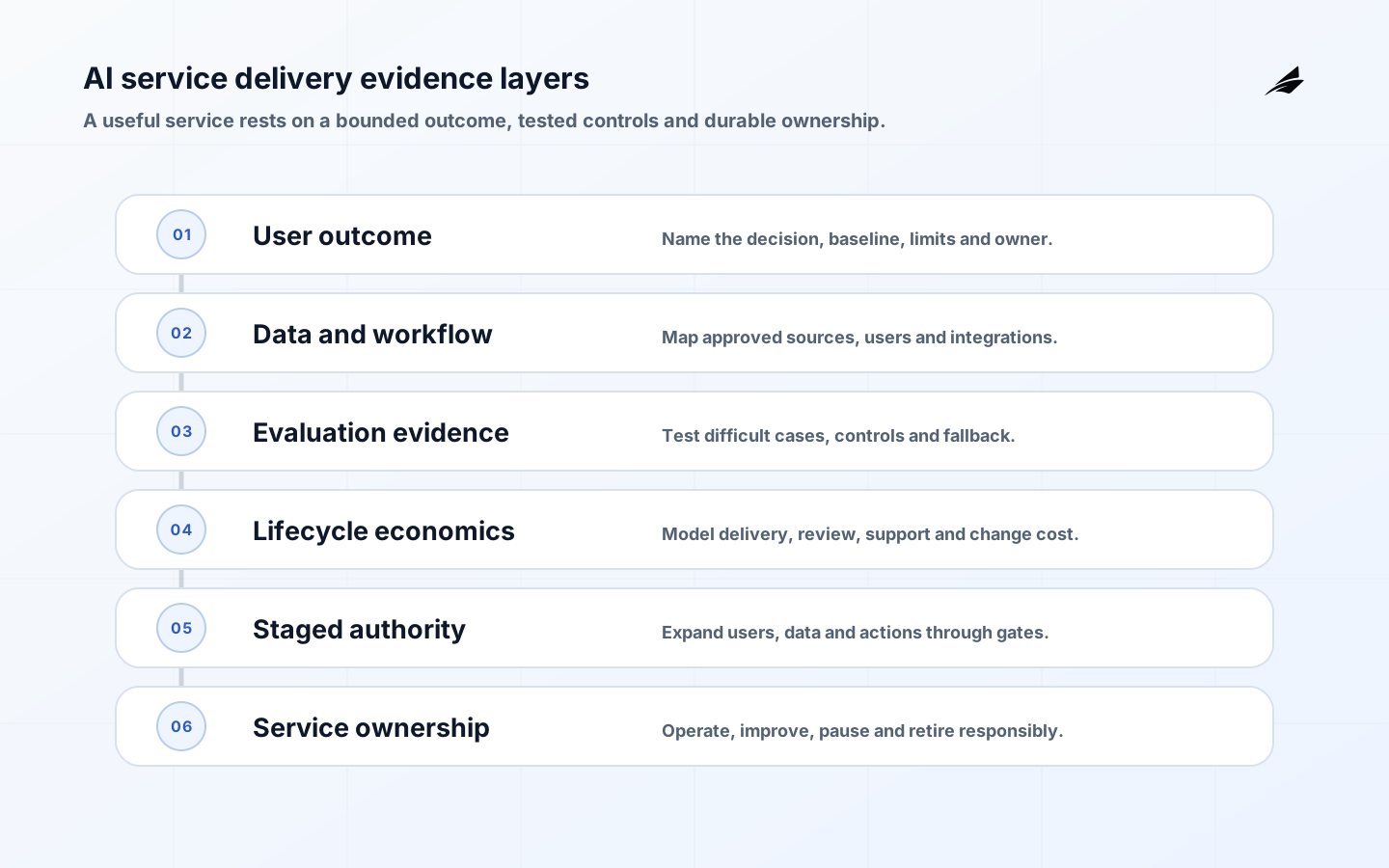
An AI services delivery plan should describe an operating change, not a model purchase. It must connect one user outcome to approved data, a testable workflow, proportionate controls, lifecycle cost and named ownership after launch. It should also make stopping credible. A fluent prototype has not demonstrated privacy, integration, recovery, support or sustained value.
Use the AI services implementation checklist, AI services FAQ, and AI workflow automation services guide. The AI approval routing checklist shows a bounded application.
A useful planning spine comes from the NIST AI Risk Management Framework, NIST Generative AI Profile, NIST Privacy Framework, and ISO/IEC 42001. They address lifecycle risk, generative systems, privacy and organizational management.
AI Services: Scope, Cost, Risks and Delivery Plan
Artificial intelligence AI services are often discussed as a purchase, but successful delivery is an operating change. A team must decide which work is in scope, what outcome users need, which data and systems can be used, how outputs are tested, and who supports the service once attention moves elsewhere. This guide avoids universal cost or performance promises because both depend on the use, existing systems, data condition, integration, security, and required level of assurance. Instead, it gives a planning method that makes assumptions visible. The NIST AI Risk Management Framework is useful for organizing that work across governance, context, measurement, and management.
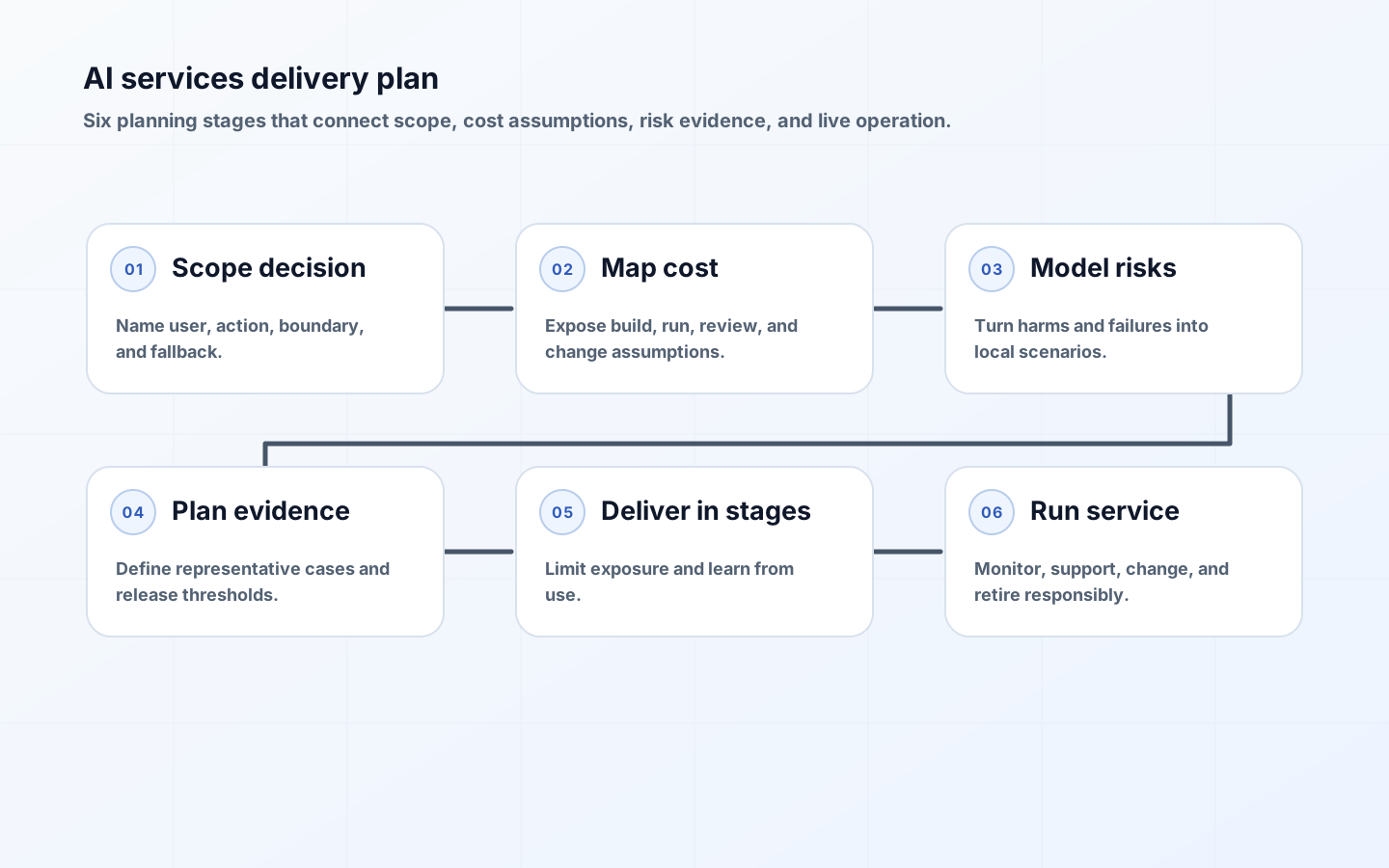
Scope the decision
Scope one decision, recommendation, or handoff before describing a technology. Name the user, trigger, input sources, intended output, possible action, and escalation authority. Define non-goals and high-consequence boundaries. A service that helps a manager locate policy information is not equivalent to one that recommends a staffing action, even if both use similar language models. Map the current workflow with people who perform it, including delays, exceptions, informal checks, and dependencies. The map will often show that the first delivery is a data cleanup, interface improvement, or retrieval service rather than an automated decision. That is progress: a realistic scope prevents a delivery plan from hiding unresolved policy choices.

| Scope element | Planning question | Useful artifact |
|---|---|---|
| Outcome | What will be better for a user? | Measurable service statement. |
| Boundary | What is explicitly excluded? | Non-goals and escalation rules. |
| Authority | Who can act on the output? | Role and approval path. |
| Dependency | What must remain available? | System and data dependency map. |
Understand cost drivers
Discuss cost as categories and assumptions, not a misleading single number. Discovery consumes time to map work, assess data, and settle authority. Build effort can include design, integration, evaluation, security review, user experience, and migration. Run cost may include provider usage, infrastructure, monitoring, support, retraining or re-evaluation, and periodic access review. A small model or hosted service may reduce some technical effort while increasing dependence on contract terms, data handling, rate limits, or vendor change. Ask what volume, latency, availability, retention, and review load the estimate assumes. Then identify the decision points at which the estimate would change. This makes trade-offs visible before a team treats a preliminary quote as a commitment.
- Discovery: process mapping, data investigation, and risk assessment.
- Delivery: interfaces, user workflow, evaluation, controls, and release preparation.
- Operations: usage, hosting, monitoring, support, and incident response.
- Change: version testing, source maintenance, and periodic review.
- Assurance: specialist review where the use, sector, or jurisdiction requires it.
Identify risks in context
Risk is not a generic list attached after design. Consider what could happen to people, operations, data, and decisions if the service is wrong, late, unavailable, manipulated, or misunderstood. A generated answer may be harmless in an internal brainstorm and unacceptable in a customer commitment. A ranking may help triage work but create an unfair or opaque result if treated as final. The NIST Generative AI Profile offers useful categories including confabulation and information integrity. Translate them into real cases, owners, and mitigations. Some risks can be reduced with scope, review, access controls, source restrictions, or a fallback; others may mean the use is not appropriate.
| Risk area | Concrete question | Possible treatment |
|---|---|---|
| Output quality | Could a user act on an unsupported claim? | Ground sources and require review. |
| Privacy | Could data be disclosed or repurposed? | Minimize, restrict, and set retention rules. |
| Resilience | What happens during an outage? | Manual fallback and incident communication. |
| Change | Could a version alter behavior unnoticed? | Stage, compare, approve, and retain evidence. |
Plan evidence before build
A delivery plan should name the evidence required for a release decision. Gather representative cases, including difficult inputs and cases that should be rejected or escalated. Define a review rubric with domain experts and compare the proposed service with the current process. Document data sources, transformations, model or prompt settings, access roles, and operational limits. The NIST Privacy Framework supports early consideration of data processing and privacy risk, which is cheaper to address before an integration is embedded. Decide who accepts residual risk and what signals would cause a pause. The output of planning should be a testable operating proposition, not a slide deck of capabilities.
Deliver in stages
Stage delivery around learning and controllability. First confirm the workflow and data assumptions. Next build a limited experience with appropriate access and logging, then evaluate it on representative cases. Release to a bounded group with active support, observe exceptions and user behavior, and decide whether to improve, extend, pause, or retire the use. Avoid treating a pilot as permission to quietly expand users, data, or decision authority. Each expansion can change both value and risk. ISO's ISO/IEC 42001 is a useful management-system reference for making responsibility, objectives, monitoring, and improvement part of the operating model rather than a one-time project artifact.
Run the service
After release, observe the workflow as well as technical health. Monitor input changes, output defects, user corrections, escalations, security events, data freshness, availability, cost assumptions, and unresolved complaints. Review material changes to models, prompts, retrieval content, integrations, and user authority. Keep a support path that joins business and technical ownership; a user should not have to decide whether a confusing result is a data problem, model problem, or policy problem before reporting it. Good operations generate evidence for the next scope decision. They also make it easier to end a service responsibly when its assumptions no longer hold.
Build a commercial model for production reality
Separate discovery, implementation, assurance, transition and recurring service cost. State assumptions for volume, context, calls, latency, availability, review, integration support, retention and incident response. Show sensitivity when queries grow, retries rise, a stronger model is needed or review takes longer.
For document intake, first map one document type and label cases. Next extract into a schema while staff submit. A bounded pilot measures corrections, missing evidence, privacy and unit cost. Automation expands only after thresholds hold. Contracts should cover model-change evaluation, support, deletion, exit help and record export.
- Define user, decision, baseline and non-goals.
- Document data, providers, integrations and exit route.
- Evaluate difficult and out-of-scope cases.
- Model lifecycle cost with sensitivity ranges.
- Stage users and action authority behind gates.
- Name support, incident and retirement owners.
Key takeaways
- Scope a real decision or handoff before choosing an AI service.
- Estimate cost by assumptions and lifecycle categories, not a single promise.
- Translate AI risk categories into plausible local failure cases.
- Make representative evaluation and release evidence part of the plan.
- Expand authority, users, and data only after deliberate review.
Frequently asked questions
What belongs in a statement of work?
Include outcome, responsibilities, dependencies, acceptance evidence, data handling, security, change control, support, commercial assumptions and exit obligations.
How should proposals be compared?
Normalize the workflow, volume, assurance, integration and operating assumptions. Compare evidence, exclusions, change process and exit support.
What is the first deliverable? Usually a verified scope and operating proposition: the decision, data, limits, owners, and acceptance evidence. How can we compare provider options? Compare their fit for the required data handling, integration, evaluation, service terms, change controls, and support model, not just a benchmark. Is a proof of concept enough? It can answer a narrow feasibility question, but it does not establish live data handling, user workflow, security, recovery, or ongoing ownership. When should we stop? Stop or pause when the team cannot establish a justified use, acceptable controls, or an operational fallback.
- Who owns cost after launch? The business owner and service owner should jointly track usage assumptions and operating workload.
- Do we need bespoke models? Not necessarily; start with the least complex approach that meets the use and control needs.
- What makes a rollout credible? Named owners, defined tests, staged exposure, pause criteria, and a support plan.
Keep a decision log
A compact decision log prevents a delivery plan from becoming a collection of unexplained choices. Record the important decision, options considered, evidence used, owner, date, residual risk, and review trigger. Include decisions to defer a feature, reject a data source, or retain human review; these are often as important as approvals. The log helps new team members understand why the service has a boundary and makes a later change easier to assess. It also distinguishes an accepted trade-off from an accidental omission. Do not use it to create bureaucracy around every small configuration detail. Use it for choices that alter purpose, authority, data, exposure, cost assumption, or ability to recover. The result is a more honest delivery conversation and a clearer audit trail.
Make the plan legible to different audiences without producing competing versions of the truth. Executives need the intended outcome, material assumptions, decisions, and exposure. Operators need the workflow boundary, support contacts, escalation path, and fallback. Technical teams need interfaces, versions, access, monitoring, and change rules. Control partners need the evidence, treatment, and review triggers. A shared core plan with audience-specific views is usually more effective than a lengthy document no one reads. At each governance point, ask what decision is being requested and what evidence is sufficient for that decision. This keeps meetings focused on choices rather than status reporting and creates a clear record of why scope, cost, or risk treatment changed.
At the end of each delivery stage, summarize the evidence gained, the assumption that changed, and the decision now required. This prevents a plan from carrying obsolete estimates or untested promises into the next stage. It also gives sponsors a clear choice: fund the next bounded question, adjust the scope, or stop before further commitments are made.
Conclusion
A credible AI delivery plan does not promise certainty. It makes the decision, assumptions, evidence, controls, and next review visible. That honesty helps teams direct effort where it matters and prevents an attractive prototype from becoming an unsupported operational dependency.