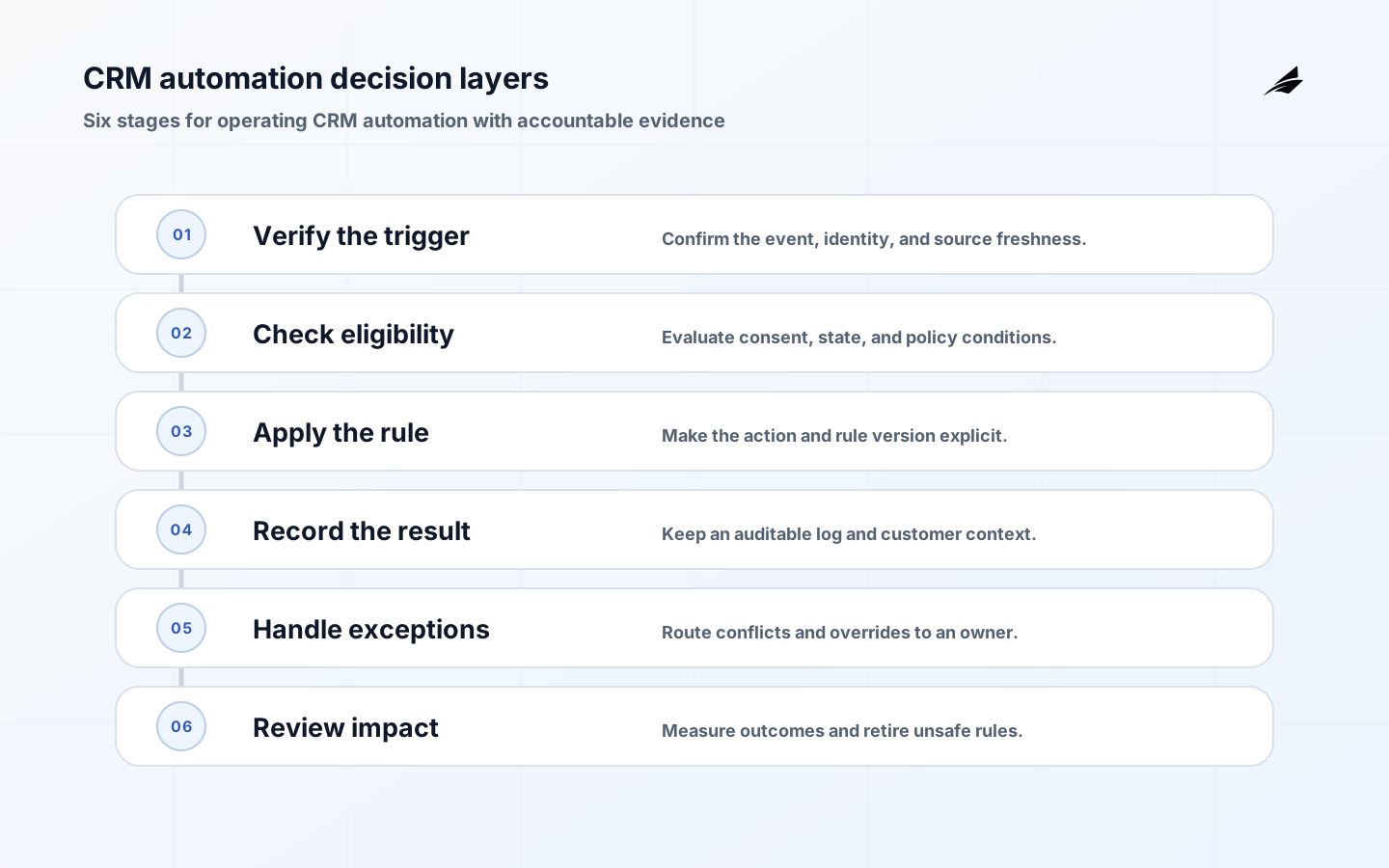
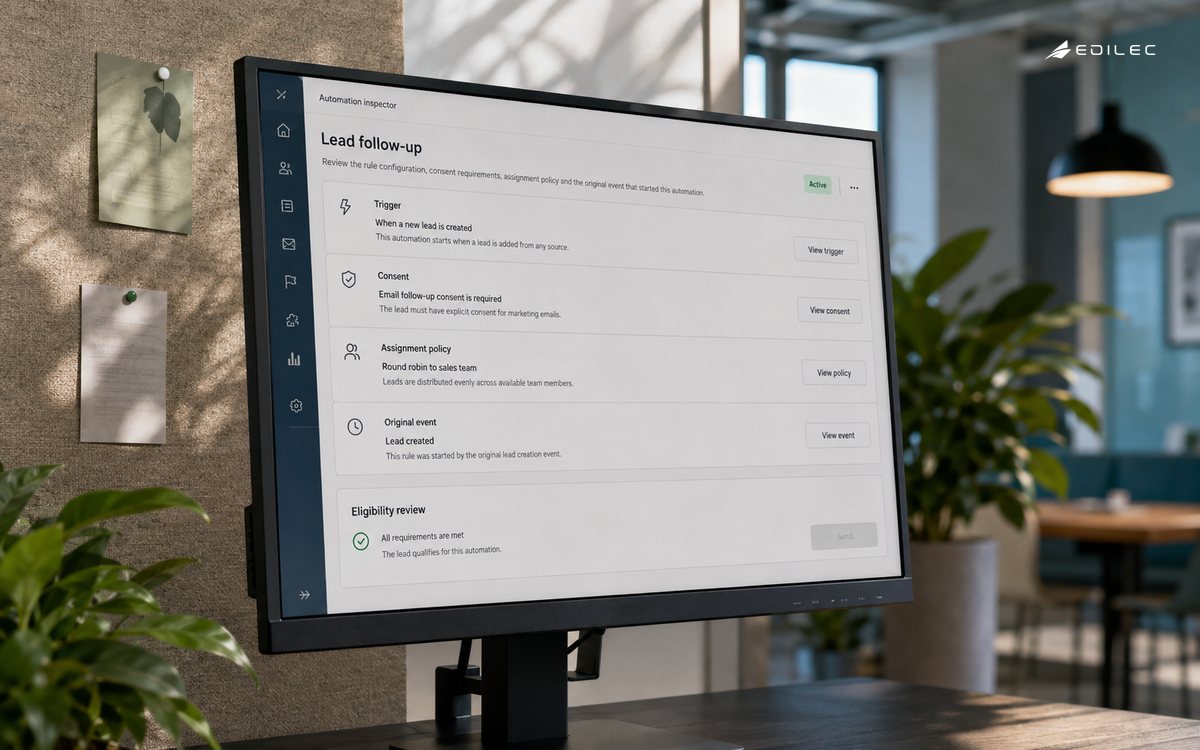
CRM automation is not a tooling category; it is a controlled way to make a qualified lead should receive the right follow-up or assignment without silently changing consent, ownership, or commercial eligibility. The first design question is therefore about the decision and its evidence, not the product logo or orchestration style. Teams should be able to identify triggers, eligibility rules, customer consent, assignment policy, automation logs, exception queues, and human overrides, explain the moment at which each becomes authoritative, and reproduce the result when an upstream record changes. Starting here prevents a familiar failure: a useful operational question becomes a broad platform programme with no testable first release.
Set the automation boundary around a customer decision
Write the workflow as a short decision record. For CRM automation, specify the actor who needs the answer, the event that starts work, the system that owns each material fact, the time boundary, and the action that follows. Then walk through a record changes, an integration event arrives, a rule version changes, or a human pauses an automated action. This exercise turns vague requirements into observable behavior. It also exposes whether the proposed design can preserve context when a person joins midstream, when data arrives twice, or when a corrective action needs to be explained months later.
| Question | Working rule | Evidence |
|---|---|---|
| Decision | State the outcome and the person accountable for it. | a qualified lead should receive the right follow-up or assignment without silently changing consent, ownership, or commercial eligibility |
| Authority | Separate business policy from technical operation. | revenue operations owns policy, data owners maintain field quality, and IT owns identity, access, and change controls |
| Change | Treat corrected and late data as normal cases. | a record changes, an integration event arrives, a rule version changes, or a human pauses an automated action |
| Exception | Keep a visible route rather than a silent bypass. | a chain of automation rules that changes customer treatment but leaves neither the reason nor the operator visible |
Model the records and handoffs
A reliable CRM automation design uses boundaries that people can inspect. Describe the input record, the validation point, the durable identifier, the state transition, and the acknowledgement from the next system or team. Do not infer ownership from where a value happens to be stored. One application may capture a fact while another applies policy, and a third presents the result. Those roles can coexist when the contract says which service is allowed to create, correct, publish, or merely consume each fact.
The most useful data model is usually small at first: preserve the original event or source value, attach the rule or model version used, record an effective timestamp, and retain the reason for an override. Those details make corrective work possible without rewriting history. They also make related disciplines easier to connect, including what changes when approval workflows move into production, what changes when service delivery systems move into production, ERP Integration: Ownership, Mappings, and Failure Recovery. The goal is not documentation for its own sake. It is a system where operations can answer what happened, why it happened, and what must happen next.
| Layer | Design decision | Operational check |
|---|---|---|
| Input | Define identity, grain, required fields, and acceptance criteria. | Can the team reject or quarantine incomplete CRM automation inputs? |
| Policy | Version thresholds, mappings, and eligibility logic. | Can a reviewer see which rule produced the CRM automation result? |
| Action | Make state change, owner, and acknowledgement explicit. | Can retries happen without duplicating the consequence? |
| Recovery | Route disputes, late facts, and corrections to an owner. | Can the prior result be reconciled after a correction? |
Build one observable path
Choose a first path that is consequential enough to matter but narrow enough to replay. For CRM automation, that means collecting real examples before configuring rules: ordinary cases, incomplete cases, contradictory cases, and cases where a downstream consumer has already acted. Run those examples through a test environment with production-like identities and permissions. The outcome should show accepted input, rejected input, the accountable queue, the downstream effect, and the recovery route. A demo that shows only a successful happy path is not evidence that the operating workflow is ready.
- Name the decision and success condition for the first CRM automation path.
- Record triggers, eligibility rules, customer consent, assignment policy, automation logs, exception queues, and human overrides with an owner and effective-time rule.
- Test a record changes, an integration event arrives, a rule version changes, or a human pauses an automated action before allowing broad adoption.
- Use durable identifiers and idempotent behavior for retried work.
- Give operators a queue, reason code, and escalation contact for exceptions.
- Instrument automation completion, override rate, stale-rule incidents, assignment delay, duplicate actions, and conversion impact by rule from the first release.
Set controls that support work
Controls should make unsafe behavior harder while keeping legitimate work moving. Apply least privilege to create, approve, override, and administer actions; log material decisions with their inputs and rule version; and review elevated access on a schedule that matches the risk. A useful control also has an operator story. When a person cannot proceed, the interface should say what evidence is missing, who can decide, and whether the request can be saved or withdrawn. That is much stronger than a generic error or an informal side channel. For CRM automation, the control emphasis is making automated customer treatment explainable when eligibility, consent, ownership, or a human override changes the result.
Use primary guidance with local evidence
The implementation details will depend on the systems already in use, but the core practices are well represented in primary documentation. Useful references for this design include Dynamics 365 documentation, SAP Help Portal, Salesforce Help, NIST Cybersecurity Framework 2.0. Read them as technical and governance inputs, then verify every claim against the organization’s own records, obligations, and operating constraints. Vendor guidance can explain supported capabilities; it cannot decide who should own a business exception or which evidence a regulated decision requires. In this CRM automation context, translate that guidance into named local owners, tested configuration, and records that can be inspected during an incident or audit.
Measure reliability and decision quality
Measure CRM automation as a living service rather than a completed deployment. Track automation completion, override rate, stale-rule incidents, assignment delay, duplicate actions, and conversion impact by rule. Segment results by source, workflow state, policy version, and owner so a rising average does not conceal a struggling queue. Review a small sample of completed and corrected cases alongside the metrics. Numbers reveal a pattern; the records reveal whether people understood the rule, whether the automation had enough context, and whether a customer or colleague encountered an avoidable delay.
Key takeaways
- CRM automation starts with a business decision and a defined evidence boundary.
- Make revenue operations owns policy, data owners maintain field quality, and it owns identity, access, and change controls visible in the workflow.
- Design explicitly for a record changes, an integration event arrives, a rule version changes, or a human pauses an automated action, not only for routine cases.
- Keep corrections, acknowledgements, and exceptions reviewable.
- Use automation completion, override rate, stale-rule incidents, assignment delay, duplicate actions, and conversion impact by rule to decide whether the next expansion is justified.
Frequently asked questions
What is the smallest useful scope for CRM automation? Start with one decision where an incorrect, late, or untraceable result creates real cost. Include the normal path and the recovery path. The first release should establish shared language, ownership, and evidence; it does not need to centralize every adjacent process.
When should a person intervene? A person should decide where policy is ambiguous, source evidence conflicts, an action has material financial, customer, or access consequences, or an automated result falls outside an agreed rule. The workflow should preserve the recommendation and the human rationale rather than hiding either one. For CRM automation, intervention is especially important when making automated customer treatment explainable when eligibility, consent, ownership, or a human override changes the result.
How do we know the workflow is ready to scale? Expand after the team can replay representative cases, reconcile the output with source records, explain exceptions within the operating target, and show that the named owner actually reviews the signals. Scale is an outcome of repeatability, not simply of higher event volume. In CRM automation, readiness also means that the team has rehearsed the failure modes specific to its decision boundary rather than assuming a successful demonstration is enough.
Review before expansion
Before adding more scope, conduct a CRM automation operating review. Inspect one successful automation, one suppressed action, one manual override, and one failed integration trigger. Verify the record snapshot, rule version, consent or eligibility evidence, actor, and customer-facing outcome. This protects teams from celebrating automation volume while a stale rule quietly produces inappropriate contact or assignment. Publish the resulting actions with an owner and due date, then repeat the same cases after the changes land. A repeatable review rhythm protects the first workflow from quiet drift and gives the next investment decision a firmer basis than anecdote.
Conclusion
CRM automation becomes dependable when its decisions, records, authority, and recovery behavior are designed together. Begin with a qualified lead should receive the right follow-up or assignment without silently changing consent, ownership, or commercial eligibility, make the first path observable, and treat exceptions as product requirements rather than inconvenient leftovers. That approach gives engineering and operations a basis for a useful next release: one supported by traceable evidence, meaningful measures, and clear accountability.