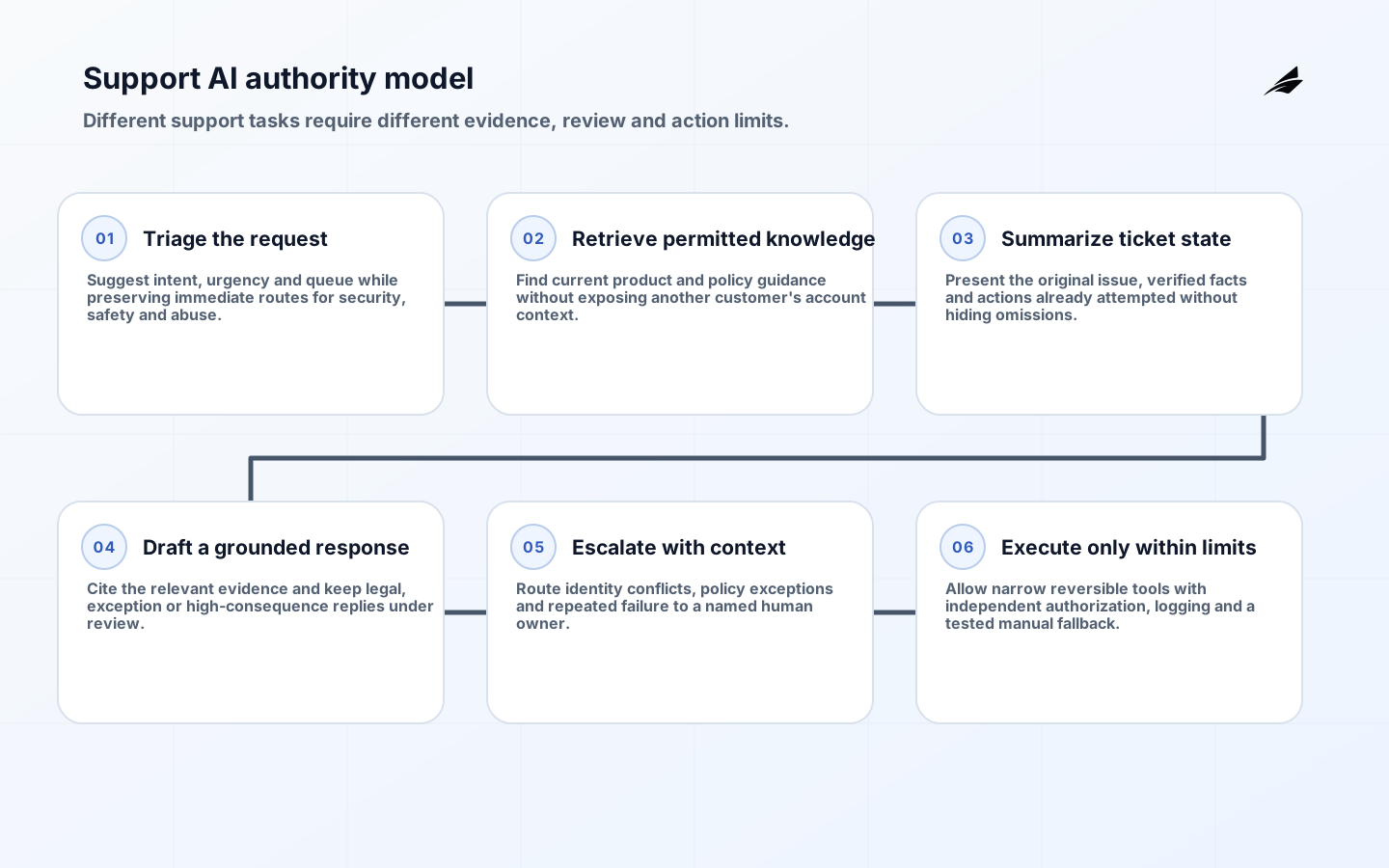
AI workflow automation can help support teams classify requests, find relevant knowledge, summarize account history, draft responses, and prepare routine actions. It becomes harmful when the system guesses identity, cites stale policy, hides uncertainty, performs an irreversible change, or makes it harder for a customer to reach a person. The useful question is not whether AI can answer tickets, but which parts of the support workflow can be made faster without weakening service ownership.
This FAQ covers the architecture, data, controls, rollout, and measurement required for dependable support automation. It applies to SaaS, ecommerce, internal IT, and enterprise service teams. Organizations can combine it with AI automation, enterprise workflow integration, and quality assurance and monitoring.
What should AI automate in a support workflow?
Start by decomposing the ticket lifecycle. Intake normalization, language detection, intent classification, duplicate detection, knowledge retrieval, case summarization, response drafting, queue routing, and follow-up reminders are distinct capabilities. Each can have its own quality threshold and fallback. Bundling them into a single autonomous agent makes failures difficult to diagnose.
| Capability | Appropriate output | Keep controlled | Quality signal |
|---|---|---|---|
| Triage | Intent, urgency suggestion and destination queue | Priority overrides for safety, fraud or contractual incidents | Correct route and reassignment rate |
| Knowledge retrieval | Relevant approved articles with citations | Access to restricted or customer-specific records | Citation relevance and freshness |
| Case summary | Timeline, stated issue and actions already attempted | Omission of material customer statements or commitments | Agent correction and missing-fact rate |
| Response drafting | Grounded reply in approved tone | Sending high-consequence, legal or exception responses | Edit distance, factual review and reopen rate |
| Action preparation | Validated parameters for a permitted operation | Refund, access, deletion or account action beyond policy | Execution success, reversal and unauthorized attempts |
Choose an initial workflow with a clear queue, repeatable evidence, and reversible next step. The goal might be reducing misrouting for billing questions or shortening the time to assemble context for an outage ticket. Do not begin with every request type and every customer tier.
How should a ticket and workflow contract be defined?
Define the ticket as structured state: customer or employee identity, organization, entitlement, channel, language, product, severity, privacy class, current owner, service-level clock, linked incidents, and action history. Free text remains important, but it should not be the only source for routing or authorization. Preserve the original message and attachments so an agent can verify a generated summary.
Each transition needs a reason and owner. A case can move from new to triaged, waiting for customer, waiting for engineering, resolved, or reopened only under defined conditions. AI may propose a transition, while the case platform enforces the valid state and records who or what caused it. Late messages and duplicate webhooks must not reopen or close the wrong case.
| Workflow field | Why it matters | Validation |
|---|---|---|
| Verified identity | Controls what account context and actions are available | Authentication method and session state |
| Entitlement and tier | Determines channel, service level and permitted support | Current contract or internal service catalog |
| Issue and product context | Improves routing and retrieval | Known product identifiers and version |
| Sensitivity class | Limits prompts, logs and reviewer access | Data classification and redaction policy |
| State and owner | Prevents silent queue loss | Valid transition and accountable queue |
| Linked incident or problem | Avoids duplicate troubleshooting | Current incident source and update timestamp |
How should knowledge and customer context be retrieved?
Separate reusable knowledge from customer-specific context. Approved troubleshooting, policy, and product documentation can be indexed with version, audience, product, and locale metadata. Account, billing, and activity records are better retrieved at request time after identity and purpose checks. NIST Zero Trust Architecture supports making access decisions around the subject, resource, and policy rather than assuming that an internal workflow may read everything.
Require source citations for factual drafts. When documents conflict or are stale, show that conflict instead of blending the wording. Establish content owners and review dates. Support teams often discover documentation defects first, so provide a direct route to flag an article and preserve the case that exposed the problem.
What architecture keeps support actions safe?
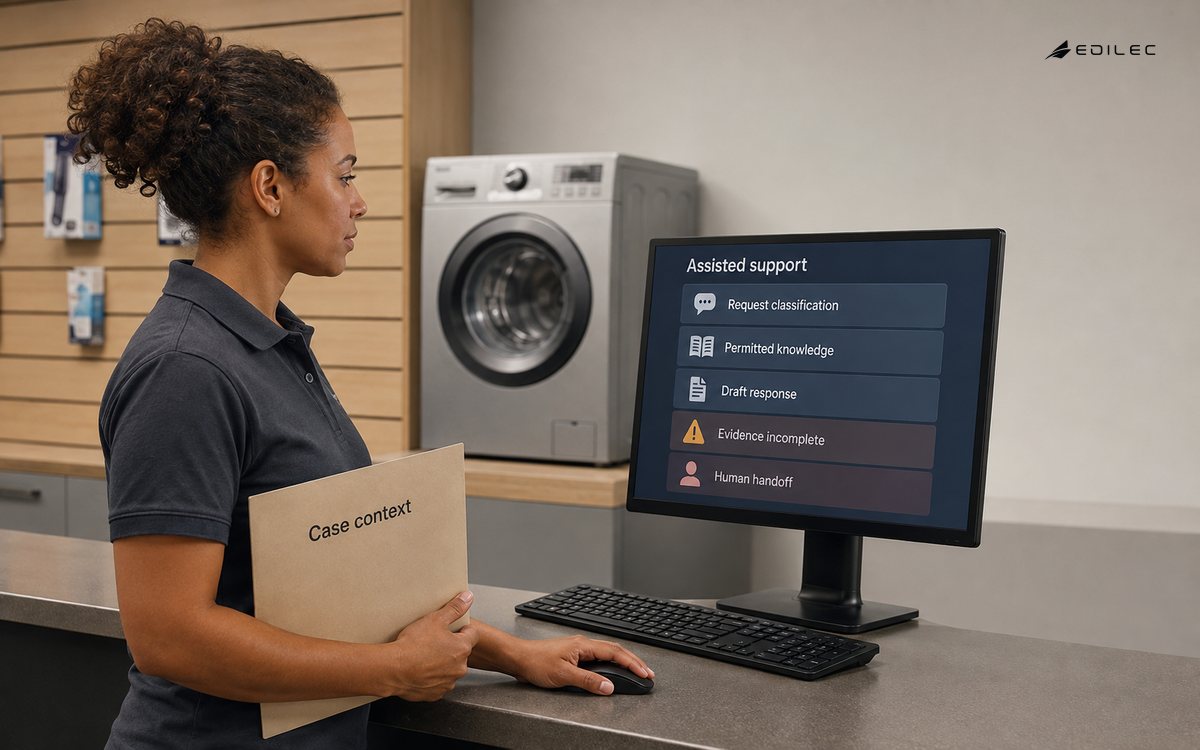
A controlled flow authenticates the user, loads the ticket, applies access policy, retrieves evidence, requests an AI output, validates the result, and presents it for review or sends it to a narrowly scoped tool. The model should not possess broad credentials. An action service should independently authorize a refund draft, password-reset request, case update, or notification and enforce parameter limits.
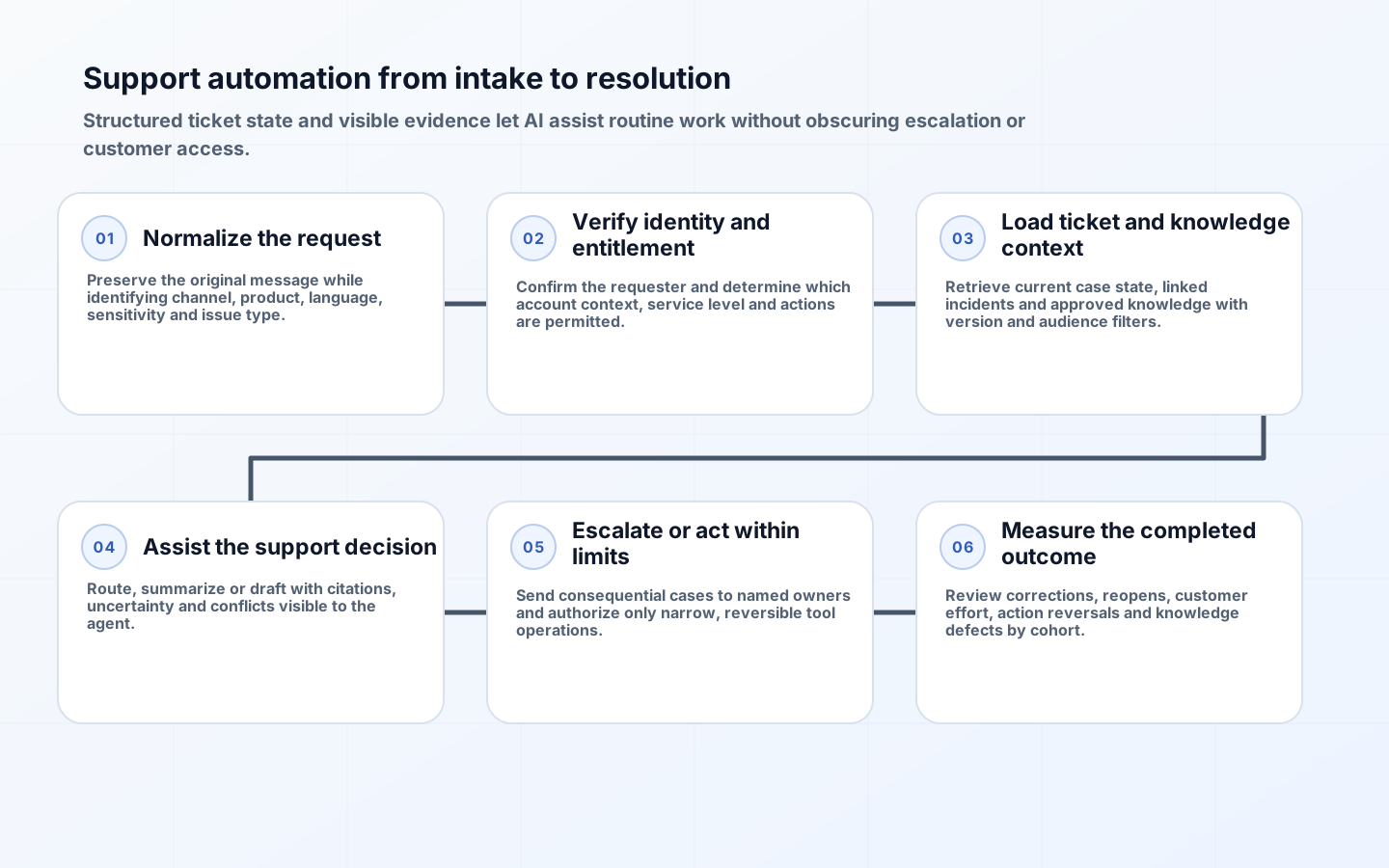
Treat customer messages and attachments as untrusted. They can contain prompt-injection text, malicious links, private information, or instructions that conflict with policy. The OWASP LLM application guidance is relevant to prompt injection, sensitive-information disclosure, improper output handling, and excessive agency. Sanitize tool inputs and render generated content safely before placing it in an agent console or email.
When should the workflow escalate to a person?
Escalate when identity is uncertain, evidence conflicts, a request falls outside policy, a consequential action is proposed, the customer disputes an automated result, or repeated attempts fail. Also define immediate routes for safety, security, fraud, abuse, legal, accessibility, and vulnerable-customer concerns. A confidence score should inform review but must not replace consequence-based policy.
Make escalation visible and accessible. Customers should know whether they are interacting with automation, how to correct the request, and how to reach appropriate help. W3C's WCAG 2.2 includes consistent help, accessible authentication, keyboard and focus requirements that matter for support interfaces. Test the complete journey with assistive technology and constrained mobile screens, not only the chat widget.
How should support automation be evaluated?
Build a de-identified test set across intents, customer tiers, products, languages, severity, and unusual cases. Evaluate route accuracy, evidence retrieval, factual grounding, action parameters, tone, privacy, accessibility, and escalation. Include tickets that should not be answered automatically. Run regression tests whenever knowledge, integrations, policies, prompts, or models change.
| Measure | What it reveals | Guardrail |
|---|---|---|
| Reassignment rate | Triage quality and taxonomy gaps | Review by intent and receiving queue |
| Draft acceptance and edits | Usefulness to agents | Sample for factual errors, not just acceptance |
| First-contact resolution | Whether the whole issue was resolved | Pair with reopen and repeat-contact rate |
| Escalation quality | Whether difficult cases reach the right owner | Audit missed high-consequence cases |
| Action reversal | Incorrect or premature operations | Stop automation when threshold is exceeded |
| Customer effort | Number of contacts and repeated information | Segment automated and human-assisted journeys |
Do not optimize deflection alone. A low contact rate can mean customers gave up. Combine service measures with complaint themes, sampled conversations, corrections, and outcome completion. Review performance separately for customer cohorts so automation does not systematically disadvantage a language, product, or accessibility need.
What is a practical rollout plan?
Start in shadow mode, producing classifications and drafts without affecting queues or customers. Next, provide agent assist with visible evidence and capture edits. Enable automated routing only for stable intents, then narrowly scoped actions with deterministic limits. Maintain a kill switch, manual queue, and rollback for each component.
- Document the current workflow, baseline and exception taxonomy.
- Establish identity, knowledge ownership, access policy and event logging.
- Create a representative evaluation set and release thresholds.
- Run shadow mode and investigate failures with support specialists.
- Release agent assist to a trained cohort with direct feedback capture.
- Expand by intent and action consequence, reviewing outcomes at each gate.
What drives implementation and operating cost?
Cost follows integration count, ticket volume, context length, knowledge quality, languages, action complexity, evaluation, security, and the expected service level. Agent-assist drafting may be relatively contained; autonomous multi-system action needs stronger authorization, testing, reconciliation, and support. Human review is part of the operating cost and should be modeled explicitly.
Estimate cost per successfully completed outcome, including model usage, platform services, monitoring, review, correction, and customer recovery. This supports rational model selection: a more expensive inference may be economical when it materially lowers corrections, while a simple rules engine may outperform AI for stable structured routing.
Key takeaways
- Decompose triage, retrieval, summarization, drafting and action into separately testable capabilities.
- Use structured ticket state and authoritative customer context.
- Give models narrow tools and enforce authorization outside the model.
- Escalate by consequence and evidence, not confidence alone.
- Measure completed support outcomes, reopens, corrections and customer effort.
- Roll out from shadow mode to assistive and then bounded automation.
Frequently asked questions
Will AI workflow automation replace support agents?
It can reduce repetitive handling and change role mix, but complex diagnosis, negotiation, empathy, exception ownership, and consequential decisions remain human work. Design should make agents more effective and reserve capacity for difficult cases rather than assume every contact can be removed.
Can the model use every resolved ticket as knowledge?
Not safely by default. Tickets can contain personal data, outdated workarounds, incorrect statements, and restricted details. Curate reusable knowledge through approval, redaction, ownership, and expiry rather than automatically indexing all conversations.
Should customers be told when automation is used?
Provide clear, context-appropriate disclosure and a usable route to human help. Specific legal requirements vary, so product, legal, and accessibility owners should define the policy for each market and channel.
Support leaders should also plan workforce and knowledge change. Explain which tasks will change, how quality is reviewed, and how agents can challenge the system without penalty. Use corrections to improve knowledge and evaluation rather than ranking individual agents against unreliable automation. Protect time for specialists to maintain troubleshooting content, investigate recurring issues, and review difficult samples; otherwise the workflow consumes the expertise it depends on without replenishing it.
Document service continuity when the model, knowledge index, or integration is unavailable. Agents should retain access to authoritative records and a manual process, while customers receive a truthful status. Queue work for later only when timing and consent permit. Test recovery and replay so delayed automation cannot send obsolete replies or execute an action after an agent has already resolved the case.
Conclusion
Support automation earns trust by preserving context, authority, and escalation. When each capability is independently measured, evidence remains visible, actions are constrained, and customers can reach a person, AI can reduce repetitive work while improving rather than obscuring service quality.