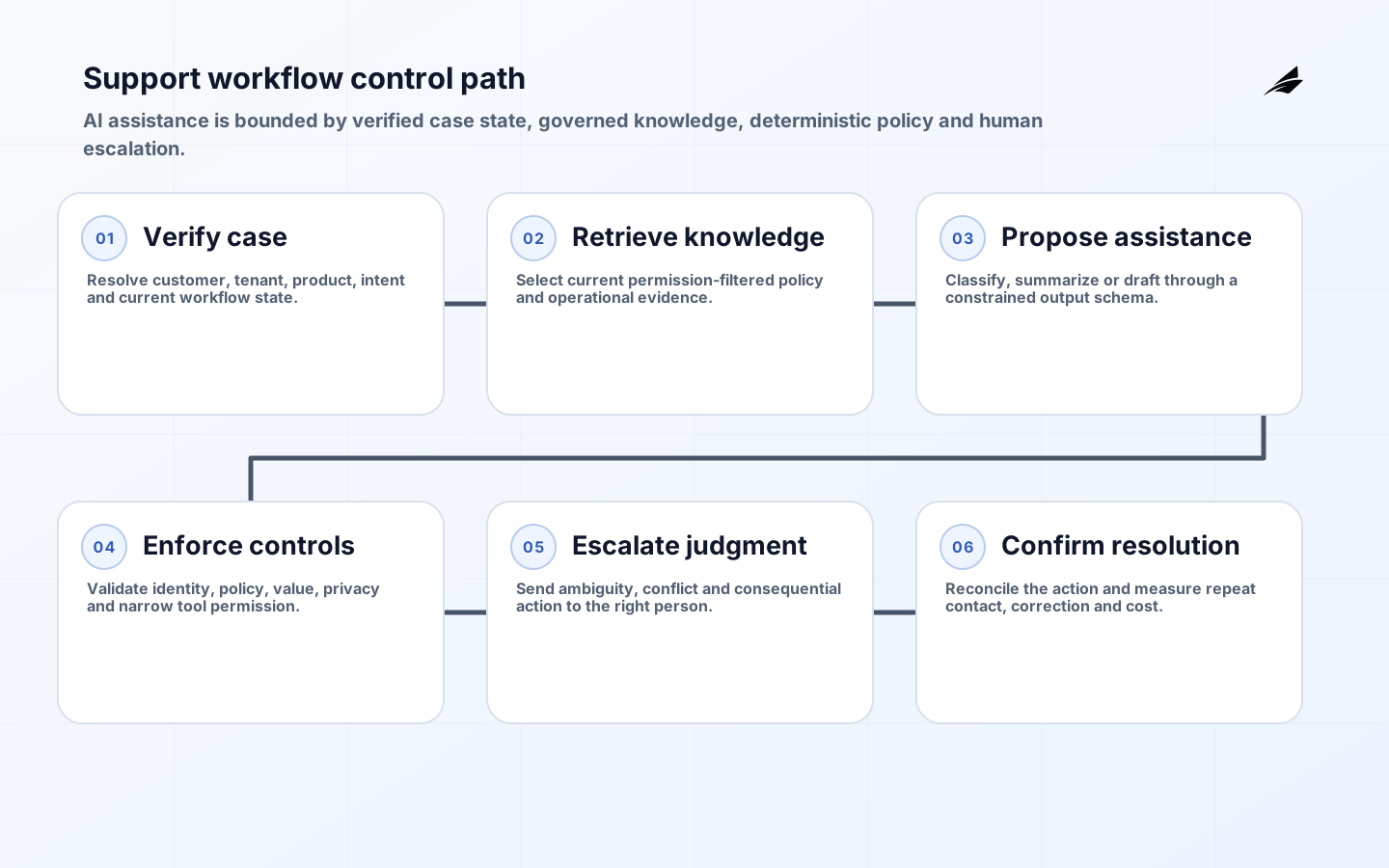
AI workflow automation for support teams can reduce time spent classifying requests, finding evidence, summarizing history and drafting routine responses. The product should still behave as a case-management system: it must know the customer, current state, owner, policy, permitted action and next deadline. A fluent model cannot replace those controls.
The most useful scope is a bounded support decision, not an autonomous service department. Conventional software retains identity, workflow state, authorization, transaction execution and audit. AI interprets language and proposes outputs from approved context. People handle ambiguity, consequential commitments and cases outside tested conditions.
Scope a complete support case
Map the case from intake to verified resolution. Identify channels, intent taxonomy, identity checks, customer and product context, evidence sources, actions, approvals, handoffs and closure criteria. Count reopening and downstream correction. A reply is not resolution if the order, account or product issue remains unchanged.
Choose an initial case class with repeated volume, reliable evidence and low irreversible impact. Password guidance, known product procedures and delivery-status explanation may be suitable after identity controls. Fraud, safety, legal threats and unusual financial disputes should remain specialist routes. Define exclusions before estimating savings.
| Stage | AI contribution | System control | Human role |
|---|---|---|---|
| Intake | Classify intent and urgency | Channel and identity record | Correct exceptional routing |
| Research | Retrieve and summarize | Permission-filtered sources | Resolve conflicting evidence |
| Response | Draft explanation | Policy and disclosure rules | Approve sensitive claims |
| Action | Propose a narrow tool call | Eligibility, value and idempotency | Authorize consequence |
| Closure | Summarize outcome | Verified state and survey | Review unresolved risk |
Make case and knowledge records authoritative
Define which system owns customer identity, entitlement, order, subscription, incident and case state. Use stable identifiers across channels. Version policies and knowledge with owner, audience, region and effective date. Solved tickets can reveal useful examples but are not approved truth until reviewed; they may contain workarounds, outdated commitments or personal data.
Fetch fast-changing operational state from its source instead of embedding it into a stale index. Retrieval should preserve citations and permission metadata. When sources disagree, open a knowledge or data issue and route the customer case. The model must not choose a policy merely because its wording ranks higher.
Use a bounded orchestration architecture
A case service owns status and invokes specialized components: retrieval, classifier, summarizer, policy checker and tool adapters. Each AI output follows a typed schema and is validated. Tool adapters expose narrow functions such as retrieve order or propose credit; they do not provide arbitrary database or browser access. Authorization is evaluated for the current employee and customer context.

Treat messages, attachments and retrieved passages as untrusted. OWASP identifies excessive agency when functionality, permission or autonomy exceeds the task. Minimize all three. Require independent approval for account, money, access or deletion actions, and preserve a deterministic manual path when the model is unavailable.
Build evaluation around resolution quality
Assemble representative cases by intent, product, language, customer tier, outcome and risk. Preserve expected source evidence, acceptable answer, correct route and escalation reason. Include prompt injection, missing identity, stale policy, cross-customer requests and cases where no safe answer exists.
Measure classification, retrieval, grounded claims, policy compliance, privacy, tool choice and verified outcome separately. Have support experts adjudicate nuanced cases. The NIST AI RMF calls for evaluation in conditions similar to deployment and for feedback and appeal mechanisms. Record uncertainty and cohort differences instead of relying on one average score.
| Measure | Meaning | Release concern |
|---|---|---|
| Grounded resolution | Correct outcome supported by evidence | Unsupported customer commitment |
| Correction rate | Agent changes material content or route | Hidden review burden |
| Repeat contact | Customer returns for the same issue | False closure |
| Tool rejection | Policy blocks proposed action | Poor action selection |
| Escalation quality | Specialist receives usable context | Automation delays help |
| Cost per resolution | Full model, review and operating cost | Savings are overstated |
Estimate full delivery and operating cost
Delivery cost includes workflow discovery, knowledge cleanup, integration, identity, evaluation, user experience, security and change management. Operating cost includes model and retrieval usage, human review, monitoring, evaluation refresh, source maintenance, incident response and vendor management. Long case context and repeated tool calls can dominate simple per-message estimates.
Model economics per correctly resolved case. Compare baseline handling, transfers, repeat contacts and error remediation with the future path. Apply realistic adoption and exception rates. Time saved has value only if capacity is redeployed or service outcomes improve; an extra AI draft followed by unchanged review may add cost.
Control privacy, security and customer harm
Minimize personal data sent to models and logs. Redact secrets and restrict evaluation datasets. Verify provider retention and processing terms. Enforce tenant filters in code. The NIST Privacy Framework can help connect data processing with organizational and individual risk. Define when customers should be informed about automation and how they can reach a person.
Threat-model account takeover, indirect prompt injection, malicious attachments, data leakage, tool misuse and systematic misinformation. Keep audit records for source retrieval, model version, policy result, human decision and action. Incident procedures should disable the affected capability, preserve evidence and reconcile any customer records changed.
Deliver in authority-based stages
Start with offline evaluation and shadow classification. Introduce retrieval and summaries to employees, then drafts requiring approval. Automate a response only for a tested low-risk class. Add narrow actions last, with deterministic eligibility and value limits. Expand by intent and language rather than turning on every channel at once.
Set go, pause and rollback thresholds. Version models, prompts, sources, policies and tools. Monitor latency, errors, corrections, unauthorized attempts, customer outcomes and cost. Train supervisors to pause a capability and agents to challenge evidence. Preserve the original case route during every rollout stage.
Example: failed delivery support
A customer reports that a package is marked delivered but missing. The workflow verifies identity, retrieves order and carrier events, checks the current carrier-claim and replacement policy, and drafts the next steps. It does not assert theft or delivery. A replacement proposal goes to a transaction service that checks item, value, prior claims and approval limits.
Ambiguous scan data routes to an agent with chronology and evidence. Evaluation includes wrong-order retrieval, duplicate replacement, outdated carrier policy and customer messages containing malicious instructions. Success is measured through correct remedy, repeat contact and unreconciled replacements, not drafting speed.
Operate knowledge, models and case policy as separate products
Give the knowledge corpus a release process. Source owners approve corrections; ingestion validates counts, permissions and effective dates; evaluation checks affected intents before publication. Track source coverage and stale passages. Do not let frontline teams upload arbitrary documents to production retrieval as a workaround for slow content governance.
Model and prompt changes follow a different path. Record the provider, version, configuration, evaluation result and rollback option. Re-run high-risk cases and compare quality, latency and cost. A model update should not silently expand tools or context. Keep the prior working configuration available until the new release is stable.
Case policy has business ownership. Refund limits, identity requirements, escalation classes and service commitments need effective dates and approval. Implement them in deterministic services and test historical and boundary cases. Support managers should see which policy caused a route without reading a prompt.
Bring these products together in a monthly review of customer outcomes, source defects, model corrections, blocked actions, incidents and economics. Assign every recurring failure to the responsible layer. This separation prevents “AI quality” from becoming a vague bucket for broken knowledge, integration or process.
Include frontline representatives in that review and publish the resulting change notes. Agents need to know when a policy, source or model correction becomes active and which old workaround should stop. Supervisors should be able to compare behavior before and after the change. This closes the operational feedback loop and reduces the temptation to maintain private prompt snippets or unofficial knowledge files.
Review multilingual and accessible operation explicitly. Case evidence, policy meaning and escalation capacity can differ by language or user need. Evaluate native examples with qualified reviewers and provide a reliable route when supported evidence is unavailable. Aggregate scores should not conceal a poor or unsafe experience for a smaller customer cohort.
Related reading
See RAG Knowledge Bases for Support Teams, Semantic Search Architecture, and the Support Workflow Automation Checklist for deeper source, retrieval and release controls.
Frequently asked questions
Which support workflow should be automated first? Choose a frequent, evidence-rich and reversible case with a known outcome. Avoid rare, sensitive or high-value disputes until governance and evaluation mature.
Can the model take account actions? It may propose a narrow action, but identity, policy, value, approval and idempotency should be enforced by a conventional service.
How is ROI calculated? Compare full baseline and future costs per verified resolution, including review, repeat contact, exceptions, model use, source maintenance and remediation.
When is human escalation required? Escalate when identity or evidence is incomplete, sources conflict, policy demands judgment, potential harm is high or the case lies outside evaluated conditions.
Key takeaways
- Scope a verified support outcome, not message generation.
- Keep case state, policy and transaction authority outside the model.
- Evaluate sources, claims, actions and resolution independently.
- Price review, source maintenance and exceptions into operating cost.
- Release by case class and authority with immediate human escalation.
Conclusion
Support automation becomes dependable when AI helps people interpret evidence inside a controlled case system. Governed knowledge, narrow tools, explicit policy, representative evaluation and honest economics prevent fast answers from becoming hidden customer debt. The result should be fewer unresolved cases and clearer escalation, not simply more automated messages.