Support queues are tempting automation targets because they contain repeated language, but repetition does not make every answer low risk. A password reset, billing dispute and suspected account takeover may arrive through the same channel while requiring different evidence and authority. AI workflow automation for support teams should therefore organize intake, retrieve approved knowledge and prepare agent decisions before it attempts account actions. This checklist treats the case system as the source of work and the support agent as an accountable operator, not a click-through obstacle.
Define the service boundary before selecting technology
Start with ticket classification, knowledge retrieval and draft assistance before high-impact account actions. Observe real cases, including exceptions, reversals and incomplete inputs. Record who initiates the work, which system owns each fact, who may approve an outcome, what makes an action irreversible and how staff recover when an integration fails. This boundary prevents AI customer support workflow from becoming a vague transformation program. It also exposes policy disagreements before software silently turns them into inconsistent behavior.
Define acceptance criteria per ticket class. A delivery-status request may use verified order context and approved wording; a refund request needs entitlement and value limits; an access incident needs identity verification and a security route. Specify which knowledge versions can support a draft, which customer attributes the model may receive, how language is detected, and when silence is safer than a guess. Every automated suggestion should preserve the case identifier, retrieved passages, confidence handling and the agent’s final edit or rejection.
Architecture and ownership
The architecture must preserve authority across channel intake and identity context, case system and entitlement record, approved knowledge retrieval, agent workspace, action gateway and audit trail. Each component needs an owner, a versioned contract and observable failure behavior. Avoid direct point-to-point writes from an interface or model into a critical record. A narrow orchestration layer can validate identity, current state, policy and idempotency before an action proceeds, while an audit event records the evidence and rule version used.
| Architecture area | Required design decision | Evidence before release |
|---|---|---|
| channel intake and identity context | For this design choice, name the accountable owner, supporting evidence, exception route, and next measurable check. | Approved data-flow and owner |
| case system and entitlement record | Within this design choice, name the accountable owner, supporting evidence, exception route, and next measurable check. | Authorization and negative tests |
| approved knowledge retrieval | When implementing this design choice, name the accountable owner, supporting evidence, exception route, and next measurable check. | Versioned interface plus retry behavior |
| agent workspace, action gateway and audit trail | Before releasing this design choice, name the accountable owner, supporting evidence, exception route, and next measurable check. | Dashboard, alert and recovery runbook |
A six-stage delivery path
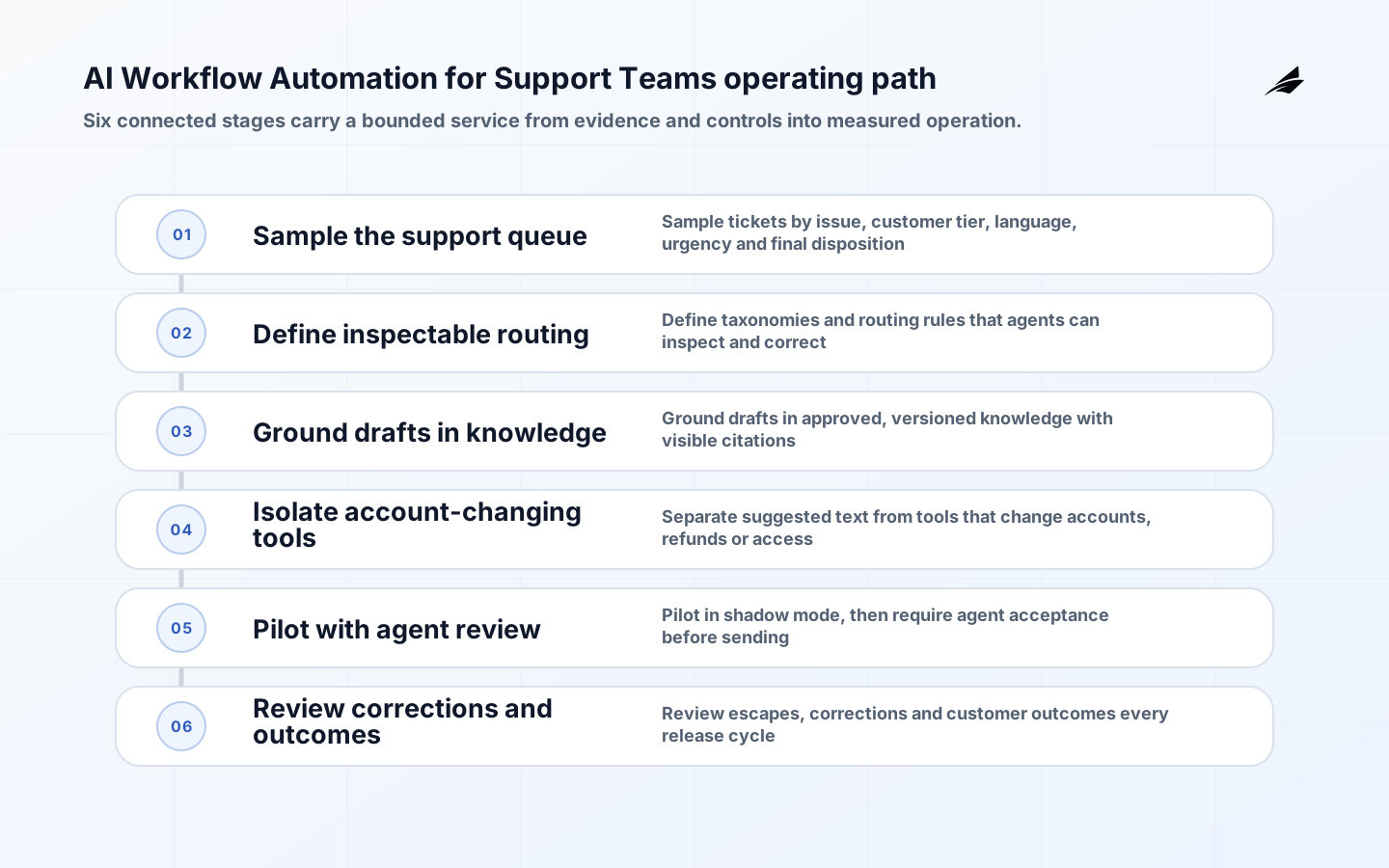
Implementation should start in shadow mode. Run classification and retrieval beside the existing queue without changing priority or sending text. Compare suggested categories, knowledge passages and escalation choices with final agent outcomes. When error patterns are understood, expose drafts to a small trained group and require deliberate acceptance. Keep refunds, credential changes and contractual commitments behind separate tools with their own authorization. Expand by issue family only after the team can explain misroutes, not simply after the aggregate acceptance rate looks high.

- Sample tickets by issue, customer tier, language, urgency and final disposition.
- Define taxonomies and routing rules that agents can inspect and correct.
- Ground drafts in approved, versioned knowledge with visible citations.
- Separate suggested text from tools that change accounts, refunds or access.
- Pilot in shadow mode, then require agent acceptance before sending.
- Review escapes, corrections and customer outcomes every release cycle.
Controls and failure modes
A support assistant should never gain broad customer access merely because an agent can see the case. Retrieval must enforce the current agent, tenant and ticket scope before documents enter model context. The send action should reject drafts that lack required identity checks or cite superseded policy. Tool calls need narrow schemas, value limits and idempotency. Supervisors should see overridden recommendations and policy gaps, while security receives alerts for unusual retrieval or repeated attempts to reach restricted records.
| Failure mode | Design response | Operating signal |
|---|---|---|
| Hallucinated policy or product detail | Retrieve only approved material and make unsupported claims fail to an agent. | Unsupported-claim rate |
| Sensitive data exposure | Minimize prompt context and enforce ticket-level authorization before retrieval. | Unauthorized retrieval attempts |
| Automation bias | Show uncertainty, sources and editable rationale instead of a single confident answer. | Agent correction and override rate |
| Queue distortion | Monitor false urgency, language performance and routing by customer segment. | Misroute and reassignment rate |
Measure outcomes, not activity
A dashboard should connect technical behavior to the intended operating result. Track time to first useful response rather than first automated message; resolution rate without reopen within the agreed window; agent acceptance and substantive edit rates; customer satisfaction segmented by automated workflow. Segment results by workflow type and material risk instead of hiding poor tails inside a global average. Review a sample of accepted, corrected, escalated and failed cases. When a metric moves, retain enough trace evidence to identify whether the cause was source data, policy, interface behavior, model output, reviewer workload or downstream execution.
Use queue history to establish first-response, resolution, reopen, transfer and escalation baselines by issue family. During rollout, distinguish a faster first message from a faster correct resolution. Examine substantive edits: an agent fixing tone is different from correcting eligibility or security advice. Segment by language, channel and customer tier to reveal uneven performance. Weekly case review should include accepted drafts, rejected drafts, reopened cases and silent failures where the assistant provided no useful evidence. Improvement must reduce total customer and agent effort.
Cost, timeline and commercial model
Budget for knowledge cleanup, case-system integration, identity controls, evaluation sets and supervisor review. Token spend is only one line item; poor routing can create more costly escalations and customer churn than it saves. Timeline should be expressed as evidence-bearing stages: discovery, thin-slice build, controlled pilot and measured expansion. Procurement should require source access, documentation, data export, incident support and transition assistance. A lower quote is not cheaper if it omits evaluation, operating ownership or the path away from the chosen provider.
Rehearse the operating model before expansion
A useful rehearsal for AI workflow automation for support teams follows one representative case from intake through final evidence. The team should interrupt the exercise after each transition and ask which record is authoritative, whether the acting identity has permission, whether the rule is current, and whether retrying would create a duplicate outcome. Run the same case with a missing field, delayed dependency and unavailable reviewer. This reveals assumptions that unit tests and polished demonstrations often miss, especially where channel intake and identity context meets case system and entitlement record.
Next, simulate the two most consequential failure modes: hallucinated policy or product detail and sensitive data exposure. Operators should identify the alert, inspect the trace without broad production access, contain further actions, communicate with affected users and restore a known state. Record elapsed time and every manual workaround. If the team cannot determine what happened from the retained evidence, the workflow is not ready for a wider cohort, even if its normal path appears efficient.
The support release packet should include the ticket taxonomy, approved knowledge owners, retrieval filters, redaction rules, tool permissions, escalation matrix and evaluation set. It should also identify who pauses a workflow when a policy changes, who investigates a poor answer and how affected conversations are found. Preserve examples of safe refusal and manual routing, not only successful drafts. These artifacts let a new supervisor understand the automation and prevent the knowledge base, model and case workflow from drifting independently.
Run a tabletop exercise with three cases: a routine how-to question, an angry customer requesting an exception and a possible account takeover. Remove one knowledge article, delay the entitlement API and change the customer’s identity evidence mid-case. The agent should understand what the assistant knows, why an action is unavailable and where to escalate. A support system is ready when staff can handle degraded behavior without guessing and when the audit trail reconstructs what the customer saw and what changed.
Practical takeaways
- Anchor AI workflow automation for support teams to one named outcome and accountable owner.
- Treat ticket classification, knowledge retrieval and draft assistance before high-impact account actions as the first deliverable, not an assumption.
- Keep permissions, policy and irreversible actions in deterministic services with review evidence.
- Pilot with representative exceptions and retain a tested manual route.
- Measure time to first useful response rather than first automated message alongside quality, risk and human workload.
- Expand only when the current release is supportable, observable and recoverable.
Frequently asked questions
- What should the first engagement deliver? It should deliver a process map, data and authority model, risk register, thin-slice backlog, evaluation plan, cost range and explicit decision on what will remain manual.
- How long should a pilot run? Long enough to include ordinary cases, realistic exceptions and at least one controlled recovery exercise. Calendar duration matters less than representative evidence and a pre-agreed exit decision.
- Can a team buy a platform before discovery? A short technical trial can inform discovery, but procurement should follow the service boundary and control requirements. Otherwise the available product features begin defining the business process.
- Who owns the released service? A business owner is accountable for policy and outcomes; a technical owner is accountable for reliability and change; security, privacy and domain specialists approve relevant controls. A vendor can support these roles but should not replace them.
- How is success demonstrated? Compare the agreed baseline with completed outcomes, corrections, exceptions, failures, cost and user impact. Pair aggregate metrics with case review so a favorable average cannot conceal harmful edge cases.
Conclusion
The best support automation makes good agents faster and inconsistent policy easier to detect. It does not hide uncertainty behind polished prose or turn every conversation into a self-service deflection. Begin with classification and grounded drafting, isolate high-impact tools, review real corrections and let issue-level evidence drive expansion. When knowledge ownership, authorization and recovery are treated as product work, AI can shorten queues while preserving the trust earned in difficult customer moments.