Custom software development services for healthcare should begin with patient safety and clinical work, not a feature inventory. A scheduling screen, referral queue, results inbox or medication workflow can change who sees information, when they see it and what action they take. That makes implementation a sociotechnical change: software behavior, clinical responsibility, data quality, downtime procedures and support ownership must work together.
This checklist is for provider organizations and product teams moving from an approved problem to a dependable service. It complements the deeper healthcare software scope and risk plan and the healthcare development FAQ. It does not replace privacy, medical-device, reimbursement or records-retention analysis for the jurisdictions in which the service will operate.
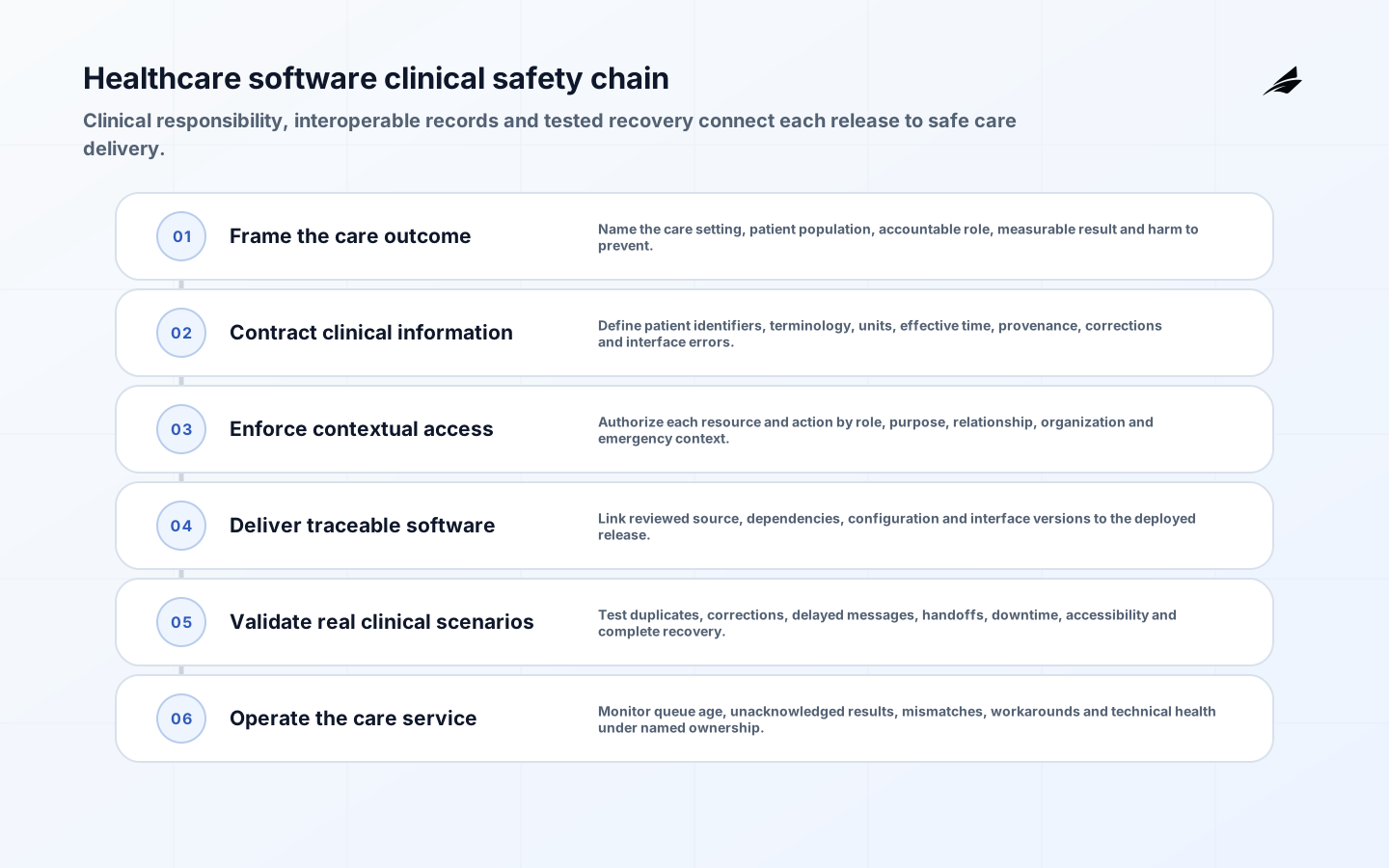
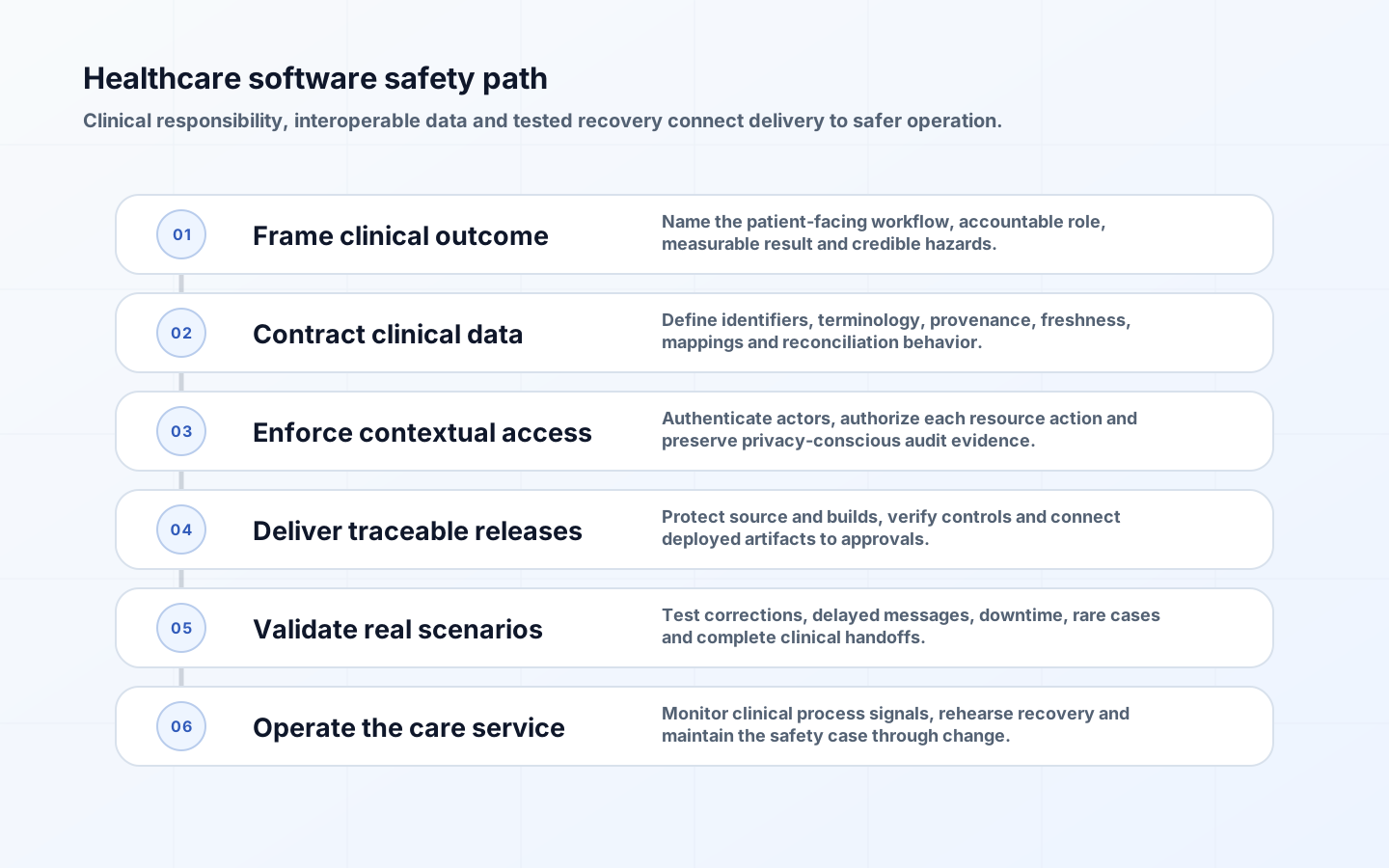
1. Frame custom software development services for healthcare around a clinical outcome
Name the care setting, user, patient population and decision that the service will support. Describe today’s workflow from trigger to closure, including handoffs, queues, telephone work, paper workarounds and duplicate entry. A useful outcome is measurable and operational, such as reducing unreviewed result age without increasing misrouted results. A vague aim such as improving efficiency cannot expose safety trade-offs or define acceptance evidence.
Run a multidisciplinary hazard workshop with clinicians, patient-safety staff, informaticians, security, privacy, operations and engineering. Ask how the system could associate data with the wrong patient, hide urgency, duplicate an order, lose a message, apply stale clinical content or fail during a transition. The current SAFER Guides organize recommended practices across organizational responsibility, system management, contingency planning, identification, ordering, results and communication. Convert applicable risks into owned requirements and tests.
| Workflow question | Evidence required | Release consequence |
|---|---|---|
| Who owns the next clinical action? | Named role, queue rule and escalation clock | No launch while responsibility is ambiguous |
| How is the patient identified? | Identifier policy, match rules and mismatch handling | Block unsafe merge or selection paths |
| What happens when data is late? | Freshness indicator and reconciliation procedure | Show uncertainty; do not imply completeness |
| How does work continue during outage? | Tested downtime and recovery procedure | Operate fallback before production dependency |
2. Define clinical data contracts and interoperability boundaries
Inventory every producer and consumer before choosing an integration style. For each exchange, record the canonical identifier, code system, units, cardinality, optional fields, effective time, provenance and error behavior. HL7 describes FHIR as a health-data exchange standard built from resources, profiles and conformance artifacts. Using FHIR does not make two implementations semantically equivalent; teams still need agreed profiles, terminology bindings, capability statements and representative conformance tests.
Treat interface transformation as governed clinical logic. A mapping from a local result code to a standard terminology, or from one status model to another, can alter meaning. Version mappings, retain rejected messages, reconcile source and destination counts, and make replay idempotent. Separate transactional facts from derived display text. Users should be able to see the source, timestamp and qualification of information that could affect care.
3. Build identity, authorization and audit into every workflow
Healthcare authorization is contextual. A user may be entitled to view a patient record for treatment but not to export a population dataset, change another clinician’s order or open a restricted note. Model permissions around resource, action, purpose, relationship and organization. Apply least privilege to people, service accounts and integration clients, and design a reviewed emergency-access path rather than a permanent bypass.
The FHIR security guidance makes an important boundary explicit: FHIR defines exchange content and supporting security labels, provenance and AuditEvent resources, but it is not itself a security protocol. Production exchange still needs authenticated clients, encrypted transport, authorization decisions, input validation and audit. Logs should capture who performed a material action, on which record, under what context and with what result, while avoiding unnecessary sensitive payload duplication.
| Control layer | Implementation decision | Verification example |
|---|---|---|
| Identity | Approved workforce or patient identity provider and recovery policy | Test joiner, mover, leaver and recovery paths |
| Authorization | Server-side policy for resource and action | Attempt horizontal and privilege-boundary access |
| Data protection | Encryption, secret custody and minimal retention | Inspect storage, backups and diagnostic output |
| Audit | Tamper-resistant event schema and review ownership | Reconstruct a sampled clinical transaction |
4. Establish a secure, traceable delivery system
Translate safety, privacy and security expectations into the backlog and definition of done. NIST’s Secure Software Development Framework groups practices around preparing the organization, protecting software, producing well-secured software and responding to vulnerabilities. In practical terms, use reviewed repositories, protected branches, isolated build credentials, dependency inventory, repeatable builds, code review, automated testing and a release record that ties deployed artifacts to source and approvals.

Select verification requirements before coding. The OWASP ASVS can provide testable web-application controls for architecture, authentication, sessions, access control, validation and other areas. Add healthcare-specific abuse cases: parameter tampering that changes a patient identifier, replayed interface messages, malicious attachments, unexpected units, excessive bulk access and unsafe rendering of external narrative. Triage findings by plausible clinical and privacy impact, not scanner severity alone.
5. Validate with realistic clinical scenarios before release
Testing must cross the seams between product, interface and workflow. Build scenario packs with common cases, rare but severe cases, malformed inputs, duplicates, corrections, late messages, daylight-saving boundaries, user interruption and partial dependency failure. Use synthetic data unless properly governed production-like data is essential. Clinicians should judge information presentation and task completion; engineers should retain deterministic evidence for mappings, access decisions and state transitions.
Release through a controlled cohort with explicit entry and exit criteria. Rehearse rollback, but recognize that database or message changes may make reversal harder than redeployment. Feature flags need safe defaults and audit. Before go-live, verify help-desk scripts, clinical escalation, status communication, monitoring, downtime materials, reconciliation and ownership for defects found outside office hours. A launch decision should cite open risks and accountable acceptance, not merely a completed test percentage.
6. Operate the service as part of the care system
Monitor technical health and clinical process health together. Latency, error rate and availability matter, but so do queue age, unacknowledged results, repeated corrections, identifier mismatches and unexpected workarounds. Define thresholds by clinical consequence and ensure alerts reach someone able to act. Sample audits and user reports can reveal quiet failure modes that infrastructure dashboards cannot see.
Maintain a safety case as the service changes. Record assumptions, hazards, controls, validation evidence, incidents and unresolved limitations. Review it when interfaces, terminologies, vendors, workflows or patient populations change. Vulnerability response, dependency updates and disaster recovery need tested service-level objectives. Post-incident learning should examine design and organizational conditions rather than stopping at an individual user’s action.
7. Assemble implementation acceptance evidence
Maintain a release evidence pack linking each material workflow requirement to design, test results, residual limitation and accountable approver. Include interface and mapping versions, patient-identification cases, role and emergency-access tests, clinical scenarios, accessibility findings, representative performance, backup restoration and downtime rehearsal. Evidence must be understandable to clinical and operational owners, not only to the engineers who produced it. Every unresolved finding needs consequence, workaround, owner and review date.
Put clinical content, routing rules, alert thresholds and feature flags under configuration management. These settings can change care behavior without a code release, so require authorized change, peer review, test-environment verification and an audit record. Keep an inventory of deployed versions across sites and integrations. When local variation is necessary, document the clinical reason and validate the resulting branch instead of allowing informal divergence.
Schedule an early post-launch review using sampled cases, help-desk themes, interface reconciliation, access logs and clinician feedback. Compare actual work with the modeled workflow and look for new queues or workarounds. Confirm that permanent owners can exercise rollback, downtime and escalation without the project team. Close implementation only after operational ownership, monitoring and learning routines are demonstrably functioning.
At the final readiness meeting, ask each owner to describe the most serious failure they watch, the signal that reveals it, the first containment action and the escalation route. Verify contacts and out-of-hours coverage. This exercise exposes mismatched assumptions between clinical operations, interface teams, security and the service desk while there is still time to correct them.
Include patients or patient representatives when the workflow changes how people receive results, instructions, consent choices or access to records. Test comprehension and correction routes across language, disability and digital confidence. Review whether notifications reveal sensitive context on shared devices. Clinical usability evidence from staff is essential, but it does not substitute for understanding how the service behaves in the patient’s environment.
Key takeaways
- Anchor the build in a named clinical outcome and mapped responsibility.
- Treat semantic mappings, patient identity and message reconciliation as safety controls.
- Enforce contextual authorization and retain useful, privacy-conscious audit evidence.
- Test complete clinical scenarios, including downtime, delayed data and recovery.
- Keep clinical-process indicators beside conventional reliability metrics.
Frequently asked questions
Does using FHIR make an application interoperable?
FHIR supplies a common exchange framework, but reliable interoperability still depends on compatible versions, profiles, terminology, identifiers, authorization and tested behavior. Publish the supported capability and validate exchanges against real partner examples, including errors and corrections.
Can a healthcare product begin with an MVP?
Yes, if minimum means the smallest safe, useful workflow rather than incomplete controls. A narrow cohort and bounded integration may reduce scope. Patient identification, access control, audit, failure handling and clinical ownership cannot be postponed when they are necessary for the chosen workflow.
What should an implementation team measure after launch?
Measure task completion and clinical exceptions alongside availability, latency and defects. The exact set follows the workflow: referral closure, result acknowledgement, reconciliation discrepancies, help-desk themes, access denials, recovery time and user-reported workarounds are often more revealing than page views.
Conclusion
Healthcare software becomes dependable when clinical responsibility, information meaning and recovery behavior are designed as deliberately as the interface. A disciplined implementation connects hazards to controls, controls to evidence and evidence to operational ownership. That chain allows teams to improve the service without losing sight of the patients and professionals who depend on it.