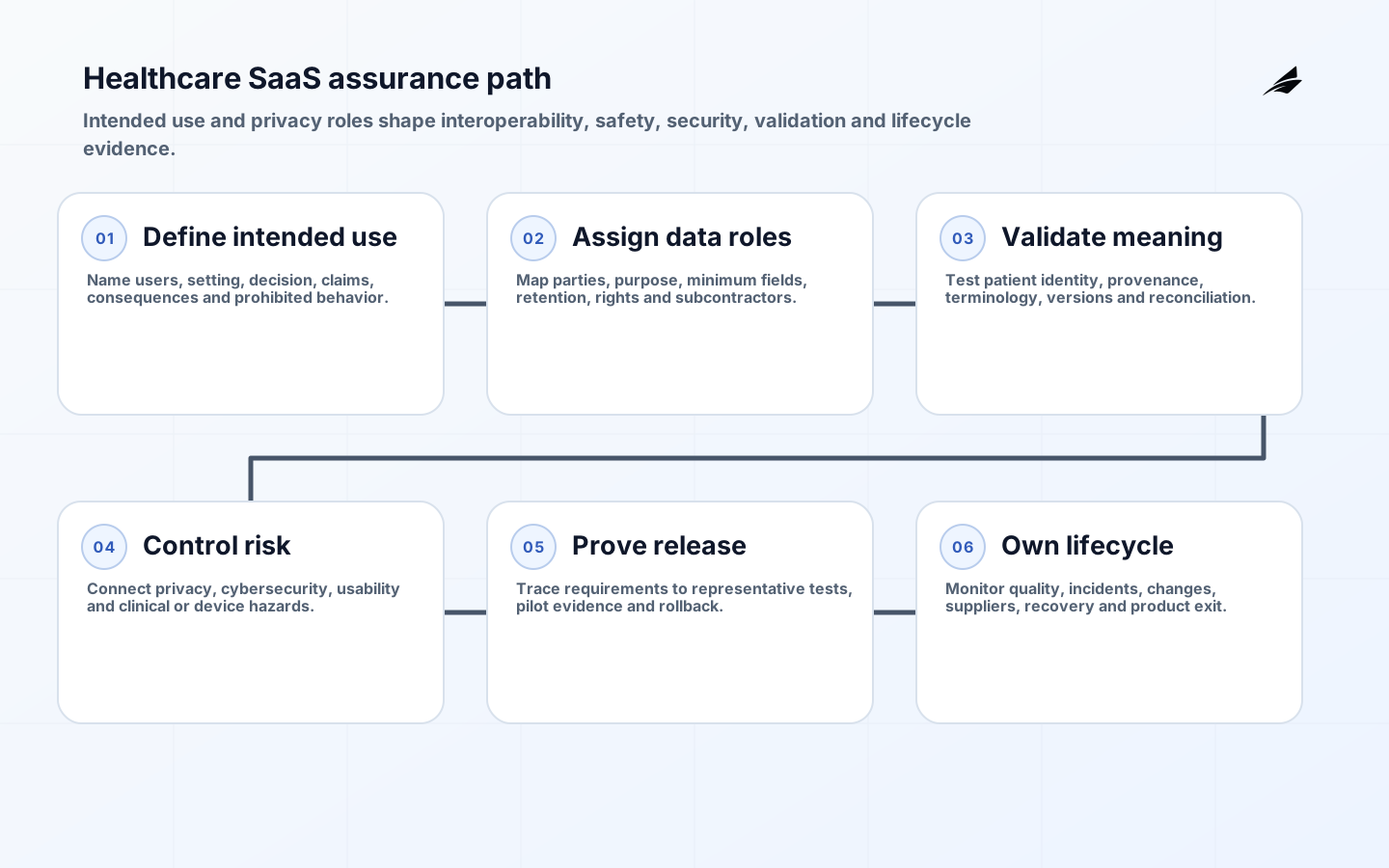
A SaaS product development company for healthcare must be able to connect product discovery and software delivery with privacy, security, interoperability, clinical safety and regulated-product boundaries. Healthcare is not one market. A scheduling tool, health-plan workflow, patient app, clinical decision-support feature and connected medical device can face very different data, evidence and oversight requirements. The first test of a partner is whether it asks what the product does, for whom, with which data and consequence before promising that a standard cloud stack will be compliant.
This FAQ is for healthcare organizations and founders evaluating a development partner. It is not legal, regulatory or clinical advice. Engage qualified counsel, privacy, security, quality and clinical specialists for the intended markets. The partner should help create the technical and operational evidence those owners need. Certifications and a business associate agreement can support the relationship, but they do not prove that the customer’s intended use, workflows, integrations and configuration satisfy all obligations.
What should be defined before partner selection?
Write intended use, users, setting, decisions supported, data sources, outputs and prohibited uses. State whether the product is administrative, patient-facing, clinical, payer-focused or part of a device. Map possible harm from incorrect, missing, delayed or disclosed information. Identify countries and states, customer types and whether buyers are covered entities, business associates, employers, consumers or another role. Product naming is not enough; two features with similar interfaces can have different regulatory and safety consequences based on claims and workflow.
Define the first end-to-end outcome and evidence. A referral product might receive a record, validate patient and order context, route it, expose status, handle missing information and reconcile completion. Baseline turnaround, rework, abandonment and safety escalation. List required electronic health record, laboratory, claims, identity and device connections. Bring sample implementation guides and customer constraints to the selection process. A credible partner will identify unknown clinical meaning and integration dependencies rather than treating every system as a generic REST API.
| Evaluation area | Evidence to request | Warning sign |
|---|---|---|
| Intended use | Example of scope, claims and prohibited-use record | Regulatory category assumed from product label |
| Interoperability | FHIR profile, terminology and reconciliation example | API connectivity presented as semantic interoperability |
| Privacy | Data-flow and role analysis artifact | HIPAA reduced to encryption and a hosting certificate |
| Safety | Hazard, usability and escalation evidence | Clinical review deferred until launch |
| Operations | Incident, downtime and recovery exercise | Production responsibility excluded from delivery |
How should privacy and contractual roles be handled?
Map every health-data flow and determine the role of each party with counsel. Under HIPAA, covered entities and business associates have specific obligations for protected health information; the Security Rule requires appropriate administrative, physical and technical safeguards for electronic PHI. Products outside HIPAA may fall under the FTC Health Breach Notification Rule and other laws. Define permitted purpose, minimum necessary data, recipients, subcontractors, residency, retention, deletion, patient rights and breach responsibilities before production data are used.
The development environment needs equal attention. Use synthetic or appropriately governed test data; prevent production records from entering issue trackers, logs, screenshots or generative tools without authorization. Separate tenants and environments. Restrict support access through named, time-bounded approvals and preserve audit evidence. Ensure contracts address subcontractors, incident notice, data return, secure deletion, vulnerability handling and transition. The customer should control production accounts and encryption-key policy appropriate to the architecture.
What interoperability capability should a partner demonstrate?
Ask for experience with the exact standards and implementation context, not simply a FHIR logo. FHIR R4 defines normative REST interactions, but deployments vary in profiles, extensions, terminology, authorization, search and version support. The partner should validate patient identity, encounter, provenance, codes, units, timestamps and missing information. It should explain SMART or other authorization profiles where applicable and distinguish technical conformance from clinical correctness. Contract tests need representative partner systems, not only a local mock server.
Design retries and asynchronous work for patient safety. Use idempotency and stable identifiers, reconcile writes in the authoritative system and expose partial failure. Define how queues, manual review and downtime work when an external system is unavailable. Avoid silently dropping unsupported fields or mapping unknown codes to a convenient default. Version mappings and implementation guides and route semantic changes to domain review. Preserve source references where users need to understand a transformed or summarized record.
When do clinical and medical-device considerations enter?
They enter during intended-use definition, not after development. If software performs a medical purpose or supports consequential clinical decisions, obtain regulatory advice for the markets involved. FDA guidance addresses cybersecurity design and premarket evidence for devices with cybersecurity risk, and section 524B requirements apply to qualifying cyber devices. A partner should work within the organization’s quality system, trace requirements to verification, manage configuration and preserve design and risk evidence. Marketing claims must remain aligned with evaluated behavior.
For predictive or AI-supported features, document purpose, inputs, training and evaluation data, populations, performance, limitations, monitoring and human factors. HTI-1 establishes algorithm-transparency requirements for certain predictive decision support in certified health IT. Even where that rule does not directly apply, users need enough information to judge appropriateness. Evaluate clinically meaningful errors and subgroup behavior, run staged prospective validation and give reviewers source evidence and genuine override authority.
What secure-development practices are required?
Require security requirements, threat modeling, protected source and pipelines, peer review, dependency governance, secret management, automated testing, hardened infrastructure and vulnerability response. Test tenant isolation, broken object authorization, identity recovery, privileged access, file handling, API abuse and export. Encrypt sensitive data in transit and at rest with managed keys appropriate to the design. Collect audit records for access and consequential changes without reproducing entire clinical payloads. Patch responsibility must continue after launch.
Plan resilience and response. Establish recovery objectives from the healthcare service, not infrastructure defaults. Back up configuration and data, isolate recovery copies where appropriate and prove restoration plus business reconciliation. Define security, privacy, clinical-safety and operational incident roles. Exercise credential compromise, ransomware, integration outage, incorrect data routing and a harmful software change. The team must be able to contain one tenant, integration or feature without unnecessarily disabling every customer.
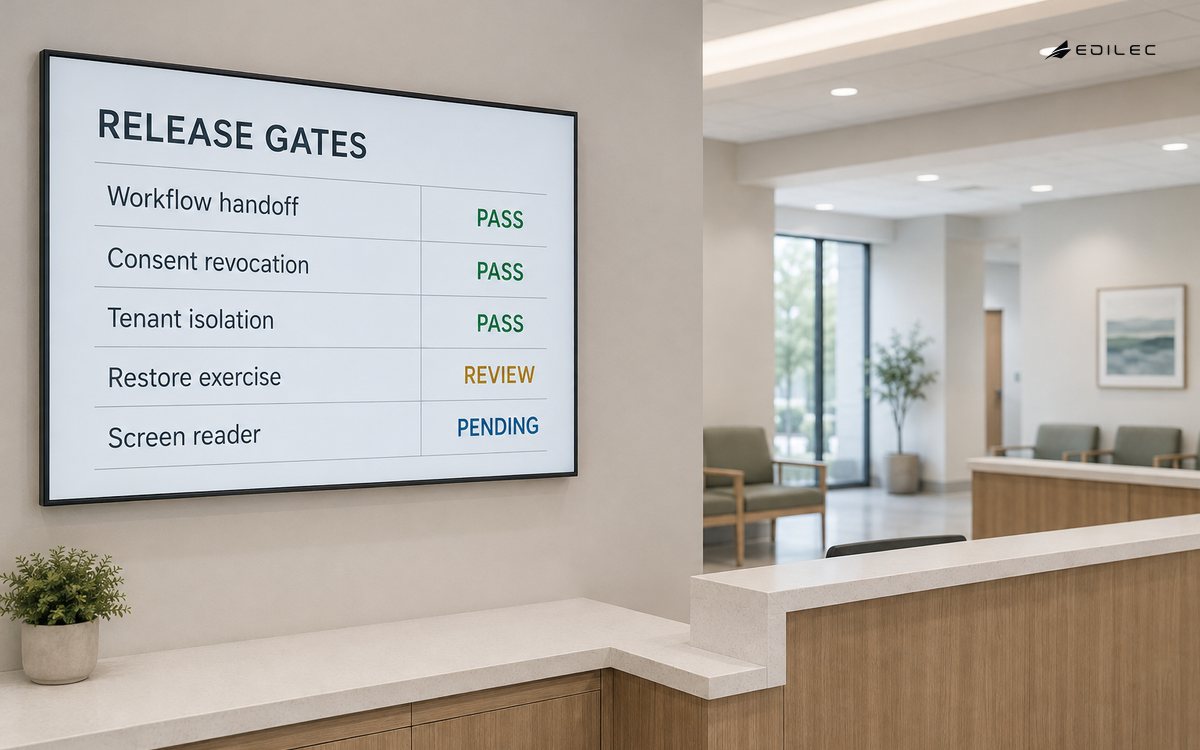
| Release gate | Required evidence | Stop condition |
|---|---|---|
| Workflow | Complete scenario including exception and downtime | Unowned clinical or administrative handoff |
| Data | Approved flow, minimum fields and retention | Unknown recipient or uncontrolled production copy |
| Interoperability | Identity, terminology, version and reconciliation tests | Valid syntax with unresolved clinical meaning |
| Security | Threat-based verification and recovery exercise | Cross-tenant access or untested restore |
| Usability | Representative accessibility and safety testing | Critical error or status not perceivable |
| Operations | Monitoring, support, incident and change ownership | No qualified owner for production response |
How should usability and accessibility be evaluated?
Test with representative clinicians, administrators, patients or caregivers in realistic conditions. Include interruptions, time pressure, assistive technology, low bandwidth, mobile devices and long records. Identify use errors that could cause harm, not only preference issues. Provide clear identity and context, distinguish draft from final information, prevent accidental duplicate submission and make destructive actions recoverable where possible. Error messages should explain what happened and how to continue without exposing sensitive data.
WCAG 2.2 provides a current accessibility standard for web content. Agree the applicable target and legal review, then include keyboard, screen-reader, zoom, contrast, focus, status announcement and touch-target tests in delivery. Clinical tables and charts need understandable text alternatives and responsive behavior. Avoid horizontal layouts that hide patient or unit context. Accessibility is part of safety and market access, not a visual polish phase.
How should validation and launch work?
Create a trace from intended use and risk to requirements, design, tests and release evidence at a level appropriate to the product. Validate with representative data and real integration behavior. Use a controlled pilot with named sites, users, training, support, monitoring and rollback. Reconcile migrated or synchronized records. Track workflow completion, exception, data correction, safety escalation, latency, support demand and user feedback. Do not scale because the interface loads successfully; prove that the intended workflow improves without unacceptable new risk.
Control changes to code, configuration, models, content, mappings and suppliers. Assess whether a change affects intended use, risk, privacy, interoperability or regulatory evidence. Maintain version and release records and communicate material changes to customers. Monitor integration errors, access anomalies, quality samples, downtime and recovery. Establish complaint and vulnerability intake that reaches qualified owners. Plan product and data exit, including export, retention and deletion, before a customer leaves.
What should the healthcare company retain?
The customer should retain intended-use and product authority, privacy and security risk acceptance, clinical or quality oversight, production accounts, source and infrastructure definitions, architecture decisions, data dictionaries, integration mappings, test evidence, incidents, runbooks and supplier relationships. Access can be delegated to a partner through named roles. Preserve an internal technical owner who can evaluate decisions and coordinate regulated functions. Supplier expertise is valuable, but outsourcing all informed judgment creates operational and assurance dependency.
Prove handover through deployment, incident, restore and integration-change exercises led by the permanent team. Remove departing access and rotate bootstrap secrets. Contract for transition assistance, data return and deletion. Maintain open risks and product surveillance after the engagement. A partner relationship can continue for years, but the healthcare organization must be able to explain and govern the service throughout that time.
Key takeaways
- Select a partner only after defining intended use, users, data, decisions and possible harm.
- Treat privacy roles, minimum data and subcontractors as architecture inputs.
- Require semantic interoperability and reconciliation, not API connectivity alone.
- Bring clinical, quality and regulatory review into discovery where the use case requires it.
- Retain production, evidence, risk and lifecycle authority within the healthcare organization.
Frequently asked questions
Does every healthcare SaaS vendor need a business associate agreement?
Not every health technology relationship has the same HIPAA role. Covered entities and vendors should determine applicability and contractual obligations with qualified counsel based on the data and services. Other privacy and breach rules may apply outside HIPAA.
Should every healthcare product use FHIR?
Use the standards required by the workflow, market and connected systems. FHIR is central to many modern exchanges, but claims, imaging, devices and legacy workflows may use other standards. The partner should support the required semantic and operational context.
Is a certified hosting platform enough for compliance?
No. Platform attestations cover a defined service and control boundary. The product organization still owns configuration, identity, application security, data use, integrations, operations and applicable regulatory responsibilities.
Conclusion
A strong healthcare SaaS development partner makes difficult boundaries visible early: intended use, data role, clinical authority, interoperability meaning, security, accessibility and lifecycle responsibility. It then produces evidence through a controlled delivery and launch process. The result should be a service the healthcare organization can explain, validate, operate and improve—not merely software that has passed a demonstration.