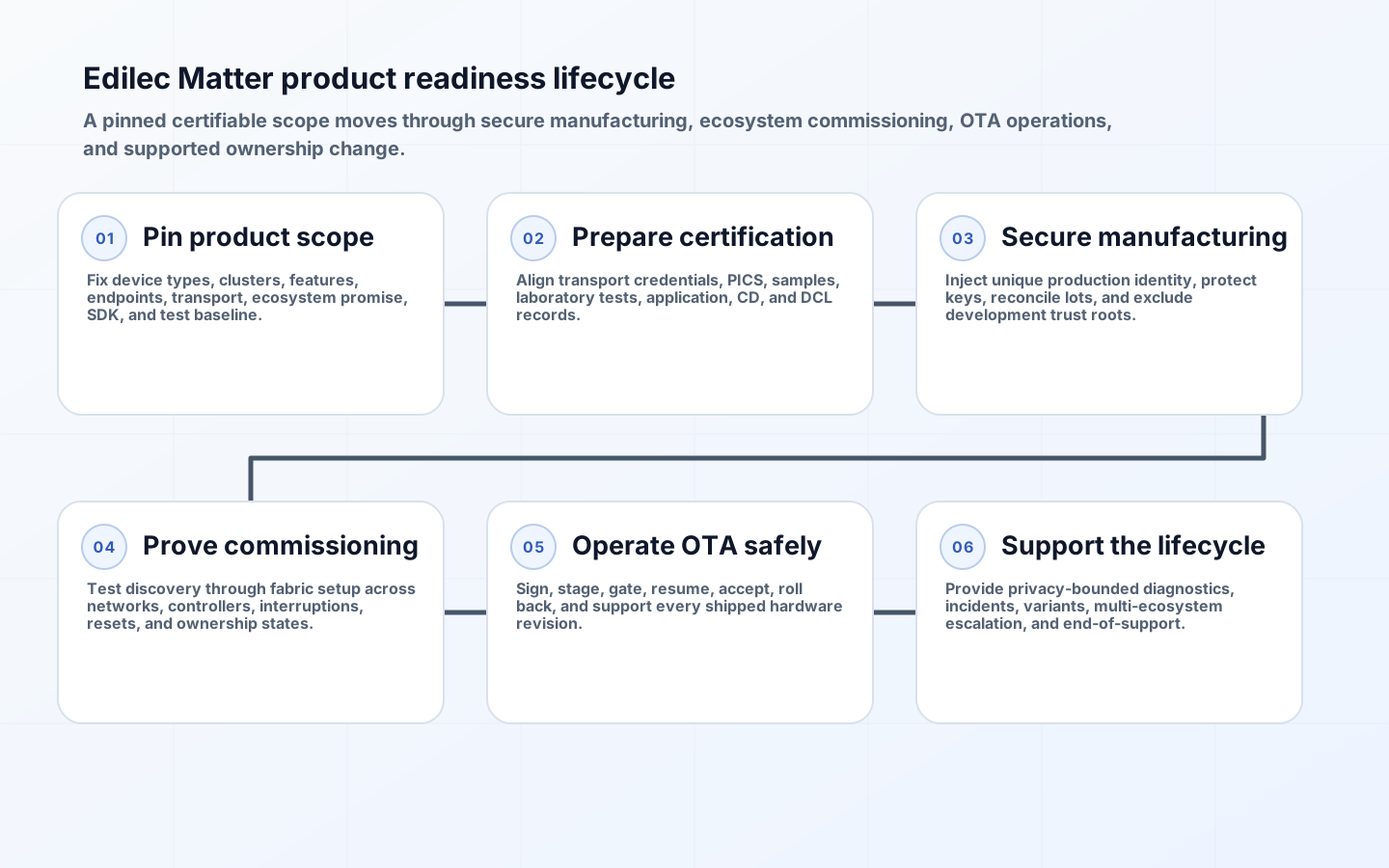
Matter product development is a complete product-lifecycle program, not the addition of an interoperability logo to firmware. A commercial device must implement the correct device types and clusters, obtain network-transport and Alliance certification, protect manufacturing credentials, commission reliably across ecosystems, update safely, preserve user control across fabrics, and give support teams enough evidence to solve failures without collecting household secrets.
As of July 13, 2026, Matter 1.6 is the current announced release. The Alliance's Matter 1.6 announcement emphasizes setup, multi-ecosystem coordination, contextual control, and clearer capability and safety information. Product teams still need to choose the specification and SDK baseline supported by their silicon, test plan, target ecosystems, and launch schedule rather than promising every newest feature.
Define the certifiable product scope and ecosystem promise
Name the device type, mandatory and optional clusters, endpoints, features, attributes, commands, events, transport, power profile, commissioning methods, administrator roles, bridge behavior, and vendor-specific functions. Map each marketed claim to a testable behavior. Decide which functions remain local through Matter and which require a vendor cloud. Explain that boundary accurately; interoperability for a core cluster does not imply every proprietary feature appears in every controller.
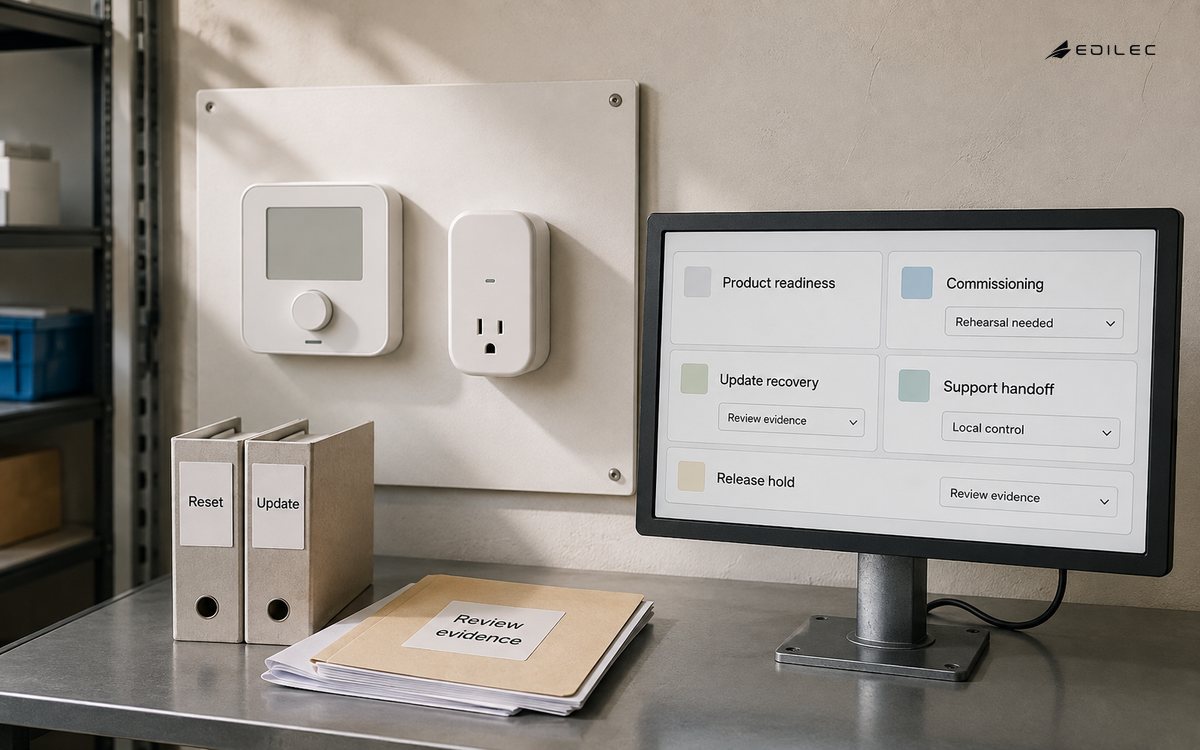
Pin the Matter specification, SDK commit, data-model definitions, test harness, toolchain, network-stack versions, and silicon errata used for a release. The Alliance-guided connectedhomeip repository is an implementation source, not a substitute for product requirements and certification policy. Maintain an upstream integration cadence and isolate product logic from SDK churn. Budget flash, RAM, persistent storage, certificates, logs, and rollback space before hardware freeze.
| Workstream | Release evidence | Owner | Late discovery risk |
|---|---|---|---|
| Specification scope | PICS-aligned device and cluster matrix | Product and firmware | Marketing mismatch or redesign |
| Connectivity | Certified Wi-Fi, Thread, or Ethernet path and coexistence tests | Hardware and networking | Commissioning and field reliability failures |
| Credentials | Production DAC/PAI process, key protection, CD and DCL records | Security and manufacturing | Uncertifiable or impersonable devices |
| Commissioning | Cross-ecosystem install-state matrix and recovery UX | Mobile, firmware, support | Returns despite protocol conformance |
| Updates | Signed OTA, version policy, staged rollout, rollback | Firmware and operations | Unpatchable field fleet |
| Support | Privacy-bounded diagnostics and trained escalation | Customer operations | Long unresolved incidents |
Plan certification and manufacturing credentials together
The Alliance certification process requires membership, relevant transport certification, an authorized test provider, test samples and PICS documentation, and an application. Matter products receive a Certification Declaration blob and a certified product record in the Distributed Compliance Ledger. Confirm current program requirements directly with the Alliance and laboratory because policy and accepted test baselines evolve.
Treat Device Attestation Certificates and keys as production security assets. Establish approved provenance, injection station controls, per-device uniqueness, hardware-backed protection where appropriate, access logs, inventory reconciliation, backup and disaster recovery for issuing services, and procedures for scrap and rework. Never ship development attestation material. Link manufacturing lot, firmware, hardware revision, attestation identity, and certification record without exposing private keys to normal factory applications.
Engineer commissioning as a multi-state customer journey
Commissioning assigns operational credentials for a fabric after discovery and secure onboarding. Test fresh device, previously commissioned device, multiple fabrics, factory reset, administrator removal, phone replacement, lost internet, missing border router, changed Wi-Fi credentials, weak radio, duplicate name, interrupted setup, stale app, accessibility needs, and transfer to a new owner. The official Matter Handbook commissioning overview describes the commissionee advertising before the flow begins; real reliability depends on every surrounding device and UI state.
Instrument stages with privacy-safe reason codes: discovery, secure channel, attestation, regulatory configuration, network provisioning, operational discovery, fabric credentials, cluster setup, and final confirmation. Do not log setup passcodes, operational keys, Wi-Fi secrets, or household topology. Give users a reversible next action and preserve the distinction between retry, reset, and remove from an existing fabric. A factory reset is destructive and should not be the first troubleshooting instruction.
| Stage | Likely causes | User-safe recovery | Support evidence |
|---|---|---|---|
| Discovery | Permissions, radio, stale advertisement, device not commissionable | Confirm mode, proximity, and app permissions | Stage code and radio summary |
| Attestation | Wrong production credentials, trust-store or CD problem | Stop; escalate product identity issue | Non-secret certificate identifiers and validation reason |
| Network join | Credentials, channel, Thread border router, DHCP | Retry network step without erasing fabric unnecessarily | Transport reason and bounded timing |
| Operational discovery | mDNS path, VLAN isolation, controller reachability | Check local-network policy and retry | Interface, discovery result, no household names |
| Final setup | Cluster or ecosystem configuration failure | Keep secure fabric state and retry configuration | Cluster/status code and software versions |
Operate Matter OTA updates and field support
Define who provides images, how devices discover availability, signature and version rules, power preconditions, download resumption, installation, health acceptance, rollback, cohort rollout, and end-of-support. Certification test tooling includes OTA workflows, but passing a case does not prove fleet operations. Test update while on multiple fabrics, during controller absence, after long sleep, near storage limits, and across every hardware revision. Keep a full-image recovery path when differential updates are used.
Support needs product, hardware, software, transport, fabric count, commissioning stage, update state, reset history, and bounded connectivity diagnostics. Build a consented diagnostic export the customer can inspect. Create ecosystem escalation packets with reproducible steps and specification evidence, because responsibility may cross device, controller, phone, access point, and border router. Monitor commissioning completion, time by stage, repeat attempts, factory resets, fabric removal, command success, subscription stability, update adoption, rollback, and returns by version.
Validate the cross-ecosystem lifecycle before launch
Maintain a device lab covering target controllers, mobile OS versions, access points, Thread border routers, IPv6 and multicast behavior, and realistic RF congestion. Test simultaneous ecosystems, controller upgrades, subscription resumption, power cycles, network reconfiguration, time loss, and ownership transfer. Run certification pretests continuously rather than at the final milestone. Freeze the certification candidate while corrective changes are controlled and traced.
Launch through a bounded field cohort and compare commissioning and support outcomes with laboratory expectations. Define stop conditions for setup failure, unexpected resets, unreachable devices, or update regressions. Coordinate inventory, packaging codes, app release, DCL and certification records, support scripts, OTA service, and replacement flow. Product readiness is achieved when the whole customer journey can be operated, not when the firmware first responds to a controller.
Key takeaways
- Pin a certifiable specification, SDK, device scope, transport, and ecosystem promise before hardware freeze.
- Integrate certification evidence with secure per-device credential manufacturing and records.
- Test commissioning across install, network, fabric, controller, interruption, reset, and ownership states.
- Operate signed staged OTA updates with hardware-specific health gates and rollback.
- Equip support with privacy-bounded stage evidence and cross-vendor escalation paths.
FAQ
Must a new product support Matter 1.6?
Not automatically. Use the version supported by the selected certification program, SDK, silicon, ecosystems, and product scope. Evaluate 1.6 capabilities and migration, but do not add unproven features solely to claim the newest number.
Can a Matter product still use a vendor cloud?
Yes. Matter supports local interoperable interactions while vendors may offer remote services and differentiated features. State which functions require cloud connectivity, protect account linking, and preserve promised local behavior during outages.
Does certification eliminate ecosystem testing?
No. Certification establishes conformance to the program scope. Product UX, network diversity, controller versions, optional features, multi-admin behavior, and support paths still require extensive cross-ecosystem testing.
Prepare launch, incident response, and end-of-support
Before shipment, reconcile certified hardware and software with factory output, packaging setup codes, DCL records, mobile applications, privacy disclosures, support content, replacement stock, and the OTA service. Prevent a late component substitution from bypassing certification and RF review. Use production credentials in a tightly controlled acceptance sample, then verify that development trust roots are absent from retail builds. Run a launch rehearsal from unboxing through adding a second ecosystem, updating, removing a fabric, factory resetting, and recommissioning.
Create incident playbooks for credential exposure, commissioning regression, ecosystem update incompatibility, network-stack vulnerability, OTA failure, and a cloud outage affecting optional services. Controls should include stopping shipment, withdrawing an image, pausing rollout, notifying ecosystem partners, scoped support messaging, and preserving local core behavior. Device attestation, operational fabric credentials, vendor accounts, and cloud API keys are distinct trust domains; a response should not reset or revoke them indiscriminately.
Publish a software support period and a decommissioning path. Near the end, move devices to the last supported release, explain which local and cloud functions continue, preserve ownership transfer and reset where feasible, and give customers enough notice to replace products safely. Maintain signing, update hosting, vulnerability intake, and support capability for the promised duration. Matter interoperability does not remove the manufacturer's responsibility for the device's security, privacy, physical safety, or honest lifecycle communication.
Track product variants carefully. Color or enclosure changes may be irrelevant to protocol behavior, while a radio, memory, power-supply, sensor, or manufacturing-location change can affect certification, security, RF, thermal behavior, or commissioning. Use a formal change-impact review that links each variant to inherited tests, new evidence, certification decisions, packaging, software compatibility, support identification, and launch approval.
Conclusion
A Matter product succeeds when conformance, credentials, commissioning, updates, and support operate as one lifecycle. Teams that pin scope, prove real ecosystems, protect manufacturing identity, and instrument recoverable setup can turn protocol interoperability into a consistently dependable customer experience.