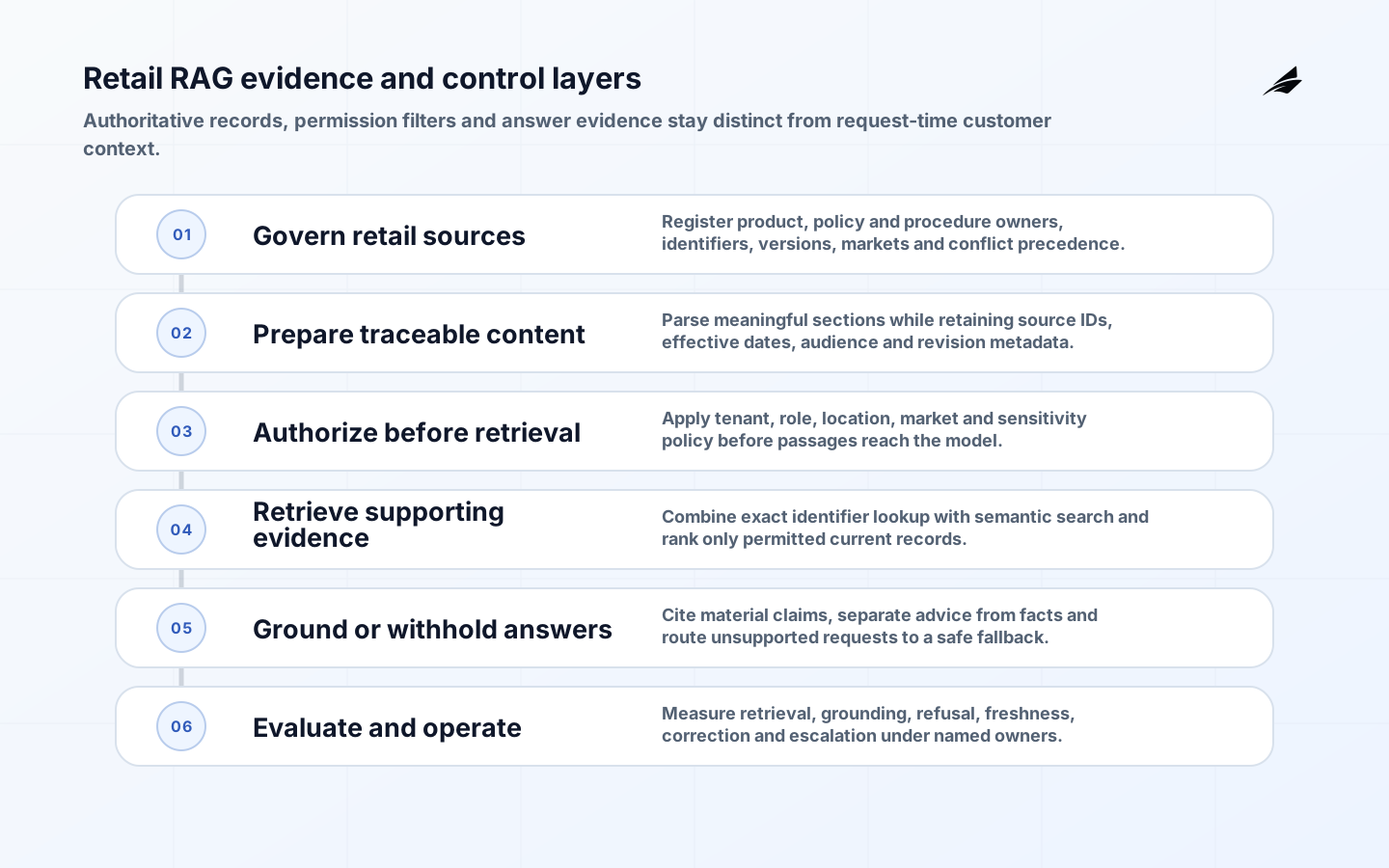
RAG knowledge base implementation for retail combines a language model with retrieval from separately governed information. The purpose is not to make a model memorize the catalog. It is to assemble current product, policy, order and operational evidence for a specific question, then produce an answer whose sources and limits can be inspected.
Retail makes that task unusually demanding. A product can vary by market, channel, pack, seller and effective date. Availability changes faster than documentation. Returns and promotions depend on transaction context. Customer records require strict tenant and identity controls. A useful retail RAG architecture therefore begins with information ownership and answer decisions rather than a vector database.
Choose a retail question with an accountable answer
Define the user, question, evidence and permitted outcome. A store associate identifying a compatible accessory needs product and location context. A customer asking about a return needs identity, order state and the policy effective at purchase. A merchandiser comparing supplier attributes needs provenance and conflict handling. These are separate retrieval contracts even when they share infrastructure.
Start with questions that have reliable sources, repeated demand and observable correctness. Keep financial, safety and account-changing actions outside the answer generator. A RAG service may explain why an item is ineligible for return, but the commerce service should calculate eligibility and any refund. Missing evidence must produce a clear limitation or escalation, not a plausible guess.
| Question | Authoritative evidence | Freshness need | Safe outcome |
|---|---|---|---|
| Product compatibility | Product master, variant and manufacturer data | At catalog change | Cited recommendation with constraints |
| Order status | Order, fulfillment and carrier events | Near real time | Explanation of verified state |
| Return policy | Order date, item class and versioned policy | At policy release | Eligibility explanation; transaction elsewhere |
| Store procedure | Approved operations documents | At procedure release | Step guidance with escalation |
| Traceability | Product identifiers and supply-chain events | Per critical event | Trace path and unresolved gaps |
Build the source-of-truth map
Inventory product information management, commerce, order management, inventory, policy repositories, supplier files, service articles and traceability systems. For each source, record the owner, identifiers, audience, region, effective dates, update mechanism and retention. Do not flatten every record into undifferentiated text; preserve fields that determine whether evidence applies.
GS1 standards illustrate the importance of globally meaningful product, party and location identifiers. The Global Traceability Standard distinguishes master, transaction and visibility event data, while EPCIS describes the what, where, when and why of supply-chain events. A retailer does not need EPCIS for every answer, but stable identifiers prevent a model from joining a product description to the wrong pack, lot or location.
Create an ingestion contract, not a document dump
Extract content through supported APIs or controlled exports. Normalize encoding and remove navigation, duplicated boilerplate and obsolete versions. Attach metadata before chunking: source ID, product or policy key, market, channel, permissions, effective period and revision. Retain a checksum and ingestion time so every indexed fragment can be traced to its origin.
Chunk along semantic boundaries such as policy clause, product feature group or troubleshooting step. Keep the heading and parent context with each fragment. Tables and structured specifications may need field-aware indexing rather than prose conversion. Validate counts and samples after every run; a successful indexing job can still omit the newest region or duplicate an entire catalog.
Retrieve with identity, filters and ranking
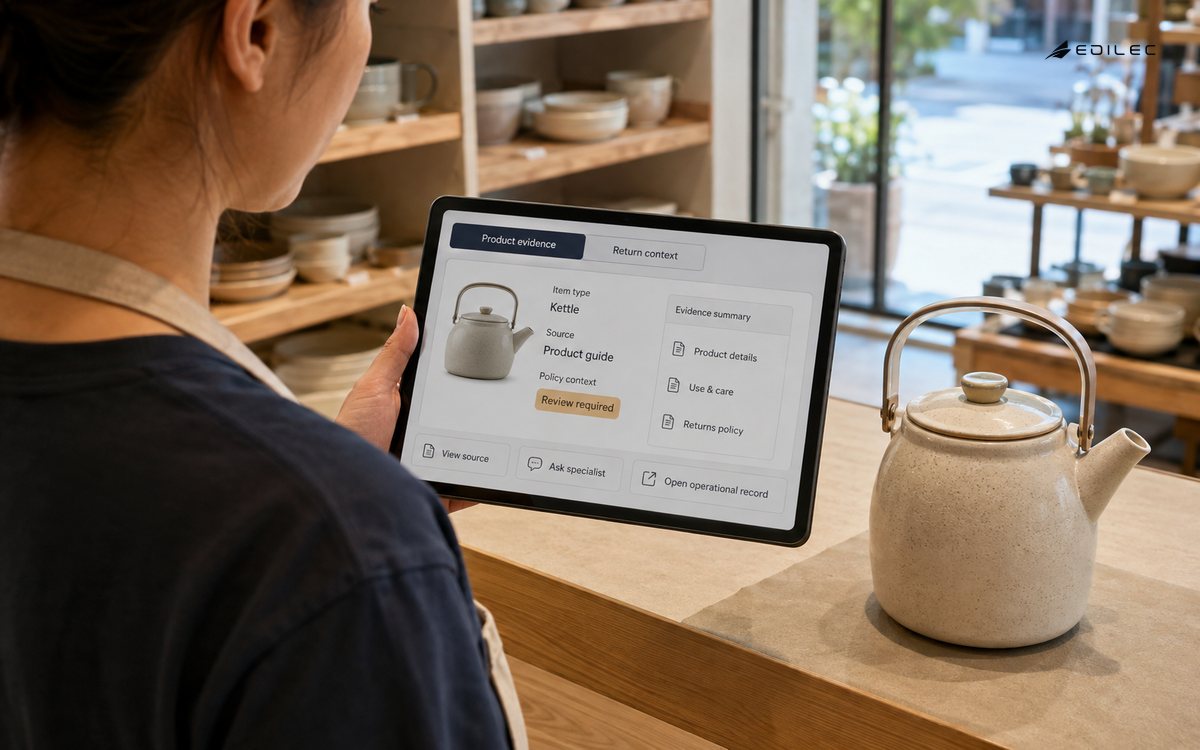
Resolve user and retail context before search. Apply permission, market, channel, product and effective-date filters in the retrieval service, not through natural-language instructions. Combine keyword and semantic retrieval where exact identifiers, model numbers or policy terms matter. Rerank a manageable candidate set and return source metadata with every passage.
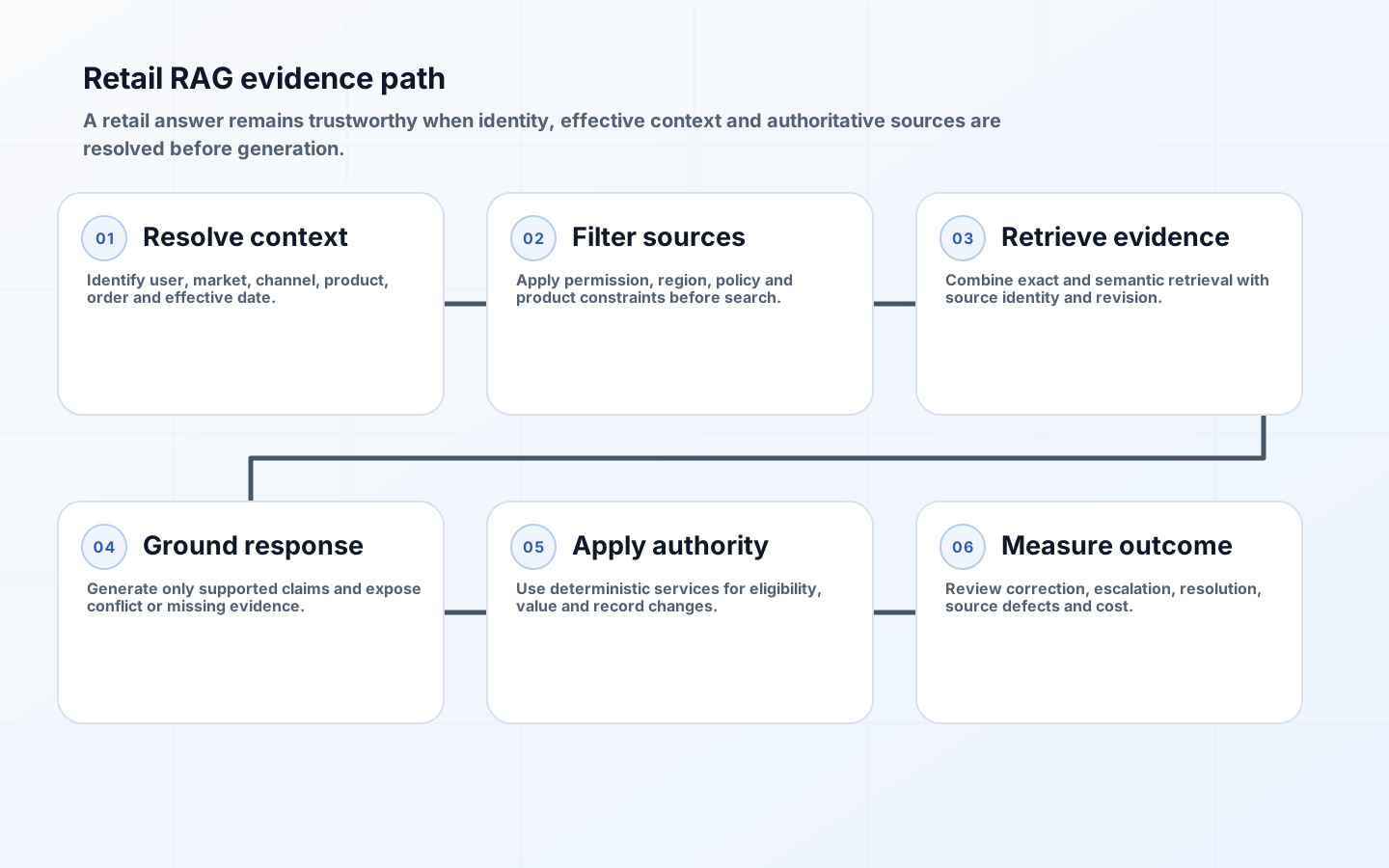
Query rewriting can improve recall but must not alter customer identity, product identifiers or stated constraints. Log the original and rewritten query safely. Use a confidence or evidence rule that can decline to answer when passages conflict or do not support the requested detail. Retrieval quality should be diagnosed separately from generation quality.
| Layer | Test question | Useful measure | Failure response |
|---|---|---|---|
| Source | Is the approved current fact indexed? | Coverage by source and market | Repair ingestion or ownership |
| Retrieval | Are supporting passages returned? | Recall at k and ranking relevance | Tune filters, query or index |
| Answer | Is every material claim supported? | Grounded correctness | Constrain prompt or abstain |
| Policy | Was the correct version applied? | Effective-date accuracy | Fix deterministic context |
| Operation | Did the user resolve the task safely? | Correction, escalation and repeat contact | Change workflow or scope |
Constrain generation around evidence
Give the model a defined task, approved passages, output schema and instruction to identify uncertainty. Require source references for claims that can change. Keep policy calculations and eligibility in deterministic services. Treat retrieved documents and user messages as untrusted data because either can contain text that attempts to redirect the model.
Tools should expose the minimum functionality and permissions. OWASP describes excessive agency as excessive functionality, permissions or autonomy. A product-answer service may read approved catalog facts but should not change prices. An order assistant should retrieve only the authenticated customer's order and should not inherit a shared administrative identity.
Evaluate retail answers with real decision cases
Build an evaluation set from representative questions across products, markets, channels, languages and edge conditions. Preserve the expected sources, answer, acceptable variation and escalation reason. Include discontinued products, overlapping promotions, similar model numbers, policy changes, sparse supplier data and attempts to retrieve another customer's information.
Score source coverage, retrieval relevance, grounded claims, policy-version accuracy, unsupported detail, privacy and task outcome. Have merchandisers, store operations, service and security review the cases they understand. The NIST AI RMF functions—Govern, Map, Measure and Manage—provide a practical structure for ownership, context, evaluation and response over the service life.
Release by question class and authority
Begin offline, then run in shadow against current answers. Release an employee-assist view that exposes evidence and allows correction. Add customer-facing responses only for question classes that meet stricter thresholds. Keep an easy handoff with the query, retrieved evidence and unresolved issue. Do not force users through repeated automated replies before reaching a person.
Version the source corpus, parser, index, embedding, ranking, model and prompt. Re-evaluate after changes to any component. Monitor unanswered questions, wrong-source corrections, stale evidence, permission denials, latency, cost and resolved-task outcomes. Incident plans should cover cross-customer retrieval, systematic misinformation and unavailable source systems.
Example: product and returns assistance
A customer asks whether a purchased appliance accessory can be returned. The service authenticates the account and resolves the order line, product variant, seller, market and purchase date. Retrieval brings the exact product restrictions and the return policy version effective for that transaction. A deterministic policy function calculates eligibility; the model explains the result with those sources.
If the supplier record and catalog disagree about the product class, the service does not choose the more convenient passage. It shows the conflict to an agent and opens a data-quality case owned by merchandising. The customer receives a human-reviewed answer, and the underlying source problem is corrected for future cases.
Govern source change and answer incidents
Create a change path for every indexed source. A merchandiser or policy owner should be able to correct the authoritative record, identify its effective date and trigger reindexing. Validate that old fragments leave active retrieval while remaining available where historical transaction context requires them. A prompt edit is not a substitute for repairing wrong product or policy data.
Prepare incident categories for cross-customer retrieval, systematically wrong product advice, stale safety information and unavailable source services. Disable the smallest affected question class, preserve query and source evidence, and identify customers or employees exposed to the error. Add confirmed failures to evaluation only after the correct source and expected response are adjudicated.
Quarterly review should compare unanswered demand, source defects, correction clusters, resolution and run cost. Retire questions whose evidence cannot be maintained. Expand only where an owner accepts source freshness and escalation. This governance keeps the knowledge service aligned with the retail operation rather than allowing the index to become an undocumented copy of it.
Related reading
Use RAG Systems Architecture for retrieval engineering, RAG Evaluation for Company Knowledge Bases for test design, and the Retail RAG Readiness Checklist before committing to delivery.
Frequently asked questions
Does a retail RAG system replace product information management? No. Product and policy systems remain authoritative. RAG retrieves and explains their approved information for a question; it does not become the master record.
How often should the index update? Match the source's business risk. Product and policy changes may require event-driven or scheduled updates, while near-real-time availability should usually be fetched from the operational service rather than a stale text index.
Can customer cases be indexed? Only with a defined purpose, permission model, minimization and retention. Do not expose one customer's details to another query, and do not assume solved cases are automatically correct knowledge.
What is the most important RAG metric? No single metric is enough. Measure source coverage, retrieval, grounded answer quality and the user's verified task outcome, segmented by question class.
Key takeaways
- Define the retail answer and authority before selecting retrieval technology.
- Preserve product, location, policy and effective-date identity throughout ingestion.
- Apply permissions and market filters outside the model.
- Evaluate source, retrieval, answer and task outcome separately.
- Release question classes progressively with visible evidence and human escalation.
Conclusion
Retail RAG is a knowledge service, not a catalog-shaped prompt. Its quality comes from authoritative identifiers, versioned sources, permission-filtered retrieval, constrained generation and evaluation against real retail decisions. When a retailer keeps transaction authority in operational systems and gives people inspectable evidence, the service can answer more questions without weakening product truth or customer privacy.