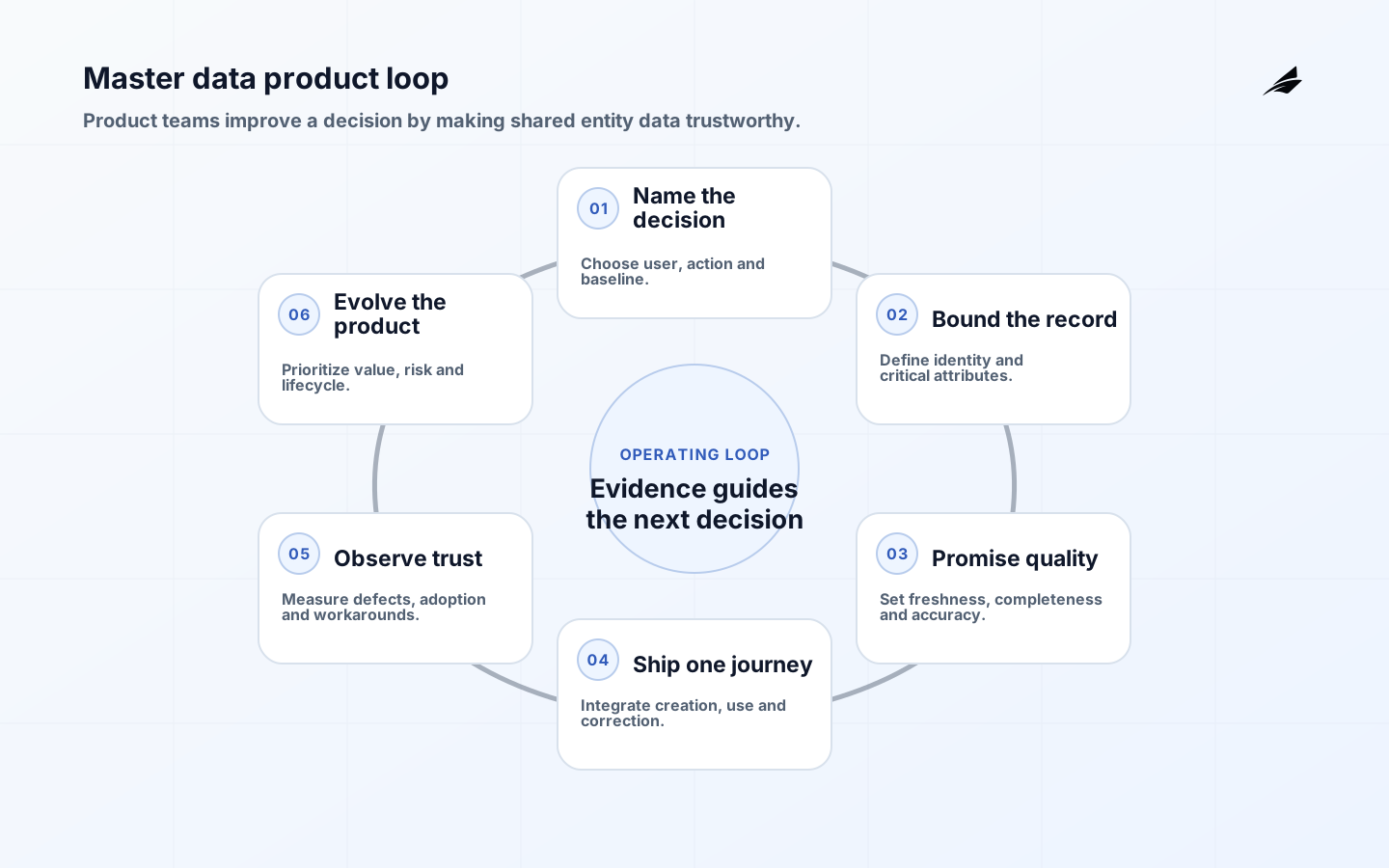
Master data management for product teams is not a request to buy a hub and clean everything. It is product work on shared entities that many journeys depend on: customers, suppliers, products, locations or employees. The product team's job is to choose valuable decisions, define a quality promise, coordinate producers and consumers, and make correction easier than living with mistrust.
Use Edilec's system of record guide for authority concepts, the enterprise MDM practical guide for foundations and the ERP integration guide for downstream exchange. This article focuses on product discovery, promises and adoption.
Key takeaways
- Start with a user decision harmed by inconsistent shared data.
- Define the entity boundary and critical attributes with domain owners.
- Offer measurable quality, freshness and correction promises by use case.
- Ship one end-to-end journey including creation, consumption and repair.
- Prioritize by outcome, risk and reusable domain capability, not record count.
Choose the decision MDM should improve
Interview the people who create, use and correct the record. Observe a specific decision: approving a supplier, publishing a product, routing a support case or consolidating customer exposure. Measure delay, duplicate work, failed transactions, incorrect decisions and manual reconciliation. 'Single source of truth' is not an outcome; faster onboarding with fewer payment holds is.

Write a product statement naming user, decision, domain, baseline and target. Bound the first population and excluded cases. Identify upstream incentives: a sales team may not benefit from entering legal-party data needed by finance. The roadmap must address that workflow and ownership gap, not assume governance policy will change behavior.
| Discovery question | Evidence | Product decision | Bad proxy |
|---|---|---|---|
| Who is blocked? | Observed user and queue | Primary persona | All employees |
| Which decision fails? | Cases and downstream impact | First use case | Data quality generally |
| Which fields matter? | Decision dependency | Critical data elements | Every source field |
| What is good enough? | Error cost and timing | Quality promise | One universal score |
| Who can repair it? | Authority and workflow | Stewardship path | Central data team alone |
Define the shared record in user language
Facilitate examples before schemas. Ask whether a household and customer are the same, whether one product in different markets is one record, and what happens after a company merger. Define identity, relationships and lifecycle using cases users recognize. Preserve source identities and let downstream teams see lineage where it affects decisions.
Assign a domain owner for meaning and attribute owners for critical fields. Authority may vary by state and time. The product manager makes decisions and dependencies visible; they do not personally arbitrate every record. External standards can reduce local invention. GS1's Global Data Model, for example, harmonizes product-data exchange across channels and markets.
Create a quality promise consumers can use
Promise quality by critical attribute and journey: supplier tax identity validated before approval, product dimensions complete before warehouse release, customer preference updated within a defined time. Specify completeness, validity, freshness, uniqueness and correction targets only where they affect the decision. Include availability and publication lag for consuming systems.
Explain uncertainty. A probable duplicate, pending verification or disputed address should not look identical to a confirmed record. Define consumer behavior for each state. ISO's data-quality management process model offers a process reference for management capability; the product promise translates such discipline into an experience and service level users can rely on.
| Promise | Example definition | Measure | Product response |
|---|---|---|---|
| Completeness | Critical launch fields present | Eligible records complete | Block or route correction |
| Freshness | Approved update published in 15 minutes | End-to-end lag | Investigate source or delivery |
| Identity | False merges below approved tolerance | Sample and confirmed defects | Unmerge and notify |
| Correction | High-impact defect owned in four hours | Age by severity | Escalate stewardship |
| Availability | Read service meets journey objective | Successful requests | Fallback or degraded mode |
Ship one complete master-data journey
A vertical release includes source capture, validation, identity resolution, stewardship, publication, consumer adoption and correction. Choose one business unit or product category and a small consumer set. Migrate with reconciliation and explicit source-of-truth timing. Do not declare success when the hub contains records but operational teams still use spreadsheets because corrections are slow.
Design the steward experience around reason and authority. Show the conflicting values, provenance, affected journeys and recommended next action. Let users report defects from consuming applications with context. Close the loop by telling them when a correction is published. For cross-company product data, the persistent GS1 standards repository illustrates how shared specifications support synchronized exchange.
Build privacy and security into product choices
Combining records can reveal relationships and profiles absent from any single source. Map purpose, access, retention, deletion, correction and sharing before adding fields. The NIST Privacy Framework helps teams discuss privacy risk as an enterprise concern. Legal obligations still depend on jurisdiction and context, so involve privacy counsel and affected stakeholders.
Protect search, bulk export, match candidates, stewardship notes and audit history. Apply least privilege and monitor sensitive access. The NIST Cybersecurity Framework connects governance to protection, detection, response and recovery. Include authorization and privacy acceptance criteria in user stories rather than scheduling them after the data model is complete.
Measure trust, adoption and business effect
Combine data measures with workflow evidence: time to approve a supplier, orders blocked by missing master data, product returns caused by wrong attributes, manual joins, duplicate customer contacts and correction age. Track consumer onboarding and successful use. Query volume alone does not show trust; a forced dependency may be heavily used and widely resented.
Review slices by source, region, product category and lifecycle stage. Watch manual overrides and shadow datasets as signals of unmet need. Compare benefit with platform, integration, stewardship, source remediation and consumer migration cost. Avoid claiming the total value of every downstream process; use causal evidence from the selected journey and widen the case as adoption grows.
Prioritize and govern the roadmap
Score opportunities by user impact, risk, reach, readiness, reusable domain capability and total cost. A second consumer of a proven customer identity service may be cheaper and more valuable than a new enterprise-wide domain. Sequence source remediation and consumer adoption explicitly. Give deprecation work equal visibility because old identifiers and feeds create ongoing confusion.
Use a domain council for meaning, policy and conflict, but keep routine decisions with named owners. Publish release notes and quality changes. Review the promise after acquisitions, regulatory change and new markets. Set retirement criteria for attributes, interfaces and manual queues. MDM is a long-lived product, so reducing complexity is part of delivery.
Worked example: trustworthy product dimensions
A retailer sees warehouse slotting errors and online returns caused by inconsistent package dimensions. The product team chooses one category and defines the decision: publish verified consumer-unit and case dimensions before warehouse and storefront release. It measures blocked receipts, manual remeasurement, return reasons and launch delay rather than promising enterprise data quality.
The record model distinguishes product, variant, consumer unit and shipping case. Brand-owner data is authoritative when it meets validation and effective-date rules; warehouse measurement can challenge it through a structured correction. The quality promise covers unit, measurement method, completeness before release, publication lag and high-impact correction time.
The vertical release adds validation at supplier intake, a steward queue with image and measurement evidence, versioned publication to warehouse and commerce systems, and a correction link in both consumer tools. Existing items migrate by risk, starting with fast-moving products and known defects. Consumers reconcile identifiers and dimensions before replacing local spreadsheets.
After launch, the team compares slotting exceptions, dimension-related returns, steward age and supplier correction by source. A decline in missing values without fewer errors would not justify expansion. The next category is selected when shared model and workflow capabilities are reusable and the new decision has measurable value, not because the hub has spare capacity.
The product review brings together a category manager, warehouse user, commerce owner, supplier operations, steward and platform engineer. They inspect a small set of recent defects from creation to correction, then compare the quality promise with observed decisions. This prevents dashboard averages from hiding a painful workflow or a consumer that quietly stopped trusting the service.
The roadmap item for each new category names source readiness, domain differences, consumer migration, steward demand, privacy impact and expected outcome. Reusable platform capability lowers effort but does not erase discovery. A category can be deferred when authority is unresolved or correction cannot be staffed, even if its record volume would make an impressive adoption chart.
MDM product discovery checklist
- Named user and decision have a measured pain baseline.
- Entity, relationships and excluded cases are illustrated with examples.
- Critical attributes have owners and usable quality promises.
- First release covers source, hub, consumer and correction experience.
- Privacy, access, lineage and recovery are acceptance criteria.
- Roadmap measures adoption, workarounds, business effect and lifecycle cost.
Frequently asked questions
Who is the customer of an MDM product?
Usually several internal producers and consumers, plus people affected by their decisions. Pick a primary persona for each release while maintaining domain-wide obligations.
Should we publish one data-quality score?
Rarely. A composite can hide a critical defect. Publish measures tied to attributes and journeys, with definitions and actions when they miss target.
When should a team buy an MDM platform?
After understanding domain, decisions, sources, matching needs, stewardship and consumers. Evaluate platforms against representative cases and operating cost, not feature counts.
Conclusion
Master data management for product teams is the work of making shared records dependable in real decisions. Start with one journey, define meaning and promises, ship correction with consumption, and measure trust through changed work. The platform matters, but product value comes from coordinated behavior around the data. Keep users and stewards in roadmap reviews so technical consolidation never outruns usable correction, adoption and accountable domain ownership across the full lifecycle.