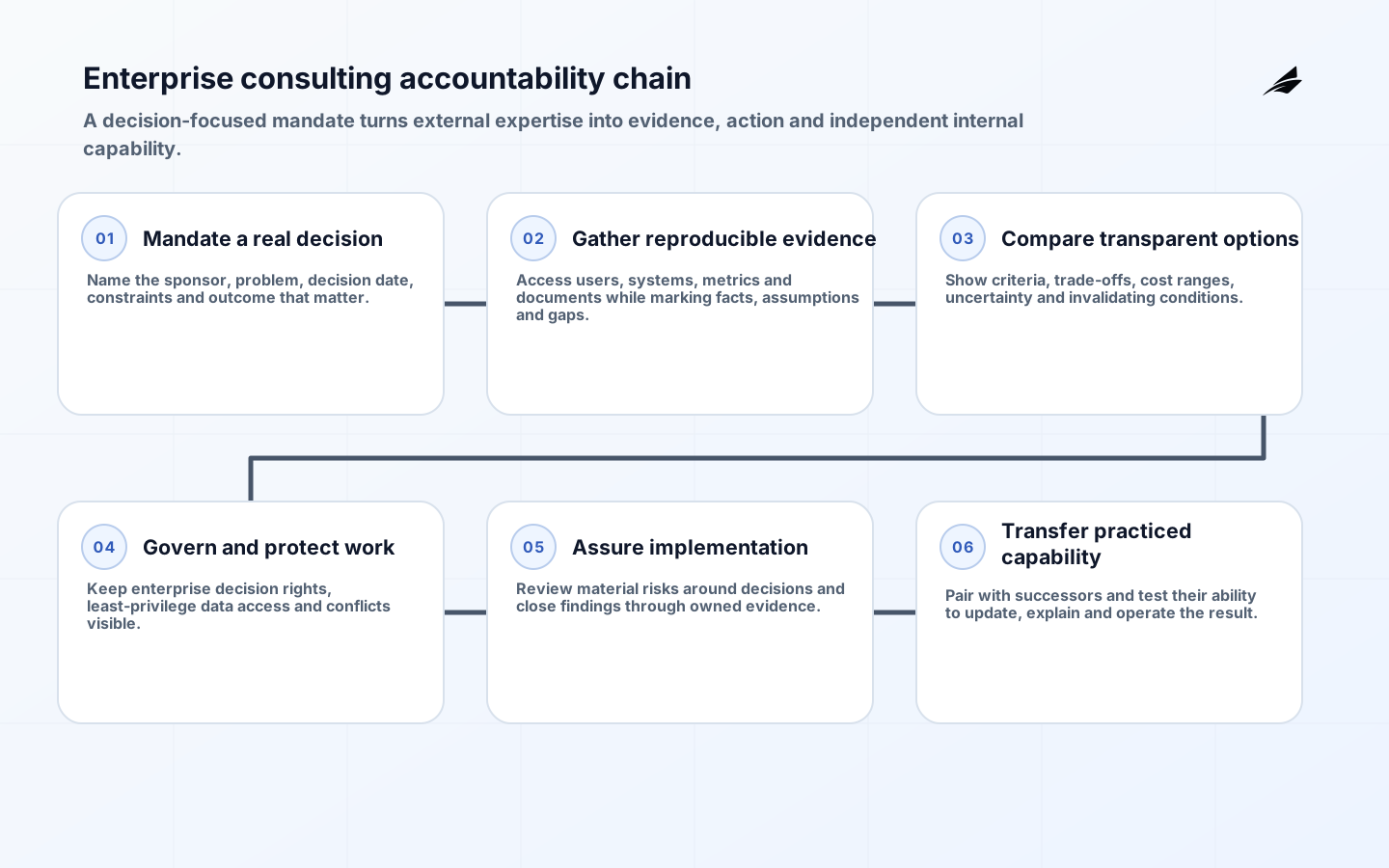
Consulting for enterprise work is most useful when an organization needs focused evidence, specialist capability or independent challenge for a consequential decision. It is least useful when the assignment has no accountable sponsor, success is described as producing a deck, or advisers are expected to substitute indefinitely for internal ownership. A well-designed engagement leaves the enterprise able to act and to explain why.
This FAQ helps sponsors shape technology and transformation consulting without surrendering decision authority. The enterprise consulting scope, cost and risk guide and implementation checklist provide more detailed planning artifacts.
1. When does consulting for enterprise initiatives create value?
Use advisers when the enterprise has a defined decision but lacks time, independent evidence or a specialist skill. Examples include portfolio rationalization, recovery of a troubled program, target operating design, security assessment or preparation for a platform choice. First ask whether the need can be met by internal staff with protected time; consulting should fill a real gap, not bypass a capable team.
Write a mandate naming the sponsor, problem, decision date, affected groups, constraints and intended outcome. GOV.UK’s discovery guidance recommends understanding users, constraints and the problem before committing to a solution. That discipline prevents an engagement from beginning with a preferred product, architecture or reorganization that has not earned its place.
| Engagement type | Useful output | Weak substitute |
|---|---|---|
| Decision discovery | Evidence, options and recommendation | Generic market overview |
| Delivery assurance | Independent findings and owned actions | Status-report restatement |
| Capability uplift | Paired work, standards and practiced skills | Training slides without application |
| Recovery | Prioritized causes, stabilization and reset plan | More governance layers |
2. How should scope and deliverables be defined?
Scope around questions and decisions rather than activities. Specify systems, business units, locations, data access, dependencies and exclusions. Define the evidence required: interviews, architecture records, operational metrics, financial data, user research or control tests. Agree what is accepted as fact, what remains an assumption and how disagreements will be recorded. The enterprise must provide timely access and decision-makers, not merely demand a fixed date.
Deliverables should be usable: an options paper with criteria, a prioritized roadmap with dependencies, an architecture decision set, a risk register with owners, or an operating model with role transitions. Require editable source and the evidence trail. A recommendation should state assumptions, trade-offs, cost range, uncertainty and conditions that would invalidate it. Presentation quality cannot compensate for an unreproducible conclusion.
3. Who governs the engagement and makes decisions?
The sponsor owns outcomes and risk acceptance. A small steering group can resolve cross-functional issues, while a working team supplies context and tests proposals. Define decision rights with dates and escalation. Consultants may recommend or facilitate, but accountable executives approve strategy, funding and material control changes. Publish a decision log and action register to prevent old debates resurfacing without new evidence.

Assurance should be independent enough to challenge and close enough to understand delivery. The UK government’s agile assurance guidance calls for reviewers with agile delivery experience and consideration of discovery and beta work. Schedule reviews around decisions and risks, not ceremonial stage gates. Findings need severity, evidence, owner, due date and closure criteria.
| Role | Accountability | Evidence of effectiveness |
|---|---|---|
| Executive sponsor | Outcome, mandate and risk acceptance | Timely decisions and removed blockers |
| Engagement lead | Method, quality and transparent status | Traceable findings and managed dependencies |
| Enterprise subject owner | Facts, constraints and adoption | Validated outputs and owned transition |
| Independent reviewer | Challenge of assumptions and controls | Evidence-based findings with closure |
4. How are architecture, security and data handled?
Require consultants to work within enterprise data classification, access and retention rules. Provision named identities with least privilege, approved devices and time-bounded access; remove them promptly at exit. Define where interview notes, extracts, models and recordings can be stored. Sensitive evidence should not be copied into unmanaged collaboration tools or public model services. Contract terms should address confidentiality, incident notification and return or deletion.
Recommendations should reference enterprise principles and measurable quality attributes. Use frameworks as structured lenses, not automatic prescriptions. The NIST Cybersecurity Framework can organize cybersecurity outcomes, while the Google Cloud Adoption Framework highlights leadership, learning, scale and security for cloud change. Explain which parts apply and why; do not convert a framework into a generic maturity score detached from business context.
5. Which commercial model and conflicts matter?
Time-and-materials works for uncertain discovery when priorities and spend are actively governed. Fixed price fits well-defined outputs and assumptions, but can encourage minimum compliance when learning changes the work. Outcome-linked fees require measures that the supplier can influence and that cannot be gamed. Whatever the model, include acceptance, change control, expenses, intellectual property, data rights, key personnel and termination assistance.
Ask advisers to disclose reseller arrangements, implementation interests, referral fees and vendor alliances relevant to recommendations. Separate option assessment from downstream sales incentives where independence matters. Retain the right to validate benchmarks and contact references. A low day rate can be expensive if staffing churn, junior leverage or proprietary methods leave the enterprise unable to maintain the result.
6. How should progress, value and knowledge transfer be measured?
Track decisions improved and capabilities changed, not consultant utilization. Establish baselines related to the mandate: incident exposure, delivery lead time, duplicate applications, unit cost, control coverage or user completion. Measure the quality and timeliness of evidence, resolution of key uncertainties and adoption of agreed changes. Distinguish recommendations delivered from benefits realized, because the latter remain an enterprise responsibility.
Knowledge transfer should occur through paired analysis, co-authored decisions, walkthroughs and rehearsed operation—not a final handover meeting. Name internal successors at the beginning. Store editable models, assumptions, research notes and decision records in enterprise repositories. Before closure, test whether internal teams can update the roadmap, explain the architecture and operate any new process without the advisers.
7. Close the engagement and verify benefits responsibly
Agree closure criteria at the start: decisions made, artifacts accepted, actions transferred, access removed and knowledge demonstrated. Conduct a final evidence review against the mandate, not merely the statement of work. Open recommendations need owner, priority, dependency and funding path. Archive superseded drafts while preserving decision records. Revoke consultant identities, retrieve equipment and confirm that controlled copies of enterprise data were returned or deleted.
Schedule benefit reviews after teams have had time to implement. Compare the baseline with observed outcomes and state other factors influencing results. Some value is risk reduction rather than immediate savings; describe the exposure and control evidence without inventing avoided-cost precision. If advice was not adopted, record whether assumptions changed, funding shifted or the recommendation lacked practicality. That learning should shape later procurement.
Review the consulting relationship itself. Examine staffing continuity, quality of challenge, inclusion of affected teams, evidence transparency, commercial changes and capability transfer. Share specific feedback and retain a supplier performance record. A repeat engagement should begin from a new mandate and demonstrated need, not automatic extension. Success means the enterprise can make the next related decision with more confidence and less dependency.
Protect continuity during key-person changes. Require current work products, interview registers, analysis methods and assumption logs in enterprise repositories throughout the assignment. New advisers should be able to reconstruct the evidence trail without repeating stakeholder demands. This reduces disruption, preserves institutional memory and gives the sponsor early warning when a supplier's staffing model threatens quality or schedule.
Design stakeholder participation so evidence is broad without exhausting the organization. Identify decision-makers, affected users, operational experts and groups that may experience disproportionate impact. Explain interview purpose, triangulate claims with records and return synthesized findings for correction. Protect attribution where candor is necessary. Consolidate repeated requests from advisory teams through a research register and shared evidence repository.
Escalate emerging delivery risk early. Status should separate completed evidence, forecast, decisions needed, budget, dependencies and threats to outcome. Use confidence ranges rather than false precision. The sponsor must know which assumption changed and what response is proposed. Hiding uncertainty until a polished milestone review removes the decision time that external advisers were engaged to create.
Make accessibility and inclusion part of the engagement method. Provide accessible workshop materials, alternatives to live participation and sufficient context for people outside specialist functions. Check whether proposed operating changes shift work or risk toward less visible teams, contractors or customers. Recommendations are stronger when affected groups can challenge assumptions before the sponsor commits, and the evidence record should show how material concerns were resolved or consciously accepted.
Keep a concise register of advice that was deliberately rejected. Record the decision-maker, rationale, accepted exposure and revisit trigger. This prevents later teams from treating an old option as unexplored and preserves accountability when conditions change.
Key takeaways
- Give the engagement a decision-focused mandate and accountable sponsor.
- Require evidence, assumptions and trade-offs in every recommendation.
- Keep enterprise decision rights and risk acceptance explicit.
- Protect consulting data and expose commercial conflicts.
- Transfer capability through paired work and tested ownership.
Frequently asked questions
Is a detailed request for proposal always necessary?
For material spend, a structured competitive process can improve comparability and governance. Still, over-specifying an uncertain solution can lock in the wrong work. State the problem, evidence access, outcomes and evaluation criteria, and allow suppliers to explain method and assumptions.
How long should an advisory engagement last?
Long enough to answer the defined questions with credible evidence. Time-box discovery and schedule decision reviews, then extend only for a named new outcome. Open-ended staffing without capability transfer should trigger a sponsor review.
What if internal leaders disagree with the recommendation?
Record the disagreement, evidence and decision criteria. Test competing assumptions where possible. The sponsor must decide and document accepted risk. Consulting provides structured challenge; it does not remove legitimate executive accountability or organizational debate.
Conclusion
Enterprise consulting is effective when it sharpens a real decision and strengthens the organization that must carry it forward. Clear authority, reproducible evidence, proportional assurance and practiced knowledge transfer turn external expertise into lasting internal capability.