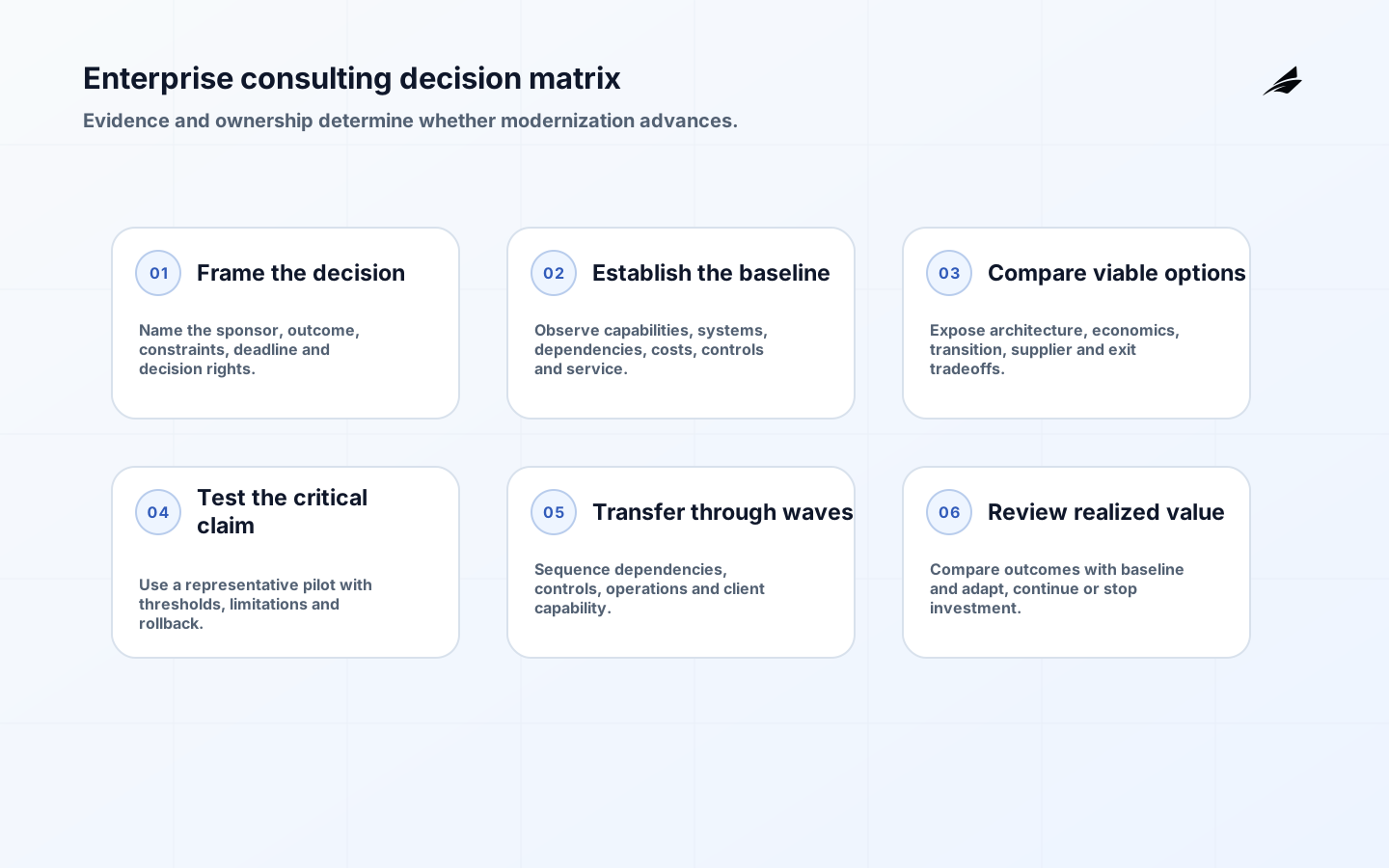
Enterprise computing consulting is useful when it improves a consequential technology decision and leaves the organization able to operate the result. The work may cover architecture, infrastructure, applications, data, security, sourcing or modernization. A large report, cloud migration or new platform is not an outcome by itself. This enterprise computing consulting FAQ explains how to define the engagement, evaluate evidence, govern delivery and accept a durable capability.
Use the enterprise computing delivery plan and implementation checklist for a program already taking shape. For organization-wide change, compare the enterprise transformation checklist and transformation FAQ.
What question should the engagement answer?
Frame one decision with sponsor, deadline, affected capabilities, constraints and available choices. Examples include whether to renew a data-center contract, which application group should modernize first, or how to reduce recovery risk without disrupting a regulated operation. Define baseline and target outcomes in business and service terms. If the consultant cannot state what leadership will decide differently after the work, the scope is still activity rather than advice.
Record decision rights. The sponsor owns value and tradeoffs; architecture owns coherence; security and data owners accept relevant risk; finance validates economics; product and operations own service behavior. Consultants provide analysis, challenge and implementation skill but should not approve the client's residual risk. Establish a route for disagreements and assumptions. A recommendation gains credibility when alternatives and uncertainty remain visible.
| Engagement output | Evidence standard | Decision it supports |
|---|---|---|
| Current-state baseline | Observed services, dependencies, costs, risks and performance | Why change and where to begin |
| Target architecture | Principles, options, tradeoffs and transition states | What future constraints to adopt |
| Roadmap | Dependency-based waves, capacity and decision gates | When to invest, pause or stop |
| Pilot | Representative working slice with measured results | Whether key assumptions hold |
| Operating model | Ownership, controls, skills, support and economics | How the capability will run |
| Handover | Client demonstration, records and access transfer | Whether acceptance is justified |
How should discovery establish a reliable baseline?
Combine system records with observation. Inventory business capabilities, applications, data stores, interfaces, infrastructure, suppliers, costs, service levels, incidents, controls and lifecycle dates. Trace representative user and operator journeys. Reconcile conflicting inventories rather than averaging them. Label unknown ownership and unverified dependencies. Discovery should explain which evidence is strong enough for a decision and which uncertainty needs a pilot.
Do not let interviews become the only source. Inspect architecture decisions, deployments, telemetry, incident reviews, contracts, invoices, access, recovery tests and backlogs. Sample important records and preserve provenance. Map pain to business impact: duplicated platforms may be rational under different residency or availability needs, while a single shared dependency can create hidden concentration. The baseline is a decision model, not a catalog for its own sake.
What should target architecture provide?
Architecture should constrain repeated decisions and expose tradeoffs. Define principles for placement, identity, integration, data, resilience, observability, security, lifecycle and exit. Show logical capabilities and transition states before selecting products. The TOGAF Standard, 10th Edition provides adaptable enterprise architecture concepts and guidance rather than one mandatory implementation. Configure the method to the decision and organizational context.
Each material choice needs context, alternatives, consequence and owner. A target diagram without migration or operating implications is incomplete. Explain compatibility, data movement, control inheritance, support skill, cost driver and failure mode. Define reference patterns and a governed exception route. Architecture review should be fast for conforming work and deeper for irreversible, high-consequence or cross-domain decisions.
How are security and supplier risk integrated?
Use the NIST Cybersecurity Framework 2.0 to express desired outcomes across Govern, Identify, Protect, Detect, Respond and Recover. Create current and target profiles linked to accountable owners and implementation evidence. Security should influence option selection and transition sequencing. A control planned for the final state does not protect an exposed migration bridge today.
For product acquisition, CISA's Secure by Demand Guide encourages buyers to assess how manufacturers approach product security before, during and after procurement. Ask about secure defaults, vulnerability disclosure, multifactor administration, logging, support duration and root-cause correction. Include requirements in evaluation and contract language. Compliance certificates do not answer every product-security question.
How should recommendations become delivery?
Sequence change by value, dependency, risk and organizational capacity. Each wave should deliver a usable capability or retire material uncertainty. Define entry, acceptance, rollback and next investment decision. The GAO Agile Assessment Guide describes iterative delivery, continuous evaluation and best practices for adoption, execution and monitoring. Use short feedback cycles without abandoning architecture, cost or oversight.

Pilot the riskiest claim in a representative slice. If migration depends on data reconciliation, prove reconciliation and rollback. If a platform promises developer speed, let one real team deliver and operate a service through it. If resilience drives investment, perform recovery under realistic dependencies. A proof with no acceptance threshold becomes a demonstration. Record what the result does and does not support before scaling.
| Gate | Required evidence | Leadership action |
|---|---|---|
| Problem confirmed | Baseline, impact, constraints and owner | Fund options or stop |
| Option selected | Tradeoffs, risk, total cost and transition feasibility | Approve target direction |
| Pilot accepted | Representative outcome, limitations and operations | Expand, revise or reject |
| Wave ready | Dependencies, capacity, controls and rollback | Authorize migration |
| Operational acceptance | Service, recovery, support and client capability | Transfer ownership |
| Value review | Outcome against baseline and remaining cost | Continue, adapt or retire |
How should cost and commercial value be tested?
Calculate total change cost: consulting, client time, licenses, cloud, migration, coexistence, data remediation, security, training, support, decommissioning and exit. Model scenarios rather than one precise forecast. Separate sunk cost from future choice and show assumptions about growth, staffing and supplier price. A modernization case should include the benefits of risks retired and decisions accelerated, not invent revenue attribution the work cannot support.
For cloud economics, the FinOps Framework connects usage and cost understanding, business-value quantification, optimization and practice management. Assign cost ownership to teams that can act, allocate shared cost consistently and measure unit economics. Consultant savings claims should preserve required reliability and security. Contract discounts and commitments can lower price while increasing lock-in or unused-capacity risk.
Select fees from uncertainty. Fixed price fits a bounded assessment or accepted deliverable; time and materials fits discovery and iterative implementation; a retainer fits ongoing architecture or assurance. Milestone fees need objective evidence. Outcome-linked pricing should account for client-controlled dependencies and avoid incentives to narrow measurement. Compare the named team, methods, access and handover, not only blended rates.
What governance keeps consulting accountable?
Run a working cadence for risks and blockers and a decision cadence for tradeoffs. Maintain a decision log with context, owner, evidence and review trigger. Demonstrate working outputs frequently. Report outcome, forecast, risk, assumption and client dependency; slide volume is not progress. Give architecture, security, data and operations enough time to review before a gate. Escalate slow client decisions as delivery risks rather than hiding them in schedule variance.
Avoid consultant dependence by pairing staff, rotating demonstration ownership and placing records in client systems. Consultants should teach the reasoning behind choices, not merely deliver templates. Track whether client engineers can use the new platform, whether operations can diagnose it and whether finance can explain its cost. Capability transfer is work with acceptance criteria, not a workshop scheduled near the end.
Implementation example: application portfolio modernization
A manufacturer has 140 applications and an expiring hosting contract. Discovery links applications to plant and corporate capabilities, validates interfaces from runtime evidence and identifies 18 unsupported systems. Instead of assigning a migration strategy to every application immediately, the team selects one customer-service slice with a database, batch integration and strict recovery requirement. Options include rehosting, managed runtime and partial replacement.
The pilot proves automated environment creation, identity integration, data reconciliation, failback and operational monitoring. It reveals that a proprietary scheduler, not compute, is the key constraint. The roadmap therefore retires that dependency before larger waves. Costs include dual running and factory blackout periods. Client operators run the recovery exercise and developers deploy the final pilot change. Leadership approves the next wave from observed evidence and retains a stop point before a major license commitment.
Key takeaways
- Anchor consulting to a named enterprise decision, baseline and accountable sponsor.
- Use observed operating evidence alongside interviews and inventories.
- Make architecture choices traceable to tradeoffs, transition and service ownership.
- Integrate security, supplier and exit questions before product commitment.
- Deliver in decision gates that test the riskiest assumptions with representative work and evidence.
- Accept the engagement only after client teams independently demonstrate and explain the resulting operating capability.
Additional enterprise computing consulting FAQ
Consultant or systems integrator? A consultant may focus on decisions and capability design; an integrator may build and connect systems. Many firms do both. Contract the actual roles, authority, outputs and handover.
Should discovery have a fixed duration? It should be bounded by questions and evidence, with a time limit and decision gate. Unknowns can move into explicit experiments rather than extending observation indefinitely.
How are recommendations kept independent? Require disclosed partnerships and incentives, documented criteria, viable alternatives, total lifecycle implications and client-owned scoring. Product expertise is useful; hidden commercial bias is not.
What signals a troubled engagement? Repeated presentations without working evidence, inaccessible consultant-held tools, decisions without owners, growing unknown dependencies and handover deferred until the final week warrant intervention.
Conclusion
Enterprise computing consulting earns its place by reducing uncertainty and enabling an owned decision. Establish a factual baseline, compare real options, test critical assumptions, sequence reversible change and transfer capability throughout. Review realized benefits after operations stabilize, and record which assumptions changed so later waves can adapt. Test benefit ownership again after each wave. The durable result is not the recommendation deck. It is an enterprise that understands the choice, can operate the change and can measure whether the expected value arrived.