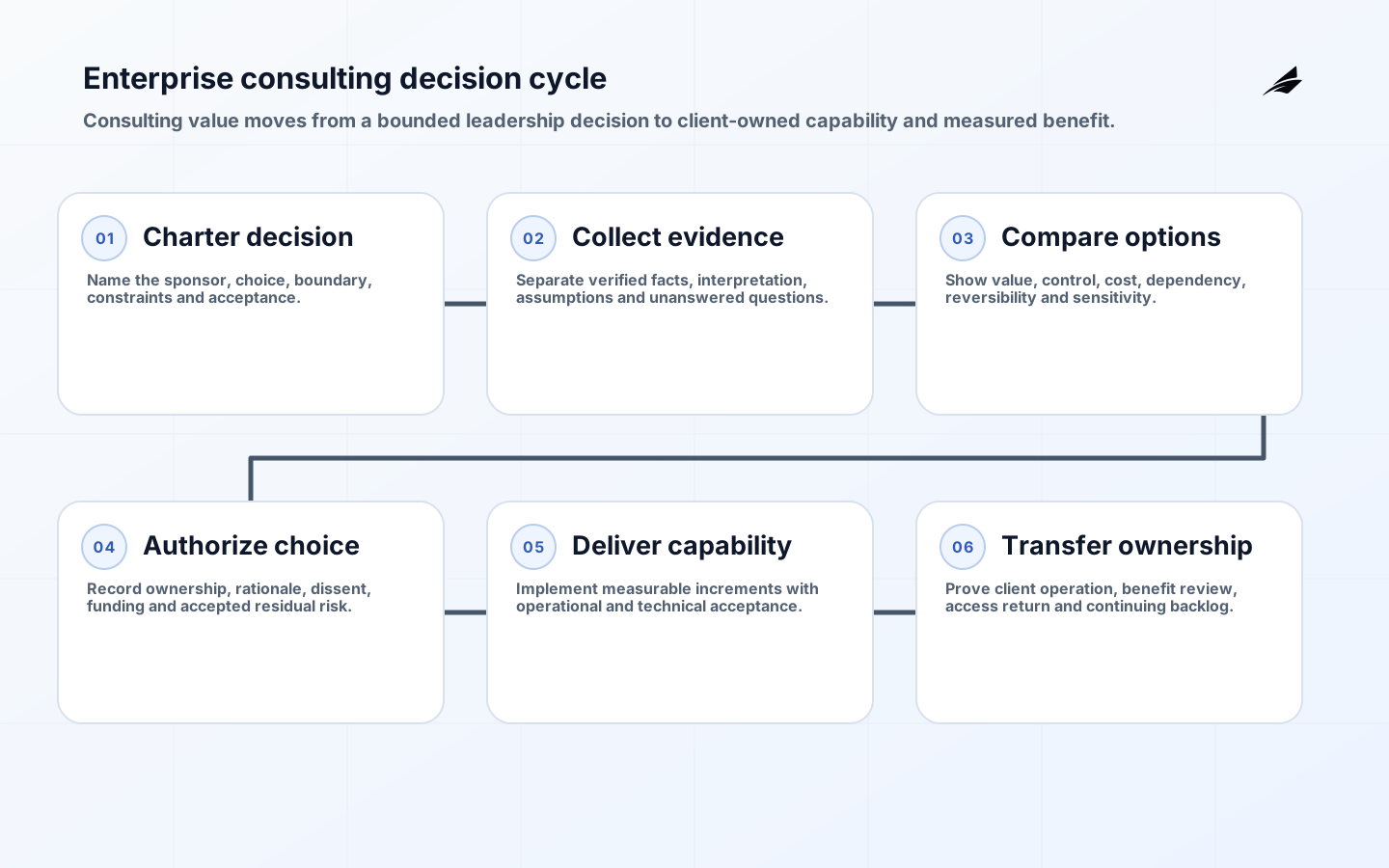
Consulting for enterprise organizations is valuable when it resolves a consequential decision and leaves the client able to operate the result. The engagement may address strategy, process, data, technology, organization or delivery, but its scope should never be “provide recommendations.” It needs a named decision, evidence standard, authority and path from analysis to adoption.
ISO 20700 emphasizes effective and transparent delivery of management consultancy services. In practice, transparency means that client and consultant understand purpose, responsibilities, methods, outputs, acceptance and closure. This guide turns those principles into a plan for complex enterprises where several business units, systems and risk owners share the outcome.
Write a decision charter before a statement of work
Describe the decision leadership must take, why it is needed now and what happens if it is deferred. Identify the executive sponsor, accountable business owner, affected operations and people who control evidence. Set the time horizon and constraints. A cloud strategy, operating-model redesign and platform selection can overlap, but they are not one decision.
Define success as changed capability or approved choice, not presentation delivery. Examples include selecting an architecture with funded transition, reducing order exceptions through a redesigned process, or establishing a portfolio sequence that finance and operations can execute. Record non-negotiable legal, safety, labor, data and customer obligations.
| Element | Question | Evidence |
|---|---|---|
| Decision | What will the sponsor approve or change? | Signed decision statement |
| Baseline | How does the capability perform now? | Reconciled operational measures |
| Boundary | Which units, systems and geographies are included? | Scope and dependency map |
| Authority | Who owns policy, data and funding? | Named decision rights |
| Acceptance | What makes an output usable? | Review criteria and approvers |
Run discovery as evidence collection
Combine interviews with observation, system records, contracts, incident history, financial data and representative cases. Interviews reveal goals and friction; they do not prove volume, delay or control effectiveness. Trace several real transactions from request to completion. Compare written policy with actual work and document where teams use manual bridges.

Maintain an evidence register that identifies source, owner, period, quality and limitations. Separate fact, interpretation, assumption and unresolved question. Conflicting measures should be reconciled or presented honestly. Enterprise decisions become fragile when a consultant chooses the number that best supports a preferred answer.
Shape workstreams around connected capabilities
Organize work by business capability and outcome rather than department alone. A customer onboarding change may involve sales, risk, identity, billing, support and data. Map processes with a notation such as BPMN where shared precision helps, but use the simplest representation stakeholders can validate. Connect activities to systems, records, controls and roles.
Give each workstream a hypothesis, deliverables, dependencies, review cadence and client counterpart. Cross-workstream decisions belong in an integration log. Architecture, organization and change cannot progress as independent slide decks: a proposed operating model must match system authority, skills and transition capacity.
Choose a commercial model that matches uncertainty
Fixed fees work when outputs and assumptions are stable. Time and materials suit discovery or evolving implementation but require budget and priority control. Milestone pricing can align payment to accepted evidence. Outcome-based fees are difficult when benefits depend on client adoption, market conditions or several suppliers; use them only with a defensible baseline and attribution.
Price the client's contribution as well as consultant effort. Subject-matter experts, data preparation, legal review, travel, environments, procurement and change communications consume capacity. Include contingency for inaccessible evidence and decision delay. State rate changes, expenses, subcontractors and intellectual-property terms before work begins.
| Cost area | Planning driver | Control |
|---|---|---|
| Discovery | Stakeholders, sites and evidence complexity | Time-boxed questions and register |
| Design | Options, models and validation depth | Decision gates |
| Implementation | Systems, processes and rollout waves | Backlog and acceptance evidence |
| Client capacity | Experts, data and approval time | Named allocation |
| Transition | Training, documentation and support | Capability handover test |
Manage independence, access and enterprise risk
Declare conflicts of interest, referral relationships and assumptions about vendors. Keep option evaluation criteria visible. Restrict consultants to the minimum systems and data necessary, with named accounts and expiry. Sensitive interviews and documents need classification, retention and return or deletion terms.
Use the organization's risk framework for recommendations, not a parallel consultancy taxonomy. NIST RMF illustrates a lifecycle approach to preparing, categorizing, selecting, implementing, assessing, authorizing and monitoring controls. The exact framework may differ, but risk owners must understand the residual exposure and approve it.
Present options with trade-offs and reversibility
A recommendation should compare credible alternatives against agreed criteria: customer value, control, cost, time, skills, dependency, resilience and reversibility. Show sensitivity to uncertain assumptions. Avoid false precision in multi-year benefit estimates. Identify decisions that can be piloted and those that create long-lived commitments.
Include a “do minimum” option and the consequence of no action. Explain implementation preconditions and what evidence would change the recommendation. Decision makers should be able to challenge the logic without reverse-engineering a scoring spreadsheet.
Move from recommendation to controlled delivery
Translate the selected option into capability increments with owners, dependencies, acceptance and adoption measures. Start with a representative slice that tests the hardest assumption. Preserve current operations through cutover and define rollback or containment. Integrate security and privacy requirements through design and delivery; the NIST SSDF is a useful reference when software is involved.
Use a decision forum for scope, funding and risk rather than routine status. Delivery teams need a fast route for unresolved policy or data ownership. Progress reporting should show accepted capability, evidence and impediments, not percentage-complete estimates disconnected from usable outcomes.
Transfer capability throughout the engagement
Pair consultant and client roles from the start. Record decisions, models, data definitions, procedures and open risks in client-controlled repositories. Have client teams lead reviews and operate pilot processes under observation. Training should use the real artifacts and exceptions they will inherit.
Closure should test whether owners can explain the design, update measures, handle an exception and continue the backlog. Return access and data, resolve intellectual-property obligations and list residual decisions. A long dependency on the original consultants may be chosen for specialist support, but it should not arise from undocumented work.
Track benefits without claiming attribution too early
Assign each benefit an owner, baseline, calculation, measurement window and dependencies. Distinguish leading adoption from realized outcome. A new workflow can be deployed without changing cycle time if teams continue using the old route. Finance should validate monetary measures and operations should validate causal explanations.
Review unintended effects such as risk concentration, employee workload, customer friction and technical debt. Stop or adjust initiatives whose assumptions fail. The consulting engagement is successful when leaders make a better decision and the organization can sustain the resulting capability, not when every original recommendation survives.
Use steering meetings for decisions, not performance theatre
Give the steering group a forward decision calendar showing funding, scope, policy and risk choices needed over the next several weeks. Circulate evidence and options before the meeting. Routine delivery detail belongs in workstream reviews. The steering agenda should state the decision owner, recommendation, dissent, consequence of delay and action that follows approval.
Maintain a decision log with versioned rationale and assumptions. When evidence changes, reopen the decision explicitly instead of allowing teams to drift into a different design. Track dependencies on procurement, labor consultation, data access and vendor commitments. Escalate unresolved ownership early; no amount of analysis can compensate for a missing accountable client.
Review consultancy performance through usefulness and behavior: quality of evidence, timeliness of risk disclosure, integration with client teams, accepted capability and knowledge transfer. Hours consumed or workshops held do not demonstrate value. If methods create excessive reporting overhead, simplify them while preserving the evidence necessary for decision and assurance.
Invite affected operators to challenge the proposed future state before authorization. Their concerns should be recorded with the response, not summarized away. This review often exposes unsupported transition assumptions and gives leaders a clearer view of adoption effort, local variation and customer impact before funding becomes difficult to reverse.
Related reading
Use Business Process Digitization for workflow evidence, Managed Cloud Architecture for platform decisions, and Operational KPI Systems for measurable controls.
Frequently asked questions
How should an enterprise choose a consultant? Evaluate relevant evidence, methods, named team, independence, security, knowledge transfer and the ability to work with internal owners. Brand and proposal polish do not replace delivery fit.
How long should discovery take? Long enough to answer bounded questions with representative evidence. Time-box discovery and use explicit unknowns; do not let it become indefinite analysis or force certainty where records are weak.
Who owns the final recommendation? Consultants own their analysis and professional advice. Client executives own the business decision, funding and accepted risk, supported by the accountable operational and technical owners.
Can consulting fees be tied to outcomes? Sometimes, but only when the baseline, attribution, measurement period and client responsibilities are clear. Otherwise milestone and transparent effort models are easier to govern.
Key takeaways
- Commission a decision and capability, not a collection of recommendations.
- Separate evidence, assumptions and interpretation during discovery.
- Match commercial terms to uncertainty and include client capacity.
- Compare options through visible trade-offs and reversibility.
- Transfer ownership and measure benefits beyond engagement closure.
Conclusion
Enterprise consulting works when specialist perspective is joined to client evidence and decision authority. A disciplined charter, transparent discovery, integrated workstreams, explicit economics and continuous capability transfer prevent the engagement from becoming outsourced thinking. The enduring deliverable is an organization able to operate, measure and improve the choice it made.