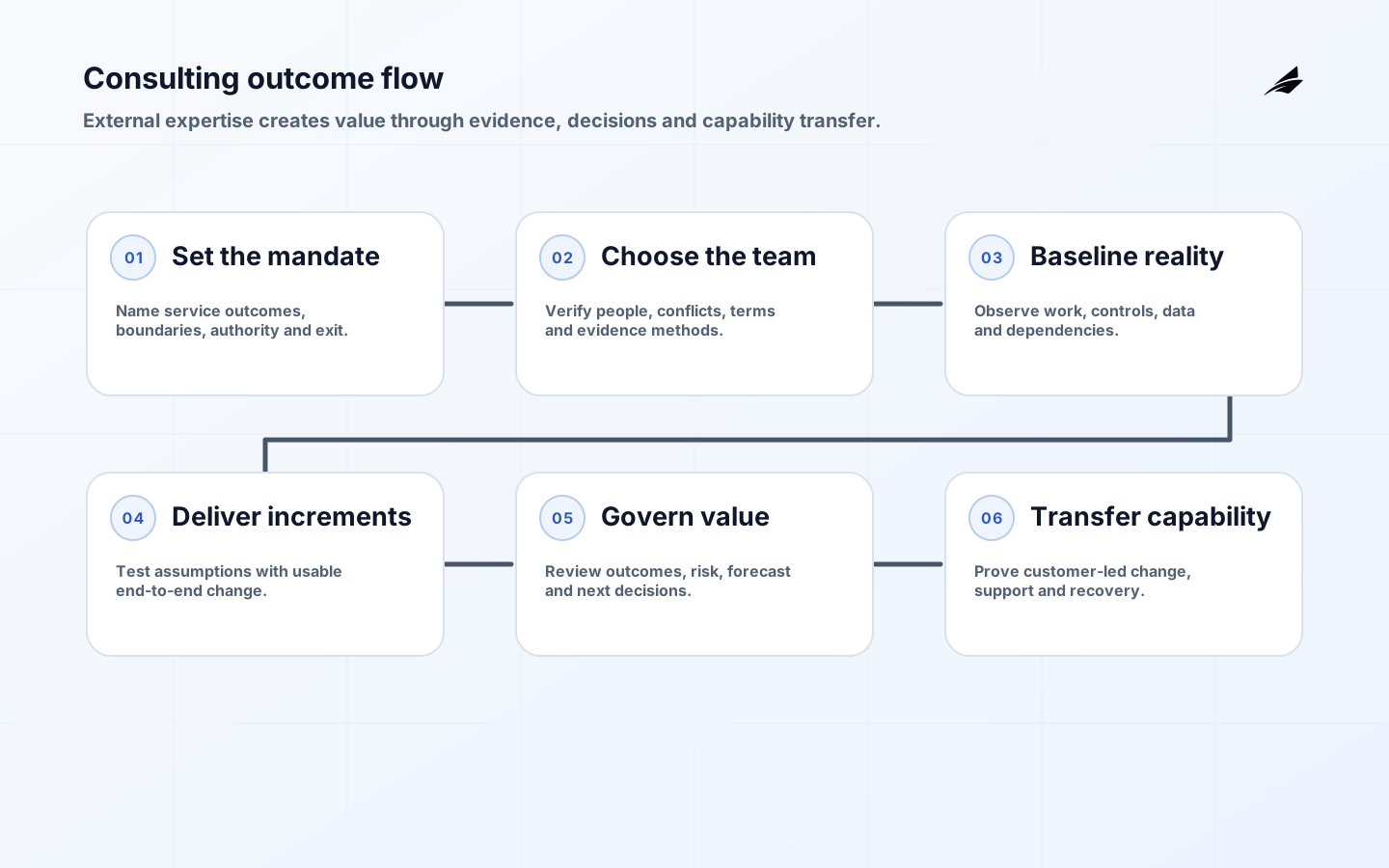
An enterprise consulting implementation checklist should protect the organization from an expensive but familiar failure: buying activity, presentations and temporary capacity without changing a measurable business service. Enterprise consulting is useful when a company needs independent diagnosis, scarce expertise, coordinated change or a short-term delivery accelerator. It becomes risky when the mandate is vague, consultants control the evidence, decisions wait for steering meetings and permanent teams cannot operate the result. This checklist gives sponsors, procurement, product, architecture, security, finance and delivery leaders a practical control path.
Use it alongside Edilec's enterprise consulting delivery plan, sponsor FAQ and enterprise transformation checklist. The contract should support the operating model described here, but governance cannot be delegated to legal language alone. Named customer leaders must own priorities, risk acceptance, benefits and the decision to continue, change direction or stop.
1. Write a decision-ready mandate
State the problem as an observable service outcome: reduce order exceptions, shorten product change lead time, retire unsupported platforms, improve close accuracy or meet a control deadline. Define the users and processes affected, baseline performance, desired range, non-negotiable constraints and target decision date. Separate known facts from assumptions. List decisions the engagement must enable, not only deliverables it must produce. A mandate for an assessment should say who will act on findings and what evidence permits funding the next stage.
Set boundaries around business units, systems, data, geographies, suppliers and organizational change. Record dependencies and exclusions with their consequences. Assign an accountable executive, service owner and empowered day-to-day product lead. The ISO 21502 project management guidance is deliberately applicable across delivery approaches; use that flexibility to fit governance to uncertainty and consequence. Avoid creating parallel consulting governance that bypasses existing risk, finance or service accountability.
| Mandate element | Useful definition | Acceptance evidence |
|---|---|---|
| Outcome | Measured change in a named service | Baseline, target range and owner |
| Boundary | Included users, process, data and technology | Scope map with exclusions |
| Authority | Who decides priority, design and risk | Decision-rights matrix |
| Constraint | Deadline, policy, continuity and budget limits | Approved assumptions and dependencies |
| Exit | What is transferred or deliberately stopped | Capability and artifact handover criteria |
2. Select the team and commercial model
Evaluate the proposed people, not only the firm's credentials. Ask candidates to work through a representative ambiguity, identify missing evidence and explain how they would reduce uncertainty. Verify domain, delivery, architecture, data, security and change skills required by the mandate. Check references for comparable scale and consequence. Name key roles and substitution rules. Require disclosure of subcontractors, product commissions and other conflicts. A team that recommends technology it resells must make that interest visible.

Choose commercial terms that match uncertainty. Fixed price can work for a bounded assessment or repeatable migration unit; time and materials may suit discovery but needs spend and outcome checkpoints. Outcome-linked fees require measures the consultant cannot manipulate and should not reward harmful shortcuts. Define intellectual-property rights, reusable accelerators, data handling, tool access, travel, expenses, acceptance, warranty, termination and transition assistance. Preserve the customer's access to repositories, plans, evidence and work in progress from day one.
3. Establish a shared baseline
Observe real work before designing the target. Combine interviews with process traces, operational data, customer feedback, control evidence, architecture and supplier constraints. Sample normal and exceptional cases. Reconcile conflicting definitions and quantify uncertainty. The consultant should make provenance visible: which conclusion comes from measured data, documented policy, stakeholder judgment or inference. A polished current-state diagram is not enough if it omits demand, queues, rework, manual controls, data quality and incentives that shape behavior.
Create a prioritized hypothesis backlog. Each item should state the suspected constraint, expected outcome, test, owner and decision it informs. Include organizational and policy hypotheses, not only technical ones. Review cybersecurity outcomes using a common vocabulary such as the NIST Cybersecurity Framework 2.0, especially where proposed change affects governance, protection, detection, response or recovery. Confirm data access and retention before consultants copy production records into analysis tools.
4. Deliver usable increments with evidence
Organize work around end-to-end service slices that a real user can exercise. Each increment should include process, data, technology, control, support and adoption work needed for use. The GAO Agile Assessment Guide emphasizes adoption, execution and program monitoring rather than treating Agile as ceremonies. Maintain an ordered backlog, explicit acceptance examples and a regular demonstration using working capability. Keep architecture and control decisions close enough to teams that feedback can change the next increment.
Define quality gates proportional to risk: peer review, automated tests, security checks, data reconciliation, accessibility, performance, resilience and operational readiness. CISA's Secure by Design guidance places responsibility on software producers to reduce customer security burden. Translate that principle into requirements for secure defaults, supported configuration and vulnerability response. A consultant should not leave the customer with a system that is compliant only while specialists manually maintain hidden settings.
| Review question | Evidence | Warning sign |
|---|---|---|
| Is outcome moving? | Trend against agreed baseline | Activity reported instead of service result |
| Is risk reducing? | Closed assumptions and exercised controls | Risks repeatedly carried without owner |
| Is delivery usable? | Real user completes end-to-end slice | Demo depends on manual consultant work |
| Is knowledge transferring? | Customer performs build, change and support | Handover deferred to final week |
| Is spend justified? | Forecast and marginal value of next increment | Sunk cost drives continuation |
5. Govern decisions, value and change
Run governance as a decision system. Maintain one log for material decisions, options, evidence, owner, date and revisit trigger. Escalate only when a decision exceeds delegated authority. Steering forums should inspect outcome trends, forecast, unresolved dependencies, risk and the next irreversible commitment. Do not let red-amber-green summaries replace evidence. Use independent assurance where safety, regulation, financial reporting or large irreversible spend warrants it, while keeping assurance early enough to influence design.
Measure both service outcomes and delivery health. Useful delivery indicators include lead time, deployment frequency, change failure, recovery, escaped defects, decision age and rework; choose those connected to the mandate. DORA research is a useful evidence base for software delivery performance, but metrics should not become targets detached from value. Benefits need an owner in the business, a baseline, an observation window and a method that accounts for other changes. Stop or redesign work whose assumptions fail.
6. Transfer capability and close deliberately
Start handover in the first increment. Pair customer staff with consultants in discovery, design, build, testing, deployment and support. Move from demonstration to supervised execution and then customer-led execution. Track access, environments, repositories, architecture decisions, data definitions, supplier contacts, runbooks, controls, test suites, licenses and known limitations. Documentation is necessary but insufficient; permanent teams must perform representative change and recovery work using it.
Close with an operational acceptance review and a benefits plan. Resolve or explicitly accept open risk, remove consultant access, transfer accounts and confirm retention or deletion of customer data. Document warranty and escalation routes. Compare outcomes and total cost with the mandate, including internal time and future operating cost. Capture which assumptions, methods and supplier behaviors should inform the next procurement. A good engagement may end by recommending no implementation; avoiding a weak investment is measurable value.
Control the consultant's use of enterprise information. Classify documents, datasets, recordings and credentials before access; provide purpose-limited workspaces and prohibit unapproved uploads to personal, analytics or AI services. Log privileged access and remove it promptly when roles change. Require return or verified deletion at closure while retaining the evidence the enterprise needs. Security review should cover the consultant's collaboration tools and subcontractors, not only the system being delivered.
Plan continuity if the engagement underperforms. Keep an up-to-date forecast, dependency map, work inventory and artifact register so another team can take over. Define correction periods and termination assistance without making exit economically impossible. Use milestone acceptance to identify incomplete or unusable work early. When disagreement occurs, return to the mandate, evidence and delegated decision rights; adding more meetings or deliverables rarely resolves a conflict about outcome or authority.
Review organizational adoption separately from technical delivery. Identify role, policy, incentive, training and workload changes for each affected group. Involve managers who schedule and evaluate the work, not only nominated champions. Measure use, exception handling, customer outcome and workarounds after release. If teams preserve the old process around a new system, the engagement has transferred software without changing the service. Fund adoption and process correction as delivery work, with owners and acceptance criteria.
Maintain a concise engagement record that a new sponsor can understand: mandate, baseline, current outcome trend, key decisions, accepted risk, forecast, dependencies, delivered capability and next decision. This continuity protects the work through leadership or consultant turnover. It also exposes engagements that survive because their purpose has become difficult to explain. Reapprove the mandate when scope or expected value materially changes.
Key takeaways
- Buy decisions and measurable service change, not a volume of deliverables.
- Evaluate the named team, conflicts, evidence method and transition terms.
- Use working end-to-end increments to test assumptions early.
- Keep risk acceptance, benefits and priority with accountable customer leaders.
- Transfer access, knowledge and operating practice throughout the engagement.
Frequently asked questions
When should an enterprise hire consultants? When independent evidence, scarce expertise or temporary coordination materially reduces risk or delay. Fixed price or time and materials? Match the model to uncertainty and define checkpoints under either. How many governance meetings are needed? Only enough to make timely decisions at the right authority. Who owns architecture? The enterprise service owner remains accountable even when consultants design it. How is knowledge transfer tested? Customer teams should independently deploy, operate, diagnose and change representative capability before closure.
Conclusion
Enterprise consulting works when external expertise strengthens an owned system of decisions and delivery. A clear mandate, honest baseline, usable increments, evidence-led governance and early capability transfer keep the engagement tied to durable outcomes. The final acceptance test is not the last presentation; it is whether permanent leaders and teams can continue improving the service without the consulting team at the center.