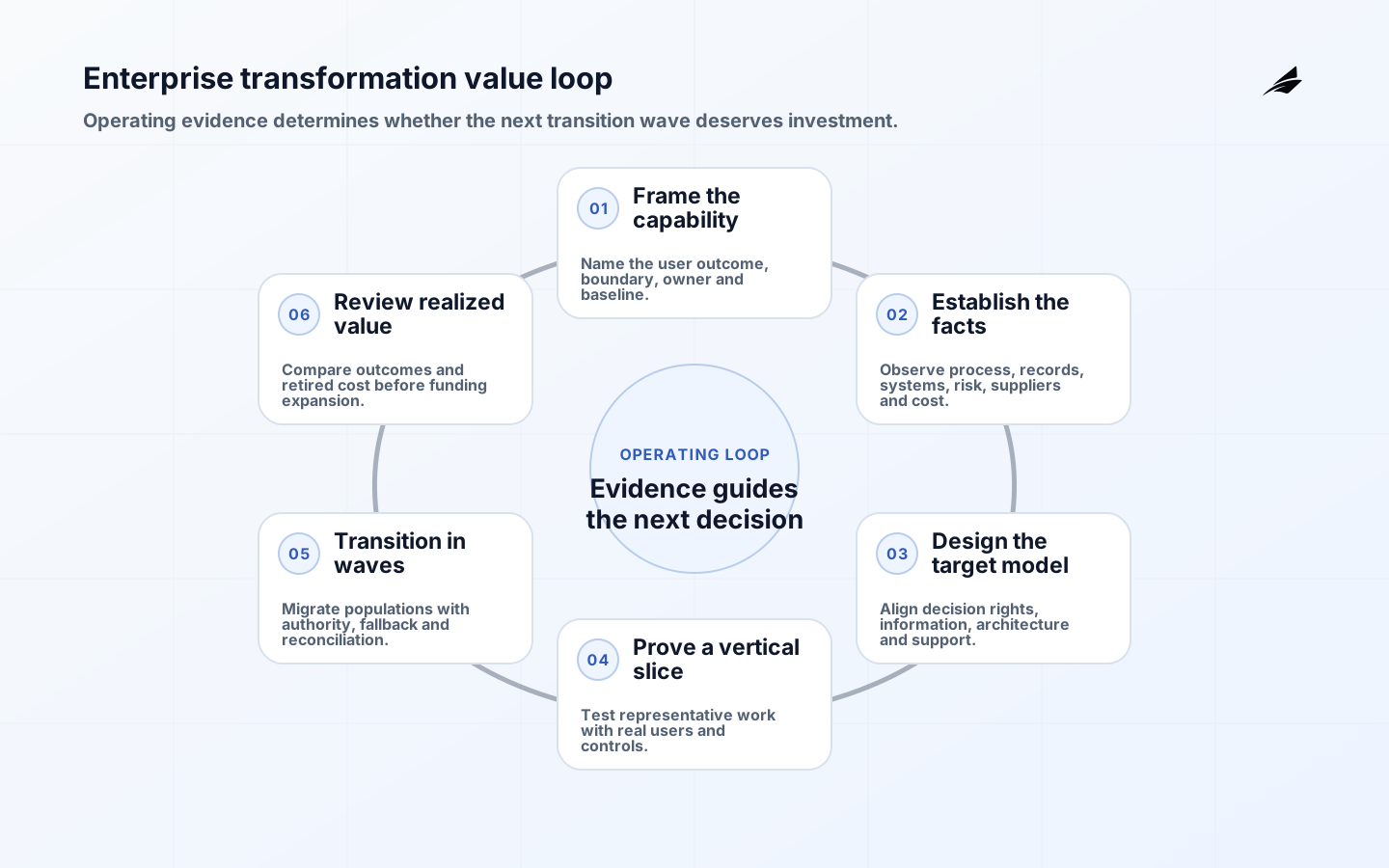
Consulting for enterprise transformation should help leaders change a business capability, not merely produce a target-state presentation. The work connects customer and employee journeys, process, decision rights, data, applications, infrastructure, suppliers, workforce and economics. A useful consulting partner reduces uncertainty, creates owned decisions, proves representative changes and leaves the organization able to continue. This FAQ covers scope, governance, delivery and selection.
Use the enterprise transformation implementation checklist to turn answers into acceptance criteria. The digital transformation checklist covers service delivery, while the enterprise computing consulting plan focuses on architecture and portfolio transition.
What counts as enterprise transformation?
Transformation is a coordinated change to how an enterprise creates and operates value. It may redesign a customer service, consolidate product operations, modernize a platform, establish shared data or change decision authority. A technology replacement is part of transformation only when process, roles, information and operating measures change with it. State the baseline and outcome in business terms, including who experiences the improvement and which existing behavior can stop.
Frame a bounded capability or value stream first. Map users, outcomes, work, decisions, records, systems, suppliers, controls, cost and failure. The GOV.UK Service Standard is a useful primary example of whole-service thinking: understand users, solve a complete problem, use multidisciplinary teams, create a secure service and define success. Adapt the principles to enterprise context rather than copying government delivery ceremonies.
| Transformation layer | Question | Decision artifact | Outcome evidence |
|---|---|---|---|
| Service | Whose complete problem changes? | Journey and service boundary | Completion, quality and satisfaction |
| Operating model | Who decides, performs and supports the work? | Roles and decision rights | Cycle and handoff results |
| Information | Which records are authoritative? | Data ownership and contracts | Quality and reconciliation |
| Technology | Which capabilities and dependencies change? | Architecture and transition views | Reliability and delivery evidence |
| Economics | Which cost and benefit move? | Baseline and benefit logic | Realized value and retired cost |
What should transformation consulting include?
A complete scope covers decision framing, baseline evidence, stakeholder and user research, capability and process mapping, architecture, data, risk, options, roadmap, delivery governance, workforce transition, supplier change, measurement and handover. State whether the consultant advises, designs, implements, assures or operates each component. Name client decisions and access needed, because delayed sponsorship and unavailable subject experts can stop work even when the consultant is staffed.

Use an architecture method to maintain coherence without turning every decision into paperwork. The TOGAF Standard, 10th Edition separates fundamental content from configurable guidance and supports digital transformation use cases. Select only artifacts that answer a decision: capability map, value stream, information ownership, application dependency, technology standard, transition state and architecture decision record.
How should governance and decision rights work?
Create a small decision forum with a sponsor who controls priorities, business owners who accept changed capability, and architecture, data, risk, finance and workforce participation. Publish decision rights, thresholds, evidence and escalation. The forum should settle cross-boundary choices and unblock teams, not replay status. Keep an assumption, dependency, risk and decision log with owners and dates. Review benefit claims and stop conditions at the same cadence as delivery.
Cybersecurity and resilience belong in enterprise risk, not a late technical workstream. NIST's CSF 2.0 enterprise risk guide uses common outcomes to integrate cybersecurity risk information across organizational units. Connect transformation risks with financial, operational, legal and reputation decisions. A faster service that creates unowned access, supplier concentration or unrecoverable data is not a successful target state.
How should the roadmap and delivery waves be structured?
Sequence vertical capability slices that join process, data, technology, controls, training and support. Choose an early slice that is important enough to reveal constraints but recoverable enough to learn. Define entry, acceptance and rollback or containment criteria. The GOV.UK guidance on agile ways of working emphasizes early use with real users, observation and iteration. Enterprise governance should enable that feedback while preserving consequential decision authority.
Maintain explicit transition states. During migration, old and new records, processes and applications may coexist. State which is authoritative for each population, how changes are synchronized, how users are routed and when the old path can be retired. Rehearse data migration, cutover, fallback, support and reconciliation. Do not count a capability as delivered while permanent shadow processes and duplicate license costs remain unowned.
| Gate | Evidence required | Decision | Stop signal |
|---|---|---|---|
| Outcome | Baseline, target, owner and benefit logic | Fund discovery | No accountable outcome |
| Option | Feasible choices, tradeoffs and dependencies | Select direction | Critical assumption untested |
| Pilot | Representative user and operating evidence | Expand, adapt or stop | Unsafe or no useful improvement |
| Wave | Migration, support, controls and reconciliation | Move next population | Acceptance or recovery failure |
| Value | Adoption, outcome, cost and retired legacy | Continue investment | Benefits absent without explanation |
How should cost and value be estimated?
Estimate discovery, design, implementation, data remediation, integration, testing, licenses, infrastructure, supplier exit, workforce transition, communication, dual operation, support and legacy retirement. Model ranges around major assumptions and update them after each slice. Consultant fees may be visible while internal subject-matter time and process disruption are not. Give benefit owners responsibility for baseline quality and realization, not just approval of the initial case.
Measure customer or employee outcomes, process flow, quality, reliability, adoption, risk, unit cost and retired cost. The FinOps Framework offers a useful model for joining technology, finance and business decisions around value, even beyond pure cloud optimization. Avoid vanity counts such as workshops, migrated records or training attendance unless they predict an operating result. Track harmful side effects and distribution across teams, channels and customer groups.
How should a consulting partner be selected and contracted?
Give candidates a real cross-boundary scenario and ask how they would establish facts, expose options, test assumptions and transfer capability. Evaluate relevant practitioners, not only account leaders. Inspect methods for user research, architecture, data migration, security, workforce change, delivery and benefit measurement. Ask for examples where the firm recommended stopping or changing direction. A partner that can only describe successful target states may not surface unwelcome evidence.
Contract around decisions and accepted outcomes: verified baseline, option evidence, target operating model, representative pilot, migrated wave, support readiness and handover. Retain client ownership of decisions, data, repositories, architecture records and supplier relationships. Control subcontractor changes and conflicts. Avoid incentives based solely on technology consumption, headcount or project duration. Include exit assistance and a declining dependency plan from the start.
Make capability transfer a delivery stream
Identify the client roles that will own product, process, architecture, data, risk, platform and supplier decisions after the engagement. Pair them with consultants during discovery and design rather than presenting finished artifacts later. Give client teams increasing authority in each wave: first observing, then working jointly, then leading while the consultant reviews. Track missing access, skills and decision authority as delivery risks.
Handover includes repositories, architecture and decision records, data definitions, migration evidence, supplier contacts, service objectives, dashboards, runbooks, financial assumptions and unresolved risks. It also includes calendar duties such as access reviews, renewals, restore exercises and benefit reviews. Test that materials are discoverable and permissions work. A document stored in the consultant's tenancy is not transferred merely because the client saw it in a meeting.
Reduce consultant dependence deliberately. Measure decisions and operations that still require external intervention, name why and choose whether to train, hire, contract or simplify. Schedule a post-handover review after the client has operated through a real cycle. Use issues found then to improve the target model and procurement approach. Transformation is incomplete while ordinary change depends on the temporary program structure.
Plan organizational transition at the level of daily work. For every affected role, show which decisions, inputs, tools, controls, measures and escalation routes change. Observe people completing representative tasks before and after training; attendance does not prove readiness. Protect time for learning and local support during the first operating cycles. Where responsibilities move between teams, run a joint shift with real tickets and approvals, then confirm that service, data and risk owners agree the new boundary.
Preserve institutional memory as the program changes shape. Record why a transition state was chosen, which assumptions remain unproven and which local variations were accepted. New leaders should be able to distinguish deliberate compromise from accidental drift. Review these records when benefits stall or a later wave proposes reversing an earlier decision. This prevents the transformation from repeatedly rediscovering the same constraints through different consulting teams. Keep superseded decisions linked to their replacements so the reasoning remains auditable.
Key takeaways
- Define transformation around a bounded business capability and measurable user outcome.
- Scope process, roles, records, technology, suppliers, risk and economics together.
- Use governance to make evidence-based decisions and unblock vertical delivery slices.
- Control transition states, authority and reconciliation during coexistence.
- Measure realized value and retired cost, not consulting activity.
- Select and contract a partner for evidence, implementation and capability transfer.
Enterprise transformation consulting FAQ
How long does enterprise transformation take? A useful capability slice should produce evidence early, while portfolio transition may take years; govern by accepted waves. Should strategy finish before delivery begins? Establish direction and constraints, then test the riskiest assumptions through delivery. Who owns the roadmap? Enterprise sponsors and capability owners; consultants facilitate and implement but should not own client priorities. How is resistance handled? Investigate the incentives, risk and workflow behind it, involve affected roles and change the design where evidence warrants. When should work stop? When the outcome is no longer valuable, assumptions fail, risk exceeds tolerance or the next wave cannot justify its cost.
Conclusion: make transformation an owned capability change
Enterprise transformation consulting earns trust when it turns ambiguity into decisions and operating evidence. Start with a whole but bounded capability, prove a representative slice, transfer authority to the people who will run it and use realized outcomes to decide the next wave.