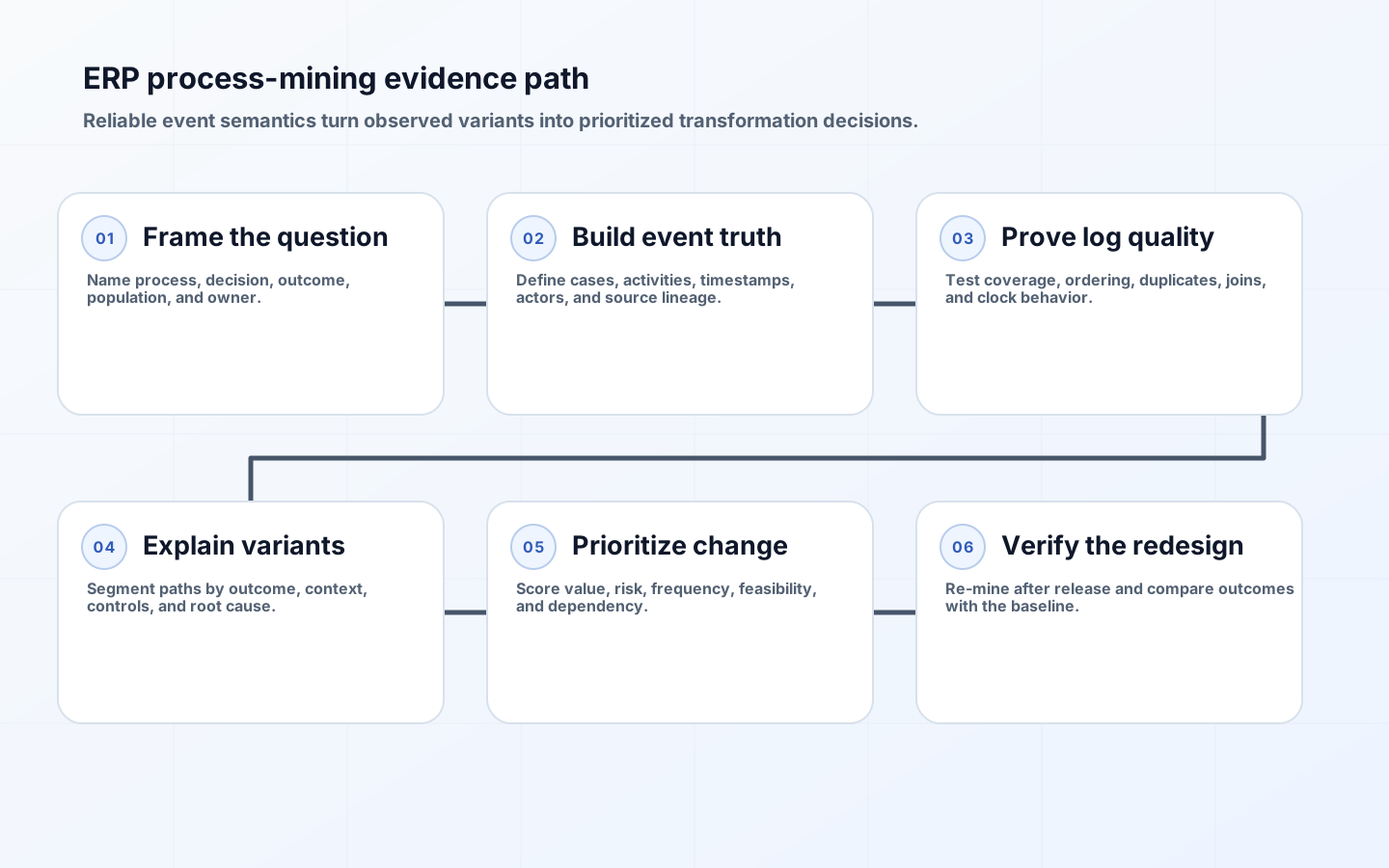
Process mining for ERP transformation can reveal how procure-to-pay, order-to-cash, record-to-report, maintenance, and fulfillment actually move through systems. It can show frequent paths, rare variants, rework, waiting, handoffs, and deviations from a target model. That evidence is valuable before configuration begins because workshops often describe the intended procedure or the loudest exception, not the distribution of recorded work across companies, plants, channels, and periods.
The map is not automatically truth. Mining software reconstructs behavior from a case identifier, activity label, and timestamp, plus optional attributes. SAP documents those fields as mandatory for its event logs; XES exists to exchange strongly typed event-log data. If a purchase-order item is treated as a whole order, timestamps mix posting and extraction time, or canceled cases disappear, the resulting variants can be precise visualizations of a flawed data model. Transformation decisions must therefore begin with an evidence contract.
Frame a decision question before extracting data
Choose a bounded process and business decision. Instead of asking to discover accounts payable, ask which invoice populations create avoidable payment delay, manual touch, or control bypass and which causes the ERP redesign can address. Name the process start and end, case population, period, legal entities, desired outcome, accountable process owner, and decisions the analysis may inform. Exclude conclusions the log cannot support, such as employee intent or root cause without corroborating attributes and interviews.

Define outcome measures independently of the mining tool: cycle time from valid receipt to cleared payment, first-pass match, on-time delivery, touchless completion, blocked-order age, or approved exception rate. Include value, customer, compliance, and workload outcomes rather than optimizing only average duration. A path can be fast because it bypasses a required control. Another can be slow because it handles legitimately complex cases. The transformation question should make those tradeoffs visible before a colorful map encourages premature standardization.
| Design decision | Example | Failure if wrong | Validation |
|---|---|---|---|
| Case identity | Invoice, invoice line, sales order, or service order | Unrelated events collapse or one journey fragments | Trace known cases to source records |
| Activity | Business transition rather than screen click | Noise creates meaningless variants | Process-owner label review |
| Timestamp | Business event time with time zone | Waiting and order are distorted | Compare source and extracted samples |
| Population | Completed, open, canceled, rejected | Survivorship bias hides failures | Reconcile source cohort counts |
| Attributes | Company, channel, value, reason, automation | Variants cannot be explained | Completeness and domain tests |
Design the case and event semantics
Select the unit that makes one coherent journey. An order header may be suitable for customer promise, while line or delivery identity may be required for split fulfillment. Procure-to-pay can cross requisition, purchase order, goods receipt, invoice, and payment identifiers, so build a documented case correlation table rather than joining on mutable descriptions. Preserve source keys and relationship types. When one event relates to several cases, decide whether to duplicate it with declared semantics, use an object-centric method, or narrow the question.
Create an activity dictionary with business name, source table and field, triggering condition, lifecycle transition, timestamp rule, actor semantics, and exclusions. Prefer durable transitions such as purchase order released over UI actions such as clicked save. Separate creation, approval request, approval, rejection, reversal, and cancellation. Define whether repeated events represent legitimate iterations or duplicates. Process owners should approve the dictionary because technical extraction teams can recognize database changes but may not know which changes alter business state.
Prove event-log quality before reading variants
Profile completeness by source, company, process stage, month, and outcome. Reconcile distinct cases and transaction values to controlled ERP reports. Test null case IDs, missing activities, impossible timestamps, duplicate source events, events before case creation, and sequences that violate hard lifecycle rules. Check clock zones, daylight-saving transitions, date-only fields, retroactive postings, and extraction timestamps. A clean overall percentage can conceal a subsidiary or legacy module with unusable coverage, so quality must be segmented like the decisions it supports.
Keep transformation and lineage reproducible. Version extraction SQL, source snapshots or cutoff times, mapping tables, activity dictionary, filters, and tool configuration. Record the source-system release and any logging changes during the period. XES can provide an interoperable representation, but format conformance does not establish semantic correctness. Restrict personal and commercially sensitive attributes to what the analysis needs, apply access controls and retention, and use stable pseudonymous actor identifiers where individual identity is unnecessary.
Analyze variants, conformance, and performance together
Begin with population coverage: what proportion follows the most common paths, how much value they represent, and how outcomes differ. A variant with many low-value cases may deserve automation; a rare path handling strategic customers may deserve stronger controls and specialist support. Compare cycle time distributions, waiting between specific activities, rework loops, manual touch, rejection, and final outcome. Do not rank paths by frequency alone or assume the shortest path is the target.
Conformance compares observed behavior with an approved model, but deviations need interpretation. Some reveal control failure, some are sanctioned local requirements, some arise from master-data defects, and some show that the target model is obsolete. SAP's process widgets distinguish discovery, conformance, funnels, and variant exploration; use those views as complementary evidence. Review representative cases with operators and control owners, then label deviation classes and likely mechanisms. Correlation between a path and delay narrows investigation; it does not prove that changing the path will remove delay.
| Observed pattern | Possible explanation | ERP response | Evidence needed |
|---|---|---|---|
| Repeated approval | Threshold change, delegation, or missing data | Rules, master data, or workflow redesign | Reason codes and case review |
| Long gap before posting | Queue, batch schedule, dependency, or backdating | Capacity, integration, calendar, or timestamp fix | Resource and source timing |
| Frequent manual change | Poor defaults or legitimate negotiation | Configuration, guided exception, or no change | Field-level change and user interview |
| Control bypass | Emergency path, role design, or extraction gap | Access and approval control | Audit trail and policy owner |
| Many local variants | Regulation, product mix, habit, or customization | Global template plus governed localization | Country and outcome comparison |
Turn findings into a prioritized change map
Create change candidates at mechanism level: remove a duplicate approval for a defined population, correct vendor master-data prerequisites, expose an exception work queue, integrate proof of delivery, or standardize reason codes. For each candidate, record affected cases and value, outcome gap, control impact, root-cause confidence, proposed intervention, ERP modules and integrations, data dependencies, process owner, change burden, and expected measurement. Avoid vague recommendations such as automate more; they cannot be designed, costed, or verified.
Score candidates using frequency, financial or customer value, risk reduction, strategic fit, evidence confidence, implementation effort, dependency, and adoption complexity. Keep confidence separate from impact: a high-impact correlation with weak causal evidence should trigger a focused experiment or deeper investigation, not an immediate template decision. Sequence foundational data and identity work before automations that depend on it. Mark local legal requirements explicitly so global standardization does not erase necessary controls.
Use the baseline to govern design and verify release
Translate approved candidates into ERP requirements with affected population, target path, permitted exceptions, control points, data prerequisites, owner, and acceptance measures. Replay representative historical cases through prototypes where possible. During testing, include dominant variants, high-value exceptions, reversals, open cases, and period-end peaks. Process mining can select test populations that scenario workshops overlook. Preserve a baseline cohort and definitions so pre-release and post-release comparisons use the same case semantics.
After go-live, re-mine the process on a declared cadence. Compare path adoption, outcome distributions, new variants, exception age, control evidence, and workload shifts. Segment for volume and mix changes; a faster average may reflect fewer complex cases. Establish guardrails for increased rejection, hidden manual work, or controls performed outside the ERP. Assign owners to findings and retire analyses that no longer support a decision. The mining model should become a governed measurement product, not a presentation abandoned after blueprinting.
Key takeaways
- Start with a bounded transformation decision and outcome, then choose the event population needed to answer it.
- Validate case identity, activity meaning, event time, population completeness, and lineage before interpreting a process map.
- Read frequency, performance, conformance, value, and control outcomes together; common and fast are not synonyms for desirable.
- Convert patterns into mechanism-level change candidates with evidence confidence, dependencies, ownership, and measurable acceptance criteria.
- Reuse the governed baseline after go-live to detect whether redesigned processes improved outcomes or merely changed visible paths.
Frequently asked questions
What data is minimally required for process mining?
A useful event log needs a case identifier, activity, and event timestamp. Serious transformation analysis also needs source lineage, case outcome, and contextual attributes such as organization, value, channel, reason, and automation status. The minimum format is not the minimum evidence for a decision.
Why mine before choosing ERP configuration?
Early evidence sizes variants and identifies data, control, integration, and localization constraints before a target template hardens. It helps teams distinguish real operational requirements from familiar habits and directs workshops toward cases with material impact.
Can process mining prove root cause?
Usually it identifies associations, sequences, and candidate mechanisms. Root cause requires corroboration through richer system evidence, case review, operator knowledge, or controlled change. Presenting correlation as causation can prioritize the wrong ERP intervention.
Conclusion
Process discovery earns a place in ERP planning when its event model is auditable and its findings change concrete decisions. A validated log, contextual variant analysis, cautious causal reasoning, and evidence-led priority map give transformation teams a realistic starting point. Reusing the same measures after release closes the loop between observed work, designed change, and achieved business outcome.