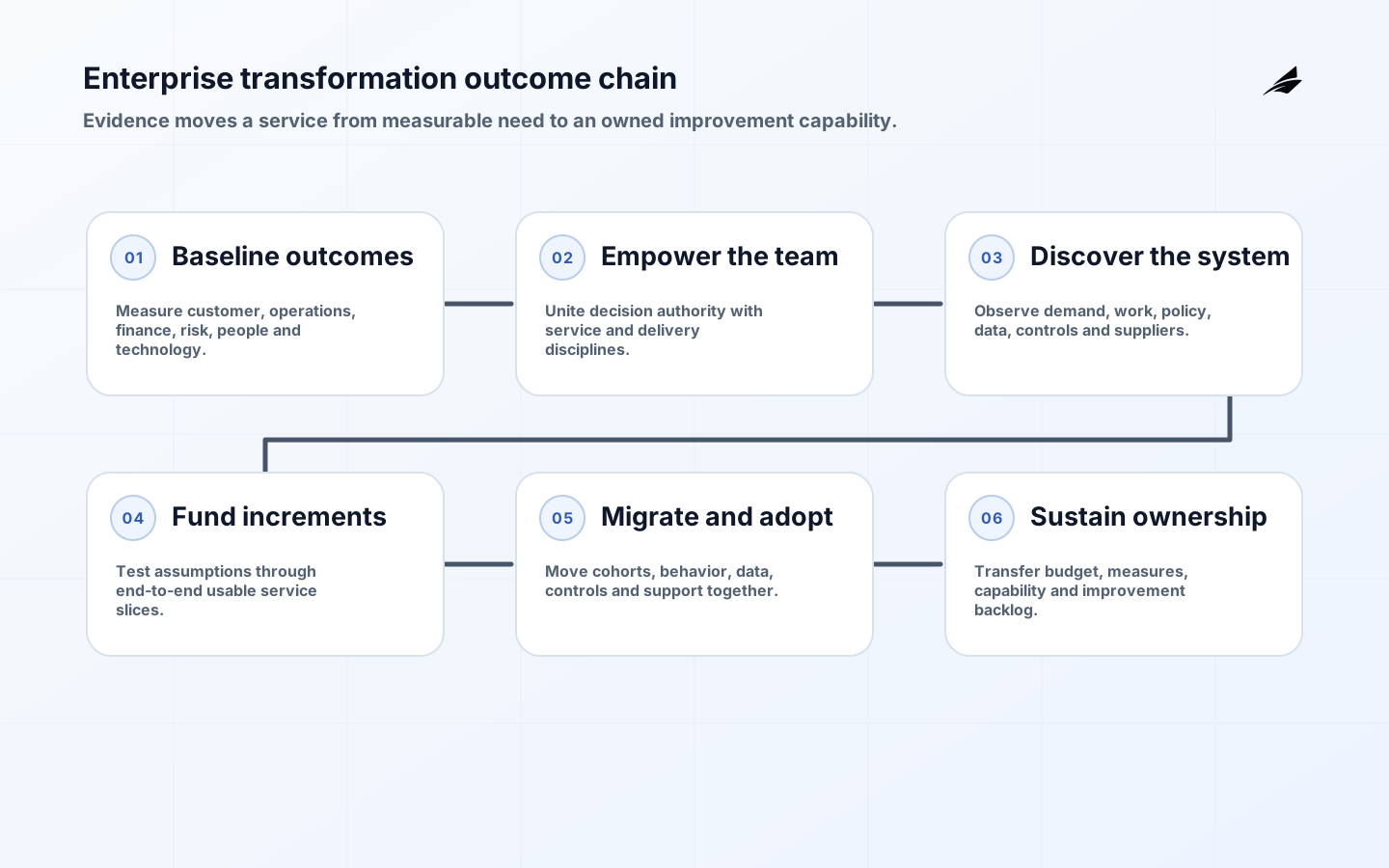
Enterprise transformation consulting should change how a business delivers measurable outcomes, not merely produce a target-state deck. The work may span customer journeys, policy, organization, data, technology, controls, suppliers and performance management. Because those elements interact, leaders need an implementation system that makes decisions close to evidence while preserving enterprise priorities and risk ownership.
This checklist is for sponsors preparing or governing a transformation partner. The enterprise transformation FAQ addresses commercial and leadership questions. The Digital Transformation Services Implementation Checklist covers service-level execution, while the enterprise computing consulting guide helps when the scope is primarily technology modernization.
1. Define outcomes, boundaries and baselines
State the problem in operational terms: onboarding takes 24 days, order exceptions require six handoffs, policy changes take nine months to reach production, or a product cannot report unit economics. For each outcome, record the affected users, baseline, target, measurement owner and decision date. Include service quality, control effectiveness and employee burden. “Implement a platform” and “become data-driven” are activities or aspirations, not measurable outcomes.
Draw the end-to-end service boundary across channels, teams, policies, data, systems and suppliers. Identify constraints that are genuinely fixed and assumptions that can be tested. Name the executive sponsor, service or value-stream owner, risk owners and people authorized to change policy, process, architecture and funding. Establish non-goals to prevent every adjacent problem from entering the program. Record benefit hypotheses and disconfirming evidence.
| Outcome layer | Example measure | Owner decision |
|---|---|---|
| Customer | Completion, resolution, accessibility and avoidable contact | Is the service solving the whole need? |
| Operations | Cycle time, first-pass yield, handoffs and work in progress | Which constraint should change next? |
| Financial | Unit cost, cash effect, avoided loss and benefit realization | Does the next increment justify funding? |
| Risk | Control performance, exposure duration and exception age | Is residual risk within tolerance? |
| People | Adoption, proficiency, workload and role clarity | What enablement or operating-model change is needed? |
| Technology | Reliability, lead time, data quality and retirement progress | Which platform debt blocks the outcome? |
2. Form an empowered multidisciplinary team
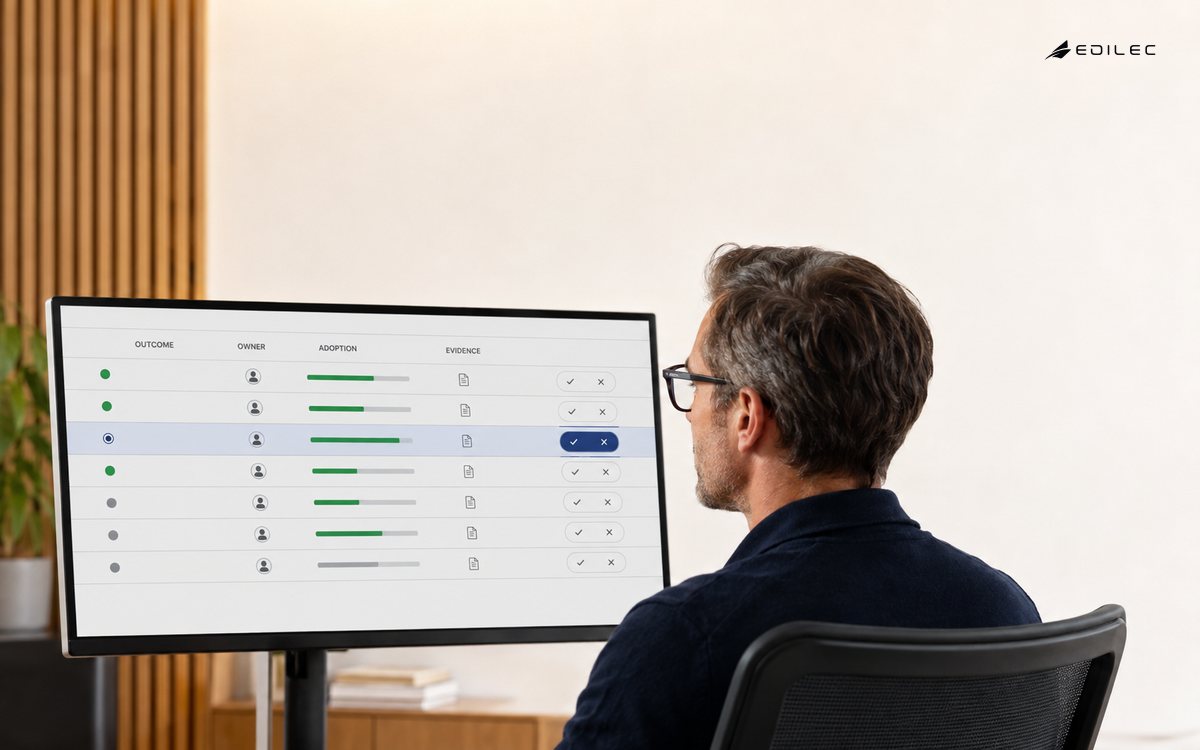
Bring product or service leadership, operations, frontline users, policy, finance, data, architecture, engineering, security, legal, procurement and change expertise into one delivery system. The GOV.UK Service Standard emphasizes a sustainable multidisciplinary team with decision makers accountable to it. Membership should change with the stage, but access to authority cannot be an occasional steering-committee favor.
Clarify consultant and client roles. Consultants can facilitate discovery, provide specialist design, coach delivery and build capability; internal leaders must own strategy, policy, people decisions, risk acceptance and benefits. Pair external specialists with named employees and make knowledge transfer part of daily work. Keep repositories, research, process models, architecture decisions and performance data in customer-controlled systems. Measure capability gained, not consultant headcount deployed.
3. Discover the service as a system
Observe real work and speak with customers, employees and partners across common and difficult cases. Map demand, handoffs, queues, exceptions, controls, data creation, system interactions, supplier boundaries and workarounds. Quantify volume and variation. Reconcile written procedure with actual behavior without blaming staff for adapting to constraints. Segment where needs differ; an average journey can hide accessibility, regional or high-risk cases.
Create a current-state evidence pack: journey and service blueprint, process and control map, information flows, application and integration view, cost baseline, skills, contracts and active risks. Validate it with the people who operate the service. Prioritize assumptions by consequence and uncertainty. Test the riskiest with prototypes, policy experiments, data analysis or thin technical slices before approving a large target state.
4. Design and fund outcome increments
Organize delivery around end-to-end increments that produce usable learning. A thin onboarding increment might cover one customer segment from application through verified account creation, including policy, data, controls, support and measurement. Avoid separate workstreams that complete process, technology and training artifacts on different timelines. The GAO Agile Assessment Guide describes incremental development and continual evaluation as ways to reduce the risk of funding obsolete or failed technology.
Use rolling funding with explicit continuation evidence. Each increment needs an outcome hypothesis, scope, dependencies, control needs, cost range, owner and acceptance measures. Keep a portfolio view of shared platforms, regulatory deadlines and scarce skills. The GOV.UK standard’s guidance to use agile ways of working supports frequent iteration, but cadence is not the goal; learning and usable service improvement are.
| Gate | Evidence required | Possible decision |
|---|---|---|
| Problem | Baseline, users, impact and accountable owner | Stop, narrow or fund discovery |
| Concept | Tested assumptions, service design and risk view | Revise or fund a thin slice |
| Pilot | Usable journey, control tests and operational support | Expand, remediate or retire |
| Scale | Capacity, training, migration and supplier readiness | Release by segment or hold |
| Adoption | Usage, proficiency, process and benefit evidence | Change incentives, design or support |
| Sustain | Owned measures, backlog, budget and retirement plan | Transfer to operations and review |
5. Integrate risk, security and procurement
Put control owners in design and acceptance, not a late approval queue. NIST CSF 2.0 elevates Govern alongside Identify, Protect, Detect, Respond and Recover, helping connect cybersecurity to enterprise objectives, roles and supplier risk. Define privacy, resilience, audit, safety and regulatory outcomes early. Automate evidence where practical and give exceptions owners, expiry and remediation paths.
Procure for change and evidence. Contracts should support iterative scope, access to users and data, transparent subcontractors, reusable deliverables, source and configuration ownership, service measures and exit. CISA’s Secure by Demand Guide offers questions buyers can use to assess whether software suppliers take ownership of security outcomes. Apply similar scrutiny to implementation partners and transformation platforms.
6. Migrate behavior, data and technology together
Plan migration by user and operational cohort, not only application component. Reconcile data, train roles in context, rehearse support, test controls and define fallback. Remove old permissions and workarounds when the new route is proven. Maintain dual operation only as long as risk requires; prolonged parallel processes create inconsistent records and employee confusion. Schedule around business peaks and communicate what changes, who is affected and where decisions will be made.
Adoption means people can complete the intended work with the new operating model and controls. Track use, proficiency, cycle time, errors, support demand and local bypasses. Investigate resistance as evidence: the design may add burden, incentives may conflict or managers may still require old reports. Give leaders visible measures and teams fast routes to improve the service. Do not declare adoption from training attendance or account creation.
7. Sustain the transformed operating model
Transfer ownership incrementally. Each service needs a leader, multidisciplinary capability, budget, architecture and data stewardship, support model, control owners and prioritized backlog. Keep outcome dashboards and decision records in normal governance. The UK government’s continuous improvement assessment framework links accountable service ownership, performance metrics, multidisciplinary delivery and responsible, resilient services.
Close the program only when line operations can govern and improve the service, benefits are measured, residual risks are owned, old technology and contracts have retirement plans, and external knowledge has transferred. Continue quarterly outcome reviews. Rebaseline when demand or policy changes. Preserve a benefits ledger that distinguishes realized, forecast and displaced costs. Transformation is complete when the organization has a durable ability to adapt, not when the final workstream reports green.
Maintain a transformation decision and benefits log
Create one linked record for material choices: outcome affected, evidence considered, options, cost, control impact, decision owner, date and review trigger. Connect each funded increment to a benefit hypothesis and baseline. Update the log when evidence disproves an assumption or a benefit moves elsewhere. This preserves institutional reasoning across leadership, consultant and supplier changes without turning governance into retrospective storytelling.
Benefits should be marked forecast, observed, validated by finance or retired. Record disbenefits such as temporary dual running, productivity dips, control work and displaced support. Prevent double counting when one process improvement contributes to several strategic themes. At quarterly reviews, decide whether to scale, adapt or stop increments from actual outcome movement and risk, then publish the rationale to affected teams.
- Link every major decision to an outcome, evidence and accountable authority.
- Keep forecasts separate from observed and finance-validated benefits.
- Record operational burden and displaced cost as well as upside.
- Set review triggers for changed policy, demand, risk or supplier conditions.
- Retire hypotheses openly when evidence does not support them.
- Use the log to orient incoming leaders and preserve delivery continuity.
Key takeaways
- Define transformation through customer, operational, financial, risk, people and technology outcomes.
- Put decision makers and delivery disciplines in one empowered service team.
- Observe real work and test consequential assumptions before committing to a broad target state.
- Fund end-to-end increments with evidence gates and integrate controls and procurement from the start.
- Measure adoption through changed behavior and outcomes, then transfer a funded improvement capability to operations.
Frequently asked questions
How long should enterprise transformation take?
A large ambition may span years, but useful outcomes and learning should arrive in months or sooner through bounded services and cohorts. Do not wait for the whole target state. Set a strategic horizon and fund shorter evidence-based increments with explicit stop and scale decisions.
Is a transformation office necessary?
It can coordinate portfolio dependencies, measures, funding and executive decisions, but it should not become a reporting layer detached from delivery. Keep service teams accountable for outcomes and use the office to remove enterprise constraints and maintain comparability.
How should knowledge transfer be measured?
Track paired delivery, internal ownership of artifacts and decisions, independent operation of key routines, reduced external dependency and demonstrated ability to improve the service. A document handover is evidence only when employees can use and maintain it.
Conclusion
Enterprise transformation becomes manageable when leaders replace broad activity with measurable service outcomes and short evidence loops. Empower a cross-functional team, integrate risk and procurement, migrate real operating behavior and leave behind funded ownership. Consulting adds value when it accelerates that institutional capability rather than becoming the capability itself.