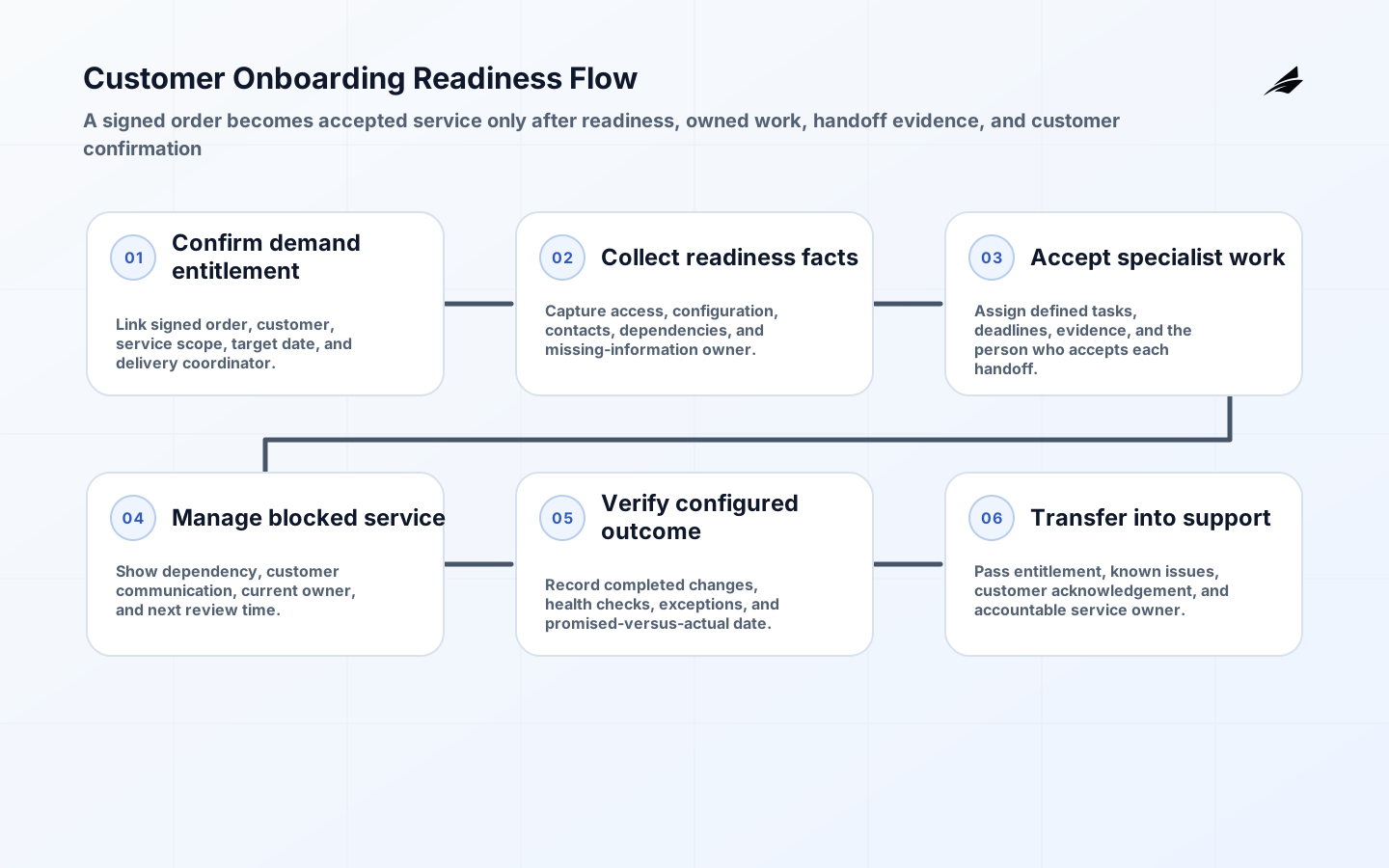
A product is not delivered when a user clicks purchase. Many services require onboarding, fulfillment, configuration, support, renewal, or an operational handoff. Service delivery systems make that work visible and connected to the customer promise. Without them, teams improvise through inboxes, spreadsheets, and private messages; work may finish, but nobody can answer what is due, who owns it, or whether the customer received the promised result.
Build service delivery systems around a clear operating model
Model a service as a sequence of outcomes, not a collection of departmental tasks. A managed implementation might begin with a signed order, require readiness information, schedule configuration, verify acceptance, and transfer the customer into support. Each state needs entry criteria, a named owner, and evidence permitting transition. That separates a delayed customer dependency from an internal capacity constraint instead of calling both an onboarding delay.

| Decision | Practical definition | Why it matters |
|---|---|---|
| State | Entry condition | Owner |
| Ready | Demand and entitlement confirmed | Coordinator |
| In progress | Team accepted defined work | Specialist |
| Blocked | Dependency and review date recorded | Current owner |
| Accepted | Evidence and outcome recorded | Service owner |
Design the service delivery systems workflow and handoffs
The operational record should link demand, entitlement, work items, communications, and completion evidence with durable IDs. Use a work queue for judgement and automation for deterministic reminders. The ticketing workflows guide helps make type, ownership, priority, and transfer history inspectable, but tickets must remain connected to the customer commitment and service state.
- Name the business outcome and accountable owner.
- Use stable identifiers for records and related entities.
- Document the normal path before configuring automation.
- Make authority, limits, and effective dates explicit.
- Route uncertainty to a named role with a response target.
- Test correction and reconciliation with representative records.
Keep service delivery systems data and evidence usable
Define what proves each outcome. A configuration task may need a recorded change, customer confirmation, and health check. A shipment may need carrier evidence and a split-delivery reason. Capture the business timestamps that matter, including when customers supplied information and when teams accepted work. A single complete date cannot represent preparation, execution, acceptance, and handoff.
Control service delivery systems exceptions without hiding them
Service delivery breaks at handoffs. A task can be done while the next team lacks access, context, or a workable deadline. Make transfer explicit with accepting owner, state, dependencies, customer communication status, and next review time. Set a route for blocked work based on customer impact. When an automated update fails, preserve work state and expose the failure rather than leaving an inaccurate customer status.
| Control area | Signal to review | Action when it fails |
|---|---|---|
| Signal | Indication | Action |
| Time blocked | Dependency or capacity concern | Review escalation |
| Reopened work | Quality gap | Inspect criteria |
| Transfer count | Unclear boundary | Refine routing |
| Status mismatch | Communication failed | Correct and notify |
Deliver service delivery systems in a manageable sequence
Choose one service line with clear demand and manageable variation. Interview operators and customers; leadership diagrams often omit recovery behavior. Instrument the baseline before changing tools. Pilot with a small group, compare predicted versus actual states, and revise before integrating every downstream application. The first release should prove a case can pause, reassign, resume, and finish without losing history.
Use service delivery systems signals that lead to action
Useful signals include time in state, blocked-work age, handoff acceptance time, rework rate, customer acknowledgement lag, and promised-versus-actual completion. Segment by service class; averaging simple requests with bespoke implementations is misleading. Review status accuracy independently. It is better to say that work is blocked and owned than to display an optimistic estimate nobody can defend.
Run a practical service delivery systems design review
A useful design review for service delivery systems begins with a specific operating decision rather than a product demonstration. Put the requester, operator, policy owner, and technical maintainer around the same example. Ask what starts the work, which record is authoritative, what decision changes the state, and what evidence must remain available afterwards. This makes assumptions visible before they become configuration. It also reveals where a label such as approved, active, delivered, or closed has different meanings to different teams. For this design choice, name the accountable owner, supporting evidence, exception route, and next measurable check.
Next, test the boundary conditions that make service delivery systems costly in real life: incomplete input, a duplicate request, changed authority, a late event, a conflicting record, or a dependency that never responds. For each condition, state whether the system should stop, queue work, request information, apply a bounded rule, or escalate. The answer should include a named role and a time expectation. A workflow that only describes successful completion gives operators no useful instruction when normal conditions break. Within this design choice, name the accountable owner, supporting evidence, exception route, and next measurable check.
Walk through a customer onboarding delayed by missing readiness information. Trace entitlement, work state, and customer commitment from the first event to final confirmation. The group should identify every handoff, ID, and external effect, then deliberately repeat the scenario after a timeout or correction. This exercise exposes hidden manual reconciliation and identifies actions that must be idempotent. It is more concrete than a high-level architecture review because it asks whether the evidence available to the next person is enough to make a defensible decision. When implementing this design choice, name the accountable owner, supporting evidence, exception route, and next measurable check.
Treat data changes as part of the operating model. Service delivery systems need clear validation at the point where facts enter, a way to record why a value changed, and a controlled route to repair a bad value. Downstream readers need to know whether they are seeing a current result, a historical result, or a pending correction. Without that distinction, teams compensate with spreadsheets and informal messages, which makes later reconciliation slower and less trustworthy. Before releasing this design choice, name the accountable owner, supporting evidence, exception route, and next measurable check.
For product teams working on service delivery systems, this operating decision should connect workflow authority, system-of-record ownership, approvals, exceptions, reconciliation, and reporting to evidence an accountable owner can inspect. Make the human interaction deliberate. Automation can route, calculate, notify, or prevent an unsafe action, but it cannot remove responsibility for ambiguous business context. Give people a concise queue with the reason work arrived, the impact of delay, the decision they are permitted to make, and links to the evidence they need. Give them an explicit way to return, reassign, or escalate work. This produces faster decisions than a generic task list because it respects the limits of the rule. In this delivery review, move beyond the operating decision only after the owner can show the accepted result, the exception path, and the signal for another review.
In service delivery systems, product teams should make the relationship between workflow authority, system-of-record ownership, approvals, exceptions, reconciliation, and reporting explicit and reviewable. Plan day-two operations while the design is still small. Name who monitors failures, who approves policy changes, who owns source data, and who decides that a recurring exception deserves redesign. Define the minimum logs, alerts, and reconciliation routine before launch. The aim is not exhaustive monitoring. It is a short set of signals that makes an emerging problem visible while a responsible team can still correct the system, notify affected people, and preserve an accurate record. This delivery review should close the operating decision only when the result, unresolved exception, and next review condition are recorded.
A dependable service delivery systems design makes workflow authority, system-of-record ownership, approvals, exceptions, reconciliation, and reporting visible to the owner responsible for this operating decision. Set release acceptance around observable outcomes. A release should demonstrate a normal record, an invalid record with a useful explanation, an authorized exception, and a correction that reaches dependent systems without a duplicate effect. Include access and audit checks where the workflow handles sensitive data or consequential decisions. Record the test data and expected result so later changes can be compared. This kind of acceptance evidence protects both operators and engineers when pressure builds to expand scope. The next step in this delivery review is justified when the team can trace the accepted outcome, the fallback route, and the owner of follow-up.
Validate service delivery systems through a complete operating case
Use this operating guide to validate service delivery systems with one complete operating case before widening the scope. Product teams should trace one business case across intake, validation, approval, system updates, downstream handoffs, and an operator-visible completion state. Begin with the initiating business record, accountable role, approval state, integration handoff, exception reason, and reconciled outcome, cross each policy and dependency boundary, and finish in a durable state that a customer or operator can recognize. Record the expected state at every handoff, who may change it, and which evidence proves that the next step was justified. This walkthrough gives product, engineering, security, and support a shared acceptance case instead of allowing each team to assume that another layer owns the transition. Use representative roles, realistic timing, and the constraints that exist during an ordinary operating day.
The operating guide should also test a second service delivery systems case that deliberately challenges the design. Include a disputed record, unavailable approver, duplicate handoff, policy exception, or mismatch between systems of record. The purpose is not to demonstrate that every dependency always succeeds; it is to prove that the service can stop safely, preserve useful evidence, and expose the next responsible action. Review record version, approval evidence, queue age, exception owner, reconciliation result, and service outcome together so the team can distinguish a policy refusal from bad input, a software defect, a delayed dependency, or an operator decision. A useful result is specific enough for a support or incident owner to act without reconstructing the entire journey from unrelated logs and messages.
Turn both cases into release evidence for service delivery systems. Keep the input conditions, expected states, observed result, decision owner, and unresolved exceptions in one reviewable record. Define the recovery action in advance: protect the authoritative record, isolate the disagreement, assign the exception, reconcile affected systems, and document the resolution. Re-run the same cases after a material policy, interface, data, model, infrastructure, or entitlement change so that improvements do not silently weaken an earlier control. For this operating guide, readiness means that the normal path is usable, the failure path is understandable, and ownership remains visible after launch rather than ending when implementation work is declared complete.
- Choose one representative service delivery systems journey and state the customer or operator result in plain language.
- Capture the initiating business record, accountable role, approval state, integration handoff, exception reason, and reconciled outcome as evidence, with a named owner for each consequential handoff.
- Exercise a disputed record, unavailable approver, duplicate handoff, policy exception, or mismatch between systems of record before broader exposure and verify that the safe state is visible.
- Review record version, approval evidence, queue age, exception owner, reconciliation result, and service outcome after release and assign every unresolved exception to a person and date.
Key service delivery systems takeaways
- Service delivery systems should support a concrete business outcome, not a generic feature list.
- Authority, identifiers, and correction paths need design before scale.
- A visible exception route is safer than an informal bypass.
- Logs and history should help an accountable person reconstruct an outcome.
- Pilot one consequential path with real operators and awkward cases.
- Use signals to improve work, not only count activity.
Service delivery systems FAQ
Do these systems replace a CRM? No. A CRM holds relationship and commercial context; delivery systems manage work and evidence. How granular are states? Add a state when it changes ownership, communication, controls, or next action. Can an agile board be enough? It can help a small team, but add durable records and handoffs once entitlements or regulated evidence matter.
Conclusion: make service delivery systems dependable in ordinary work
Service delivery systems become valuable when the real path of work is legible, including pauses and recovery. Build around an outcome, preserve handoff evidence, and use the data to improve the service.