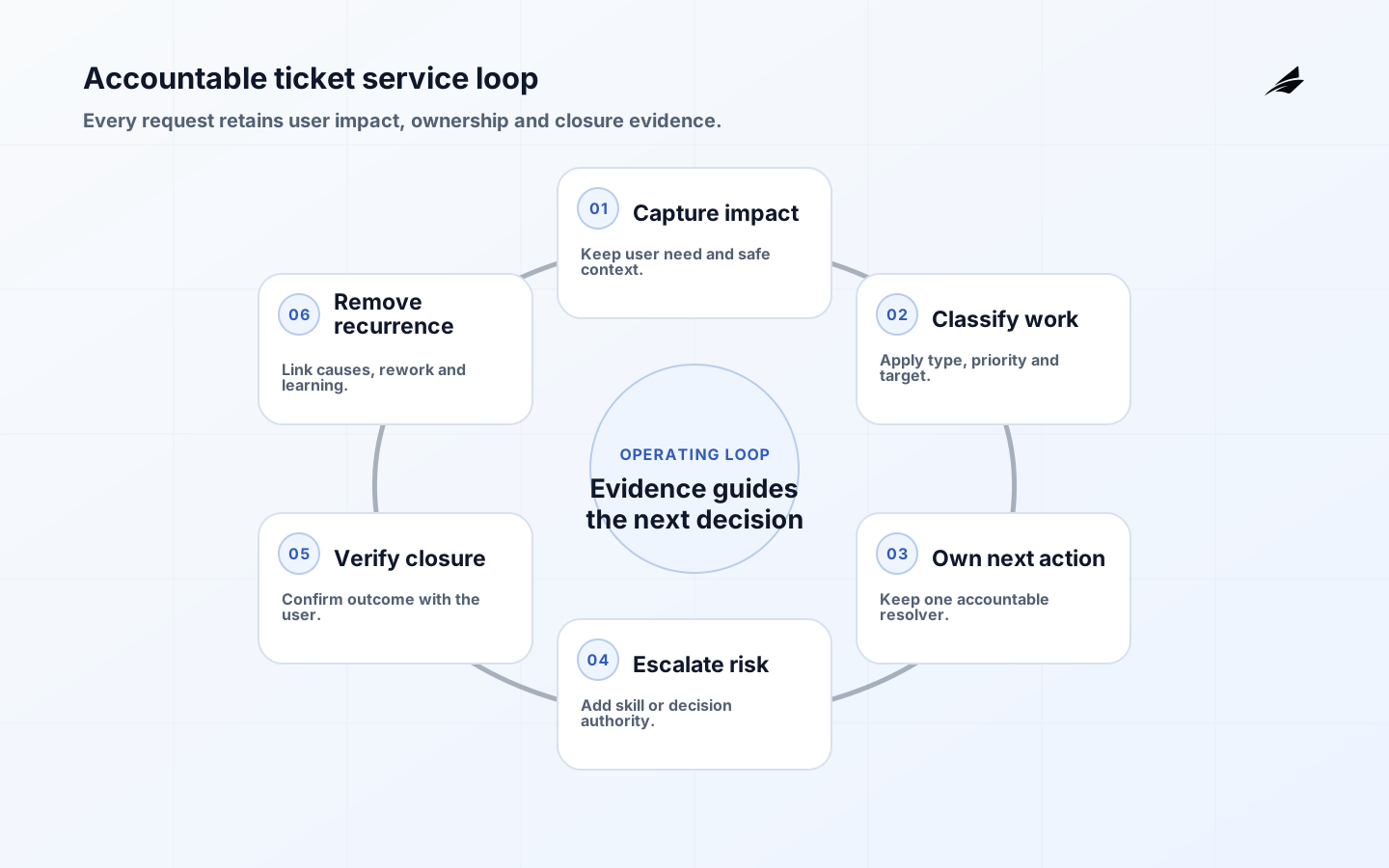
Ticketing workflows help IT managers coordinate demand only when each record preserves the user’s need, current owner, next action, time expectation, and closure evidence. Adding forms and statuses to unclear service ownership creates a more elaborate queue, not a better service. Use this operating guide with Edilec’s ticketing workflow checklist, workflow exception guide, and operations control-room guide.
Define the service request lifecycle
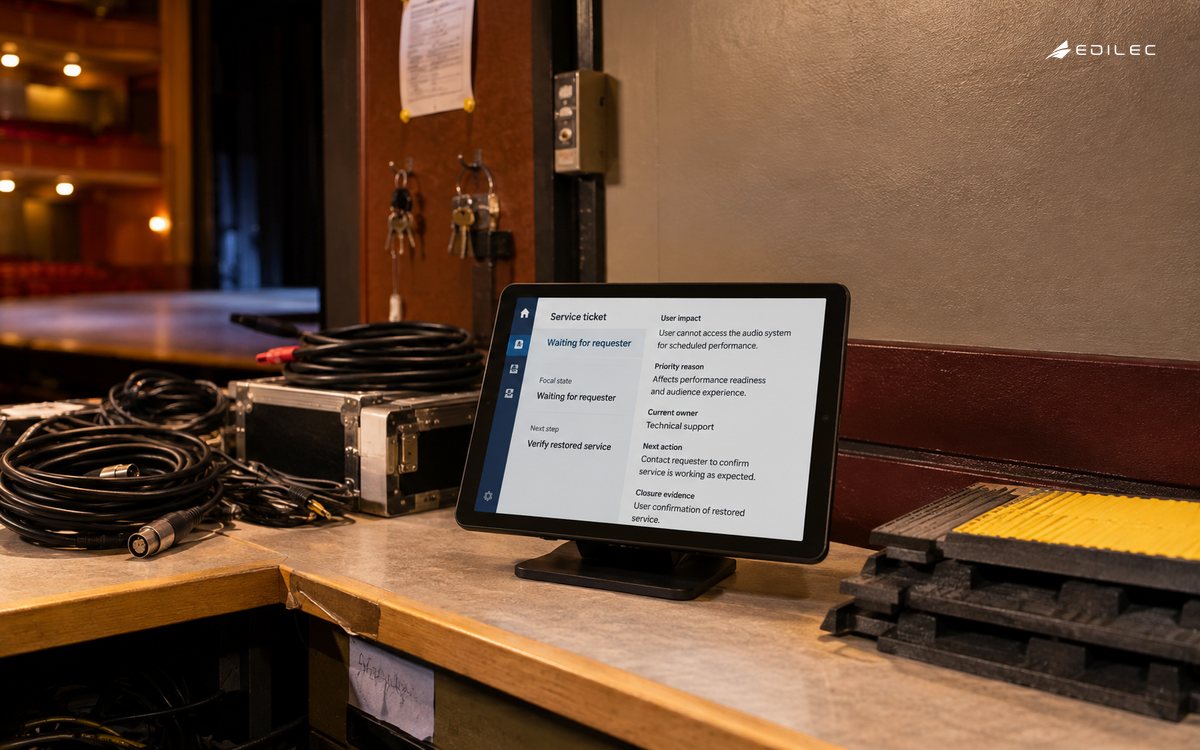
Define a ticket as a service record, not a container for conversation. Use states such as new, acknowledged, assigned, in progress, waiting for requester, waiting for dependency, resolved, verified, and closed only when each state changes ownership or the service clock in a clear way. Specify which roles may move between states and what evidence is required: impact assessment before priority escalation, dependency reference before pausing a clock, resolution code and user confirmation before closure. Give every item a stable identifier, service, requester, affected asset, current owner, priority rationale, timestamps, and linked incident or change where relevant. Prohibit silent edits that rewrite history. A new team member should be able to reconstruct why the case moved, where time was spent, and who accepted the result without searching personal chats.
| Decision | Working rule | Evidence to retain |
|---|---|---|
| Boundary | State the ticketing workflows outcome and exclusions. | Examples, lifecycle states, and success condition. |
| Authority | Name business, technical, and exception owners. | Role, delegation, and escalation route. |
| Identity and time | Keep durable references and effective dates. | Source reference, policy version, and change history. |
| Exception | Route ambiguity visibly rather than silently bypassing it. | Queue, reason, resolver, and disposition. |
Design priority, routing, and ownership
Priority is a decision system. Map observable impact and urgency, support groups, business hours, dependencies, and delegation rules. Automation may suggest a queue, but ambiguous or high-impact cases need accountable human triage.
Rehearse a payroll integration incident on a regional holiday: a vague request arrives, the customer journey is affected, and an on-call team needs context. Follow classification, communications, escalation, recovery verification, and closure evidence.
| Failure mode | Design response | Review signal |
|---|---|---|
| Incomplete input | Reject or hold records with an explainable reason. | Required-field and validation-failure trend. |
| Duplicate action | Use stable keys, idempotent handling, and reconciliation. | Duplicate rejection and replay volume. |
| Ownership gap | Escalate to a named decision-maker with context. | Aged queue and transfer count. |
| Late correction | Link the compensating action to the original record. | Correction cycle time and recurrence. |
Use evidence and controls deliberately
Use public frameworks to sharpen specific ticketing decisions. The NIST Cybersecurity Framework can help assign governance, detection, incident response, and recovery responsibilities for the service. The NIST Privacy Framework prompts teams to justify why personal details enter a ticket, limit their use, and define retention. Apply relevant OWASP ASVS controls to portal authentication, authorization, attachments, privileged support actions, and audit trails. Google’s monitoring guidance helps distinguish a page-worthy symptom—such as intake stopping—from the ticket and integration details needed for diagnosis. Translate each chosen principle into an owned workflow rule or test; citing a framework without that local mapping does not establish that requests, incidents, and sensitive evidence are handled appropriately.
- State the ticketing workflows decision in language IT managers can test.
- Keep source, state, timing, policy, and correction rationale together.
- Limit service identities and recovery permissions to the action required.
- Test normal work alongside retries, corrections, unavailable dependencies, and disputed outcomes.
- Reconcile intended work to the final result before treating expansion as success.
Run escalation and closure with evidence
Escalation should change the response deliberately, not merely add recipients. Define functional escalation when expertise is missing, hierarchical escalation when authority or resources are needed, and incident escalation when aggregated impact requires coordination. Preserve the original priority rationale and record new evidence when urgency or impact changes. Closure requires a resolution result, the affected configuration or service reference, any workaround and expiry, customer-facing explanation, and verification appropriate to the request. Reopened tickets should retain the previous resolution and show why it failed. Test the workflow with an unavailable resolver group, a dependency owned by another supplier, a requester who replies after resolution, and a disputed closure. The related enterprise systems guide places these case-level rules within the broader integration and governance model.
Design role-specific views around the next legitimate action. A requester needs plain-language status, required information, expected response, and a safe way to add evidence. A service-desk analyst needs identity, entitlement, service, impact, diagnostic history, and knowledge suggestions without unnecessary sensitive fields. A resolver needs dependency and configuration context; a duty manager needs breach risk, business impact, and escalation authority. Keep privileged remediation outside free-form ticket commands and record any approved action through controlled interfaces. Make waiting reasons visible so staff do not pause service clocks with vague notes. When categories, priority policy, or resolver groups change, update forms, routing, knowledge, service targets, reports, and training in one release. Test with actual operators to ensure they can hand off, correct, and explain a case without copying it into spreadsheets or private chat.
Measure service health, not ticket volume
Measure flow and outcome by service and request class. Useful indicators include time to acknowledgement, time to first diagnostic action, active handling time, age in each waiting reason, assignment churn, target-breach risk, requester response delay, reopen rate, abandoned intake, and verified resolution. Report incoming demand and backlog together so falling completion time is not celebrated while old work accumulates. Segment transfers by source and resolver pair to locate broken routing or unclear service ownership. Sample breached and rapidly closed cases: both can contain poor classification or premature closure. Review trends with service owners and frontline staff, then link improvements to a concrete cause such as a missing form field, knowledge gap, supplier delay, permission bottleneck, or priority rule. Ticket count alone measures activity, not whether users regained a service or received the requested outcome.
| Signal | Question it answers | Action when it worsens |
|---|---|---|
| Aged exceptions | Where has normal processing failed to produce a final result? | Assign a resolver, classify the cause, and prevent blind replay. |
| Manual overrides | Which rule, input, or ownership boundary is failing? | Review the decision trail and repair the upstream cause. |
| Reconciled outcomes | Did expected work produce the intended result? | Pause expansion until material differences are understood. |
Build a controlled first release
Choose a first release with one intake channel, a defined service catalogue slice, named resolver groups, and staffed escalation hours. A practical scope might cover standard employee access requests for one business unit while leaving privileged and unusual applications on the existing route. Bring the service owner, identity or application owner, service desk, resolver lead, security reviewer, and reporting owner together to agree eligibility, priority, approval evidence, fulfilment result, and closure verification. Use real identities and integrations in a bounded production cohort so routing, notifications, permissions, and handoffs are exercised. Keep volume low enough that the team can reconcile every created request with its final status and manually protect users if a rule fails.
Turn service rules into scenario-based acceptance checks. Submit an eligible request and verify its identifier, requester, service, entitlement evidence, priority calculation, assignment, target clock, approval where required, fulfilment reference, notification, and verified closure. Then test an incomplete form, duplicate submission, changed manager, rejected approval, resolver reassignment, late requester reply, fulfilment API timeout, and cancellation after work begins. The system should show exactly one accountable owner at each stage and preserve who changed material facts and why. Confirm that retries do not provision twice, that sensitive notes remain restricted, and that reports derive state durations consistently. These checks create a shared definition of done for engineering, service operations, and audit, and they leave operators with examples they can reuse when diagnosing production exceptions.
Catalogue exceptions by remedy. A temporary notification failure may retry with duplicate protection; an invalid service or requester identity must return for correction; a fulfilment result that cannot be reconciled should pause closure; an unavailable resolver group should escalate to a duty owner. Give analysts a controlled way to reclassify, reassign, cancel, or link duplicates while retaining the original values and reason. For bulk routing failures, identify the affected ticket cohort by rule revision and restore ownership without replaying fulfilment actions. Rehearse that recovery and verify service clocks, customer messages, and downstream records afterward. Staff should never need database edits or administrator impersonation to make a routine correction, because those shortcuts destroy the history needed to understand the incident.
Run a monthly service-record review alongside metric reporting. Select a normally completed request, a high-transfer case, a breached target, a reopened item, and an exception corrected by staff. Trace form data, priority evidence, assignments, state-clock changes, approvals, integration events, customer updates, and final verification. Ask whether each handoff had a receiver, whether waiting time was classified honestly, whether restricted information was necessary, and whether closure described the user outcome. Compare findings with transfer, backlog, and reopen trends to decide whether the root cause sits in catalogue design, ownership, form validation, knowledge, staffing, supplier performance, or automation. Assign one observable improvement with an owner and review date—for example, removing a misleading category and measuring misroutes next month. Case review supplies the context a dashboard lacks and prevents recurring workarounds from becoming accepted service design.
Scale by catalogue service or intake channel, not by switching every team at once. Before expansion, confirm resolver ownership, hours, targets, priority rules, privacy needs, integration contracts, reporting definitions, knowledge, and support capacity for the new scope. Replay representative historical tickets through routing, then pilot with a capped cohort and compare created, assigned, fulfilled, and closed records. Version category mappings and automation rules so operators can identify and reverse a faulty release. Require the current scope to meet reconciliation, transfer, exception-age, and recovery thresholds for a sustained period. Growth is safe when added teams inherit a proven operating pattern and their genuine differences are explicit; copying unresolved ambiguity into a larger queue only creates faster misrouting.
Worked example: restore access without queue bouncing
For a failed-access request, intake should capture the affected service, user, business impact, error time, location, recent change, and safe diagnostic context. Classification distinguishes a known request, an isolated fault, and a wider incident. Route to one accountable resolver group while specialists collaborate behind that ownership. The user should not have to determine whether identity, application, or network teams are responsible, and transfers should preserve elapsed time and diagnostic evidence.
Define a verification condition such as successful access to the required function, not merely a password reset or technical task completion. Repeated tickets linked to the same cause should create a problem record with an owner and review date. Measure time waiting for assignment, time waiting on users or suppliers, transfer count, reopen rate, breached targets by impact, recurring cause, and verified resolution. Review a sample of low-priority closures because aggregate service levels can conceal poor outcomes for smaller groups.
Key takeaways
- Anchor ticketing workflows in a consequential decision rather than a platform ambition.
- Make state, authority, timing, and evidence visible where people act.
- Design correction, retry, and reconciliation before scaling automation.
- Use recurring exceptions to improve upstream quality and policy.
- Judge success by reliable outcomes for the people affected.
Frequently asked questions
What is the first practical step for ticketing workflows?
Can incidents and requests use one workflow? They can share records, but state transitions and evidence should diverge when risk, urgency, or approvals are different.
How should teams handle exceptions?
When should automation route a ticket? Use it for stable categories with monitored fallback. New or consequential work should retain an accountable triage path.
Conclusion
Ticketing workflows become dependable when IT managers make ownership clearer than queue mechanics. Preserve user impact, keep one accountable next action, expose waiting and exception paths, and verify the service outcome before closure. Review recurring causes and rework as management evidence, then improve the operating design instead of adding more fields. That is how the ticket record supports daily service leadership rather than becoming another destination for administrative data.