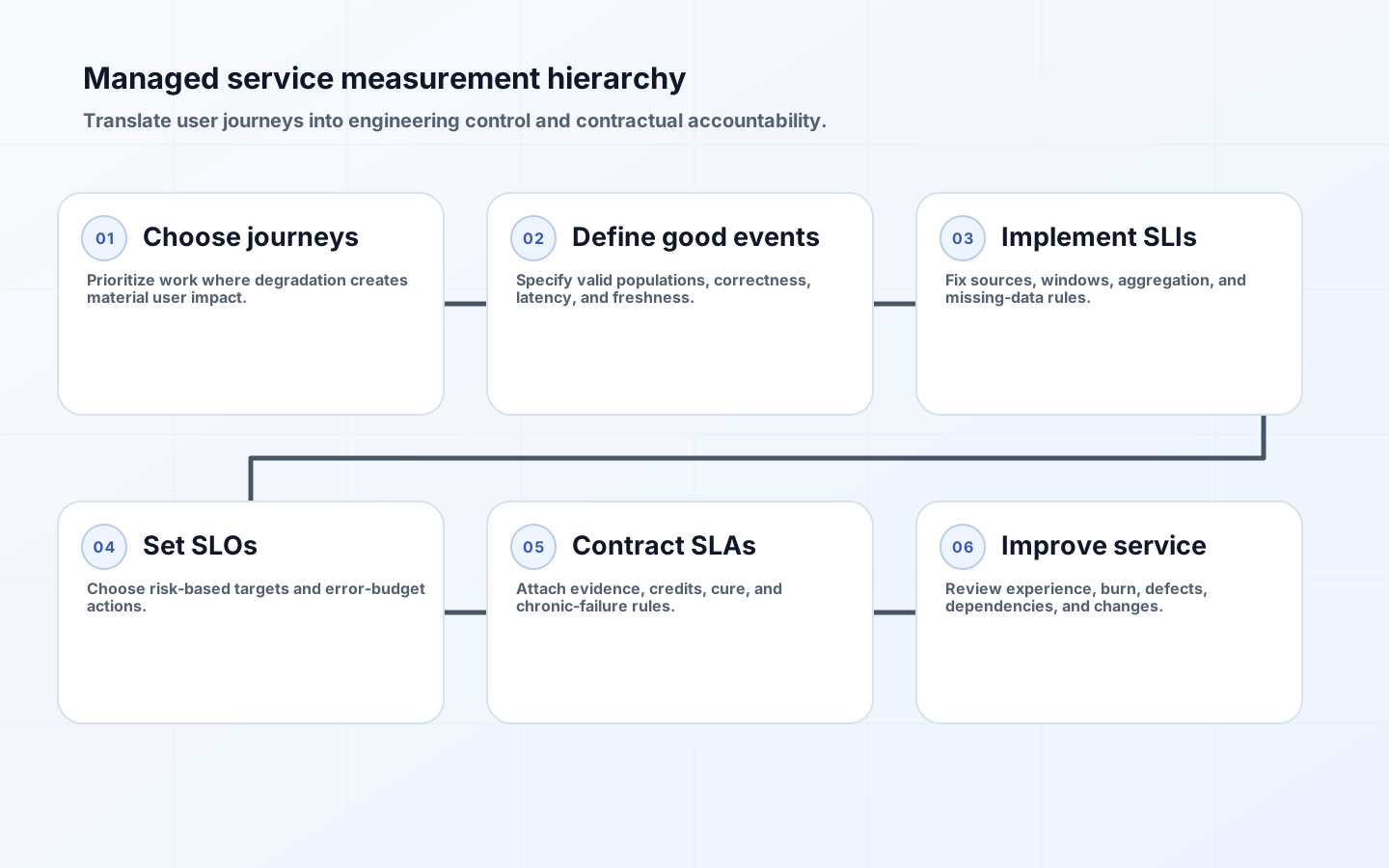
A managed services SLA and SLO framework should reveal whether people can complete important work, not merely whether infrastructure emits green status. A platform can report 99.9 percent server availability while authentication loops, batch deadlines slip, search returns stale data, or support takes hours to engage the right resolver. Useful accountability layers business journeys, user experience, technical service objectives, operational process, and contractual consequences.
The design task is to choose a small set of decision-grade measures and define each one precisely. Every target needs a population, event, threshold, measurement point, window, exclusions, source, data-quality rule, owner, and response. The contract then identifies which objectives carry commercial consequences and how evidence is challenged. This preserves the engineering value of SLOs without turning every telemetry fluctuation into a legal dispute.
Separate SLIs, SLOs, SLAs, KPIs, and experience measures
A service level indicator is the measured quantity, such as the proportion of valid checkout attempts completed within four seconds. An SLO is the target for that indicator over a window. An SLA is an agreement that attaches explicit consequences to defined performance. Google's Service Level Objectives chapter uses the presence of consequences as a practical distinction between an SLO and an SLA. A KPI is broader and may cover delivery, risk, improvement, or commercial health rather than reliability.
An experience measure reports what users encounter or perceive. It may be behavioral, such as successful task completion and abandonment, or perceptual, such as a carefully sampled satisfaction response. Avoid treating an experience label as inherently superior evidence. A survey can be biased and a journey metric can be distorted by policy or data outside the provider's control. Pair experience with diagnostic service measures and explicit dependency ownership.
| Layer | Question | Example | Primary use |
|---|---|---|---|
| Business outcome | Did the process achieve its purpose? | Eligible payroll completed by deadline | Executive and service governance |
| Experience | Could users complete the journey well? | Completion rate and perceived effort | Product and service improvement |
| SLO | Is service behavior within an engineering target? | 99.5% valid submissions succeed in 30 days | Operational decision and error budget |
| SLA | Which misses trigger contractual action? | Monthly target with credit and chronic-failure rule | Commercial accountability |
| Process KPI | Does the operating system work? | Priority incidents engaged within target | Supplier management and improvement |
Start with critical user and business journeys
Map the service from the consumer's entry point to a meaningful result. Identify user classes, channels, peak periods, regulated deadlines, failure consequences, and dependencies. Choose measures for the few journeys where degraded performance changes a business decision or causes material harm. Infrastructure telemetry remains necessary for diagnosis and capacity, but it should not be the only contracted view of a composite service.
For each journey, identify good events and valid events. Availability can be expressed as good divided by valid, where good means the user received a correct and timely result. Exclude malformed or unauthorized requests using governed rules, not retrospective discretion. Add correctness, freshness, durability, throughput, or deadline attainment when success alone is incomplete. A technically successful request that returns yesterday's balance is not good for a real-time balance journey.
Write a complete SLI specification
Define measurement close to the user where practical: browser or mobile telemetry, synthetic transaction, API edge, queue consumer, or reconciled business event. State event schema, clock, duplicate handling, aggregation, percentile or ratio, missing telemetry treatment, and source precedence. Averages often hide tail latency and affected cohorts; percentiles and event ratios usually expose distributions more honestly. Segment only where the segment has a different promise or decision.
Establish telemetry ownership and independent access. The provider may operate measurement, but the customer should be able to inspect definitions, raw-enough evidence, corrections, and calculation versions. Define what happens when the monitoring system fails. Never automatically count unknown data as perfect service. Depending on design, use a conservative failure rule, a separately measured observability SLO, or a governed period marked not calculable with escalation.
| Field | Definition | Reason |
|---|---|---|
| Population | Eligible interactive claims submitted through supported channels | Prevents mixing unsupported traffic |
| Good event | Correct receipt returned within 3 seconds and claim persisted | Combines latency and durable acceptance |
| Window | Rolling 28 days for operations; calendar month for SLA | Supports fast control and invoice certainty |
| Exclusions | Approved tests and documented customer suspension only | Limits discretionary denominator changes |
| Source | Edge events reconciled to claim ledger | Detects false success before persistence |
| Target | Set after baseline and user-impact review | Avoids invented precision |
| Owner | Jointly approved definition; supplier operates pipeline | Separates governance from collection |
Set targets, windows, and exclusions from risk tolerance
Choose targets from user need, business consequence, architecture capability, cost, and expected improvement, not simply current performance or an attractive number of nines. Implementing SLOs recommends documenting authors, reviewers, approvers, service context, SLI implementation, objective, and error-budget calculation. Baseline with representative demand before contract launch and retain a review date.
Use rolling windows for timely operational decisions and calendar windows where invoices need closure. Define maintenance carefully: approved planned work may be excluded from one availability measure, but user-impact and change-quality measures should still reveal it. Dependency relief should require evidence that the dependency caused the miss and that the provider fulfilled detection, escalation, resilience, and communication duties. Broad force-majeure-style exclusions make an SLA look strong while removing accountability when users need it most.
Use error budgets as an operating control
An error budget is the permitted miss implied by an SLO. For a ratio objective it is the difference between the target and perfection, applied to the valid-event population. Track consumption and burn rate so a team can respond before the full window is lost. Connect thresholds to actions such as enhanced review, reliability work, rollout limits, dependency remediation, or executive risk acceptance.
An error-budget policy is an operational agreement, not necessarily a commercial penalty. Google's official example policy explicitly frames it as a way to balance reliability and innovation rather than punishment. In a managed service, the customer, provider, product, security, and change authorities should approve the actions. A release freeze must still allow urgent security fixes and should account for failures outside the team's control.
Attach contractual consequences without distorting behavior
Select only material objectives for contractual service levels. Define threshold, frequency, evidence, reporting time, challenge period, credit formula, caps, earn-back if any, chronic breach, rectification, escalation, and termination rights. Service credits should create proportionate accountability and fund management attention; tiny automatic credits can become a price for poor service, while extreme penalties encourage risk premium, exclusions, and metric gaming.
Use separate remedies for different failure types. Reliability miss may consume budget and trigger credit. Incorrect data may require correction and loss handling. A missed support engagement may trigger process remediation. Security incidents require response and notification duties independent of ordinary availability. The UK government's official call-off schedule templates illustrate detailed performance monitoring and service-credit schedules; buyers should tailor, legally review, and simplify such mechanisms for their actual service.
Govern measures, disputes, and improvement
Maintain a versioned service-measure catalog with definitions, owners, data sources, targets, dependencies, exclusions, and consequences. Review operational SLOs frequently, SLA results monthly, and experience or outcome trends at a suitable business cadence. Show total affected users and duration alongside percentages. Report error-budget burn, repeat failure classes, monitoring gaps, open rectification, and improvement experiments rather than a red-amber-green summary alone.
Assign authority for data correction and disputes, with time limits and preserved original records. Rebaseline only for a material service, population, dependency, or policy change and never solely because a target was missed. ISO/IEC 20000-1 requires an organization to plan, transition, deliver, measure, review, and improve services through a service management system. Measurement should therefore drive a controlled improvement loop, not terminate at monthly reporting.
Managed-service measurement takeaways
- Begin with critical business journeys and user-visible good events.
- Keep SLI, SLO, SLA, KPI, and experience concepts distinct.
- Specify populations, windows, measurement points, exclusions, and missing-data treatment.
- Set targets from risk and user need after representative baselining.
- Use error budgets to govern reliability work and change, not as punishment.
- Attach credits and remedies only to material, supplier-influenceable obligations.
- Preserve versioned evidence and make measure review an improvement control loop.
Managed services SLA and SLO FAQ
What is the simplest difference between an SLA and SLO?
An SLO is a target for measured service behavior. An SLA places one or more obligations in an agreement and defines consequences. Internal SLOs can be tighter than contractual targets to create response margin.
Should experience measures replace uptime?
No. Journey and perception measures reveal user impact, while component and platform measures support diagnosis and capacity. Use a layered set with clear causal limits rather than replacing one blind spot with another.
Is a 100 percent availability target useful?
Usually not. It leaves no explicit tolerance, can be prohibitively expensive, and may discourage beneficial change. Safety-critical contexts need specialized hazard analysis, redundancy, and continuity controls beyond a headline percentage.
Conclusion
Managed-service accountability becomes useful when technical evidence connects to real work. Define user-centered indicators, set risk-based objectives, reserve contractual consequences for important promises, and use error budgets and review to change operating behavior. A smaller coherent hierarchy will govern service quality better than dozens of green metrics that cannot explain whether customers succeeded.