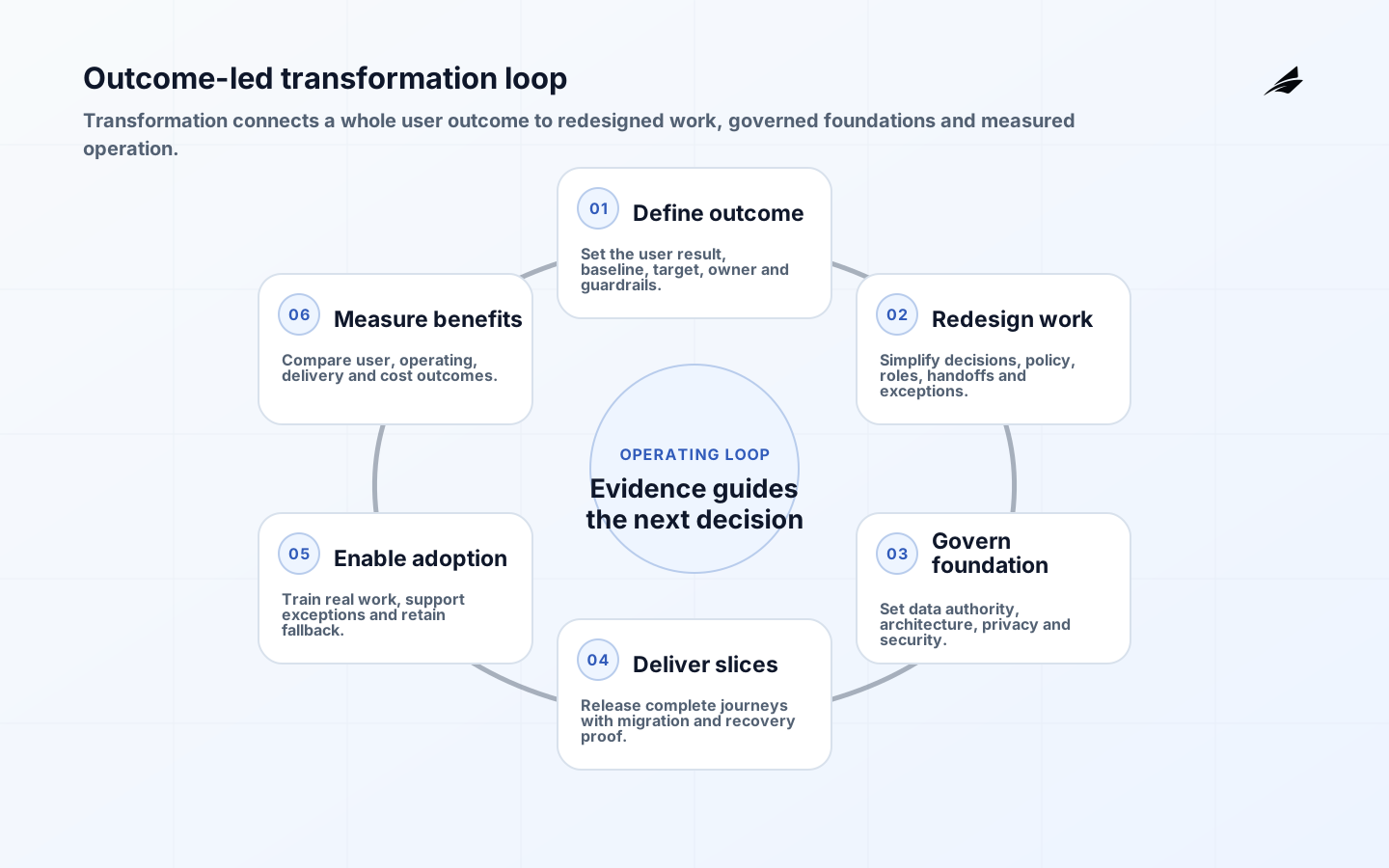
A digital transformation guide for business teams must answer a harder question than which platform to buy: what should become materially better for a customer, employee, supplier or regulator? Transformation changes how a whole service works across policy, process, roles, data and technology. Digitizing the same approvals and duplicate entry can make a poor process faster without making it useful. The practical starting point is an owned outcome and an end-to-end journey.
This guide connects strategy to delivery. Use it with the digital transformation implementation checklist, the digital transformation FAQ and the transformation scope and migration guide. The UK Government Service Standard is written for public services, but its principles of understanding users, solving a whole problem, joining channels and defining success are useful for enterprise programs too.
Define a transformation outcome that can be observed
Write the outcome as a changed behavior or service result: a customer can resolve a request in one interaction; a planner can commit inventory from current availability; a field worker records evidence once; or a finance team closes with fewer manual reconciliations. Name the population, baseline, target, guardrails and accountable owner. Separate outputs such as migrated records from outcomes such as fewer disputed invoices. A roadmap without this causal link becomes a list of projects.
Map the complete journey across digital and non-digital channels. Observe users doing the work, review call and complaint data, measure waiting and touch time, and identify policy or control constraints. Include people who need accessibility support, low-bandwidth access, delegated authority or a manual channel. Transformation should remove avoidable burden while preserving a reliable route for cases that cannot use the default path.
| Decision | Weak framing | Useful transformation question | Evidence |
|---|---|---|---|
| Outcome | Install a new CRM | Can customers resolve the request with less effort? | Completion, repeat contact and satisfaction |
| Process | Automate approvals | Which decision needs which evidence and authority? | Cycle time, exceptions and control results |
| Data | Create one dashboard | Which definition and source support the decision? | Lineage, freshness and reconciliation |
| Technology | Move to cloud | Which service quality or change constraint improves? | Reliability, lead time, cost and recovery |
Redesign policy, process and responsibility before automation
Document the current path at the level of decisions, queues, handoffs, evidence and exceptions. Ask why each check exists, whether the source is authoritative, what risk it controls and whether the same evidence is requested elsewhere. Remove obsolete steps, combine checks that use the same facts and clarify authority. Do not automate an informal workaround until its purpose and consequences are understood.
Design the future path with explicit service ownership. A product or service owner needs authority over priorities and outcomes across departmental boundaries. Process owners govern rules and controls; data owners govern meaning and access; technical owners govern reliability and change. Publish how tradeoffs and escalations are decided. Funding should support the enduring service and its improvement, not end the day the initial software release is accepted.
Prototype the riskiest assumptions early. Test whether users understand the new interaction, whether staff can handle exceptions, whether data arrives with sufficient quality and whether policy permits the proposed decision. A low-fidelity service walkthrough often exposes more than a polished interface. Record what was learned, what changed and which uncertainties still require a pilot.
Build a governed data and architecture foundation
Define authoritative sources for customers, products, employees, suppliers, transactions and cases. For each critical field, document meaning, owner, permitted use, quality rule, freshness and correction path. Avoid creating a transformation data store that becomes another unexplained master. Reconcile data at boundaries and preserve source, time and version for important decisions. Apply privacy minimization and retention rules while designing, using the NIST Privacy Framework to connect processing choices with risks to people.

Choose architecture from service needs: availability, latency, volume, geographic constraints, auditability, integration and expected change. Use stable interfaces and versioned contracts around capabilities that will evolve independently. Design idempotency, retries, reconciliation and degraded modes for integrations. Legacy coexistence is an architecture, not an embarrassment; document which system owns each record during transition and how users locate work across both.
Treat cybersecurity as a transformation requirement. NIST CSF 2.0 adds Govern to Identify, Protect, Detect, Respond and Recover, emphasizing that risk ownership sits with leadership. Model likely misuse and attack paths, minimize privilege, secure administrative operations, protect secrets and monitor important actions. Exercise incident decisions and service recovery before increasing dependence on the new path.
Deliver thin end-to-end slices with release evidence
Break the roadmap into slices that produce a usable outcome across interface, workflow, data, integration, controls and support. Component completion is useful internally, but users only experience a service. Define acceptance scenarios from real journeys, including amendments, missing information, high-risk approvals, downstream outages and recovery. Keep a trace from outcome to requirement, test, release and measure so leaders can see whether scope still supports the original case.
Use automated tests for repeatable behavior and human evaluation for usability, accessibility, policy interpretation and operational readiness. Test migration through multiple rehearsals with immutable inputs and versioned mappings. Reconcile counts, balances, relationships and sampled records. Performance tests should use production-shaped concurrency and data. Recovery tests should prove restored services do not duplicate financial actions, notifications or queue items.
| Release gate | Question | Required proof | Decision owner |
|---|---|---|---|
| User value | Can the target group complete the whole task? | Observed task tests and journey metrics | Service owner |
| Operational fit | Can staff manage normal and exceptional work? | Runbooks, simulations and staffing model | Operations lead |
| Control | Are privacy, security and financial duties effective? | Control tests and resolved findings | Risk owners |
| Recovery | Can the service fail and return safely? | Restore, replay and reconciliation exercise | Technical owner |
Manage adoption and realize benefits in operation
Adoption is changed work, not course attendance. Identify each role's new decisions, removed tasks, permissions, measures and escalation routes. Train with realistic cases and verify performance. Managers need capacity plans for the learning period and permission to surface friction. Keep support close to delivery during early life, classify issues by root cause and feed changes into the backlog. Do not suppress a useful manual path before the new service is accessible and stable.
Measure service outcomes alongside delivery health. The Government Service Manual recommends combining performance metrics with user research and establishing a baseline across channels. Track completion, time, satisfaction, cost and demand failure where relevant. For software delivery, DORA's current model uses change lead time, deployment frequency, failed deployment recovery time, change fail rate and deployment rework rate. Interpret all measures in service context; a faster deployment process does not prove a better customer outcome.
Example: transform supplier onboarding
Replacing an emailed form with a portal is digitization. Transformation measures approval time, duplicate requests, supplier effort, fraud and payment errors; identifies authoritative tax, banking and company records; removes repeated checks; separates collection from risk decisions; and gives suppliers status and correction. The first slice can cover one supplier class and region from invitation through an approved master record.
Acceptance should include accessibility, delegated submission, duplicate detection, risk review, bank-detail verification, ERP creation, audit evidence and recovery after an integration outage. Compare the pilot with similar old-path cases, interview suppliers and approvers, reconcile downstream records and verify benefits with finance. If results improve only because difficult cases were excluded, the evidence is not scalable.
Classify every rejection and manual intervention by policy, design, data, integration, capacity or training. The next roadmap decision should address the binding constraint revealed by evidence. This prevents a visible interface backlog from displacing less visible work that actually determines whether the whole journey completes safely.
Maintain a decision log linking each roadmap item to outcome, evidence and owner. Record policy interpretations, rejected options, migration boundaries and temporary manual controls. At monthly review, remove work that no longer supports the outcome and add discoveries that change the causal model. This keeps funding and scope connected to measurable service improvement.
Key takeaways
- Anchor transformation in an observable user or operating outcome with a baseline and guardrails.
- Redesign decisions, policy and ownership before automating the existing path.
- Make data authority, privacy, integration failure and legacy coexistence explicit.
- Release complete service slices and test exceptions, migration, security and recovery.
- Fund adoption and continuous operation, then measure benefits rather than project outputs.
Frequently asked questions
How long should a digital transformation roadmap be?
Use a durable outcome horizon and a short, revisable delivery horizon. Leaders may need a multi-year view of capability, funding and dependency, while teams need the next few outcome slices defined well enough to test. Revisit sequence when evidence changes; do not preserve dates by quietly reducing control or user value.
Should platform selection come before process design?
Usually no. Establish outcomes, journeys, essential rules, data, integrations and nonfunctional needs first. A time-boxed product evaluation can run alongside design, but demonstrations should use representative scenarios and data. Prefer configuration where it fits, and identify any gap that would force harmful process distortion or fragile customization.
Why do transformation programs stall after launch?
Common causes include unclear service ownership, unresolved legacy dependencies, weak data quality, benefits detached from operations, insufficient exception capacity and funding that ends at go-live. Prevent this by assigning enduring owners, rehearsing difficult paths, baselining measures and carrying a funded improvement backlog into operation.
Govern the legacy exit as carefully as the new launch. Inventory users, interfaces, records, reports, controls and contracts; define archive and read access; and prove decommissioning removes credentials and cost without destroying required evidence. Benefits should reflect actual retirement, not a planned shutdown that operations cannot safely complete.
Conclusion
Digital transformation is disciplined service change. Start with a whole outcome, simplify the work, govern the information, build for failure and place each release in the hands of the people who must use and operate it. When adoption and benefits are measured after launch, technology becomes an enabling part of transformation instead of its substitute.