Digital transformation services are often purchased when an organization feels the drag of legacy systems, fragmented data and manual handoffs. Those symptoms are real, but replacing technology without changing ownership can reproduce them on a newer platform. Leaders should frame transformation around a service outcome: approving a supplier, opening an account, resolving a claim or fulfilling an order. The frequently asked questions in this guide focus on how to select that outcome, divide the work into useful increments and retire the old operating path rather than funding indefinite coexistence.
Define the service boundary before selecting technology
Start with a value stream with known users, records, constraints and an accountable executive owner. Observe real cases, including exceptions, reversals and incomplete inputs. Record who initiates the work, which system owns each fact, who may approve an outcome, what makes an action irreversible and how staff recover when an integration fails. This boundary prevents digital transformation consulting from becoming a vague transformation program. It also exposes policy disagreements before software silently turns them into inconsistent behavior.
Acceptance criteria belong to the value stream, not the vendor contract alone. For supplier onboarding, they might specify one authoritative supplier record, required due-diligence evidence, approval authority, turnaround target, integration with purchasing and the conditions for rejecting or reopening a request. Migration criteria should cover record counts, permissions, balances, retention and unresolved exceptions. The program should also define when the legacy form stops accepting new work, how in-flight cases move, and who confirms that reports still reconcile after cutover.
Architecture and ownership
The architecture must preserve authority across customer or employee journey and operating policy, authoritative data and integration contracts, applications, platforms and identity controls, adoption, service management and benefits reporting. Each component needs an owner, a versioned contract and observable failure behavior. Avoid direct point-to-point writes from an interface or model into a critical record. A narrow orchestration layer can validate identity, current state, policy and idempotency before an action proceeds, while an audit event records the evidence and rule version used.
| Architecture area | Required design decision | Evidence before release |
|---|---|---|
| customer or employee journey and operating policy | For this design choice, name the accountable owner, supporting evidence, exception route, and next measurable check. | Approved data-flow and owner |
| authoritative data and integration contracts | Within this design choice, name the accountable owner, supporting evidence, exception route, and next measurable check. | Authorization and negative tests |
| applications, platforms and identity controls | When implementing this design choice, name the accountable owner, supporting evidence, exception route, and next measurable check. | Versioned interface plus retry behavior |
| adoption, service management and benefits reporting | Before releasing this design choice, name the accountable owner, supporting evidence, exception route, and next measurable check. | Dashboard, alert and recovery runbook |
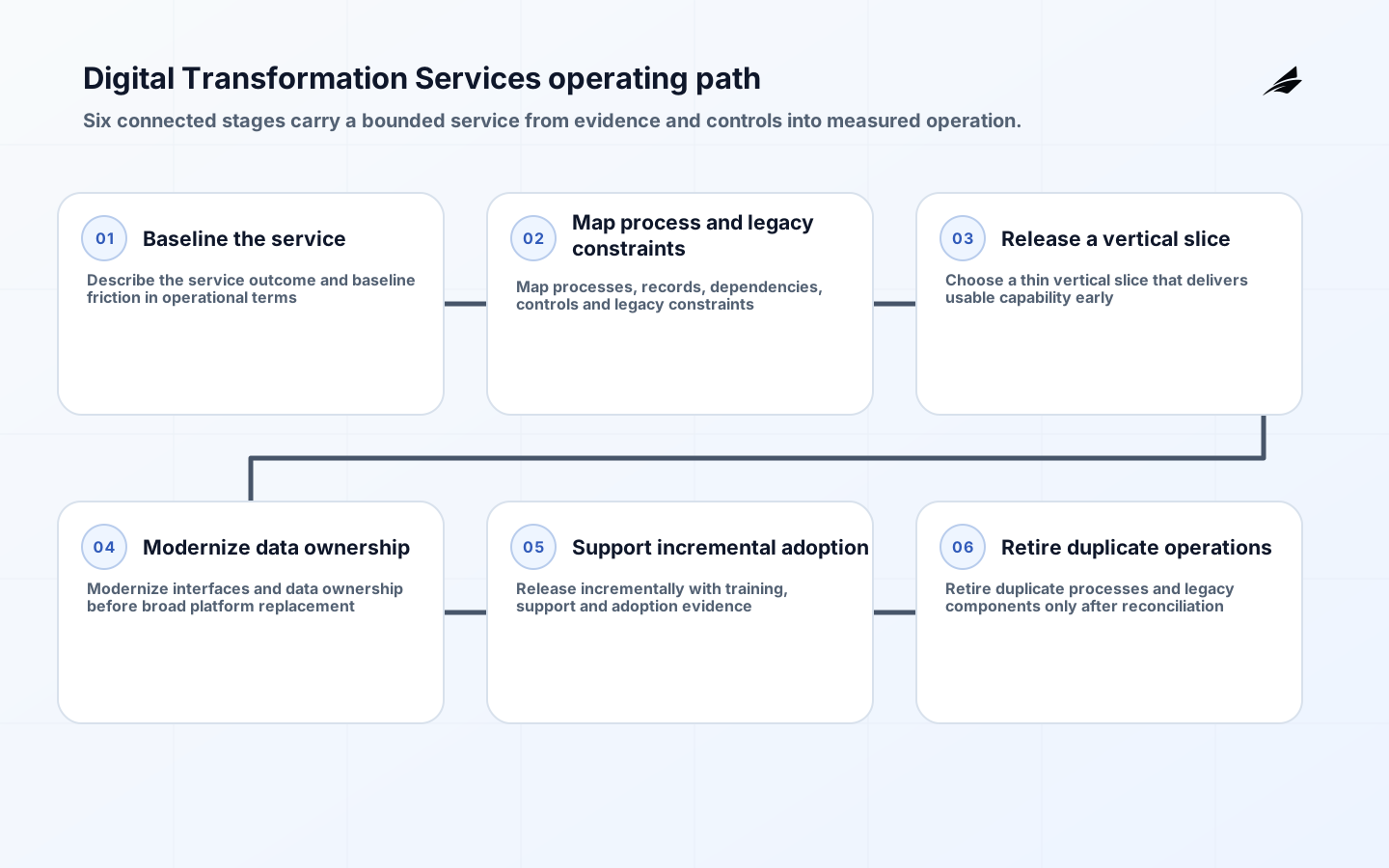
A six-stage delivery path
A transformation roadmap should release thin vertical slices. A first slice might let one business unit submit, review and approve a supplier through the new process while the legacy system remains read-only for history. This tests identity, data ownership, integration and support together. Subsequent slices can add regions or supplier types after the prior cohort stabilizes. Platform foundations are useful only when attached to these journeys; a year spent building generic capability without a live service delays feedback and encourages requirements to grow unchecked.

- Describe the service outcome and baseline friction in operational terms.
- Map processes, records, dependencies, controls and legacy constraints.
- Choose a thin vertical slice that delivers usable capability early.
- Modernize interfaces and data ownership before broad platform replacement.
- Release incrementally with training, support and adoption evidence.
- Retire duplicate processes and legacy components only after reconciliation.
Controls and failure modes
Governance should distinguish enterprise guardrails from product decisions. Security may define identity and logging standards, data owners define authoritative fields and retention, while the value-stream owner prioritizes workflow changes. Architecture review should focus on irreversible choices, shared dependencies and exceptions rather than approving every screen. Each temporary bridge to a legacy system needs capacity, monitoring and an expiry decision. Benefits owners should attend release reviews so schedule and spending remain tied to operating outcomes rather than percentage-complete reports.
| Failure mode | Design response | Operating signal |
|---|---|---|
| Technology-first scope | Tie each workstream to a user outcome, owner and baseline. | Outcome movement by release |
| Permanent coexistence | Give transitional interfaces and legacy systems explicit exit criteria. | Duplicate-process volume |
| Data migration defects | Reconcile counts, balances, permissions and retention before cutover. | Unresolved reconciliation items |
| Change fatigue | Sequence role changes and support around actual operating capacity. | Adoption and support demand |
Measure outcomes, not activity
A dashboard should connect technical behavior to the intended operating result. Track cycle time for the selected value stream; percentage of work completed in the target process; legacy operating cost and incidents retired; user success, exception and rework rates. Segment results by workflow type and material risk instead of hiding poor tails inside a global average. Review a sample of accepted, corrected, escalated and failed cases. When a metric moves, retain enough trace evidence to identify whether the cause was source data, policy, interface behavior, model output, reviewer workload or downstream execution.
Establish a baseline from transaction logs, staff observation and user research. Measure total elapsed time, hands-on effort, rework, abandonment, exception age and cost to operate both old and new paths. Adoption alone can be misleading if policy forces users into a slower system. Review results by business unit and case type, and reconcile downstream reports before claiming benefit. A release may be technically successful yet commercially negative if it adds licensing and integration cost without retiring manual coordination or legacy support.
Cost, timeline and commercial model
Transformation budgets should expose discovery, product delivery, integration, migration, security, adoption and legacy retirement separately. A low build estimate that omits coexistence and decommissioning creates an expensive half-finished state. Timeline should be expressed as evidence-bearing stages: discovery, thin-slice build, controlled pilot and measured expansion. Procurement should require source access, documentation, data export, incident support and transition assistance. A lower quote is not cheaper if it omits evaluation, operating ownership or the path away from the chosen provider.
Rehearse the operating model before expansion
A useful rehearsal for digital transformation services follows one representative case from intake through final evidence. The team should interrupt the exercise after each transition and ask which record is authoritative, whether the acting identity has permission, whether the rule is current, and whether retrying would create a duplicate outcome. Run the same case with a missing field, delayed dependency and unavailable reviewer. This reveals assumptions that unit tests and polished demonstrations often miss, especially where customer or employee journey and operating policy meets authoritative data and integration contracts.
Next, simulate the two most consequential failure modes: technology-first scope and permanent coexistence. Operators should identify the alert, inspect the trace without broad production access, contain further actions, communicate with affected users and restore a known state. Record elapsed time and every manual workaround. If the team cannot determine what happened from the retained evidence, the workflow is not ready for a wider cohort, even if its normal path appears efficient.
A transformation release should leave an evidence trail that another team can continue: service blueprint, domain model, integration contracts, migration reconciliation, security decisions, support model, training material and benefits baseline. The legacy disposition plan is equally important. It should name archives, interfaces to remove, licences to cancel, data to retain and a date when read-only access ends. Without this disposal work, organizations pay twice and keep the operational ambiguity that the program was meant to resolve.
Test the operating model by handing a real exception to staff outside the project team. Ask them to trace a supplier record from submission through approval, identify which system owns each field, correct an integration failure and explain whether the legacy copy is authoritative. Repeat during an identity outage and at month-end reporting. Confusion at these boundaries is not a training defect; it is evidence that ownership or transition design remains incomplete. Resolve it before migrating another region or value stream.
Practical takeaways
- Anchor digital transformation services to one named outcome and accountable owner.
- Treat a value stream with known users, records, constraints and an accountable executive owner as the first deliverable, not an assumption.
- Keep permissions, policy and irreversible actions in deterministic services with review evidence.
- Pilot with representative exceptions and retain a tested manual route.
- Measure cycle time for the selected value stream alongside quality, risk and human workload.
- Expand only when the current release is supportable, observable and recoverable.
Frequently asked questions
- What should the first engagement deliver? It should deliver a process map, data and authority model, risk register, thin-slice backlog, evaluation plan, cost range and explicit decision on what will remain manual.
- How long should a pilot run? Long enough to include ordinary cases, realistic exceptions and at least one controlled recovery exercise. Calendar duration matters less than representative evidence and a pre-agreed exit decision.
- Can a team buy a platform before discovery? A short technical trial can inform discovery, but procurement should follow the service boundary and control requirements. Otherwise the available product features begin defining the business process.
- Who owns the released service? A business owner is accountable for policy and outcomes; a technical owner is accountable for reliability and change; security, privacy and domain specialists approve relevant controls. A vendor can support these roles but should not replace them.
- How is success demonstrated? Compare the agreed baseline with completed outcomes, corrections, exceptions, failures, cost and user impact. Pair aggregate metrics with case review so a favorable average cannot conceal harmful edge cases.
Conclusion
Digital transformation is complete only when a better operating path is in daily use and the displaced path is deliberately retired. Leaders should demand increments that deliver real service outcomes, migration evidence that reconciles records, and measures that include adoption, quality and avoided legacy cost. Technology partners can accelerate discovery and delivery, but accountability for policy, data and benefit remains with the organization. That clarity is what turns modernization spending into lasting operational change.